
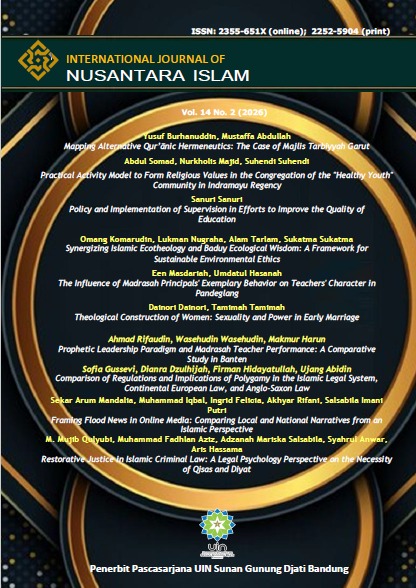
Prophetic Leadership Paradigm and Madrasah Teacher Performance: A Comparative Study in Banten
Article Sidebar
Main Article Content
Abstract
This study analyzes the application of the prophetic leadership paradigm in madrasah educational institutions and its influence on teacher performance in Banten Province. Using a comparative qualitative method, the study was conducted in four leading madrasahs: MAN Insan Cendekia Serpong, MAN 2 Serang City, MAN 2 Pandeglang, and MAS Miftahul Huda Pasirnangka Tigaraksa. Data were collected through in-depth interviews, participatory observation, and documentation studies, then analyzed using the Miles and Huberman model. The results of the study indicate that prophetic leadership based on prophetic values (shiddiq, amanah, tabligh, and fathanah) is proven to be a key factor in improving the performance of madrasah teachers. The three dimensions of prophetic leadership—spiritual transcendence, humanity, and prophetic morals—are implemented with different patterns in each madrasah according to institutional characteristics. MAN IC Serpong stands out in professionalism and modern management systems; MAN 2 Serang City in participatory communication and moral-bureaucratic balance; MAN 2 Pandeglang in spirituality and religious culture. Meanwhile, MAS Miftahul Huda excels in sincerity and personal exemplary behavior. The principal's exemplary behavior is a dominant factor in fostering trust, loyalty, and intrinsic motivation among teachers, thereby improving lesson planning, innovative teaching methods, work discipline, and socio-religious involvement. This study recommends internalizing prophetic values in the madrasah management system and integrating them into the Islamic educational leadership training curriculum.
Article Details
The Authors submitting a manuscript do so on the understanding that if accepted for publication, copyright of the article shall be assigned to International Journal of Nusantara Islam, Sunan Gunung Djati State Islamic University.
The copyright encompasses exclusive rights to reproduce and disseminate articles in all forms and media, including reprints, photographs, microfilm, and similar reproductions, as well as translations. Some or all of the contents of this journal can be stored in databases and transmitted in any form and media without the need for written permission from the International Journal of Nusantara Islam, Sunan Gunung Djati State Islamic University.
The Editors and the Advisory International Editorial Board make every effort to ensure that no wrong or misleading data, opinions or statements be published in the journal. In any way, the contents of the articles and advertisements published in the International Journal of Nusantara Islam (IJNI) are sole and exclusive responsibility of their respective authors and advertisers.
References
Abbaspour, F., Hosseingholizadeh, R., & Bellibaş, M. Ş. (2024). Uncovering the role of principals in enhancing teacher professional learning in a centralized education system. International Journal of Educational Management, 38(3), 873–889. https://doi.org/10.1108/IJEM-12-2023-0654
Abdul Jaleel, K. A., Abdul Khader Aneesh, A., Shahid, M., Abdul Rasheed, K. M., Razeena, S., Mubeena, M., & Nubeera, M. (2024). Cultivating Knowledge: A Comprehensive Examination of Madrasa Education System in India (pp. 787–801). https://doi.org/10.1007/978-3-031-54383-8_60
Adibah, I. Z., Muyasaroh, M., Adnan, M., D. Rimbe, A., & Ismail, D. (2025). Inclusive Pedagogical Strategies of Islamic Religious Education Teachers in Instilling Multicultural Values Among Students. Scaffolding: Jurnal Pendidikan Islam Dan Multikulturalisme, 7(3), 156–173. https://doi.org/10.37680/scaffolding.v7i3.7842
Alazmi, A. A., & Bush, T. (2024). An Islamic-oriented educational leadership model: towards a new theory of school leadership in Muslim societies. Journal of Educational Administration and History, 56(3), 312–334. https://doi.org/10.1080/00220620.2023.2292573
Ariwibowo, G. A., Fibiona, I., Rostiyati, A., . S., Tresnasih, R. I., & Harnoko, A. D. (2025). Preserving Cultural Heritage and Social Cohesion: The Tukuder Festival at Al-Muttaqin Mosque, Kendal, Indonesia. Journal of Population and Social Studies, 34, 813–838. https://doi.org/10.25133/JPSSv342026.041
Asbari, M. (2024). Madrasah Diniyyah Takmiliyah: Pilar Pendidikan Karakter di Indonesia [Madrasah Diniyyah Takmiliyah: A Pillar of Character Education in Indonesia]. Jurnal Ilmu Sosial, Manajemen, Akuntansi Dan Bisnis, 1(2), 10–14. https://doi.org/[in Indonesian]
Bartlett, L., & Vavrus, F. (2017). Comparative Case Studies: An Innovative Approach. Nordic Journal of Comparative and International Education (NJCIE), 1(1). https://doi.org/10.7577/njcie.1929
Brutu, D., Annur, S., & Ibrahim, I. (2023). Integrasi Nilai Filsafat Pendidikan Dalam Kurikulum Merdeka Pada Lembaga Pendidikan Islam [Integration of Educational Philosophical Values in the Independent Curriculum at Islamic Educational Institutions]. Jambura Journal of Educational Management, 442–453. https://doi.org/[in Indonesian]
Chukwuma, V. P. (2022). The Role of Christian Education in Building Skills and Instilling Moral Values among Students in Higher Ed Institutions for National Unity and Economic Advancement in Sub-Saharan Africa. OKH Journal: Anthropological Ethnography and Analysis Through the Eyes of Christian Faith, 6(1). https://doi.org/10.18251/okh.v6i1.139
Darmawan, L. (2025). Kepemimpinan Profetik Dalam Meningkatkan Kulitas Lembaga Pendidikan Islam Yang Berkelanjutan [Prophetic Leadership in Improving the Sustainable Quality of Islamic Educational Institutions]. Jurnal Manajemen Pendidikan Islam, 3(1), 23–33. https://doi.org/[in Indonesian]
Dartey-Baah, K., Bawole, J. N., & Mumin, A. A. (2025). Towards Ethical Universities in West Africa: Integrating Communal and Global Ethics into Academic Institutions. Journal of Academic Ethics, 23(4), 1683–1707. https://doi.org/10.1007/s10805-025-09620-4
Diab, A., & Green, E. (2024). Cultivating Resilience and Success: Support Systems for Novice Teachers in Diverse Contexts. Education Sciences, 14(7), 711. https://doi.org/10.3390/educsci14070711
Diana, E. E., & Sopingi, I. (2025). Internalisasi Nilai-Nilai Shiddiq, Amanah, Tabligh, Dan Fathonah Dalam Praktik Akuntansi Berbasis Etika Islam [Internalization of the Values of Shiddiq, Amanah, Tabligh, and Fathonah in Accounting Practices Based on Islamic Ethics]. Jurnal Akuntansi Dan Ekonomi Bisnis, 14(01), 1–10. https://doi.org/[in Indonesian]
Diş, O., & Demirkasımoğlu, N. (2025). School Learning Climate and Teacher Commitment: The Hidden Role of School Administrators’ Sensemaking Skills. The Asia-Pacific Education Researcher, 34(3), 1051–1062. https://doi.org/10.1007/s40299-024-00920-8
Djaed, R. F. (2023). Quo Vadis Kurikulum Keagamaan MAN Insan Cendikia Serpong: Ketika Prestasi Keagamaan Tidak Menjadi Prioritas di Madrasah Aliyah [Quo Vadis Religious Curriculum of MAN Insan Cendikia Serpong: When Religious Achievement Is Not a Priority at Madrasah Aliyah]. Revorma: Jurnal Pendidikan Dan Pemikiran, 3(2), 1–7. https://doi.org/[in Indonesian]
Eka Mahendra Putra. (2025). Teaching Professional Ethics: A Comparative Study between Qur’an-Based Teaching Professional Ethics and Modern Professional Ethics. Al-Fahmu: Jurnal Ilmu Al-Qur’an Dan Tafsir, 4(2), 561–573. https://doi.org/10.58363/alfahmu.v4i2.619
Enyinnaya, G., & Ogbechie, R. (2024). Human Quality Treatment: The Ethics of Respect and Team Growth. In Business Ethics in Africa, Volume I (pp. 127–145). Springer Nature Switzerland. https://doi.org/10.1007/978-3-031-64427-6_8
Ermita, L., & Baysa, M. L. (2025). Transformational Leadership Practices of School Heads: Teachers’ Motivation and School Performance. Jurnal Inovasi Pendidikan, 3(3), 178–202. https://doi.org/10.60132/jip.v3i3.499
Farwati, W. W. (2025). Principal Instructional Leadership in Building a Religious School Culture for Students’ Character Development. Journal of Educational Management Research, 4(6), 3190–3205. https://doi.org/10.61987/jemr.v4i6.1597
Ghamrawi, N., Shal, T., & Ghamrawi, N. A. R. (2024). Cultivating teacher leadership: evidence form a transformative professional development model. School Leadership & Management, 44(4), 413–441. https://doi.org/10.1080/13632434.2024.2328056
Gümüş, A. (2022). Twenty-First-Century Teacher Competencies and Trends in Teacher Training (pp. 243–267). https://doi.org/10.1007/978-981-16-9640-4_11
Gunawan, A., Pratama, D. P., Hasri, S., & Sohiron, S. (2024). Kepemimpinan kharismatik dalam perspektif pendidikan Islam [Charismatic leadership in the perspective of Islamic education]. Al-Liqo: Jurnal Pendidikan Islam, 9(1), 19–35. https://doi.org/[in Indonesian]
Handayani, E. P., Afnibar, A., & Ulfatmi, U. (2024). Modeling Dalam Teori Belajar Sosial Dan Keteladanan Rasulullah SAW [Modeling in Social Learning Theory and the Exemplary Behavior of the Prophet Muhammad SAW]. Jurnal Intelek Insan Cendikia, 1(10), 7951–7960. https://doi.org/[in Indonesian]
Hanum, L., Asma, N., Khairiah, S., & Novianti, W. (2025). Institutionalizing Kindness as a Systemic Value in Acehnese Madrasahs: A Bourdieusian Analysis of Religious Cultural Reconstruction. AL-ISHLAH: Jurnal Pendidikan, 17(3). https://doi.org/10.35445/alishlah.v17i3.8275
Hartati, Y. (2021). Pembentukan Karakter melalui Pendidikan Agama Islam [Character Building through Islamic Religious Education]. GUAU: Jurnal Pendidikan Profesi Guru Agama Islam, 1(3), 335–342. https://doi.org/[in Indonesian]
J. Miles., M. B., H., & Saldana. (2014). J. Miles. M. B., Huberman, A, M ., & Saldana, Qualitatif Data Analysis; Metheds Sourcebook (Third Edit). Sage Publication. Inc, 3, 8.
Kalsum, U., Mesiono, & Zein, A. (2025). Implementation Of Prophetic Communication Of The Head Of Man Medan City (Multi-Site Study In MAN Medan). Nidhomul Haq : Jurnal Manajemen Pendidikan Islam, 10(2), 333–353. https://doi.org/10.31538/ndhq.v10i2.183
Khusnah, A. (2025). Strategi Kepala Madrasah Dalam Meningkatkan Kompetensi Profesionalisme Guru Di MI Al Huda II Kedamean Gresik [The Principal’s Strategy in Improving Teacher Professionalism Competence at MI Al Huda II Kedamean Gresik]. Al-Hasib: Jurnal Manajemen Pendidikan Islam, 2(1), 300–317. https://doi.org/[in Indonesian]
Kusumajati, C. (2024). Dinamika Sejarah Peradaban Islam Di Banten (Beserta Pemikiran Pendidikan Islam Kh. Tb. Achmad Chatib) [The Dynamics of the History of Islamic Civilization in Banten (Along with the Islamic Educational Thoughts of Kh. Tb. Achmad Chatib)]. Jurnal Literasi Indonesia, 1(6), 240–247. https://doi.org/[in Indonesian]
Limnawati, Abdul Goffar, & Abdul Haq As. (2026). Reconfiguration Of The Role Of Madrasah Principals In Developing Teacher Personality Professionality. Jurnal Manajemen Pendidikan Islam Darussalam, 8(1), 91–108. https://doi.org/10.30739/jmpid.v8i1.4870
Lomas, T., Bradshaw, M., Case, B., Cowden, R. G., Crabtree, S., English, C., Fogleman, A., Johnson, K. A., Ritter, Z., Johnson, B. R., & VanderWeele, T. J. (2025). The development of the Global Flourishing Study questionnaire: charting the evolution of a new 109-item inventory of human flourishing. BMC Global and Public Health, 3(1), 30. https://doi.org/10.1186/s44263-025-00139-9
M. Wahyu Hidayat, & Janan, M. (2023). Enhancing moral integrity: islamic education’s role in fostering superior character within islamic boarding school management. Managere: Indonesian Journal of Educational Management, 5(2), 155–164. https://doi.org/10.52627/managere.v5i2.334
Mahmudulhassan, M., & Abuzar, M. (2024). Ethical Curriculum Development: Insights From Islamic Epistemology. JURNAL PEDAGOGY, 17(2), 169–178. https://doi.org/10.63889/pedagogy.v17i2.295
Mahmudulhassan, M., Abuzar, M., Khondoker, S. U. A., & Khanom, J. (2025). The Integration of Islamic Epistemology in Ethical and Multicultural Education: Pedagogical Strategies and Challenges. Multicultural Islamic Education Review, 2(2). https://doi.org/10.23917/mier.v2i2.7612
Marlina, M., Zailani, Z., & Amini, N. R. (2025). The Role of Islamic Religious Education Teachers in Cultivating Positive School Culture: A Multisite Case Study at SMPN 6 Torgamba. Journal of General Education and Humanities, 4(3), 1225–1238. https://doi.org/10.58421/gehu.v4i3.658
Mawikere, M. C. S., & Hura, S. (2025). The theology of spirituality of the christian teacher for the effectiveness of their ministry. Imitatio Christo : Jurnal Teologi Dan Pendidikan Agama Kristen, 1(1), 93–110. https://doi.org/10.63536/imitatiochristo.v1i1.7
Miles, M. B., & Huberman, A. M. (1994). Qualitative Data Analysis: An Expanded Sourcebook (2nd ed.). Sage.
Miles, M. B., & Huberman, A. M. (2013). Qualitative Data Analysis: An Expanded Sourcebook. Sage Publications, Inc.
Miles, M. B., Huberman, A. M., & Saldana, J. (2024). Qualitative Data Analysis: A Methods Sourcebook. SAGE Publications.
Morrison, T. (2025). Mixed Methods Interpretative Phenomenological Analysis: Bridging Lived Experience and Contextual Complexity. International Journal of Qualitative Methods, 24. https://doi.org/10.1177/16094069251400179
Mukminin, A., Khamidi, A., & Wardoyo, D. T. W. (2025). Implementasi Manajemen Berbasis Madrasah Terhadap Mutu Pendidikan di MAN 3 Jombang [Implementation of Madrasah-Based Management on the Quality of Education at MAN 3 Jombang]. MODELING: Jurnal Program Studi PGMI, 12(1), 201–214. https://doi.org/[in Indonesian]
Muliawan, F., & Ulum, M. (2025). Analisis Gaya Kepemimpinan Transformasional dan Peningkatan Kinerja Karyawan [Analysis of Transformational Leadership Style and Employee Performance Improvement]. ETNOMANAJEMEN: Journal of Management Research, 1(1), 1–12. https://doi.org/[in Indonesian]
Nikma, S., Asy’ari, H., & Ratnaningsih, S. (2023). Strategi Kepala Madrasah Dalam Meningkatkan Nilai Tambah Bagi Siswa Era Society 5.0 [Madrasah Principals’ Strategies for Increasing Added Value for Students in the Society 5.0 Era]. DIDAKTIKA: Jurnal Pemikiran Pendidikan, 29(2), 175–187. https://doi.org/[in Indonesian]
Obet, I. (2023). Model kepemimpinan kepala sekolah berbasis nilai profetik dalam meningkatkan mutu pendidikan di mts abu bakar al-islamy sumbawa [The principal’s leadership model based on prophetic values in improving the quality of education at MTS Abu Bakar Al-Islamy . Institut PTIQ Jakarta. https://doi.org/[in Indonesian]
Pratama, A. W., & Mulyadi, A. (2024). Konsep Ilmu Sosial Profetik Dan Relevansinya Terhadap Pendidikan Agama Islam Telaah Pemikiran Kuntowijoyo [The Concept of Prophetic Social Science and Its Relevance to Islamic Religious Education: A Study of Kuntowijoyo’s Thoughts]. Turats, 17(1), 31–47. https://doi.org/[in Indonesian]
Punch, K. F. (2008). Quantitative and qualitative approaches. The Sociology of Healthcare: A Reader for Health Professionals, 51.
Sadullah, M. L. (2025). Adaptasi dan Inovasi: Fragmentasi Sosial dalam Transisi Kepemimpinan Pesantren [Adaptation and Innovation: Social Fragmentation in the Transition of Islamic Boarding School Leadership]. Visionaria: Journal of Educational Innovation Management, 1(1), 1–17. https://doi.org/[in Indonesian]
Saidina, M. F. (2025). Revitalisasi Pendidikan Islam Humanis dalam Menanggapi Isu-isu Global Kontemporer: Telaah Al-Quran dan Sunnah [Revitalizing Humanistic Islamic Education in Responding to Contemporary Global Issues: A Study of the Qur’an and Sunnah]. Arba: Jurnal Studi Keislaman, 1(3), 197–214. https://doi.org/[in Indonesian]
Siahaan, A., Aswaruddin, A., Maulidayan, M., Zaki, A., Sari, N., & Rahman, A. A. (2023). Principal Leadership Ethics as A Role Model in High School. AL-ISHLAH: Jurnal Pendidikan, 15(3), 2834–2845. https://doi.org/10.35445/alishlah.v15i3.1563
Surahmat, S. (2025). Analisis Manajemen Kelas Berbasis Profetik Di Pps Al-Furqon Sawangan Dan Pptq Al-Furqon Mungkid [Analysis of Prophetic-Based Classroom Management at Al-Furqon Sawangan Islamic Boarding School and Al-Furqon Mungkid Islamic Boarding School]. Universitas Muhammadiyah Magelang. https://doi.org/[in Indonesian]
Syafei, I., Wasehudin, W., Kesuma, G. C., Septuri, S., & Frimayanti, A. I. (2020). Public Higher Education Studies: Developing a Multicultural-Based Islamic Religious Education Learning Model. Jurnal Keguruan Dan Ilmu Tarbiyah, 5(2), 327–333.
Tang, M., & Mappatunru, S. (2024). Keteladanan Guru Dan Moralitas Peserta Didik Studi Guru Pendidikan Agama Islam Di Sekolah Menengah Pertama Islam Terpadu Insan Cendikia Makassar [Teacher Exemplary Behavior and Student Morality: A Study of Islamic Religious Education Teachers at the Insan. CENDEKIA: Jurnal Ilmu Pengetahuan, 4(4), 472–485. https://doi.org/[in Indonesian]
Thoha, A. F. K., Mayudi, G., Handriana, T., Qisom, S., & Ekowati, D. (2025). Ethical leadership in religious institutions: fostering social cohesion in a multicusltural Indonesian community. International Journal of Ethics and Systems. https://doi.org/10.1108/IJOES-11-2024-0368
Thoyibah, F. A. (2025). Model Kepemimpinan Profetik Rasulullah dalam Konteks Kepemimpinan Transformasional Modern [Prophet Muhammad’s Prophetic Leadership Model in the Context of Modern Transformational Leadership]. IHSAN: Jurnal Pendidikan Islam, 3(3), 582–589. https://doi.org/[in Indonesian]
Toh, R. Q. E., Koh, K. K., Lua, J. K., Wong, R. S. M., Quah, E. L. Y., Panda, A., Ho, C. Y., Lim, N.-A., Ong, Y. T., Chua, K. Z. Y., Ng, V. W. W., Wong, S. L. C. H., Yeo, L. Y. X., See, S. Y., Teo, J. J. Y., Renganathan, Y., Chin, A. M. C., & Krishna, L. K. R. (2022). The role of mentoring, supervision, coaching, teaching and instruction on professional identity formation: a systematic scoping review. BMC Medical Education, 22(1), 531. https://doi.org/10.1186/s12909-022-03589-z
Wahyudi, A. N., Nasith, A., & Bashith, A. (2025). Kompetensi Manajerial Kepala Sekolah dalam Meningkatkan Mutu Pendidikan [Principals’ Managerial Competence in Improving the Quality of Education]. JIIP-Jurnal Ilmiah Ilmu Pendidikan, 8(7), 6961–6967. https://doi.org/[in Indonesian]
Wasehudin, W., & Upiyani, U. (2024). Penguatan Moderasi Beragama dan Pelajar Pancasila pada Kelembagaan Pendidikan Islam di Pondok Pesantren Al-Munir Lebak Banten. Asatiza: Jurnal Pendidikan, 5(2), 144–156.
Xiao, C., Patrician, P. A., Montgomery, A. P., Wang, Y., Jablonski, R., & Markaki, A. (2024). Filial piety and older adult caregiving among Chinese and Chinese-American families in the United States: a concept analysis. BMC Nursing, 23(1), 115. https://doi.org/10.1186/s12912-024-01789-0
Yanto, A., Yanto, M., & Kholilah Harahap, E. (2024). Strategi kepala Madrasah Aliyah Negeri (MAN) Rejang Lebong dalam meningkatkan jumlah siswa di era globalisasi pendidikan [The strategy of the principal of the State Islamic Senior High School (MAN) Rejang Lebong in increasing the number of students in the. Institut Agama Islam Negeri Curup. https://doi.org/[in Indonesian]
Yousaf, U., & Dogar, M. N. (2025). Fostering sustainability through workplace spirituality: qualitative study of case study organizations. International Journal of Organization Theory & Behavior, 28(2), 254–273. https://doi.org/10.1108/IJOTB-10-2023-0210
Zhang, L., Zhang, R., & Wang, Z. (2023). Intergovernmental collaboration, instrument adaptation and embedded synergistic governance: based on 1984–2020 water pollution control policy research. Environment, Development and Sustainability, 26(11), 28727–28749. https://doi.org/10.1007/s10668-023-03838-1
Zulmi, N. A., & Natuna, D. A. (2025). Digitalization of Teacher Personality Competency Development. Future Space: Studies in Geo-Education, 2(2), 209–219. https://doi.org/10.69877/fssge.v2i2.64