
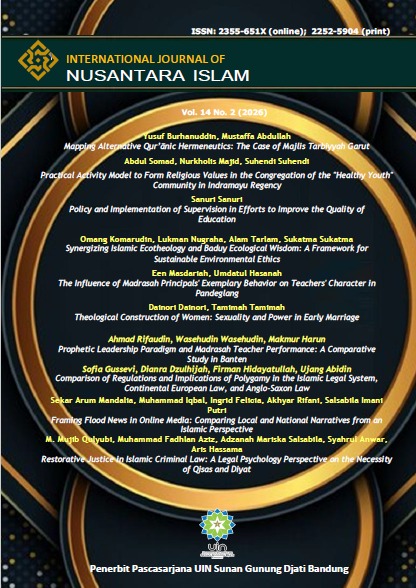
Synergizing Islamic Ecotheology and Baduy Ecological Wisdom: A Framework for Sustainable Environmental Ethics
Article Sidebar
Main Article Content
Abstract
The escalating global ecological crisis demands solutions that transcend mere technical fixes, drawing instead on the profound synergy between sacred religious values and deeply rooted indigenous wisdom. This study, pioneering in its examination of the integration of Islamic ecotheology with the centuries-old ecological traditions of the Baduy community, crafts a groundbreaking environmental ethics model tailored for contemporary Indonesia. Utilizing a qualitative narrative-comparative research design, insights were dynamically gathered through an immersive mix of literature reviews, field observations, in-depth interviews, and meticulous documentation. Subsequent thematic analysis uncovers a powerful, harmonious alignment between core Islamic concepts—such as khalīfah (stewardship), amānah (trust), and mīzān (cosmic balance)—and the foundational Baduy principles of pikukuh karuhun (ancestral mandates), strict ecological taboos, and sacred forest conservation. Remarkably, both value systems independently champion a shared ethos of deep moral responsibility, voluntary simplicity, and an absolute rejection of environmental exploitation. By weaving these two worldviews together, this research produces a highly holistic environmental ethics model that bridges divine religious legitimacy with time-tested, practical indigenous conservation methods. Rather than treating faith and tradition as static relics, this integrated framework revitalizes them into active catalysts for deep ecological awareness. Ultimately, this newly forged model offers transformative strategic potential, providing an authentic and culturally resonant blueprint to revolutionize environmental education, reshape grassroots policy development, and drive sustainable community empowerment initiatives across the nation.
Article Details
The Authors submitting a manuscript do so on the understanding that if accepted for publication, copyright of the article shall be assigned to International Journal of Nusantara Islam, Sunan Gunung Djati State Islamic University.
The copyright encompasses exclusive rights to reproduce and disseminate articles in all forms and media, including reprints, photographs, microfilm, and similar reproductions, as well as translations. Some or all of the contents of this journal can be stored in databases and transmitted in any form and media without the need for written permission from the International Journal of Nusantara Islam, Sunan Gunung Djati State Islamic University.
The Editors and the Advisory International Editorial Board make every effort to ensure that no wrong or misleading data, opinions or statements be published in the journal. In any way, the contents of the articles and advertisements published in the International Journal of Nusantara Islam (IJNI) are sole and exclusive responsibility of their respective authors and advertisers.
References
Abumoghli, I. (2025). “Faith for Earth”: an Ethical Approach to Global Environmental Challenges. Religion and Development, 3(2), 236–247. https://doi.org/10.30965/27507955-00302007
Agita, N., & Harun, M. S. (2025). Rekonstruksi Makna Fasad dalam Isu Pemanasan Global Perspektif Tafsir Maqasidi [Reconstruction of the Meaning of Facade in the Issue of Global Warming from the Perspective of Maqasidi Interpretation]. Al-Qudwah, 3(1). https://doi.org/10.24014/alqudwah.v3i1.29774 [in Indonesian]
Ahmad, V. I., Ali, N., & Zuhriyah, I. A. (2025). Islamic Values in Environmental School Culture: Character Formation and Challenges. EDUKASIA Jurnal Pendidikan Dan Pembelajaran, 6(1), 267–280. https://doi.org/10.62775/edukasia.v6i1.1400
Al-Jayyousi, O., Tok, E., Saniff, S. M., Wan Hasan, W. N., Janahi, N. A., & Yesuf, A. J. (2022). Re-Thinking Sustainable Development within Islamic Worldviews: A Systematic Literature Review. Sustainability, 14(12), 7300. https://doi.org/10.3390/su14127300
Al-Qaradhawi, Y. (2002). Islam agama ramah lingkungan [Islam is an environmentally friendly religion] (A. H. Shah, L. Hakim, M. S. Yusuf, & A. Z. Akaha (Eds.); 1st ed.). Pustaka Al-Kautsar.
Al-Qur’an, L. P. mushaf. (2022). Qur’an Kemenag [Qur’an Ministry of Religion]. Kementerian Agama Republik Indonesia.
Altieri, M. A., & Nicholls, C. I. (2017). The adaptation and mitigation potential of traditional agriculture in a changing climate. Climatic Change, 140(1), 33–45. https://doi.org/10.1007/s10584-013-0909-y
Antoni, M. R., Brata, Y. R., & Sudarto, S. (2025). Integration of Islamic Values and Local Knowledge in Social Practices for Environmental Conservation in Banjaranyar. JAMASAN: Jurnal Mahasiswa Pendidikan Sejarah, 1(2). https://doi.org/10.25157/jamasan.v1i2.5480
Arsyad, M., & Hasanah, N. (2025). Nilai Ekologis Islam: Konsep Khalifah dan Amanah [Islamic Ecological Values: The Concept of Caliph and Trust]. Al-Mustafid: Journal of Quran and Hadith Studies, 4(1), 33–48. https://doi.org/10.30984/mustafid.v4i1.1361 [in Indonesian]
Asteria, D., Alvernia, P., Kholila, B. N., Husein, S. I., & Asrofani, F. W. (2024). Forest conservation by the indigenous Baduy community in the form of customary law. Journal of Cultural Heritage Management and Sustainable Development, 14(2), 175–189.
Azra, A. (2006). Indonesia, Islam, and Democracy: Dynamics in a Global Context. Equinox Publishing.
Bakti, I., Karimi, R., & Rahimi, R. (2025). An Ethnoforestry Study of The Baduy Community’s Indigenous Knowledge in Forest Conservation and Water Resource Management. Journal of Selvicoltura Asean, 2(4), 225–242. https://doi.org/10.70177/jsa.v2i4.2482
Berger, P. L., & Luckmann, T. (1967). The Social Construction of Reality: A Treatise in the Sociology of Knowledge. Anchor.
Bowen, G. A. (2009). Document analysis as a qualitative research method. Qualitative Research Journal, 9(2), 27–40.
Coria, J., & Calfucura, E. (2012). Ecotourism and the development of indigenous communities: The good, the bad, and the ugly. Ecological Economics, 73, 47–55. https://doi.org/10.1016/j.ecolecon.2011.10.024
Creswell, J. W., & Poth, C. N. (2018). Qualitative Inquiry & Research Design: Choosing Among Five Approaches (Fourth). SAGE Publications, Inc.
Denzin, N. K., & Lincoln, Y. S. (2017). Handbook of Qualitative Research (5th ed.). Sage Publication.
Durkheim, É. (1912). The Elementary Forms of the Religious Life. George Allen & Unwin Ltd.
Escobar, A. (2011). Encountering Development: The Making and Unmaking of the Third World. Princeton University Press.
Habiyaremye, A., & Korina, L. (2021). Indigenous knowledge systems in ecological pest control and post-harvest rice conservation techniques: sustainability lessons from Baduy communities. Sustainability, 13(16), 9148. https://doi.org/0.3390/su13169148
Hajar, A. (2024). Transforming Islamic Education for Environmental and Social Sustainability. Sinergi International Journal of Islamic Studies, 2(2), 82–95. https://doi.org/10.61194/ijis.v2i2.601
Halim, A., Rafii, M., & Kusnadi, E. (2023). Ecotheology In Promoting Environmental Sustainability: Conserving The Eco-Friendly Islamic Doctrine In Jambi Province. Jurnal Ilmiah Ilmu Ushuluddin, 22(2), 171–178. https://doi.org/10.18592/jiiu.v22i2.10069
Hamdi, F., Ladraa, K., Benjammour, M., Hafidzi, A., & Ilhami, H. (2025). Integrating Maqashid al-Sharia, Fiqh al-Bi’ah, and Islamic Ethics for Sustainable Water Management. Al-Ahkam: Jurnal Ilmu Syari’ah Dan Hukum, 10(1), 1–19. https://doi.org/10.22515/alahkam.v10i1.11277
IPCC. (2021a). Climate Change 2021: The Physical Science Basis. Contribution of Working Group I to the Sixth Assessment Report.
IPCC. (2021b). Climate Change 2021: The Physical Science Basis.
IPCC. (2021c). Sixth Assessment Report.
Iskandar, J., & Iskandar, B. S. (2017). Local knowledge of the Baduy Community of South Banten (Indonesia) on the traditional landscapes. Biodiversitas Journal of Biological Diversity, 18(3), 928–938. https://doi.org/10.13057/biodiv/d180309
Izmuddin, I., Rusyaida, R., Bashir, G., Hasibuan, P., & Awaluddin, A. (2022). The Indonesian Ulema Council Fatwa Analysis on The Environment and Their Relationship to The Green Economics Concept Development. Jurnal Syntax Admiration, 3(12), 1559–1568. https://doi.org/10.46799/jsa.v3i12.536
Kallis, G. (2018). Degrowth. Agenda Publishing.
Kismawadi, E. R. (2024). Halal Food Industry and Sustainability. In Economics And Business Management Journal (EBMJ) Environmental Responsibility in the Global Beverage Industry (pp. 170–197). IGI Global Scientific Publishing. https://doi.org/10.4018/979-8-3693-2149-2.ch010
Kvale, S., & Brinkmann, S. (2009). Interviews: Learning the craft of qualitative research interviewing. sage.
Li, T. M. (2007). The Will to Improve. Duke University Press. https://doi.org/10.1215/9780822389781
Mathevet, R., Bousquet, F., Larrère, C., & Larrère, R. (2018). Environmental Stewardship and Ecological Solidarity: Rethinking Social-Ecological Interdependency and Responsibility. Journal of Agricultural and Environmental Ethics, 31(5), 605–623. https://doi.org/10.1007/s10806-018-9749-0
Muizudin, M. (2026). Revisiting Islamic Theology: Lived Eco-Theology in Contemporary Environmental Activism. International Student Conference FUPI, 110–120.
Mukhroman, I., & Haryanti, E. (2025). Framing Banten’s north coastal sea fence as eco-theology and social movement. International Journal of Nusantara Islam, 13(2), 351–364. https://doi.org/10.15575/ijni.v13i2.45628
Nadroh, S. (2018). Pikukuh Karuhun Baduy Dinamika Kearifan Lokal di Tengah Modernitas Zaman [Pikukuh Karuhun Baduy: Dynamics of Local Wisdom in the Midst of Modern Times]. Jurnal PASUPATI, 5(2), 196. https://doi.org/10.37428/pspt.v5i2.117 [in Indonesian]
Naess, A. (1973). The shallow and the deep, long‐range ecology movement. A summary∗. Inquiry, 16(1–4), 95–100. https://doi.org/10.1080/00201747308601682
Nasr, S. H. (1968). Man and Nature: The Spiritual Crisis in Modern Man. Mandala Books.
Patton, M. Q. (2015). Qualitative Research & Evaluation Methods. SAGE.
Permana, C. E. (2006). Tata Ruang Masyarakat Baduy. Wedatama Widya Sastra.
Riessman, C. K. (2007). Narrative Methods for the Human Sciences. Sage Publications.
Sakdiah, H., Zein, M. D. S., Ma’arif, M. G., Lubis, A. N., & Farabi, M. Al. (2026). Environmental Education From the Qur’anic Perspective: Ecological Analysis of Surah Ar-Rūm 41 on the Flood and Landslide Crisis in Sumatra. IJERM: International Journal of Islamic Education, Research, and Multiculturalism, 8(1), 1–25. https://doi.org/10.47006/ijierm.v8i1.656
Santos, B. de S. (2014). Epistemologies of the South Justice Against Epistemicide (1st ed.). Routledge.
Sayem, M. A. (2021). Islam and Environmental Ethics. ISLAMIC STUDIES, 60(2), 157–172. https://doi.org/10.52541/isiri.v60i2.1438
Senoaji, G. (2010). Masyarakat baduy, hutan, dan lingkungan [Baduy Community, Forest, and Environment]. Jurnal Manusia Dan Lingkungan, 17(2), 113–123. https://doi.org/10.22146/jml.18710 [in Indonesian]
Senoaji, G. (2011). Perilaku masyarakat baduy dalam mengelola hutan, lahan, dan lingkungan di Banten Selatan [The behavior of the Baduy people in managing forests, land and the environment in South Banten]. Humaniora, 23(1), 1–15. https://doi.org/10.22146/jh.v23i1.1006 [in Indonesian]
Setiawan, N., Mardiana, R., & Adiwibowo, S. (2023). Ekologi Budaya dan Ekospiritualitas Komunitas Adat Baduy Menghadapi Modernisasi [Cultural Ecology and Ecospirituality of the Baduy Indigenous Community Facing Modernization]. FOCUS, 4(2), 107–120. https://doi.org/10.26593/focus.v4i2.7123 [in Indonesian]
Shiva, V. (2016). Who Really Feeds the World?: The Failures of Agribusiness and the Promise of Agroecology. North Atlantic Books.
Sponsel, L. E. (2008). Spiritual Ecology. Journal for the Study of Religion, Nature and Culture, 1(3), 340–350. https://doi.org/10.1558/jsrnc.v1i3.340
Spradley, J. P. (1980). Participant Observation. Holt, Rinehart and Winston.
Susana, L. M., Tripalupi, R. I., Kholil, S., Efendi, N., & Sakinah, G. (2025). Reconstructing Islamic Legal Norms in Environmental Governance: A Maqasid-Based Legal Critique of Indonesia’s Resource Policies. Al-Istinbath: Jurnal Hukum Islam, 10(2), 650–670. https://doi.org/10.29240/jhi.v10i2.13038
Tilbury, D. (1995). Environmental Education for Sustainability: defining the new focus of environmental education in the 1990s. Environmental Education Research, 1(2), 195–212. https://doi.org/10.1080/1350462950010206
UNEP. (2022). The Sustainable Development Goals Report 2022.
WRI Indonesia. (2020). 2020 Annual Report Wri Indonesia.
Wulan, S. R. (2025). Konsep Keseimbangan (Mīzān) dalam Islam sebagai Dasar Pembangunan Berkelanjutan [The Concept of Balance (Mīzān) in Islam as the Basis for Sustainable Development]. Socius: Jurnal Penelitian Ilmu-Ilmu Sosial, 2(6), 526–532. https://doi.org/10.5281/zenodo.15398043 [in Indonesian]