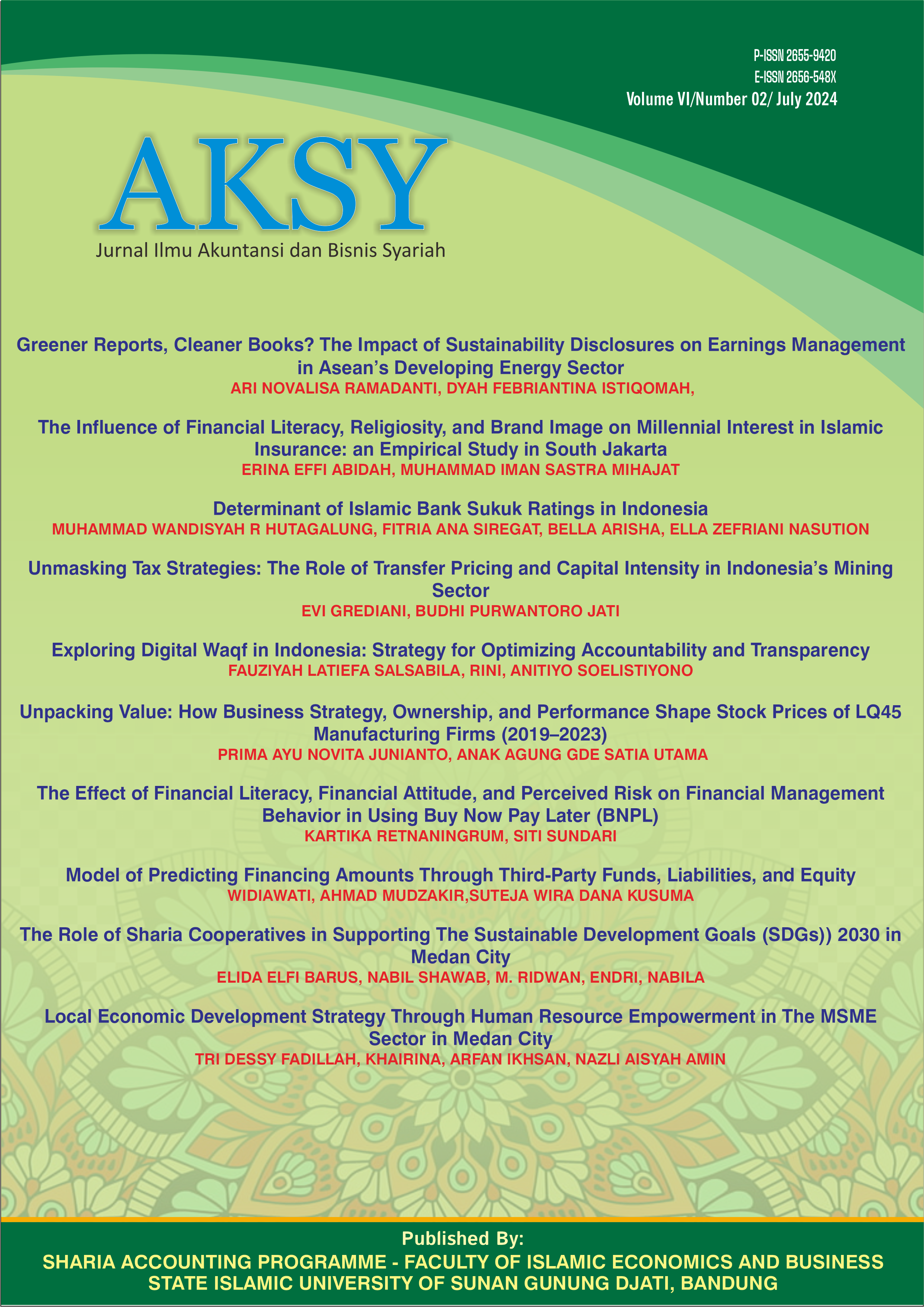
EXPLORING DIGITAL WAQF IN INDONESIA: STRATEGY FOR OPTIMIZING ACCOUNTABILITY AND TRANSPARENCY
DOI:
https://doi.org/10.15575/aksy.v7i2.45931Keywords:
Accountability, Digital Waqf, Strategy, TransparencyAbstract
This research aims to explore the strategies of BMM and BSI Maslahat in optimizing accountability and transparency in digital waqf instruments. This research uses a qualitative approach with two case studies, where the data collected is then analyzed using the Miles, Huberman, and Saldana modeling technique with the help of the NVivo 12 application. Using the Theory of sharia governance as a grand Theory, this research produces findings on the strategies carried out by both institutions in optimizing accountability and transparency, namely: conducting regular independent audits, forming an independent oversight committee, implementing the Waqf Core Principles (WCP), providing an online platform, involving all stakeholders, providing open financial reports on the website, and implementing a blockchain-based reporting system. By exploring and analyzing institutional strategies for accountability and transparency in waqf management through digital waqf instruments, this research can provide new insights into understanding the growing phenomenon of waqf fund management. In addition, the results of this study can be utilized by the general public as information that can be utilized by the general public as information that can increase public trust and participation in giving cash waqf. Therefore, this research argues that strengthening accountability and transparency will optimize digital waqf fundraising instruments to encourage the growth of waqf in Indonesia
References
Anggraeni, R. D., Yunus, N. R., & Rezki, A. (2020). Legal Policies for Implementing Waqaf Online in Indonesia. Mizan: Journal of Islamic Law, 4(1). https://doi.org/10.32507/mizan.v4i1.601
Antonio, M. S. (2011). Bank Syariah dari Teori ke Praktik. Gema.
Arshad, R., & Mohd Zain, N. (2017). Performance Measurement and Accountability of Waqf Institutions in Malaysia. SHS Web of Conferences, 36, 00005. https://doi.org/10.1051/shsconf/20173600005
Aryana, K. (2022). Akuntabilitas dan Transparansi Lembaga Pengelola Wakaf melalui Waqf Core Principle dan PSAK 112. Jurnal Akuntansi Bisnis Dan Ekonomi, 7(2), 2065–2080. https://doi.org/10.33197/jabe.vol7.iss2.2021.783
Barkah, Q., Azwari, P. C., Saprida, & Umari, Z. F. U. (2020). Fikih Zakat, Sedekah, dan Wakaf. Prenadamedia Group.
Beckham, J. D. (1997). The Accountability Crisis in Healthcare. The Healthcare Forum Journal, 40(5), 34–37.
Beik, I. S. (2013). Mengoptimalkan Wakaf Uang Bagi Pengembangan UMKM. Iqtishodia Jurnal Ekonomi Islam Republika, 23. 19-11-2023.
Bin Mohd Sharif, A. ’Azam, Nasrullah, N., Hatta, M., & Hidayatullah, H. (2023). Accountability of Nazir in the Waqf Legal System of Indonesia. Al-Adl : Jurnal Hukum, 15(1), 1. https://doi.org/10.31602/al-adl.v15i1.9800
Board, G. A. S. (1998). Governmental Accounting and Financial Reporting Standards. Conn.
Dmytriyev, S. D., Freeman, R. E., & Hörisch, J. (2021). The Relationship between Stakeholder Theory and Corporate Social Responsibility: Differences, Similarities, and Implications for Social Issues in Management. Journal of Management Studies, 58(6), 1441–1470. https://doi.org/10.1111/joms.12684
Efunniyi, C. P., Abhulimen, A. O., Osafiele, A. N. O., Osundare, O. S., Agu, E. E., & Adeniran, I. A. (2024). Strengthening Corporate Governance and Financial Compliance: Enhancing Accountability and Transparency. Finance & Accounting Research Journal, 6(8), 1597–1616. https://doi.org/10.51594/farj.v6i8.1509
Fauziah. (2017). Strategi Fundraising Wakaf Uang di Indonesia (Studi Kasus Badan Wakaf Indonesia dan Dompet Dhuafa) [Disertation]. UIN Syarif Hidayatullah Jakarta.
Fitri, Y., Rini, & Amilin. (2024). Transparansi dan Akuntabilitas Organisasi Pengelola Zakat. Jurnal Bimas Islam, 17(1), 17–30. https://doi.org/10.37302/jbi.v17i1.1013
Fox, J. (2007). The Uncertain Relationship Between Transparency and Accountability. Development in Practice, 17(4–5), 663–671. https://doi.org/10.1080/09614520701469955
Freeman, R. E. (2017). Five Challenges to Stakeholder Theory: A Report on Research in Progress. In D. M. Wasieleski & J. Weber (Eds.), Business and Society 360 (Vol. 1, pp. 1–20). Emerald Publishing Limited. https://doi.org/10.1108/S2514-175920170000001
Freeman, R. E., Harrison, S. J., Wicks, C. A., Parmar, L. B., & Colle, de S. (2010). Stakeholder Theory: The State of the Art. Cambridge University Press.
Hisamuddin, N. (2018). Transparansi dan Pelaporan Keuangan Lembaga Zakat. ZISWAF : Jurnal Zakat dan Wakaf, 4(2), 327. https://doi.org/10.21043/ziswaf.v4i2.3049
Hsu, A., & Schletz, M. (2023). Digital Technologies – The Missing Link Between Climate Action, Transparency, and Accountability? Climate Policy, 1–18. https://doi.org/10.1080/14693062.2023.2237937
Hussain, S., Guangju, W., Jafar, R. M. S., Ilyas, Z., Mustafa, G., & Jianzhou, Y. (2018). Consumers’ Online Information Adoption Behavior: Motives and Antecedents of Electronic Word of Mouth Communications. Computers in Human Behavior, 80, 22–32. https://doi.org/10.1016/j.chb.2017.09.019
Indonesia, D. P. R., & Indonesia, P. (2004). Undang-Undang No.41 Tahun 2004 Tentang Wakaf. Presiden Republik Indonesia.
Ismail, S., Hassan, M., & Rahmat, S. (2023). Islamic Social Finance: Waqf, Endowment, and SMEs. Edward Elgar Publishing. https://doi.org/10.4337/9781803929804
Lewis, M. K. (2001). Islam and Accounting. Accounting Forum, 25(2), 103–127. https://doi.org/10.1111/1467-6303.00058
Mabillard, V., & Zumofen, R. (2020). Debate: The Transparency–Accountability Relationship Depends on the Context and the Issues at Stake. Public Money & Management, 40(2), 89–90. https://doi.org/10.1080/09540962.2019.1665365
Masnoni, Moi, M. O. V., Asmara, R. Y., Judijanto, L., Amyulianthy, R., Abdullah, S., Nainggolan, C. D., Widiastuty, E., Handajani, L., Sanjaya, P. S., Indayani, Utami, W., Sutandi, S., & Febrianto, R. (2024). Teori Akuntansi (Teori Komprehensif dan Perkembangannya) (1st ed.). Sonpedia Publishing Indonesia.
Miles, M. B., Huberman, M., & Saldana, J. (2014). Qualitative Data Analysis a Methods Sourcebook (3rd ed.). Sage.
Obaidullah, M., Izhar, H., Muljawan, D., Ismal, R., Savitri, A., Saptono, I. T., Tanjung, H., Hosen, N., Benyounis, H., Cajee, Z. A., Dafterdar, Mohd. H., A-Mutawa, E., Mohammad, J., Alobaid, S., Zajimovic, S., Nazirwan, M., Masyita, D., & Beik, I. S. (2018). Core Principles for Effective Waqf Operation and Supervision. Badan Wakaf Indonesia (BWI).
Ortega-Rodríguez, C., Licerán-Gutiérrez, A., & Moreno-Albarracín, A. L. (2020). Transparency as a Key Element in Accountability in Non-Profit Organizations: A Systematic Literature Review. Sustainability, 12(14), 5834. https://doi.org/10.3390/su12145834
Palmer, M. S. R., & Knight, D. R. (2022). The Constitution of New Zealand: A Contextual Analysis. Hart Publishing. https://doi.org/10.5040/9781849469067
Pujakesuma, S. (2024, Mei). Wawancara Pribadi [Personal communication].
Pujonegoro, G. (2024, March 27). Wawancara Pribadi [Personal communication].
Putra, E. V. (2020). Implementation of Public Accountability and Transparency at Non-Government Organizations at the Local Level. Proceedings of the International Conference on Public Administration, Policy and Governance (ICPAPG 2019). International Conference on Public Administration, Policy and Governance (ICPAPG 2019), Negeri Padang, Indonesia. https://doi.org/10.2991/aebmr.k.200305.222
Rahim, A. (2019). Peran Wakaf dalam Perkembangan Pendidikan Islam. Al Qalam: Jurnal Ilmiah Keagamaan dan Kemasyarakatan, 89. https://doi.org/10.35931/aq.v0i0.131
Ramírez, Y., & Tejada, Á. (2019). Digital Transparency and Public Accountability in Spanish Universities in Online Media. Journal of Intellectual Capital, 20(5), 701–732. https://doi.org/10.1108/JIC-02-2019-0039
Ruslan, I. (2020). Kontribusi Lembaga-Lembaga Keagamaan dalam Pengembangan Toleransi Antar Umat Beragama di Indonesia (1st ed.). Arjasa Pratama.
Sari, E. novita, Parasmono, A. putri, & Djasuli, M. (2022). Application of Good Corporate Governance Principles in Sharia Banking Institutions from the Perspective of Islamic Sharia in Indonesia. Jurnal Ekonomika Dan Bisnis ; Vol. 2 No. 2 (2022): Jurnal Ekonomika Dan Bisnis (JEBS); 616-622 ; 2807-8438 ; 10.47233/Jebs.V2i1. http://jurnal.minartis.com/index.php/jebs/article/view/235
Satriya, I. Y. (2024, March 27). Wawancara Pribadi [Personal communication].
Siswantoro, D., Rosdiana, H., & Fathurahman, H. (2018). Reconstructing Accountability of the Cash Waqf (Endowment) Institution in Indonesia. Managerial Finance, 44(5), 624–644. https://doi.org/10.1108/MF-05-2017-0188
Sukrisno, A. (2017). Auditing: Petunjuk Praktis Pemeriksaan Akuntan oleh Akuntan Publik (5th ed.). Salemba Empat.
Sulistyanto, S. (2018). Manajemen Laba: Teori dan Model Empiris. Grasindo.
Suryaningsum, S., Purwanto, H. S., Tanjung, R. W., Kusumastutik, B., Bour, B. A., & Limbong, A. J. (2020). Strategi Pendanaan Penelitian pada Perguruan Tinggi untuk Meningkatkan Kinerja Penelitian. Nugra Media.
Taufik, M. (2022). Hukum Kebijakan Publik Teori dan Praksis. Tanah Air Beta.
Wahyudi, A. (2024, Mei). Wawancara Pribadi [Personal Communication].
Wong, C. W. Y., Wong, C. Y., Boon-itt, S., & Tang, A. K. Y. (2021). Strategies for Building Environmental Transparency and Accountability. Sustainability, 13(16), 9116. https://doi.org/10.3390/su13169116
Zarkasyi, W. (2008). Good Governance pada Badan Usaha Manufaktur, Perbankan, dan Jasa Keuangan Lainnya. Alfabeta.
Zein, A. S., Lubis, D. S., & Sovia, A. K. (2020). Digitalization of Mustahiq Economic Empowerment Model based on Productive Zakah Fund. International Conference of Zakat, 419–428. https://doi.org/10.37706/iconz.2020.220
Downloads
Published
How to Cite
Issue
Section
Citation Check
License
Copyright (c) 2025 Jurnal Ilmu Akuntansi dan Bisnis Syariah (AKSY)

This work is licensed under a Creative Commons Attribution-ShareAlike 4.0 International License.
Lisensi Creative Commons
Jurnal Ilmu Akuntansi dan Bisnis Syariah are licensed under Attribution-ShareAlike 4.0 International