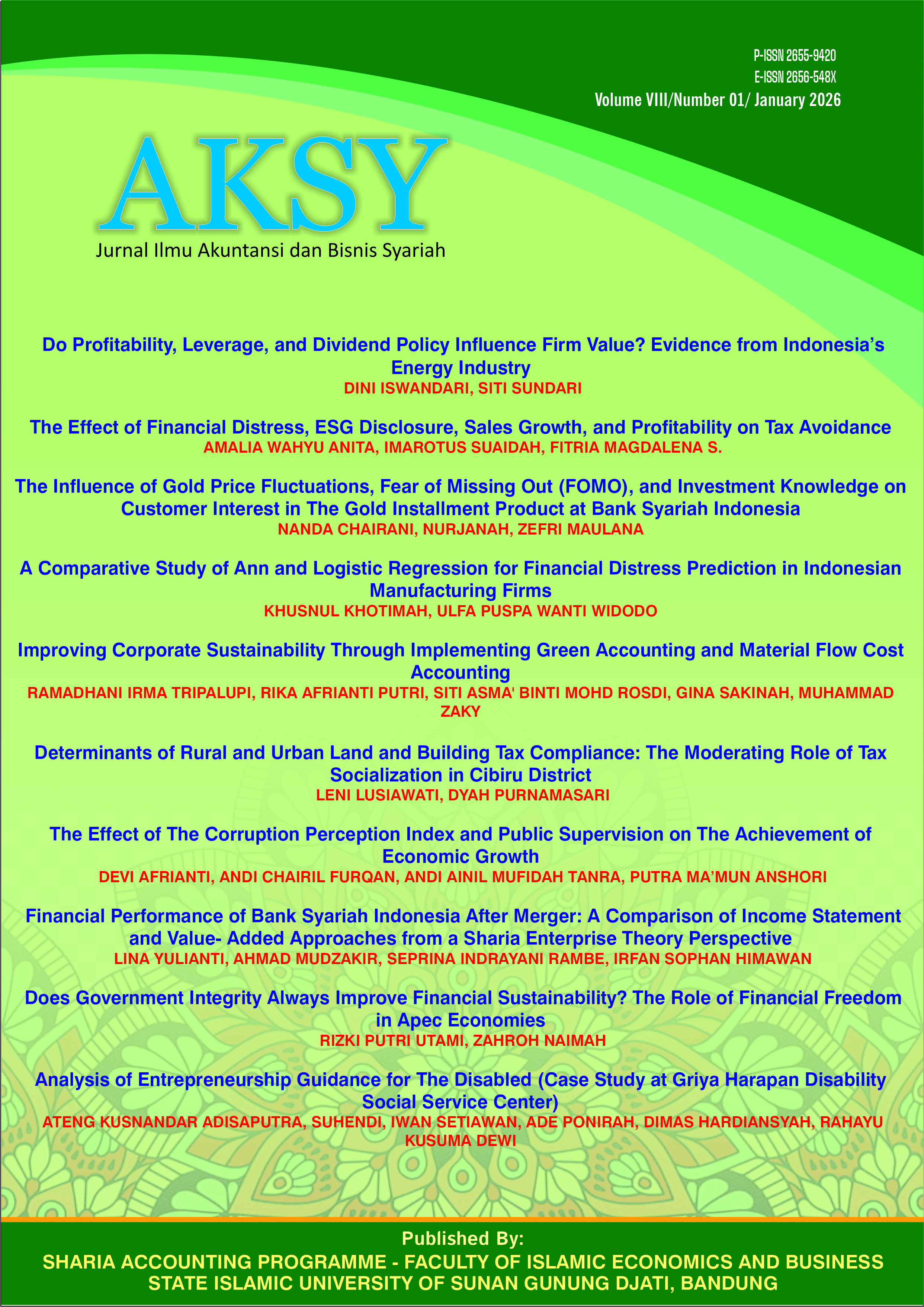
A COMPARATIVE STUDY OF ANN AND LOGISTIC REGRESSION FOR FINANCIAL DISTRESS PREDICTION IN INDONESIAN MANUFACTURING FIRMS
DOI:
https://doi.org/10.15575/aksy.v8i1.52046Keywords:
Artificial Neural Network, Financial Distress, Logistic Regression, Manufacture, RecallAbstract
This study aims to compare the predictive performance of the Logistic Regression (LR) model and the Artificial Neural Network (ANN) in forecasting financial distress among manufacturing firms listed on the Indonesia Stock Exchange (IDX) during 2022–2024. Financial distress represents a deterioration in a company’s financial condition and serves as an early warning of potential bankruptcy; therefore, accurate prediction models are crucial for investors, creditors, and corporate decision-makers. The sample comprises manufacturing companies selected through purposive sampling, based on the availability and completeness of financial statements for the observation period. The variables used include financial ratios such as Return on Assets (ROA), Debt-to-Assets Ratio (DAR), and Current Ratio (CR). Two predictive models were developed: Logistic Regression, a conventional statistical approach, and an Artificial Neural Network, a nonlinear machine learning method. The results indicate that the Logistic Regression model achieves a higher recall rate than the Artificial Neural Network model (55.56%), suggesting that Logistic Regression provides better predictive performance in identifying companies experiencing financial distress.
References
Alamsyah, A., Kristanti, N., & Kristanti, F. T. (2021). Early warning model for financial distress using Artificial Neural Network. IOP Conference Series: Materials Science and Engineering, 1098(5), 052103. https://doi.org/10.1088/1757-899x/1098/5/052103
BPS. (2025). Ekonomi Indonesia Tahun 2024 Tumbuh 5,03 Persen (C-to-C). Ekonomi Indonesia Triwulan IV-2024 Tumbuh 5,02 Persen (Y-on-Y). Ekonomi Indonesia Triwulan IV-2024 Tumbuh 0,53 Persen (Q-to-Q). https://www.bps.go.id/id/pressrelease/2025/02/05/2408/ekonomi-indonesia-tahun-2024-tumbuh-5-03-persen--c-to-c---ekonomi-indonesia-triwulan-iv-2024-tumbuh-5-02-persen--y-on-y---ekonomi-indonesia-triwulan-iv-2024-tumbuh-0-53-persen--q-to-q--.html
CRIF Indonesia. (2025). PKPU Cases in Q4 2024: Growing Challenges for Indonesian Businesses? https://www.id.crifasia.com/resources/industry-insights/pkpu-cases-in-q4-2024-growing-challenges-for-indonesian-businesses/
Daeli, A., Hutauruk, R. A., Rifai, M. B., & Silaen, K. (2024). Analisis Laporan Keuangan Sebagai Penilai Kinerja Manajemen. PPIMAN: Pusat Publikasi Ilmu Manajemen, 2(3), 158–168.
Goh, T. S. (2023). Monograf: Financial Distress. In International Journal of Theoretical and Applied Finance (1st ed.). Indomedia Pustaka.
Hikmah, N., & Muniarty, P. (2024). Analisis Current Ratio pada Pt Indofood Sukses Makmur Tbk. Journal Of Managemet, 7(2), 617–626.
Ishak, R. (2025). Optimalisasi Seleksi Atribut K-Means Menggunakan Correlation Matrix pada Clustering Penyakit Pasien Optimization of K-Means Attribute Selection Using Correlation Matrix in Patient Disease Clustering. Jambura Journal of Electrical and Electronics Engineering, 7(2), 2–9.
Ismail, S. (2022). Pengaruh Penggunaan Model Pembelajaran Berbasis Proyek “Project Based Learning” Terhadap Hasil Belajar Fisika Peserta Didik Kelas X IPA SMA Negeri 35 Halmahera Selatan Pada Konsep Gerak Lurus”. Jurnal Ilmiah Wahana Pendidikan, 8(5), 256–269. https://doi.org/10.5281/zenodo.6466594
Jurlinda, J., Alie, J., & Veronica, M. (2022). Pengaruh Debt to Asset Ratio dan Debt to Equity Ratio Terhadap Return On Asset Perusahaan Sektor Industri Makanan dan Minuman yang Terdaftar Di Bursa Efek Indonesia. Jurnal Ilmu Sosial, Manajemen, Akuntansi, Dan Bisnis, 3(1), 1–12.
Kolmogorov, A. N. (1933). Sulla Determinazione Empirica di Une Legge di Distribuzione. Giornale Dell’Intituo Italiano Degli Attuari, 4, 83–91.
Kristanti, F. T., & Dhaniswara, V. (2023). The Accuracy of Artificial Neural Networks and Logit Models in Predicting the Companies’ Financial Distress. Journal of Technology Management and Innovation, 18(3), 42–50. https://doi.org/10.4067/s0718-27242023000300042
Kristanti, F. T., Safriza, Z., & Salim, D. F. (2023). Are Indonesian construction companies financially distressed? A prediction using artificial neural networks. Investment Management and Financial Innovations, 20(2), 41–52. https://doi.org/10.21511/imfi.20(2).2023.04
Kurniati, A. B., Sidik, W. A., & Jajang. (2024). Model Artificial Neural Networks (ANN) untuk Prediksi COVID-19 di Indonesia. JST (Jurnal Sains Dan Teknologi), 12(3), 833–844. https://doi.org/10.23887/jstundiksha.v12i3.53437
Lokanan, M. E., & Ramzan, S. (2024). Predicting financial distress in TSX-listed firms using machine learning algorithms. Frontiers in Artificial Intelligence, 7(November), 1–19. https://doi.org/10.3389/frai.2024.1466321
Manik, I. A. P. I., Iskandar, E., & Anan, M. (2023). PENERAPAN STANDAR AKUNTANSI KEUANGAN (PSAK) NO.2 TENTANG LAPORAN ARUS KAS PADA CV. MANDIRI PRATAMA SEJAHTERA. WORKSHEET: Jurnal Akuntansi, 2(2), 175–181.
Mishra, N., Ashok, S., & Tandon, D. (2024). Predicting Financial Distress in the Indian Banking Sector: A Comparative Study Between the Logistic Regression, LDA and ANN Models. Global Business Review, 25(6), 1540–1558. https://doi.org/10.1177/09721509211026785
Moss, L., Corsar, D., Shaw, M., Piper, I., & Hawthorne, C. (2022). Demystifying the Black Box : The Importance of Interpretability of Predictive Models in Neurocritical Care. Neurocritical Care, 37, 185–191. https://doi.org/10.1007/s12028-022-01504-4
Muthalib, S., Murni, S., & Untu, V. (2021). Analisis Faktor Internal Perusahaan Terhadap Harga SahamPerusahaan Sektor Property Real Estate Yang TerdaftarDi Bursa Efek Indonesia. 691 Jurnal EMBA, 9(4), 691–701.
Navianti, D. R., Dewi, P. A. G. K., & Ryanto, S. S. (2023). Identification of Loading and Unloading Process Time At Denpasar Goods Terminal. Jurnal Teknologi Transportasi Dan Logistik, 4(1), 57–66.
Pratama, A. R. Y., Prapanca, D., & Sriyono. (2024). Return On Asset (ROA), Return On Invesment (ROI), Earning Per Share (EPS) Terhadap Harga Saham (Studi Kasus Perusahaan Subsektor Otomotif Dan Komponen Yang Terdaftar Di Bursa Efek Indonesia Tahun 2020-2023). 5(2), 5755–5769.
Raharja, N. B., & Gunardi, A. (2023). Penundaan Kewajiban Pembayaran Utang (PKPU) Dalam Hukum Kepailitan. Jurnal Kewarganegaraan, 7(2), 2009–2016.
Rahayu. (2020). Kinerja Keuangan Perusahaan. In Kinerja Keuangan Perusahaan. Program Pascasarjana Universitas Prof. Moestopo (Beragama).
Rivanda, A. K., & Muslim, A. I. (2021). Analisis Perbandingan Model Prediksi Financial Distress pada Sub Sektor Textile dan Garment. Jurnal Riset Akuntansi Dan Keuangan, 9(3), 485–500. https://doi.org/10.17509/jrak.v9i3.32450
Said, A. P., & Pangestuti, D. C. (2024). Analisis Pengaruh Pertumbuhan Penjualan, Profitabilitas, Risiko Pasar, dan Inflasi Terhadap Nilai Perusahaan Sektor Consumer Non-Cyclicals. Jurnal Nusantara Aplikasi Manajemen Bisnis, 9(2), 521–539.
Salmi, M., Atif, D., Oliva, D., Abraham, A., & Ventura, S. (2024). Handling imbalanced medical datasets : review of a decade of research. In Artificial Intelligence Review (Vol. 57, Issue 10). Springer Netherlands. https://doi.org/10.1007/s10462-024-10884-2
Sari, N. R., Hasbiyadi, & Arif, M. F. (2020). Mendeteksi Financial Distress dengan Model Altman Z- Score. Jurnal Ilmiah Akuntansi Dan Humanika, 10(1), 93–102. https://ejournal.undiksha.ac.id/index.php/JJA/article/download/23102/14923
Sethi, S. R., & Mahadik, D. A. (2025). Forecasting financial distress for organizational sustainability : An empirical analysis. Sustainable Futures, 9(December 2024), 100429. https://doi.org/10.1016/j.sftr.2024.100429
Silvia, D., & Yulistina, Y. (2022). Pengaruh Current Ratio, Return On Asset, Debt To Asset terhadap Financial Distress Selama Masa Pandemi. Global Financial Accounting Journal, 6(1), 89. https://doi.org/10.37253/gfa.v6i1.6528
Siswanto, E. (2021). Buku Ajar Manajemen Keuangan Dasar. In Etika Jurnalisme Pada Koran Kuning : Sebuah Studi Mengenai Koran Lampu Hijau (I, Vol. 16, Issue 2). Universitas Negeri Malang.
Sitorus, F. D., Hernandy, F., Triskietanto, W., Angela, A., & Vanessa. (2022). Pengaruh Likuiditas, Leverage, Profitabilitas dan Ukuran Perusahaan terhadap Financial Distress pada Perusahaan Barang Konsumsi yang Terdaftar di BEI Tahun 2016-2020. Owner, 6(1), 85–98. https://doi.org/10.33395/owner.v6i1.530
Sitorus, M., & Yulita, S. M. (2023). Analisis Potensi Kebangkrutan Pada PT. Prima Mulia Engineering dengan Metode Altman Z-Score untuk Periode 2017-2020. Jurnal Teknologi Dan Manajemen, 21(1), 1–8. https://doi.org/10.52330/jtm.v21i1.69
Situngkir, R. H., & Sembiring, P. (2023). Analisis Regresi Logistik Untuk Menentukan Faktor-Faktor YangMempengaruhi Kesejahteraan Masyarakat Kabupaten/Kota Di Pulau Nias. Jurnal Matematika Dan Pendidikan Matematika, 6(1), 25–31.
Song, X., Jing, Y., & Qin, X. (2023). BP neural network-based early warning model for financial risk of internet financial companies. Cogent Economics and Finance, 11(1). https://doi.org/10.1080/23322039.2023.2210362
Spence, M. (1973). Job Market Signaling. The Quarterly Journal of Economics, 87(3).
Spence, M. (1974). Market Signaling : Informational transfer in Hiring and Related Screening Processes. 143.
Suryani, S., & Mariani, D. (2022). Memprediksi Financial Distress melalui Faktor Internal pada Perusahaan Jasa Sub Sektor Property dan Real Estate. Jurnal Ilmiah Akuntansi Kesatuan, 10(3), 443–454. https://doi.org/10.37641/jiakes.v10i3.1441
Tumpach, M., Surovičová, A., Juhaszova, Z., Marci, A., & Kubascikova, Z. (2020). Prediction of the bankruptcy of Slovak companies using neural networks with SMOTE. Ekonomický Časopis, 1021–1039. https://doi.org/10.31577/ekoncas.2020.10.03.This
Umat, Y. N. K., Nafsyi, D. R., Kusumaningsih, D., & Hakim, L. (2024). Analisis Faktor Yang Mempengaruhi Pemilihan Gubernur Daerah Khusus Jakarta Menggunakan Algoritma Naive Bayes Dan Regresi Logistik. Rabit : Jurnal Teknologi Dan Sistem Informasi Univrab, 9(2), 211–224. https://doi.org/10.36341/rabit.v9i2.4778
Ungkari, M. D., Nurlaela, L., & Imam, I. (2023). Analisis Kebangkrutan Model Altman Z-Score pada Perusahaan Ritel yang Terdaftar di BEI. Jurnal Kalibrasi, 21(2), 183–188. https://doi.org/10.33364/kalibrasi/v.21-2.1441
Wang, L., Feng, M., Luo, Y., & Wang, C. (2025). Predicting nosocomial infections in critically Ill children : a comprehensive systematic review of risk assessment models. Frontiers in Pediatrics, 1–12. https://doi.org/10.3389/fped.2025.1636580
Weo, A. S. U., Amtiran, P. Y., & Ballo, F. W. (2022). Analisis Financial Distress Pada Pt Bank Muamalat Indonesia Tbk Periode 2014-2018. JOURNAL OF MANAGEMENT Small and Medium Entreprises (SME’s), 15(1), 47–70.
Yan, D., Chi, G., & Lai, K. K. (2020). Financial Distress Prediction and Feature Selection in Multiple Periods by Lassoing Unconstrained Distributed Lag Non-linear Models. Mathematics, 1–29.
Yulianti, L., Karmila, R., & Ruhimat, I. (2025). Analysis of financial performance through sharia compliance in the islamic banking. Journal Ilmu Akuntansi Dan Bisnis Syariah, 7(1), 16–27.
Zizi, Y., Jamali-Alaoui, A., El Goumi, B., Oudgou, M., & El Moudden, A. (2021). An optimal model of financial distress prediction: A comparative study between neural networks and logistic regression. Risks, 9(11). https://doi.org/10.3390/risks9110200
Downloads
Published
How to Cite
Issue
Section
Citation Check
License
Copyright (c) 2026 Jurnal Ilmu Akuntansi dan Bisnis Syariah (AKSY)

This work is licensed under a Creative Commons Attribution-ShareAlike 4.0 International License.
Lisensi Creative Commons
Jurnal Ilmu Akuntansi dan Bisnis Syariah are licensed under Attribution-ShareAlike 4.0 International