
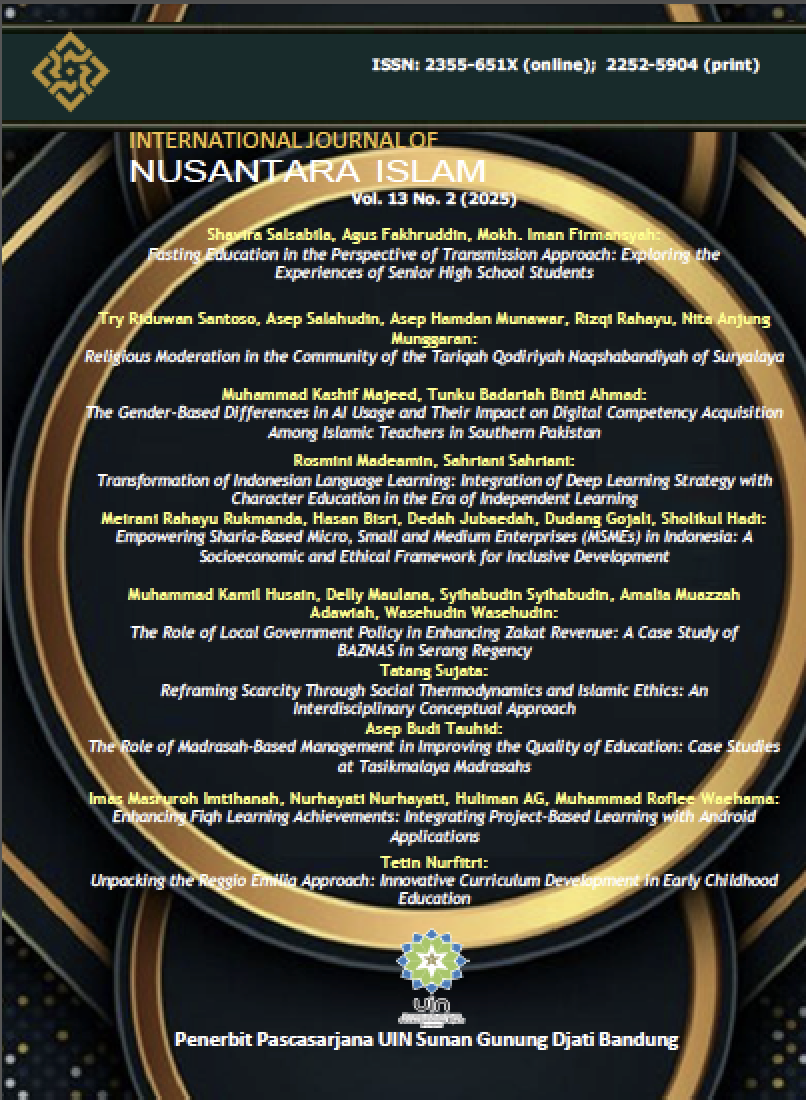
the Gender-based differences in AI usage and their impact on digital competency acquisition among Islamic teachers in Southern Pakistan english
Article Sidebar
Main Article Content
Abstract
The study looks at how men and women in Southern Pakistan teaching Islamic subjects use AI tools and what impact this has on their digital competencies. Now that AI is used in schools, knowing how gender affects people’s ability to use these tools is necessary for ensuring that digital transformation in religious education is inclusive. There are three main objectives that drove the study. There are three main objectives: to study how AI is influenced by gender among Islamic teachers; to evaluate whether men or women are more skilled in digital use in Islamic education; and to find out whether digital talent rises as a result of using AI in teaching contexts. A survey device, used in conjunction with a quantitative research method, was deployed to collect information from 150 male and 150 female Islamic teachers. Gender differences were studied using descriptive statistics and independent sample t-tests, while multiple regression was carried out to determine if AI use played a role in increasing digital skills. The survey results indicated that males use AI more than females and that the reverse is true for digital tasks. In addition, using AI tools was shown to strongly influence digital competency development in both populations, indicating that this usage can help with greater improvements in digital skills. These results suggest ways in which policymakers, curriculum designers, and educational leaders can enhance digital literacy in religious education, especially among people from disadvantaged areas.
Article Details
The Authors submitting a manuscript do so on the understanding that if accepted for publication, copyright of the article shall be assigned to International Journal of Nusantara Islam, Sunan Gunung Djati State Islamic University.
The copyright encompasses exclusive rights to reproduce and disseminate articles in all forms and media, including reprints, photographs, microfilm, and similar reproductions, as well as translations. Some or all of the contents of this journal can be stored in databases and transmitted in any form and media without the need for written permission from the International Journal of Nusantara Islam, Sunan Gunung Djati State Islamic University.
The Editors and the Advisory International Editorial Board make every effort to ensure that no wrong or misleading data, opinions or statements be published in the journal. In any way, the contents of the articles and advertisements published in the International Journal of Nusantara Islam (IJNI) are sole and exclusive responsibility of their respective authors and advertisers.
References
Ala-Mutka, K. (2011). Mapping Digital Competence: Towards a Conceptual Understanding. https://doi.org/10.2791/82116
Alawi, H. A. I. (2024). Management of Islamic Education During Covid 19. Journal of Education and Technology Development, 2(1), 27–35.
Ali, W., Ullah, H., & Ahmad, I. (2020). Digital Inclusion in Education: A Case Study of Public-Sector Madrassas in Pakistan. Education and Information Technologies, 25(4), 3293–3307. https://doi.org/10.1007/s10639-020-10102-1
Creswell, J. W., & Creswell, J. D. (2018). Research Design: Qualitative, Quantitative, and Mixed Methods Approaches. Sage Publications.
Farooq, M. S., & Tariq, S. (2021). Integration of digital technologies in Islamic schools: Challenges and prospects. International Journal of Educational Development, 86, 102481. https://doi.org/10.1016/j.ijedudev.2021.102481
Ghavifekr, S., & Rosdy, W. A. W. (2015). Teaching and Learning with Technology: Effectiveness of ICT Integration in Schools. International Journal of Research in Education and Science (IJRES), 1(2), 175–191. https://doi.org/10.21890/ijres.23596
Haleem, A., Javaid, M., Qadri, M. A., & Suman, R. (2022). Understanding the role of digital technologies in education: A review. Sustainable Operations and Computers, 3, 275–285.
Hanif, A., Syarifudin, E., & Muhtarom, A. (2025). Integration of Religious Moderation in Islamic Education: Challenges and Opportunities in The Digital Era. Edukasi Islami: Jurnal Pendidikan Islam, 14(01), 49–66.
Holmes, W., Bialik, M., & Fadel, C. (2022). Artificial Intelligence in Education: Promises and Implications for Teaching and Learning. Center for Curriculum Redesign.
Ilomäki, L., Paavola, S., Lakkala, M., & Kantosalo, A. (2016). Digital Competence – An Emergent Boundary Concept for Policy and Educational Research. Education and Information Technologies, 21(3), 655–679. https://doi.org/10.1007/s10639-014-9346-4
Redecker, C. (2017). European framework for the digital competence of educators: DigCompEdu. Publications Office of the European Union.
Redecker, C., & Punie, Y. (2017). Digital competence of educators. Publications Office of the European Union.
Shah, R. K., & Khalid, R. (2021). Gender and Digital Technology in Education: Barriers for Female Teachers in Rural Pakistan. Journal of Educational Technology & Society, 24(1), 80–91.
Silverman, D. (2015). Interpreting qualitative data (5th edition). Sage Publications. https://research.gold.ac.uk/id/eprint/13619
Sugiyono. (2017). Metode penelitian Kuantitatif dan Kualitatif. Alfabeta.
UNESCO. (2020). Closing Gender Gaps in Digital Skills Through Education. United Nations Educational, Scientific and Cultural Organization.
Widarjono, A. (2010). Ekonometrika: Teori dan Aplikasi Untuk Ekonomi dan Bisnis. Ekonisia.
Zawacki-Richter, O., Marín, V. I., Bond, M., Gouverneur, F., M., & Taylor, S. (2019). Systematic Review of Research on Artificial Intelligence Applications in Higher Education–Where Are the Educators? International Journal of Educational Technology in Higher Education, 16(1), 1–27 ,.