
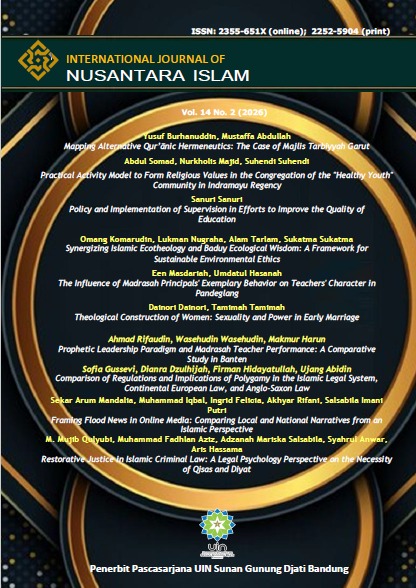
In relation to the existing situation, we, the editorial board of International Journal of Nusantara Islam, are aware of the importance of Islamic sciences in order to perceive and criticize what is happening and changing among the communities. Then, we make every possible effort to extrapolate any Islamic theory and concept concerning fiqh (Islamic jurisprudence), tarbiyah (education), kalam (Islamic theology), philosophy and the like with the intention of following changes that happens rapidly.

Published: 2025-06-30

Fasting education in the perspective of transmission approach: Exploring the experiences of senior high school students

191-204

Religious moderation in the community of the Tariqah Qodiriyah Naqshabandiyah of Suryalaya

205-216

the Gender-based differences in AI usage and their impact on digital competency acquisition among Islamic teachers in Southern Pakistan

english

217-228

Transformation of Indonesian language learning: Integration of deep learning strategy with character education in the era of independent learning

229-244

Empowering sharia-based Micro, Small and Medium Enterprises (MSMEs) in Indonesia: A Socioeconomic and ethical framework for inclusive development

245-256

The role of local government policy in enhancing zakat revenue: A case study of BAZNAS in Serang Regency

257-276

Enhancing fiqh learning achievements: Integrating Project-Based Learning with Android applications

313-324

Unpacking the Reggio Emilia approach: Innovative curriculum development in early childhood education

325-338

Charismatic leadership: Contribution of Catholic theology of priesthood to leadership model for religious moderation in Indonesia

339-350

Framing Banten's north coastal sea fence as eco-theology and social movement

351-364

Western values of sexual consent in Muhammad Shahrur’s theory of milk al-yamin

365-380

The traditional economic systems based on local wisdom of indigenous communities in Indonesia

381-396

Tawḥīdī Epistemology: Uniting Rationality, Empiricism, and Transcendence within the Framework of Islamic Science

397-412