About The Journal
Archives
-
Politicon : Jurnal Ilmu Politik
Vol. 8 No. 1 (2026)Politicon is an open-access, peer-reviewed journal specializing in Political Science. It is published by the Department of Political Science, Faculty of Social and Political Sciences (FISIP) at UIN Sunan Gunung Djati Bandung. The journal aims to disseminate original research and scholarly articles on contemporary political issues, covering topics such as the development of politics and democracy, political parties and elections, defense and security politics, politics and religion, media and digital democracy, regional and comparative politics, environmental politics, as well as gender and politics. Politicon has been nationally accredited by the Ministry of Research, Technology, and Higher Education of the Republic of Indonesia (Ristekdikti) with accreditation number 225/E/KPT/2022, earning a Sinta 2 ranking as of December 7, 2022. The journal is published twice a year, with English as the primary language for both articles and its website. Politicon is also indexed by prominent international databases such as DOAJ and Copernicus. The journal carries an online ISSN of 2685-6670 and is registered with DOI: 10.15575/politicon.
Politicon: Jurnal Ilmu Politik proudly presents Volume 8, Number 1 (2026), featuring seven scholarly articles that advance critical debates in political science across the fields of international relations, security studies, democratic governance, political communication, gender politics, indigenous politics, and environmental political economy. Collectively, these contributions explore how power is exercised, contested, and legitimized within contemporary political systems, offering important insights for understanding political dynamics at both global and local levels.
The issue opens with Nathan Decety’s examination of political-military corruption and military performance in extra-state wars. By linking corruption, security governance, state capacity, and civil-military relations, the study demonstrates how governance failures undermine the ability of states to transform material resources into effective military outcomes. This contribution enriches the growing literature on security governance and provides a valuable framework for understanding the political foundations of military effectiveness.
Expanding the international dimension of this volume, Oscar Rodrigo Victoria Velasco analyzes Mexico’s engagement in the MIKTA coalition as a strategy for enhancing influence within unequal global governance structures. Through the lens of middle-power theory and role theory, the article demonstrates how diplomatic influence can be generated through coalition-building, institutional engagement, and strategic role performance rather than solely through material capabilities. The study offers important insights into the evolving role of middle powers in an increasingly complex international order.
Questions of democratic legitimacy and political competition are further explored in Shogar Bashar Deifa Khateir’s analysis of Tanzania’s dominant-party system. The article reveals how political stability and electoral legitimacy may coexist in tension, challenging assumptions that peaceful succession and regular elections necessarily indicate democratic consolidation. By distinguishing between stability, competition, and legitimacy, the study contributes to broader comparative debates on electoral authoritarianism and dominant-party politics.
The issue also pays particular attention to gender and political representation. In their study of women politicians in Banten, Yeby Ma’asan Mayrudin, M. Dian Hikmawan, Moh. Rizky Godjali, and Herlina introduce the concept of political expressionism to examine how women navigate patriarchal structures within political parties and legislative institutions. Their findings reveal diverse strategies of resistance, conformity, existence, and subservience through which women negotiate symbolic violence, discrimination, and double burdens. By integrating gender studies with the concept of expressionism, the article offers an innovative perspective on political agency and representation.
Democratic practice at the local level is examined through Rudiana Rudiana and Muhammad Younus’s study of deliberative democracy within the Kasepuhan Gelar Alam indigenous community. Challenging conventional assumptions that deliberation must follow liberal-democratic models, the article demonstrates how participatory decision-making can coexist with customary authority and hereditary leadership. The study contributes to a growing body of scholarship that recognizes indigenous governance systems as important sites of democratic innovation and political legitimacy.
The quality of democratic participation is further investigated by Ni Wayan Widhiasthini, Made Srinitha Millinia Utami, Nyoman Sri Subawa, and Nyoman Sridiva Dian Prabarini through their analysis of political communication and the public’s right to information in the 2024 Bali Regional Elections. Their findings highlight persistent gaps between formal transparency and substantive public access to electoral information, emphasizing the need for more participatory, educational, and deliberative forms of political communication. The study contributes significantly to discussions on information politics, electoral accountability, and democratic governance in the digital era.
The volume concludes with Gede Indra Pramana, Kadek Dwita Apriani, and I Ketut Putra Erawan’s investigation of coastal governance and Special Economic Zone development in Bali. By examining how state-led development projects reshape access to coastal commons, the article reveals the political and economic mechanisms through which local communities become marginalized within development processes. The study advances environmental political science by conceptualizing Special Economic Zones as contested political spaces where struggles over participation, rights, and resource access are continuously negotiated.
Taken together, the articles in this issue reflect the breadth and diversity of contemporary political science. They highlight the importance of examining governance not merely as a technical process but as a political arena shaped by competing interests, institutional arrangements, cultural contexts, and power relations. From global coalition diplomacy and military governance to indigenous deliberation, gendered political expression, electoral legitimacy, public communication, and environmental justice, this volume demonstrates the continued relevance of political science in understanding the complex challenges facing contemporary societies.
For Indonesia in particular, these contributions offer valuable perspectives on democratic consolidation, inclusive governance, political representation, public accountability, and sustainable development. At the same time, by incorporating comparative and international cases, this issue situates Indonesian political scholarship within broader global conversations, reinforcing Politicon’s commitment to advancing rigorous, critical, and internationally engaged political science research.
-
Politicon : Jurnal Ilmu Politik
Vol. 7 No. 2 (2025)Politicon is an open-access, peer-reviewed journal specializing in Political Science. It is published by the Department of Political Science, Faculty of Social and Political Sciences (FISIP) at UIN Sunan Gunung Djati Bandung. The journal aims to disseminate original research and scholarly articles on contemporary political issues, covering topics such as the development of politics and democracy, political parties and elections, defense and security politics, politics and religion, media and digital democracy, regional and comparative politics, environmental politics, as well as gender and politics. Politicon has been nationally accredited by the Ministry of Research, Technology, and Higher Education of the Republic of Indonesia (Ristekdikti) with accreditation number 225/E/KPT/2022, earning a Sinta 2 ranking as of December 7, 2022. The journal is published twice a year, with English as the primary language for both articles and its website. Politicon is also indexed by prominent international databases such as DOAJ and Copernicus. The journal carries an online ISSN of 2685-6670 and is registered with DOI: 10.15575/politicon.
The latest issue of Politicon: Jurnal Ilmu Politik (Volume 7, Number 2, 2025) brings together seven thought-provoking studies that illuminate the dynamic intersections of governance, representation, and political identity in Indonesia and beyond. Together, these contributions reaffirm Politicon’s commitment to fostering rigorous, interdisciplinary scholarship that bridges theory and empirical inquiry across diverse political settings.
The opening article, “Women Candidates, Social Capital, and Family Networks in the 2024 Indonesian Local Election,” offers a refreshing look at women’s agency in politics. Moving beyond the elite-centric lens, it demonstrates how non-elite female candidates mobilize social capital, community trust, and kinship networks to overcome structural barriers. This insight enriches gender and representation studies in Indonesia’s still-patriarchal electoral culture.
The second contribution, “Public Governance Orchestration and Politics Agenda in Implementing Indonesia’s Nutritious Meal Program,” situates governance reform within the context of policy innovation. Through a meticulous cost–benefit analysis and qualitative governance mapping, the study reveals how fragmented coordination and information asymmetries hinder a potentially transformative national program. It advances the discourse on evidence-based policymaking and public sector coordination in post-populist democracies.
The third article, “Voter Turnout Among Compulsory Voting Countries: Evidence from 1973 to 2018,” broadens Politicon’s comparative horizon by re-examining the efficacy of compulsory voting across 34 countries. By employing panel data and robust quantitative models, it reveals that the institutional enforcement of compulsory voting yields variable outcomes across election types, adding nuance to longstanding debates on political participation and democratic legitimacy.
Two subsequent articles turn attention back to Indonesia’s political landscape. “Dynastic Politics and Party Persistence: Mechanisms of Elite Power Reproduction in Indonesian Democracy 2024 Elections” dissects how dynastic networks and cartelized parties perpetuate elite domination. It warns of a democracy reduced to procedure, not substance—echoing global concerns about the resilience of oligarchic regimes in electoral systems. Complementing this, “Cultural Legitimacy and Political Identity: Traditional Titles in Electoral Politics, Lampung, Indonesia” investigates how local elites instrumentalize cultural symbols and customary law to extend their political reach, urging scholars to reflect on the fine line between cultural authenticity and pragmatic politicization.
The sixth paper, “Pilkada and Identity Politics in Multicultural Cities: An Analysis of the 2024 Singkawang’s Local Politics Contestation,” examines how ethnic and religious identities shape urban electoral dynamics. By using Singkawang as a multicultural microcosm, the study offers critical insight into Indonesia’s struggle to balance inclusivity and political competition amid growing identity polarization.
Finally, “Modalities of the First Female Regional Head in North Maluku in the 2020 Sula Islands Regional Election” revisits women’s leadership trajectories, showing how social modalities and dynastic linkages intersect to shape local power structures. The case of Fifian Adeningsi Mus underlines both the opportunities and limitations of dynastic access in promoting gender equality in subnational politics.
Collectively, these seven articles deepen our understanding of representation, governance innovation, and the evolving nature of Indonesian democracy. They underscore the importance of contextual, empirically grounded political research in navigating Indonesia’s democratic transformations. As Politicon enters its seventh volume, it continues to serve as a vital platform for re-imagining political science as an inclusive, critical, and future-oriented discipline in Southeast Asia.
-
Politicon : Jurnal Ilmu Politik
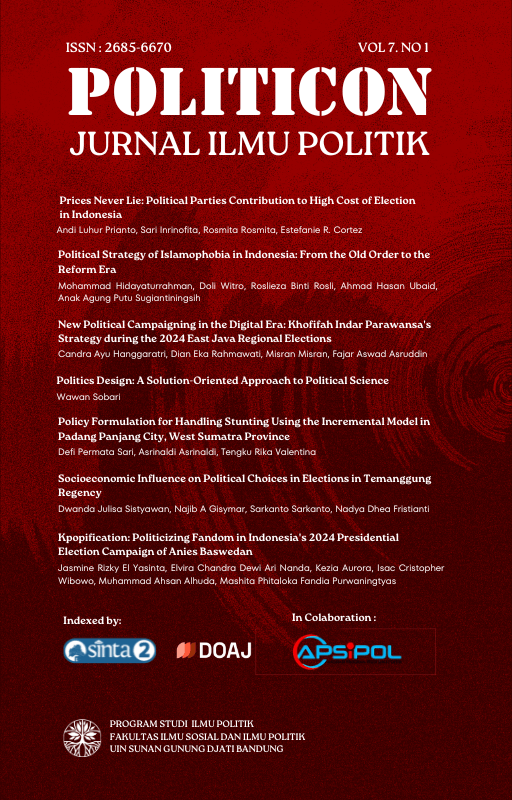
Vol. 7 No. 1 (2025)Politicon is an open-access, peer-reviewed journal specializing in Political Science. It is published by the Department of Political Science, Faculty of Social and Political Sciences (FISIP) at UIN Sunan Gunung Djati Bandung. The journal aims to disseminate original research and scholarly articles on contemporary political issues, covering topics such as the development of politics and democracy, political parties and elections, defense and security politics, politics and religion, media and digital democracy, regional and comparative politics, environmental politics, as well as gender and politics. Politicon has been nationally accredited by the Ministry of Research, Technology, and Higher Education of the Republic of Indonesia (Ristekdikti) with accreditation number 225/E/KPT/2022, earning a Sinta 2 ranking as of December 7, 2022. The journal is published twice a year, with English as the primary language for both articles and its website. Politicon is also indexed by prominent international databases such as DOAJ and Copernicus. The journal carries an online ISSN of 2685-6670 and is registered with DOI: 10.15575/politicon.
-

Politicon : Jurnal Ilmu Politik
Vol. 6 No. 2 (2024)Politicon is an open-access, peer-reviewed journal specializing in Political Science. It is published by the Department of Political Science, Faculty of Social and Political Sciences (FISIP) at UIN Sunan Gunung Djati Bandung. The journal aims to disseminate original research and scholarly articles on contemporary political issues, covering topics such as the development of politics and democracy, political parties and elections, defense and security politics, politics and religion, media and digital democracy, regional and comparative politics, environmental politics, as well as gender and politics. Politicon has been nationally accredited by the Ministry of Research, Technology, and Higher Education of the Republic of Indonesia (Ristekdikti) with accreditation number 225/E/KPT/2022, earning a Sinta 2 ranking as of December 7, 2022. The journal is published twice a year, with English as the primary language for both articles and its website. Politicon is also indexed by prominent international databases such as DOAJ and Copernicus. The journal carries an online ISSN of 2685-6670 and is registered with DOI: 10.15575/politicon.
-
Vol 6, No 1 (2024): Politicon : Jurnal Ilmu Politik
Vol. 6 No. 1 (2024) -
Politicon : Jurnal Ilmu Politik
Vol. 5 No. 2 (2023) -
Politicon : Jurnal Ilmu Politik
Vol. 5 No. 1 (2023) -

Politicon : Jurnal Ilmu Politik
Vol. 4 No. 1 (2022)The Politicon Journal is an open-access journal that discusses political issues in Indonesia. in this issue, Politicon journal discusses elections. This edition looks at the electoral process in regions in Indonesia, supported by several articles from the movement of an organization in dealing with elections and how a person with a disability can participate in elections. -

Politicon : Jurnal Ilmu Politik
Vol. 1 No. 1 (2019)Our hope by publishing this journal can help readers to provide insight, ideas, references, in the development of innovations in the field of political science. This journal review contains 6 articles.


.jpg)