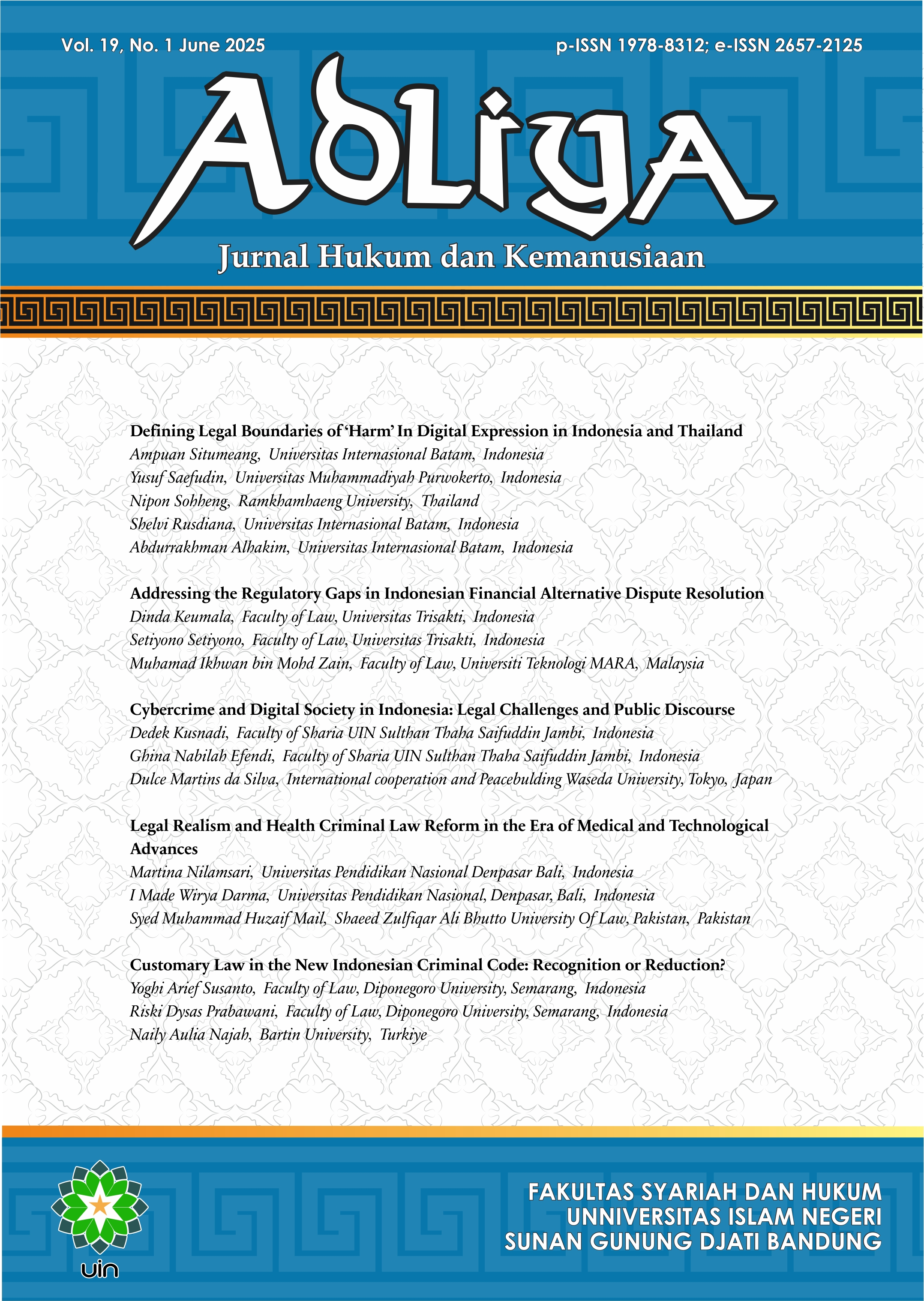
Cybercrime and Digital Society in Indonesia: Legal Challenges and Public Discourse
DOI:
https://doi.org/10.15575/adliya.v19i1.40404Keywords:
Cybercrime, Law, Society, Digital Era.Abstract
Cybercrime is a communication technology offence that disrupts the public through the use of computers and the internet. It occurs due to the negative impact of technology affecting human life. Regarding legal protection, the government is obligated to protect every citizen from harmful actions, including cybercrime, which can cause both material and non-material harm to its users. Therefore, this study aimed to analyse cybercrime, which had become a global threat to both national and international security. Although cyber-related analysis had been widely conducted, studies focusing on the content analysis of cybercrime within the context of digital-era law remained limited. This study specifically examined the content of cybercrime discourse in Indonesia’s digital society. A descriptive qualitative method was adopted with data sourced from big data on social media, official reports, and journalistic materials related to the topic. Data analysis was carried out using the NVivo 12 Plus software and word processing applications for qualitative analysis. The results showed that cybercrime content on social media, particularly Twitter, was predominantly harmful, with 77.62% classified as moderately negative and 22.38% as very negative. The consistent use of the hashtag showed the widespread nature of cybercrime. Furthermore, the digital legal framework in Indonesia was found to be insufficient in addressing the complexities of cybercrime, rendering law enforcement weak and hampered by various structural and technical challenges.
References
Adi Ahmad, Riyan Maulana, and Muhammad Yassir. “Cybersecurity Challenges In The Era Of Digital Transformation A Comprehensive Analysis Of Information Systems.” Journal Informatic, Education and Management (JIEM) 6, no. 1 (2024): 7–11. https://doi.org/10.61992/jiem.v6i1.57.
APJII. “Survei Pengguna Internet Indonesia.” APJII, 2020.
Bahri, Saiful. “Communication Strategies in Building Public Trust Based on Cyber Public Relations.” Proceeding of International Conference on Education, Society and Humanity 2, no. 1 (2024): 535–46. https://ejournal.unuja.ac.id/index.php/icesh/article/view/7918.
Bakhtiar, Handar Subhandi, Amir Ilyas, Abdul Kholiq, and Handina Sulastrina Bakhtiar. “The Utilisation of Scientific Crime Investigation Methods and Forensic Evidence in the Criminal Investigation Process in Indonesia.” Egyptian Journal of Forensic Sciences 15, no. 1 (May 29, 2025): 39. https://doi.org/10.1186/s41935-025-00456-y.
Bandler, John, and Antonia Merzon. Cybercrime Investigations: A Comprehensive Resource for Everyone. CRC Press, 2020. https://doi.org/https://doi.org/10.1201/9781003033523.
Bunga, Dewi. “Legal Response to Cybercrime in Global and National Dimensions.” PADJADJARAN Jurnal Ilmu Hukum (Journal of Law) 06, no. 01 (April 2019): 69–89. https://doi.org/10.22304/pjih.v6n1.a4.
CNBC. “Tersangka Kasus Judi Online Kelas Atas,” 2022.
Ellyona Putri, Kadek Devina, Mariano Wawan Latbin, and Gerald Aldytia Bunga. “Phenomenom Cyber Crime in Indonesia in the Digitalization Era.” Journal of Digital Law and Policy 3, no. 2 (2024): 99–109. https://doi.org/10.58982/jdlp.v3i2.549.
Fatmawati. “Kajian KritisTerhadap Media Sosial Sebagai ‘Tuhan Kedua’ Bagi Para Netizen.” MAHARSI 1, no. 01 (February 28, 2019): 89–98. https://doi.org/10.33503/maharsi.v1i01.358.
Gay Querol Leiva, Llysselie. “Impact of Information and Communication Technologies on Everyday Life.” Management (Montevideo) 3 (February 8, 2025): 130. https://doi.org/10.62486/agma2025130.
Hai-Jew, Shalin. “NVivo 12 Plus’s New Qualitative Cross-Tab Analysis Function,.” C2C Digital Magazine 1, no. 10 (2020): Article 15. https://scholarspace.jccc.edu/c2c_online/vol1/iss10/15.
Hakim, Lukmanul, Tien F. Kusumasari, and Muharman Lubis. “Text Mining of UU-ITE Implementation in Indonesia.” Journal of Physics: Conference Series 1007, no. 1 (2018). https://doi.org/10.1088/1742-6596/1007/1/012038.
Hamilton, Alison B., and Erin P. Finley. “Qualitative Methods in Implementation Research: An Introduction.” Psychiatry Research 280 (2019): 112516. https://doi.org/10.1016/j.psychres.2019.112516.
Iman, Nur, Aris Susanto, and Rahmat Inggi. “Analysis of the Development of Digital Forensics in Cybercrime Investigations in Indonesia (Systematic Review).” Jurnal Telekomunikasi Dan Komputer 9, no. 3 (2020): 186. https://doi.org/10.22441/incomtech.v9i3.7210.
Irfan, M, M A Ramdhani, W Darmalaksana, A Wahana, and R G Utomo. “Analyzes of Cybercrime Expansion in Indonesia and Preventive Actions.” IOP Conference Series: Materials Science and Engineering 434 (December 3, 2018): 012257. https://doi.org/10.1088/1757-899X/434/1/012257.
Jackson, Kristi, and Patricia Bazeley. Qualitative Data Analysis with NVivo. 3rd ed. SAGE Publications, 2019.
Laksana, Andri Winjaya. “Pemidanaan Cybercrime Dalam Perspektif Hukum Pidana Positif.” Jurnal Hukum 35, no. 1 (June 2, 2019): 52. https://doi.org/10.26532/jh.v35i1.11044.
Lezzi, Marianna, Mariangela Lazoi, and Angelo Corallo. “Cybersecurity for Industry 4.0 in the Current Literature: A Reference Framework.” Computers in Industry 103 (December 2018): 97–110. https://doi.org/10.1016/j.compind.2018.09.004.
Mursalin, Ayub. “Indonesian Blasphemy Laws and the Gradual Shrinking of the Domain of Religious Freedom since 1965.” Archipel 98 (2019): 151–76. https://doi.org/10.4000/archipel.1349.
Musofiana, Ida. “Legal Protection For Victims Of Cybercrime In The Digital Era In Strengthening Cyber Democracy In Indonesia Post 2019 General Election.” In The 2nd International Conference And Call Paper 1, no. 1 (2021): 84–90.
Nekaj, Epi Ludvik. “The Crowd Economy.” In Digital Marketing and Consumer Engagement, 1513–31. IGI Global, n.d. https://doi.org/10.4018/978-1-5225-5187-4.ch076.
O’Neill, Maureen, Sarah Booth, and Janeen Lamb. “Using NVivoTM for Literature Reviews: The Eight Step Pedagogy (N7+1).” The Qualitative Report 23, no. 13 (March 6, 2018): 21–39. https://doi.org/10.46743/2160-3715/2018.3030.
Olubiyi, Omotayo, Garrett Smiley, Henry Luckel, and Ralph Melaragno. “A Qualitative Case Study of Employee Turnover in Retail Business.” Heliyon 5, no. 6 (2019): e01796. https://doi.org/10.1016/j.heliyon.2019.e01796.
Raihan Khoerunisa, Inkcrah Prudensia, Rahyadu Maulana Husada. “Cybersex Dan Cyberpornography Studi Kasus Putusan PN Bekasi Nomor 76/Pid.Sus/2021/PN.Bks Raihan.” De Juncto Delicti 2, no. 41 (2022): 14–22.
Seinecke, Ralf. “Der Rechtsbegriff Des Lebenden Rechts.” Zeitschrift Für Rechtssoziologie 44, no. 1 (May 7, 2024): 241–76. https://doi.org/10.1515/zfrs-2024-2003.
Selamat, Siti Rahayu, Robiah Yusof, Shahrin Sahib, Nor Hafeizah Hassan, Mohd Faizal Abdollah, and Zaheera Zainal Abidin. “Traceability in Digital Forensic Investigation Process.” In 2011 IEEE Conference on Open Systems, 101–6. IEEE, 2011. https://doi.org/10.1109/ICOS.2011.6079259.
Siregar, Gomgom TP, and Sarman Sinaga. “The Law Globalization in Cybercrime Prevention.” International Journal of Law Reconstruction 5, no. 2 (2021): 211. https://doi.org/10.26532/ijlr.v5i2.17514.
Sitorus, Herowati. “Pemahaman Generasi Millenial Terhadap Hak Asasi Manusia: Studi Hak Asasi Manusia Menurut Alkitab.” Jurnal Christian Humaniora 4, no. 1 (2020): 93–103. https://doi.org/10.46965/jch.v4i1.153.
Srinivas, Jangirala, Ashok Kumar Das, and Neeraj Kumar. “Government Regulations in Cyber Security: Framework, Standards and Recommendations.” Future Generation Computer Systems 92, no. 1 (2019): 178–88. https://doi.org/10.1016/j.future.2018.09.063.
Sukayasa, I Nyoman, and Wayan Suryathi. “Law Implementation of Cybercrime in Indonesia.” SOSHUM : Jurnal Sosial Dan Humaniora 8, no. 2 (2018): 123–30. https://doi.org/10.31940/soshum.v8i2.985.
Sutijono, and Dimas Ardika Miftah Farid. “Cyber Counseling Di Era Generasi Milenial.” Sosio Humanika 11, no. 1 (2018): 3–4.
Tarigan, Vita Cita Emia, Lidya Rahmadani Hasibuan, Rahima br Purba, Irawan, Pipit Buana Sari, Yossie Rossanty, and Muhammad Dharma Tuah Putra Nasution. “Cybercrime Case on Social Media in Indonesia.” International Journal of Civil Engineering and Technology 9, no. 7 (2018): 783–88. https://iaeme.com/Home/article_id/IJCIET_09_07_081.
Technologies, Akamai. “Akamai Research: Web Attacks Up 33%, APIs Emerge as Primary Targets.” Cambridge, 2025. https://www.akamai.com/newsroom/press-release/akamai-research-web-attacks-up-33-apis-emerge-as-primary-targets#:~:text=The majority of AI-powered,the second most attacked sector).
Tolkah, Tolkah. “Customary Law Existency in The Modernization of Criminal Law in Indonesia.” Varia Justicia 17, no. 1 (May 7, 2021): 72–89. https://doi.org/10.31603/variajusticia.v17i1.5024.
Umanailo, M. Chairul Basrun, Imam Fachruddin, Deviana Mayasari, Rudy Kurniawan, Dewien Nabielah Agustin, Rini Ganefwati, Pardamean Daulay, et al. “Cybercrime Case as Impact Development of Communication Technology That Troubling Society.” International Journal of Scientific and Technology Research 8, no. 9 (2019): 1224–28. https://www.ijstr.org/final-print/sep2019/Cybercrime-Case-As-Impact-Development-Of-Communication-Technology-That-Troubling-Society.pdf.
Xie, Jiushu, Yun Lian, Zixin Liu, Wenli He, and Zihan Yin. “When Humanity Fades: The Chain Roles of Self-Dehumanization and Empathy in Cyberostracism-Flaming Link.” Current Psychology 44, no. 11 (June 5, 2025): 10336–47. https://doi.org/10.1007/s12144-025-07890-0.
Yuen, Kai Wan, Edward Park, Melda Hazrina, Muh Taufik, Edgardo Latrubesse, and Janice Ser Huay Lee. “A Comprehensive Database of Indonesian Dams and Its Spatial Distribution.” A Functional Biology of Sticklebacks 15, no. 925 (2023): 4–19. https://doi.org/10.2307/jj.8306147.7.
Downloads
Published
How to Cite
Issue
Section
Citation Check
License
Copyright (c) 2025 Dedek Kusnadi, Ghina Nabilah Efendi, Ducle Martins da Silva

This work is licensed under a Creative Commons Attribution-ShareAlike 4.0 International License.
Authors who publish in ADLIYA: Jurnal Hukum dan Kemanusiaan agree to the following terms:
- Authors retain copyright and grant the journal right of first publication with the work simultaneously licensed under a Attribution-ShareAlike 4.0 International (CC BY-SA 4.0) License that allows others to share the work with an acknowledgment of the work's authorship and initial publication in this journal.
- Authors are able to enter into separate, additional contractual arrangements for the non-exclusive distribution of the journal's published version of the work (e.g., post it to an institutional repository or publish it in a book), with an acknowledgment of its initial publication in this journal.
- Authors are permitted and encouraged to post their work online (e.g., in institutional repositories or on their website) prior to and during the submission process, as it can lead to productive exchanges, as well as earlier and greater citation of published work (See The Effect of Open Access).