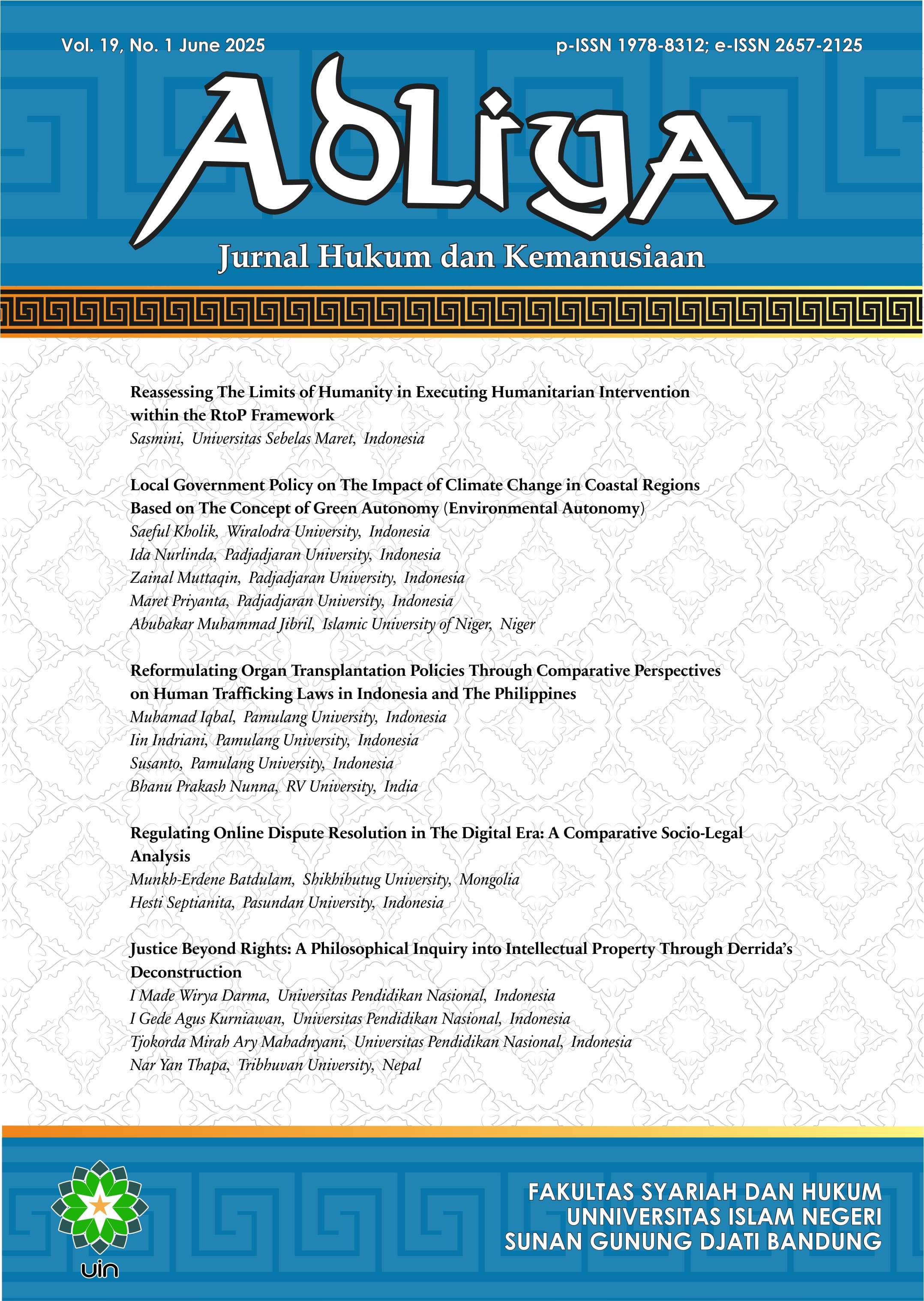
Reassessing The Limits of Humanity in Executing Humanitarian Intervention within the RtoP Framework
DOI:
https://doi.org/10.15575/adliya.v19i2.40483Keywords:
humanitarian intervention, humanity, RtoPAbstract
Humanitarian Intervention (HI) is the third pillar of the Responsibility to Protect (RtoP) framework, which frequently invokes the concept of humanity as the fundamental source of legitimacy. However, the absence of clear criteria defining the limit of humanity has led to a double standard in the implementation. Therefore, this study aims to examine two main legal issues, namely the broader legal implications of the principle of humanity in the international legal system and the standard threshold to legitimize the intervention within the RtoP framework. A doctrinal legal method was used with regulatory, conceptual, and case approaches. In addition, interpretative methods were used for legal argumentation. The results showed that the concept of humanity has historically played a crucial role in shaping international law. The evolution of international humanitarian law (IHL) and international human rights law, particularly within the context of international criminal law, is closely related to the concept of humanity. According to this concept, intervention may be justified to prevent and stop humanitarian crises within a specific state to protect the victims. However, only actions that exceed the limits of humanity, including extraordinary acts of cruelty and crimes under universal jurisdiction, can serve as the basis for HI legitimacy. Moreover, the threshold for invoking HI must also include a determination that the state is unwilling or unable to prevent or stop the ongoing atrocities.
References
Annan, Kofi A. “We the Peoples: The Role of the United Nations in the 21st Century.” New York, 2000.
Badescu, Cristina G. “Authorizing Humanitarian Intervention: Hard Choices in Saving Strangers.” Canadian Journal of Political Science 40, no. 1 (March 19, 2007): 51–78. https://doi.org/10.1017/S0008423907070084.
Bassiouni, M. Cherif. Crimes against Humanity: Historical Evolution and Contemporary Application. New York: Cambridge University Press, 2011. https://doi.org/10.1017/CBO9780511976537.
Bruch, Elizabeth M. Human Rights and Humanitarian Intervention Law and Practice in the Field. New York: Routledge, 2018.
Cançado Trindade, Antônio Augusto. International Law for Humankind. Leiden: Brill | Nijhoff, 2010. https://doi.org/10.1163/ej.9789004184282.i-728.
Canefe, Nergis. Crimes Against Humanity: The Limits of Universal Jurisdiction in the Global South. Cardiff: University of Wales Press, 2021.
Coupland, Robin. “Humanity: What Is It and How Does It Influence International Law?” International Review of the Red Cross 83, no. 844 (December 27, 2001): 969–89. https://doi.org/10.1017/S156077550018349X.
Cryer, Robert, Håkan Friman, Darryl Robinson, and Elizabeth Wilmshurst. An Introduction to International Criminal Law and Procedure. Cambridge: Cambridge University Press, 2007. https://doi.org/10.1017/CBO9780511801006.
Deitelhoff, Nicole. “Is the R2P Failing? The Controversy about Norm Justification and Norm Application of the RtoP.” Global RtoP 11, no. 2 (April 1, 2019): 149–71. https://doi.org/10.1163/1875984X-01102003.
Frederking, Brian. The United States and the Security Council: Collective Security since the Cold War. 1st ed. London: Routledge, 2007.
Gluchman, Vasil. “Humanity in Context of Professional Life.” European Scientific Journal 10, no. 10 (2014).
Harhoff, Frederick. “Unauthorised Humanitarian Intervention s – Armed Violence in the Name of Humanity?” Nordic Journal of International Law 70, no. 1–2 (2001): 65–119. https://doi.org/10.1163/15718100120296520.
Hingst, Zachary D.A. “Libya and the RtoP: Building Block or Roadblock.” Transnational Law and Contemporary Problems Spring (2013).
Hobson, Christopher. “The Moral Untouchability of the RtoP.” Journal of Intervention and Statebuilding 16, no. 3 (May 27, 2022): 368–85. https://doi.org/10.1080/17502977.2021.2015146.
Ilias Bantekas, Susan Nash. International Criminal Law. 2nd ed. London: Cavendish Publishing Limited, 2003.
International Committee of the Red Cross. “The Fundamental Principles of the Red Cross: Commentary,” January 1, 1979. https://www.icrc.org/en/doc/resources/documents/misc/fundamental-principles-commentary-010179.htm.
International Criminal Tribunal for Rwanda. “Prosecutor v. Jean Kambanda (Case No. ICTR 97-23-S).” Judgement and Sentence. Arusha, September 4, 1998.
———. “Prosecutor v. Serushago (Case No. ICTR-98-39-S).” Arusha, February 5, 1999.
Janzekovic, John. The Use of Force in Humanitarian Intervention: Morality and Practicalities. 1st ed. New York: The Use of Force in Humanitarian Intervention Morality and Practicalities, 2006.
Kolb, Robert, and Richard Hyde. An Introduction to the International Law of Armed Conflicts. Oxford: Hart Publishing, 2008.
Korsgaard, Christine M. “Kant’s Formula of Humanity.” In Creating the Kingdom of Ends, 106–32. Cambridge: Cambridge University Press, 1996. https://doi.org/10.1017/CBO9781139174503.005.
Labonte, Melissa. Human Rights and Humanitarian Norms, Strategic Framing, and Intervention: Lessons for the RtoP. London: Routledge, 2013.
Meron, Theodor. “The Martens Clause, Principles of Humanity, and Dictates of Public Conscience.” American Journal of International Law 94, no. 1 (January 27, 2000): 78–89. https://doi.org/10.2307/2555232.
Paddeu, Federica I. “Humatarian Intervention and the Law of State Responsibility.” European Journal of International Law 32, no. 2 (August 19, 2021): 649–78. https://doi.org/10.1093/ejil/chab041.
Pattison, James. Humanitarian Intervention and the RtoP. Oxford: Oxford University Press, 2010. https://doi.org/10.1093/acprof:oso/9780199561049.001.0001.
Preparatory Commission for the International Criminal Court. “Report of the Preparatory Commission for the International Criminal Court. Addendum. Part II, Finalized Draft Text of the Elements of Crimes,” November 2, 2000. https://www.refworld.org/legal/leghist/icc/2000/en/46337.
Provost, René. International Human Rights and Humanitarian Law. Cambridge: Cambridge University Press, 2002. https://doi.org/10.1017/CBO9780511495175.
Reydams, Luc. “The Rise and Fall of Universal Jurisdiction.” In Routledge Handbook of International Criminal Law. London: Routledge, 2010.
Schabas, William A. An Introduction to the International Criminal Court. Cambridge: Cambridge University Press, 2004. https://doi.org/10.1017/CBO9781139165310.
———. Genocide in International Law: The Crimes of Crimes. 1st ed. Cambridge: Cambridge University Press, 2000.
Smith, Rhona K. M., Njäl Høstmælingen, Christian Ranheim, Satya Arinanto, Fajrul Falaakh, Enny Soeprapto, Ifdhal Kasim, et al. Hukum Hak Asasi Manusia. Edited by Knut D. Asplund, Suparman Marzuki, and Eko Riyadi. Yogyakarta: Pusat Studi Hak Asasi Manusia Universitas Islam Indonesia, 2008.
Thakur, Ramesh. Reviewing the RtoP. New York: Routledge, 2018. https://doi.org/10.4324/9781351016797.
Trebicka, Viola. “Lessons from the Kosovo Status Talks: On Humanitarian Intervention and Self-Determination.” Yale Journal of International Law 32 (2007).
United Nations. Convention Against Torture and Other Cruel, Inhuman or Degrading Treatment or Punishment (1987).
———. Convention on the Prevention and Punishment of Crimes Against Internationally Protected Persons Including Diplomatic Agents (1977).
———. Convention on the Prevention and Punishment of the Crime of Genocide (1948).
———. Hague Convention for the Suppression of unlawful seizure of aircraft (1971).
———. International Convention Against the Taking of Hostages (1983).
———. International Convention on the Suppression and Punishment of the Crime of Apartheid (1973).
———. Montreal Convention for the Suppression of Unlawful Acts Against the Safety of Civil Aviation (1971).
———. Rome Statute of the International Criminal Court (1998).
———. United Nations Convention on the Law of the Sea (1982).
Welsh, Jennifer M. “Norm Robustness and the RtoP.” Journal of Global Security Studies 4, no. 1 (January 1, 2019): 53–72. https://doi.org/10.1093/jogss/ogy045.
Wheeler, Nicholas J. “Legitimating Humanitarian Intervention: Principles and Procedures.” Melbourne Journal of International Law 32, no. 2 (2001): 550–67.
———. Saving Stranger: Humanitarian Intervention in International Society. Oxford: Oxford University Press, 2000.
Downloads
Published
How to Cite
Issue
Section
Citation Check
License
Copyright (c) 2025 Sasmini

This work is licensed under a Creative Commons Attribution-ShareAlike 4.0 International License.
Authors who publish in ADLIYA: Jurnal Hukum dan Kemanusiaan agree to the following terms:
- Authors retain copyright and grant the journal right of first publication with the work simultaneously licensed under a Attribution-ShareAlike 4.0 International (CC BY-SA 4.0) License that allows others to share the work with an acknowledgment of the work's authorship and initial publication in this journal.
- Authors are able to enter into separate, additional contractual arrangements for the non-exclusive distribution of the journal's published version of the work (e.g., post it to an institutional repository or publish it in a book), with an acknowledgment of its initial publication in this journal.
- Authors are permitted and encouraged to post their work online (e.g., in institutional repositories or on their website) prior to and during the submission process, as it can lead to productive exchanges, as well as earlier and greater citation of published work (See The Effect of Open Access).