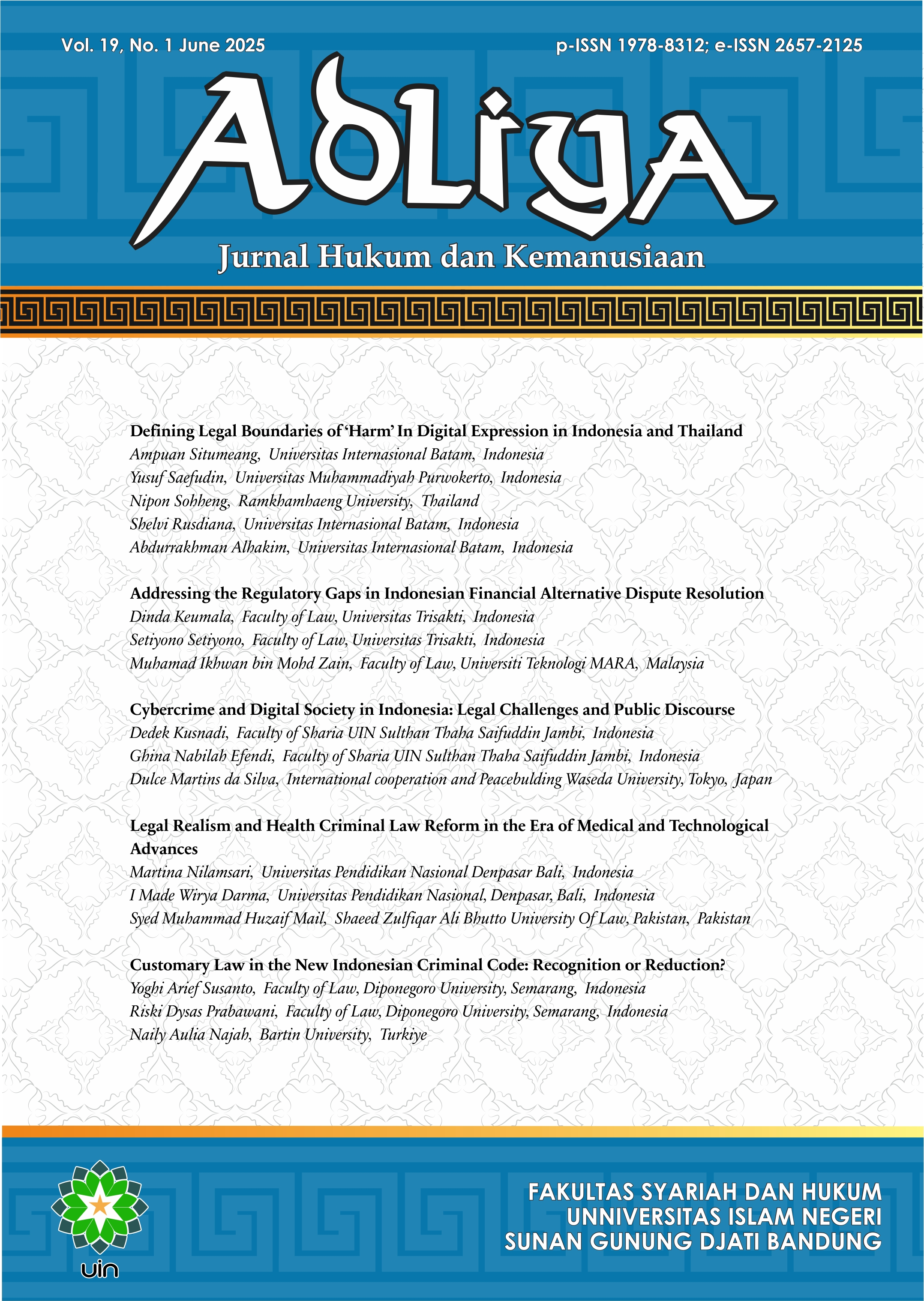
Defining Legal Boundaries of ‘Harm’ In Digital Expression in Indonesia and Thailand
DOI:
https://doi.org/10.15575/adliya.v19i1.44685Abstract
The enforcement of digital conduct provisions is currently gaining more relevance. Indonesia and Thailand, as two countries with diverse socio-cultural and religious backgrounds, continue to struggle with ensuring that online conduct was within safe boundaries. However, ongoing efforts to regulate this situation raised numerous questions regarding the balance between freedom of expression and societal sensitivities, particularly in relation to how 'harm' was defined by individuals and the legal system. A normative legal study was conducted to analyze the relevant primary law sources from both countries and examined how ‘harm’ is defined by the Indonesian and Thailand legal system. The results showed that there was a significant disconnect between Indonesia and Thailand's diverse societies and how the legal system tried to balance competing interests. Legal provisions and enforcement also showed a strong focus on socio-cultural preservation that may inadvertently limit digital discourse.
References
Aidha, Fakhriyyah Asmay, Muyassaroh Muyassaroh, and Lavatee Chite. “A Reflection of Kinship Between Indonesian and South Patani Malay Languages: Homophone and Homograph.” Lensa: Kajian Kebahasaan, Kesusastraan, Dan Budaya 14, no. 2 (December 2024): 373–92. https://doi.org/10.26714/lensa.14.2.2024.373-392.
Amnesty International. “Indonesia: Drop Blasphemy Case against Jakarta Governor.” Amnesty International, November 2016.
Arifin, Evi Nurvidya, Aris Ananta, Dwi Retno Wilujeng Wahyu Utami, Nur Budi Handayani, and Agus Pramono. “Quantifying Indonesia’s Ethnic Diversity: Statistics at National, Provincial, and District Levels.” Asian Population Studies 11, no. 3 (2015): 233–56. https://doi.org/10.1080/17441730.2015.1090692.
Arifin, Muhammad Ardiansyah, Owen Maskintama, and Nugroho Adhi Pratama. “Indonesia Abuse of Defamation Clause in Article 27 Section ( 3 ) of Electronic Information and Transaction Law.” South East Asia Journal of Contemporary Business, Economics and Law 23, no. 1 (2020): 25–33. https://doi.org/10.1016/b0-08-043076-7/02840-0.Ibid.
Black’s Law Dictionary. “HARM.” The Law Dictionary, n.d.
Citron, Danielle Keats, and Neil Richards. “Four Principles for Digital Expression (You Won’t Believe #3!).” Washington University Law Review 95 (2018): 1353–87.
Croissant, Aurel. “Comparing Governments and Political Institutions in Southeast Asia.” In Comparative Politics of Southeast Asia: An Introduction to Governments and Political Regimes, edited by Aurel Croissant, 443–89. Cham: Springer International Publishing, 2022. https://doi.org/10.1007/978-3-031-05114-2_13.
Disemadi, Hari Sutra. “Lenses of Legal Research: A Descriptive Essay on Legal Research Methodologies.” Journal of Judicial Review 24, no. 2 (2022): 289–304. https://doi.org/10.37253/jjr.v24i2.7280.
Eka Wisanjaya, I. Gede Pasek, and Putri Bella Rosy Widodo. “Freedom of Expression on Social Media in Indonesia: Why Are the Limitations Imposed?” Udayana Journal of Law and Culture 8, no. 1 (2024): 109–28. https://doi.org/10.24843/UJLC.2024.v08.i01.p06.
Fahrudin, Ahmad Yogi, Ardiansyah, and Bintang Wicaksono Ajie. “Hukum Pidana Dan Konflik Agama: Menganalisis Kasus Penistaan Agama Dan Dampak Sosialnya.” HUMANIORUM 1, no. 4 (January 2024): 116–23. https://doi.org/10.37010/hmr.v1i4.32.
Gielow Jacobs, Leslie. “Freedom of Speech and Regulation of Fake News.” The American Journal of Comparative Law 70, no. Supplement_1 (October 2022): i278–311. https://doi.org/10.1093/ajcl/avac010.
Haberkorn, Tyrell. “Dictatorship, Monarchy, and Freedom of Expression in Thailand.” The Journal of Asian Studies 77, no. 4 (2018): 935–43. https://doi.org/DOI: 10.1017/S0021911818002528.
Han, Yuxuan. “The Impact of Digital Media on Language Styles and Communication Methods Based on Text, Image, and Video Forms.” Lecture Notes in Education Psychology and Public Media 40, no. 1 (2024): 211–19. https://doi.org/10.54254/2753-7048/40/20240754.
Haslam, Nick. “Concept Creep: Psychology’s Expanding Concepts of Harm and Pathology.” Psychological Inquiry 27, no. 1 (January 2016): 1–17. https://doi.org/10.1080/1047840X.2016.1082418.
Human Rights Watch. “Thailand: Constitutional Court Dissolves Opposition Party.” Human Rights Watch, August 7, 2024. https://www.hrw.org/news/2024/08/07/thailand-constitutional-court-dissolves-opposition-party.
Hurwood, Jessica. “Application of the Hart-Devlin Debate to the Ideas and Arguments Raised in ‘Legalising Assisted Dying Would Be a Failure of Collective Human Memory and Imagination.’” The Student Journal of Professional Practice and Academic Research 1, no. 2 (July 12, 2019): 24–38. https://doi.org/10.19164/sjppar.v1i2.872.
Kalliris, Konstantinos. “Online Harm, Free Speech, and the ‘Legal but Harmful’ Debate: An Interest-Based Approach.” Journal of Media Law 16, no. 1 (2024): 1–27. https://doi.org/10.1080/17577632.2024.2425547.
Karaatmaca, Ceren, Fahriye Altinay, Zehra Altinay, and Gokmen Dagli. “The Role of Sensitivity Training for Managing Diversities in Sustainable Smart Societies.” European Journal of Sustainable Development 9, no. 3 (October 1, 2020): 13–26. https://doi.org/10.14207/ejsd.2020.v9n3p13.
Kleinfeld, Joshua. “Reconstructivism: The Place of Criminal Law in Ethical Life.” Harvard Law Review 129, no. 6 (April 2016): 1485–1565.
Kozyreva, Anastasia, Stefan M. Herzog, Stephan Lewandowsky, Ralph Hertwig, Philipp Lorenz-Spreen, Mark Leiser, and Jason Reifler. “Resolving Content Moderation Dilemmas between Free Speech and Harmful Misinformation.” Proceedings of the National Academy of Sciences of the United States of America 120, no. 7 (2023): 1–21. https://doi.org/10.1073/pnas.2210666120.
Kurniawan, Reski. “Balancing Freedom of Expression and Cultural Sensitivity in West Java, Indonesia.” Journal of Judikaltura 1, no. 2 (July 2023): 1–6. https://doi.org/10.61963/jkt.v1i2.32.
Laungaramsri, Pinkaew. “Mass Surveillance and the Militarization of Cyberspace in Post-Coup Thailand.” Austrian Journal of South-East Asian Studies 9, no. 2 (2016): 195–214. https://doi.org/10.14764/10.ASEAS-2016.2-2.
Mazya, Thita M., Kholis Ridho, and Ali Irfani. “Religious and Cultural Diversity in Indonesia: Dynamics of Acceptance and Conflict in a Multidimensional Perspective.” International Journal of Current Science Research and Review 7, no. 7 (July 2024): 4932–45. https://doi.org/10.47191/ijcsrr/V7-i7-32.
Mérieau, Eugénie. “A History of the Thai Lèse-Majesté Law.” In Thai Legal History: From Traditional to Modern Law, edited by Andrew Harding and Munin Pongsapan, 77–88. Cambridge: Cambridge University Press, 2021. https://doi.org/DOI: 10.1017/9781108914369.007.
Merriam-Webster. “Harm Definition & Meaning.” Merriam-Webster, n.d.
Metzler, Hannah, and David Garcia. “Social Drivers and Algorithmic Mechanisms on Digital Media.” Perspectives on Psychological Science 19, no. 5 (2023): 707–883. https://doi.org/10.1177/17456916231185057.
Morelli, Alessandro, and Oreste Pollicino. “Metaphors, Judicial Frames, and Fundamental Rights in Cyberspace.” The American Journal of Comparative Law 68, no. 3 (September 2020): 616–46. https://doi.org/10.1093/ajcl/avaa028.
Ong-Artborirak, Parichat, and Katekaew Seangpraw. “Association between Self-Care Behaviors and Quality of Life among Elderly Minority Groups on the Border of Thailand.” Journal of Multidisciplinary Healthcare 12 (2019): 1049–59. https://doi.org/10.2147/JMDH.S227617.
Palumbo, Andrea. “A Medley of Public and Private Power in DSA Content Moderation for Harmful but Legal Content: An Account of Transparency, Accountability and Redress Challenges.” JIPITEC - Journal of Intellectual Property, Information Technology and E-Commerce Law 15, no. 3 (2024): 246–68.
Pangaribuan, Johnson Sahat Maruli Tua. “Kepastian Hukum Atas Tindak Pidana Pencemaran Nama Baik Berdasarkan Keputusan Bersama Tentang Pedoman Implementasi Atas Pasal Tertentu Dalam Undang-Undang Informasi Dan Transaksi Elektronik.” Honeste Vivere 33, no. 1 (2023): 37–48. https://doi.org/10.55809/hv.v33i1.183.
Prelec, Tena, Saipira Furstenberg, John Heathershaw, and Catarina Thomson. “Is Academic Freedom at Risk from Internationalisation? Results from a 2020 Survey of UK Social Scientists.” International Journal of Human Rights 26, no. 10 (2022): 1698–1722. https://doi.org/10.1080/13642987.2021.2021398.
Pujianti, Sri. “MK Mempertegas Pemaknaan Unsur-Unsur Pencemaran Nama Baik Dalam UU ITE.” Mahkamah Konstitusi Republik Indonesia, April 29, 2025. https://www.mkri.id/index.php?page=web.Berita&id=23133.
Putra, Yagie Sagita, Pujiyono Pujiyono, Nur Rochaeti, and Zico Junius Fernando. “EIT Law at the Crossroads: Exploring Legal Dilemmas, Freedom of Expression, and Human Rights.” Pakistan Journal of Criminology 16, no. 3 (June 2024): 1315–32. https://doi.org/10.62271/pjc.16.3.1315.1332.
Rama, Bagus Gede Ari. “Press Freedom in The Digital Era in Indonesia: A Human Rights Perspective.” JIHAD: Jurnal Ilmu Hukum Dan Administrasi 6, no. 4 (December 2024): 556–64.
Riyanti, Rahayu Febri, Fitri Puji Rahmawati, Arifah Dwi Widyastuti, and Lina Hasna. “Understanding the Values of Pancasila and the Kebhinekaan Tunggal Ika Diversity in the Middle of the Diversity of Students.” Jurnal VARIDIKA 35, no. 2 (December 2023): 94–109. https://doi.org/10.23917/varidika.v1i2.23209.
Rohmy, Atikah Mardhiya, Teguh Suratman, and Arini Indah Nihayaty. “UU ITE Dalam Perspektif Perkembangan Teknologi Informasi Dan Komunikasi.” Dakwatuna: Jurnal Dakwah Dan Komunikasi Islam 7, no. 2 (August 2021): 309–39. https://doi.org/10.54471/dakwatuna.v7i2.1202.
Saragih, Denni Boy. “Religions in Indonesia: A Historical Sketch.” Research in the Social Scientific Study of Religion 30 (2020): 54–66. https://doi.org/10.1163/9789004416987_005.
Shepherd, Aqilah Shakirah, and Chunhua Liu. “From Screens to Statutes: Comparative Study on the Regulation of Cyberbullying through the Criminal Law of China and Cybercrime Act of Guyana.” Beijing Law Review 15, no. 04 (2024): 2218–52. https://doi.org/10.4236/blr.2024.154124.
Situmeang, Ampuan, Shelvi Rusdiana, Hien Trinh, Agustianto Agustianto, and Winsherly Tan. “Blasphemy Laws and Their Implications for Religious Freedom and Expression: A Tri-Country Southeast Asian Perspective.” Jurnal Hukum UNISSULA 40, no. 1 (June 2024): 156–70.
Streckfuss, David. “Lèse-Majesté within Thailand’s Regime of Intimidation.” In Routledge Handbook of Contemporary Thailand, 134–44, 2019. https://doi.org/10.4324/9781315151328-10.
Su, Min-Hsin, Jiyoun Suk, and Hernando Rojas. “Social Media Expression, Political Extremity, and Reduced Network Interaction: An Imagined Audience Approach.” Social Media + Society 8, no. 1 (January 2022): 1–13. https://doi.org/10.1177/20563051211069056.
Tan, David. “Metode Penelitian Hukum: Mengupas Dan Mengulas Metodologi Dalam Menyelenggarakan Penelitian Hukum.” NUSANTARA: Jurnal Ilmu Pengetahuan Sosial 8, no. 5 (2021): 2463–78. https://jurnal.um-tapsel.ac.id/index.php/nusantara/article/view/5601.
Vaid, Sumer S, Lara Kroencke, Mahnaz Roshanaei, Sanaz Talaifar, Jeffrey T Hancock, Mitja D Back, Samuel D Gosling, Nilam Ram, and Gabriella M Harari. “Variation in Social Media Sensitivity across People and Contexts.” Scientific Reports 14, no. 1 (2024): 6571–6532. https://doi.org/10.1038/s41598-024-55064-y.
Yih, Caroline. “Forgiveness, Power, and Gender in a Chinese Context.” Transformation online-fir (September 4, 2024): 1–13. https://doi.org/10.1177/02653788241271885.
Zhan, Siran, Namrita Bendapudi, and Ying Yi Hong. “Re-Examining Diversity as a Double-Edged Sword for Innovation Process.” Journal of Organizational Behavior 36, no. 7 (2015): 1026–49. https://doi.org/10.1002/job.2027.
Downloads
Published
How to Cite
Issue
Section
Citation Check
License
Copyright (c) 2025 Ampuan Situmeang, Yusuf Saefudin, Nipon Sohheng, Shelvi Rusdiana, Abdurrakhman Alhakim

This work is licensed under a Creative Commons Attribution-ShareAlike 4.0 International License.
Authors who publish in ADLIYA: Jurnal Hukum dan Kemanusiaan agree to the following terms:
- Authors retain copyright and grant the journal right of first publication with the work simultaneously licensed under a Attribution-ShareAlike 4.0 International (CC BY-SA 4.0) License that allows others to share the work with an acknowledgment of the work's authorship and initial publication in this journal.
- Authors are able to enter into separate, additional contractual arrangements for the non-exclusive distribution of the journal's published version of the work (e.g., post it to an institutional repository or publish it in a book), with an acknowledgment of its initial publication in this journal.
- Authors are permitted and encouraged to post their work online (e.g., in institutional repositories or on their website) prior to and during the submission process, as it can lead to productive exchanges, as well as earlier and greater citation of published work (See The Effect of Open Access).