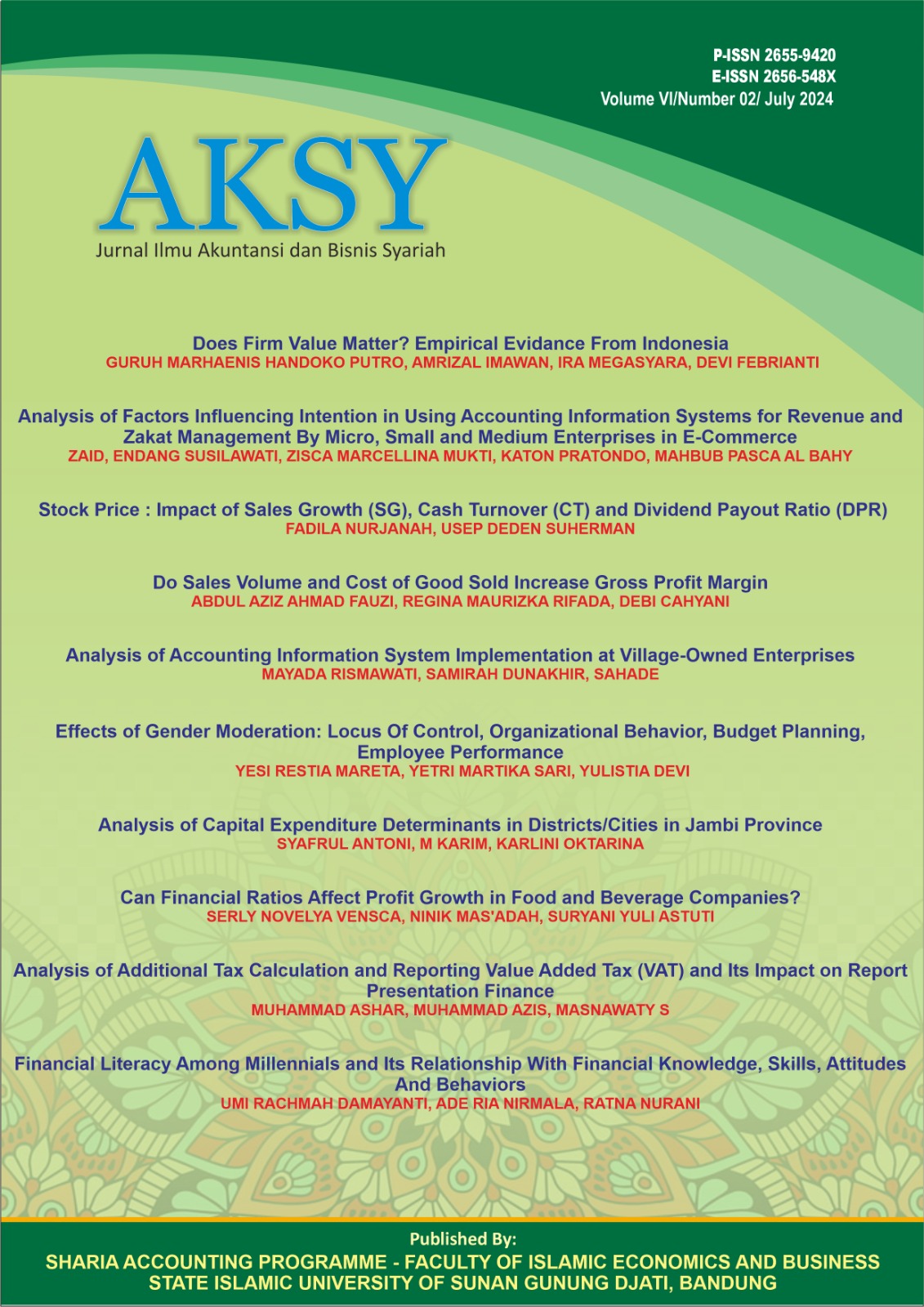
FINANCIAL LITERACY AMONG MILLENNIALS AND ITS RELATIONSHIP WITH FINANCIAL KNOWLEDGE, SKILLS, ATTITUDES AND BEHAVIORS
DOI:
https://doi.org/10.15575/aksy.v6i2.35138Kata Kunci:
Financial Attitudes, Financial Behavior, Financial Knowledge, Financial SkillAbstrak
Referensi
Ajzen, I. (1991). The Theory of Planned Behavior. Organizational Behavior and Human Decision Processes, 50, 179–211. https://doi.org/10.1080/10410236.2018.1493416
Akben-Selcuk, E. (2015). Factors Influencing College Students’ Financial Behaviors in Turkey: Evidence from a National Survey. International Journal of Economics and Finance, 7(6). https://doi.org/10.5539/ijef.v7n6p87
Atkinson, A., & Messy, F. (2012). Measuring Financial Literacy: Results of the OECD / International Network on Financial Education (INFE) Pilot Study. (No. 15). https://doi.org/http://dx.doi.org/10.1787/5k9c sfs90fr4-en.
Cudmore, B., & Patton, J. (2010). The millennials and money management. Journal of Management …, (September), 1–29. Retrieved from http://ww.w.aabri.com/manuscripts/09328.pdf
Dew, J., & Xiao, J. J. (2011). The financial management behavior scale: Development and validation. Journal of Financial Counseling and Planning, 22(1), 43–59.
Dewi, V. I., Febrian, E., Effendi, N., & Anwar, M. (2020). Financial literacy among millennials: Relationships between knowledge, skills, attitude, and behavior. Australasian Accounting, Business and Finance Journal, 14(4), 24–37. https://doi.org/10.14453/aabfj.v14i4.3
Diacon, S., & Ennew, C. (2001). Consumer Perceptions of Financial Risk. Geneva Papers on Risk and Insurance: Issues and Practice, 26(3), 389–409. https://doi.org/10.1111/1468-0440.00125
Elam, C., Stratton, T., & Gibson, D. D. (2007). Welcoming a New Generation to College: The Millennial Students. Journal of College Admission, (195), 20–25. Retrieved from http://scholar.google.com/scholar?hl=en&btnG=Search&q=intitle:Welcoming+a+New+Generation+to+College+:+The+Millennial+Students#0
Elbogen, E. B., Tiegreen, J., Vaughan, C., & Bradford, D. W. (2011). Money management, mental health, and psychiatric disability: A recovery-oriented model for improving financial skills. Psychiatric Rehabilitation Journal, 34(3), 223–231. https://doi.org/10.2975/34.3.2011.223.231
Fishbein, M. A., & Ajzen, I. (1975). Belief, attitude, intention and behaviour: An introduction to theory and research. Reading, Addison-Wesley, (July).
Hung, A., Parker, A. M., & Yoong, J. (2011). Defining and Measuring Financial Literacy. SSRN Electronic Journal. https://doi.org/10.2139/ssrn.1498674
Huston, S. J. (2010). Measuring Financial Literacy. Journal of Consumer Affairs, 44(2), 296–316. https://doi.org/10.1111/j.1745-6606.2010.01170.x
Khan, M. N., Rothwell, D. W., Cherney, K., & Sussman, T. (2017). Understanding the Financial Knowledge Gap: A New Dimension of Inequality in Later Life. Journal of Gerontological Social Work, 60(6–7), 487–503. https://doi.org/10.1080/01634372.2017.1317311
Lusardi, A., & Mitchell, O. (2011). FINANCIAL LITERACY AROUND THE WORLD: An Overview. NBER WORKING PAPER SERIES (Vol. 17).
Lusardi, A., Mitchell, O. S., Scheresberg, B., Gazmuri, A., & Yu, Y. (2013). Debt and Debt Management among Older Adults. 15th Annual Joint Conference of the Retirement Research Consortium, 1–25.
Lusardi, A., & Oggero, N. (2017). Millennials and financial literacy: A global perspective. Global Financial Literacy Excellence Center, (5), 17. Retrieved from http://gflec.org/wp-content/uploads/2017/07/Millennials-and-Financial-Literacy-Research-Paper.pdf?x87657
Navickas, M., Gudaitis, T., & Krajnakova, E. (2014). Influence of financial literacy on management of personal finances in a young household. Business: Theory and Practice, 15(1), 32–40. https://doi.org/10.3846/btp.2014.04
Ng, E. S. W., Schweitzer, L., & Lyons, S. T. (2010). New generation, great expectations: A field study of the millennial generation. Journal of Business and Psychology, 25(2), 281–292. https://doi.org/10.1007/s10869-010-9159-4
OJK. (2022). Siaran Pers Survei Nasional Literasi Dan Inklusi Keuangan Tahun 2022. Otoritas Jasa Keuangan, (November), 10–12.
Priyadharshini, S. H. (2017). From financial literacy to financial well-being: A study of the level of financial literacy of women teaching faculty in educational institutions in Coimbatore region. Bharathiar University, (1), 17.
Prochaska, J. O., Diclemente, C. C., & Norcross, J. C. (1993). In search of how people change: Applications to addictive behaviors. Journal of Addictions Nursing, 5(1), 2–16. https://doi.org/10.3109/10884609309149692
Sarigül, H. (2014). Muhasebe ve finansman dergisi A survey of financial literacy among university students. Muhasebe ve Finansman Dergisi, 1(64), 207–224.
Tan, G. (2016). Overall financial literacy score hits a record low in Mastercard’s latest Financial Literacy Index.
Tschache, C. A. (2019). Importance of financial literacy and financial literacy content in curriculum. Dissertation, (July), 67. Retrieved from https://scholarworks.montana.edu/xmlui/bitstream/handle/1/2449/TschacheC0809.pdf?sequence=1
Widdowson, D., & Hailwood, K. (2007). Financial literacy and its role in promoting a sound financial system. Reserve Bank Of New Zealand, 70(2), 37–47.
Woodyard, A. (2013). Measuring Financial Wellness. Consumer Interests Annual, 59, 1–6.
Xiao, J. J. (2016). Handbook of Consumer Finance Research: Second Edition. Handbook of Consumer Finance Research: Second Edition, (August), 1–376. https://doi.org/10.1007/978-0-387-75734-6
Xiao, J. J., Chen, C., & Chen, F. (2014). Consumer financial capability and financial satisfaction. Social Indicators Research, 118(1), 415–432. https://doi.org/10.1007/s11205-013-0414-8
Unduhan
Diterbitkan
Cara Mengutip
Terbitan
Bagian
Citation Check
Lisensi
Lisensi Creative Commons
Jurnal Ilmu Akuntansi dan Bisnis Syariah are licensed under Attribution-ShareAlike 4.0 International