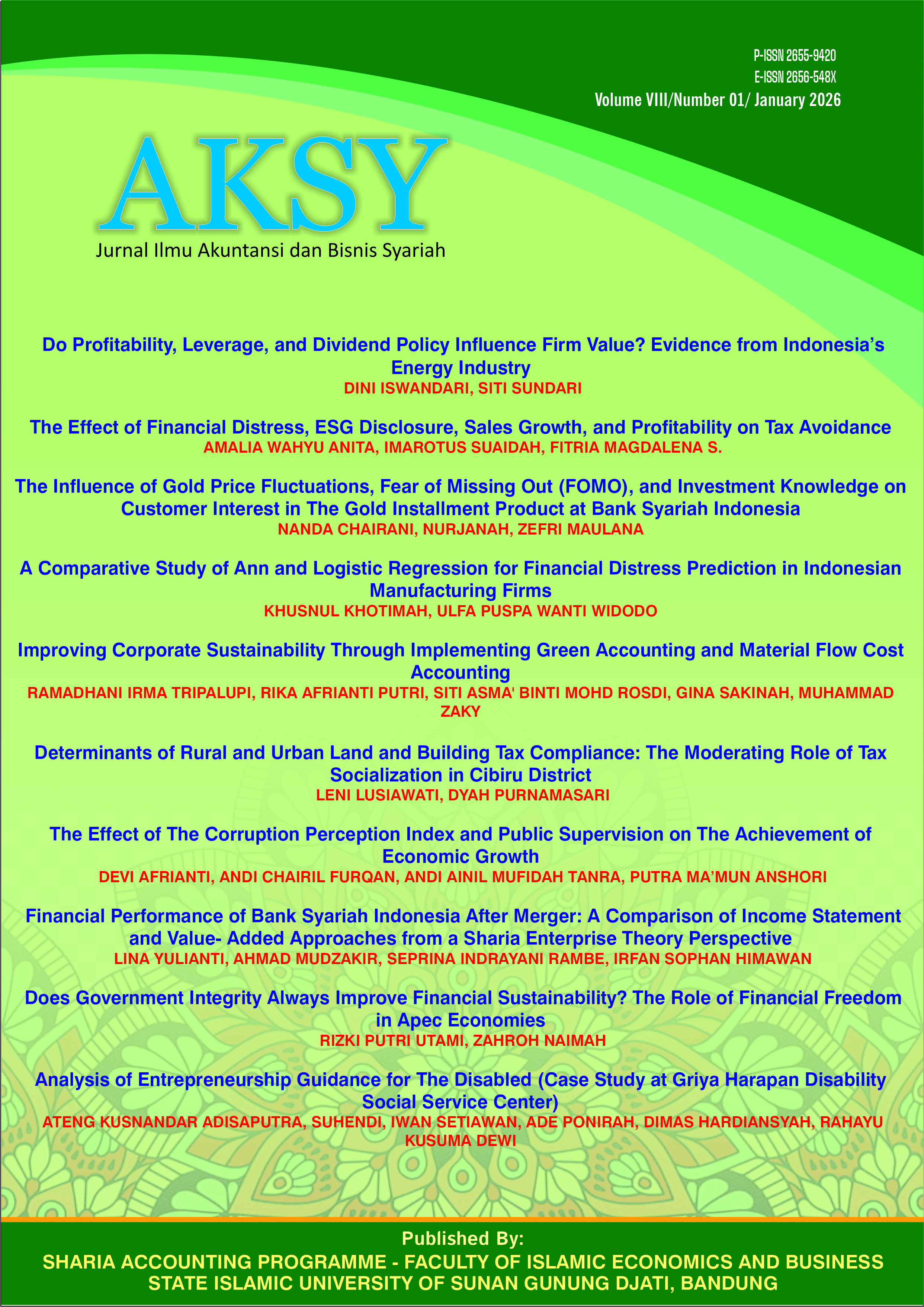
THE EFFECT OF THE CORRUPTION PERCEPTION INDEX AND PUBLIC SUPERVISION ON THE ACHIEVEMENT OF ECONOMIC GROWTH
DOI:
https://doi.org/10.15575/aksy.v8i1.51492Keywords:
Corruption Perception Index, Public Oversight, Sustainable Development Goals 8Abstract
The achievement of the Sustainable Development Goals (SDGs), particularly SDG 8 on inclusive and sustainable economic growth, faces significant challenges across many countries. One of the main obstacles is corruption, which undermines economic efficiency, reduces investment, and weakens public trust. In addition, weak public oversight leads to a lack of accountability in the management of national budgets. These issues create a need to understand the extent to which the Corruption Perceptions Index (CPI) and public oversight influence the attainment of economic growth. This study aims to empirically analyze the impact of the Corruption Perceptions Index (CPI) and public oversight on the achievement of SDG 8. The study employs secondary data sourced from Transparency International, the Worldwide Governance Indicators, and the UNDP, covering 148 countries in 2021, and uses multiple linear regression with the Human Development Index (HDI) as a control variable. The results indicate that both CPI and public oversight have a positive and significant effect on the attainment of SDG 8, while HDI shows no significant influence. These findings underscore the importance of governance integrity and effective public oversight in supporting inclusive and sustainable economic growth. They also provide implications for governments and stakeholders in formulating more responsive development policies to accelerate the achievement of SDG 8.
References
Alfaris, R. D., Rustam, R., & Syafri. (2023). Ke-8: Studi Kasus Di Jawa Tengah. Journal of Comprehensive Science, 2(2), 493–500.
Aminda, R. S., Aminda, A., & Rizki, M. (2024). Analisa Capaian Pelaksanaan Pekerjaan Layak Dan Pertumbuhan Ekonomi Dalam Sustainable Development Goals (Sdgs) Di Kabupaten Bogor. SINKRON: Jurnal Pengabdian Masyarakat UIKA Jaya, 2(2), 190. https://doi.org/10.32832/jpmuj.v2i2.2279
Angelina, N., Efni, Y., & Rasuli, M. (2020). 2757-Article Text-10472-3-10-20210518. Jurnal Bahtera Inovasi, 4(1), 36–53.
Barbier, E. B., & Burgess, J. C. (2017). The sustainable development goals and the systems approach to sustainability. Economics, 11, 1–22. https://doi.org/10.5018/economics-ejournal.ja.2017-28
Baumann, H. (2020). The corruption perception index and the political economy of governing at a distance. International Relations, 34(4), 504–523. https://doi.org/10.1177/0047117819897312
Christos, P., Eleni, K., Dimitrios, K., Zacharias, D., Athanasios, A., & Panagiotis, L. (2018). Corruption Perception Index (CPI), as an Index of Economic Growth for European Countries. Theoretical Economics Letters, 08(03), 524–537. https://doi.org/10.4236/tel.2018.83037
Deseraldo, G. L., Zanufa Sari, P., Sari, N., & Prastoeti, R. R. (2024). Analisis Akuntabilitas Penggunaan Dana Kelurahan Dalam Meningkatkan Pembangunan Sarana Dan Prasarana Dan Pemberdayaan Masyarakat Kelurahan. Jurnal Kompetensi Ilmu Sosial, 3(1), 66–71. https://doi.org/10.29138/jkis.v3i1.48
Domashova, J., & Politova, A. (2021). The Corruption Perception Index: Analysis of dependence on socio-economic indicators. Procedia Computer Science, 190(2020), 193–203. https://doi.org/10.1016/j.procs.2021.06.024
Effendi, B. (2021). Implementasi Sustainable Development Goals (SDGs) dalam Meningkatkan Kepuasan Masyarakat di Provinsi Banten. STATERA: Jurnal Akuntansi Dan Keuangan, 3(2), 119–132. https://doi.org/10.33510/statera.2021.3.2.119-132
Epaphra, M., & Masawe, J. (2017). The Effect of Corruption on Foreign Direct Investment: A Panel Data Study. Turkish Economic Review, 4(1), 19–54. www.kspjournals.org
Furqan, A. C., & Din, M. (2019). Social perception on corruption and its influence on public legitimacy and open government (Indonesia). Espacios, 40(13).
Guritno, D. C., & Mangkunegara, I. (2022). Korupsi dan SDGs: Perspektif Ekonomi Kelembagaan. Researchgate.Net, September, 131–151. https://www.researchgate.net/profile/Danur-Guritno/publication/363920061_Korupsi_dan_SDGs_Perspektif_Ekonomi_Kelembagaan/links/633509ef76e39959d682c3e0/Korupsi-dan-SDGs-Perspektif-Ekonomi-Kelembagaan.pdf
Haeruddin, R., Zakaria, J., Erfah, A., Utaran, K., & Indonesia, U. M. (2023). Jurnal Akuntansi & Sistem Informasi. 1.
Halkos, G., Bampatsou, C., & Aslanidis, P. S. (2025). Global perspectives on club convergence: Unraveling the nexus of human and sustainable development in the face of corruption. Sustainable Development, 33(1), 534–553. https://doi.org/10.1002/sd.3137
Hazmi, R. A. Al. (2024). Pengaruh Kemiskinan Dan Korupsi Terhadap Pertumbuhan Ekonomi Indonesia. Jurnalku, 4(1), 1–10.
Ichvani, L. F. I., & Sasana, H. (2019). Jurnal REP ( Riset Ekonomi Pembangunan ) World Sumber : Transparency International Sumber : World Bank. Jurnal REP (Riset Ekonomi Pembangunan), 4(1), 61–72.
Ismowati, M., Abbas, S., & Putri, A. (2022). Sosialisasi Peran Pemuda dalam SDGs Tujuan 8 Pekerjaan Layak dan Pertumbuhan Ekonomi Inklusif di Desa Junrejo Kecamatan Junrejo Kota Malang. Jurnal Pengabdian Mandiri, 1(12), 2315–2322.
Lisa, H., & Sjarief, A. (2025). Atestasi : Jurnal Ilmiah Akuntansi Pengaruh Partisipasi , Transparansi dan Akuntabilitas terhadap Kinerja Keuangan Instansi Publik. 8(2), 562–573.
Ritonga, P. (2024). Transparansi Dan Akuntabilitas: Peran Audit Dalam Meningkatkan Kepercayaan Stakeholder. Equilibrium : Jurnal Ilmiah Ekonomi, Manajemen Dan Akuntansi, 13(2), 323. https://doi.org/10.35906/equili.v13i2.2004
Sauda, S. F. S., & Furqanb, A. C. (2024). Machine Translated by Google Akuntansi Akrual dan Pengendalian Korupsi Machine Translated by Google. 15(April), 128–136. https://doi.org/10.26740/jaj.v15n2.p128-p136
Sunday Kalisa. (2019). International Public-Sector Accounting Standards adoption and implementation issues in Africa. African Accounting and Finance Journal, 2(1), 1–132. https://www.aafassociation.com/resources/Documents/AAFJ/AAFJ Vol.2 No.1 August 2019.pdf#page=119
Suprapto, Utari, D. A. D. S., Faried, L. N. A. I., Soeharjoto, I. H. K., & Wismayanti, P. E. P. K. W. D. (2023). Dinamika Administrasi Publik Indonesia. In Global Eksekutif Teknologi (Vol. 1, Issue April). https://books.google.com/books?hl=en&lr=&id=XsqpEAAAQBAJ&oi=fnd&pg=PA53&dq=administrasi+publik&ots=YftTH4RKTX&sig=G9bTS9kXE5LAc1awTIN-O--MiyA
Suyatmiko, W. H. (2020). Memaknai Turunnya Skor Indeks Persepsi Korupsi Indonesia Tahun 2020. 7(1), 161–178. https://doi.org/10.32697/integritas.v7i1.717
Tantikul, N., & Soranarak, W. (2024). Impacts of Macroeconomic Indicators, Corruption and Corporate Governance on Sustainable Development Goals: The Case of Southeast Asia. Journal of Multidisciplinary in Social Sciences, 20(2), 1–14.
Taufiq, M., Purwanto, A., & Farah, A. (2025). Perceived Corruption and Economic Growth : A World Panel Data Analysis. 14(1).
Wardhani, R. (2023). Evaluasi Kinerja Keberlanjutan melalui Pengembangan Sustainability Performance Measurement Framework (SPMF) dalam Mendukung Pencapaian Sustainable Development Goals (SDGs). Jurnal Ilmiah Sain Dan …, 1. https://dgb.ui.ac.id/wp-content/uploads/123/2023/07/Prof.-Dr.-Ratna-Wardhani-Buku-Pidato-1.pdf
Zouaoui, A., Al Qudah, A., & Arab, M. Ben. (2017). World Corruption Perception Index Analysis. Research Journal of Finance and Accounting, 8(24), 85–91. https://ssrn.com/abstract=3095852
Downloads
Published
How to Cite
Issue
Section
Citation Check
License
Copyright (c) 2026 Jurnal Ilmu Akuntansi dan Bisnis Syariah (AKSY)

This work is licensed under a Creative Commons Attribution-ShareAlike 4.0 International License.
Lisensi Creative Commons
Jurnal Ilmu Akuntansi dan Bisnis Syariah are licensed under Attribution-ShareAlike 4.0 International