
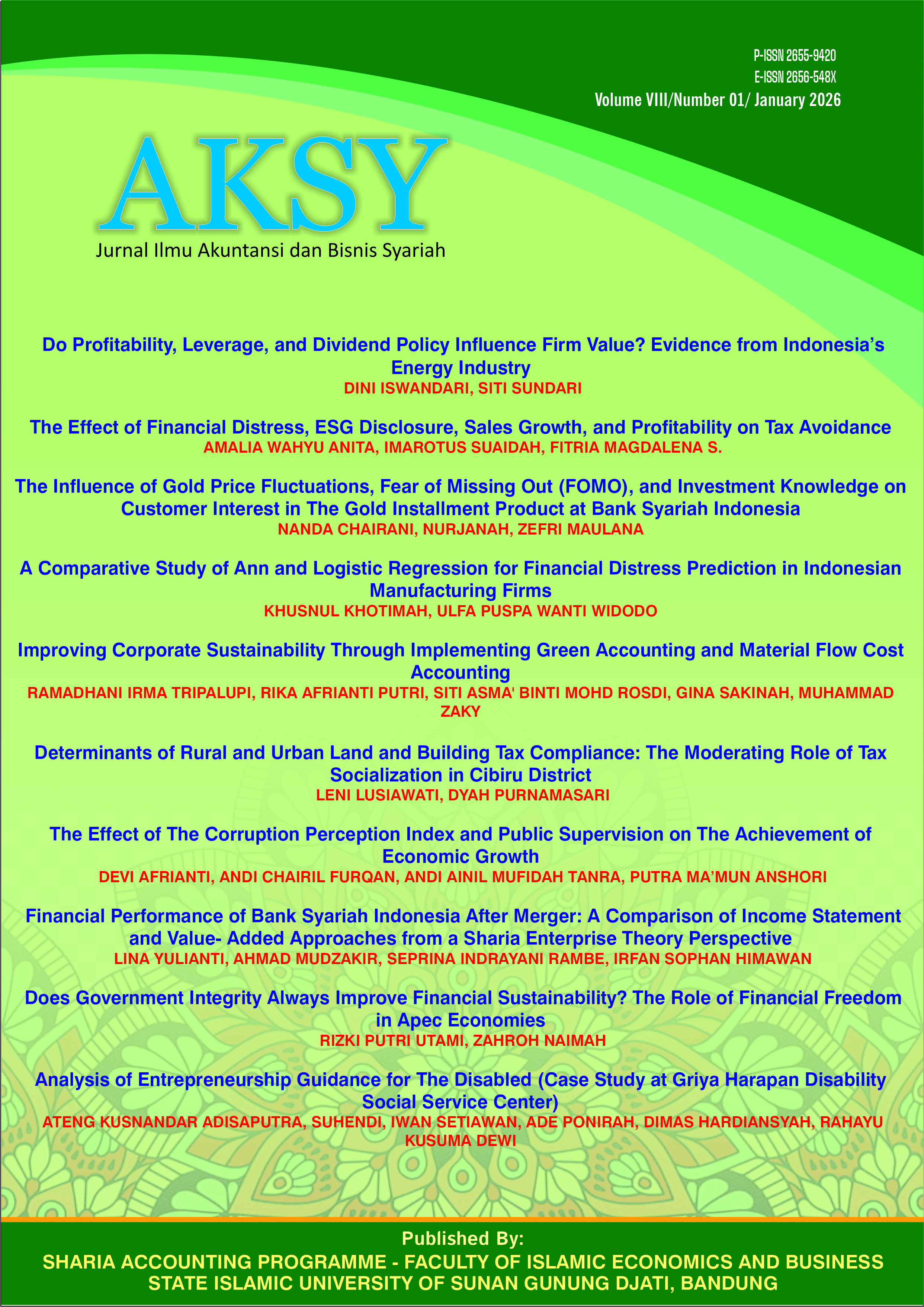
ANALYSIS OF ENTREPRENEURSHIP GUIDANCE FOR THE DISABLED (CASE STUDY AT GRIYA HARAPAN DISABILITY SOCIAL SERVICE CENTER)
DOI:
https://doi.org/10.15575/aksy.v8i1.52746Kata Kunci:
Entrepreneurship Guidance, Empowerment Of The Disabled, Economic Independence, Regional Technical Implementation Unit Griya Harapan DifabelAbstrak
This study aims to analyze the implementation of entrepreneurial guidance for people with disabilities at the Regional Technical Implementation Unit of the Griya Harapan Difabel Social Service Center of the West Java Provincial Social Service. The research background is the persistently low levels of work participation and economic independence among persons with disabilities, despite various national regulations that guarantee their right to employment and entrepreneurship. The research employs a descriptive qualitative approach, collecting data through Field Research, Observation, Interviews, and Research. The study's results indicate that local government policies provide a solid foundation for the development of entrepreneurship among people with disabilities; however, their implementation still requires stronger coordination and sustainability. The guidance program at the Regional Technical Implementation Unit runs through vocational skills training, entrepreneurship guidance, direct practice, and business mentoring. This program has been shown to enhance participants' skills, confidence, and ability to start or develop an independent business.
Referensi
Alqahtani, H. H. (2025). Empowering the intellectually disabled: Innovations and pathways to employment inclusion. Journal of Human Sciences, 24(1), 1-11.
Arifin, R., Ningsih, A. A. T., & Putri, A. K. (2021). The important role of MSMEs in improving the economy. East Asia Journal of Contemporary Business, Economics and Law, 24(6), 52-59.
Chavan, B., & Mehta, S. (2018). Classificatory systems and disability. Indian Journal of Social Psychiatry, 34(5), 86. https://doi.org/10.4103/ijsp.ijsp_33_18
Dasaraju, H., & Tambunan, T. T. (2023). Introduction: Role of MSMEs in achieving SDGs—Perspectives from emerging economies. In Role of micro, small and medium enterprises in achieving SDGs: Perspectives from emerging economies (pp. 1-16). Singapore: Springer Nature Singapore.
Diandra, D., & Azmy, A. (2020). Understanding definition of entrepreneurship. International Journal of Management, Accounting and Economics, 7(5), 235-241.
Djunaidi, D. (2022). Service Strategy and Policy for the Disabled. JMKSP (Jurnal Manajemen, Kepemimpinan, dan Supervisi Pendidikan), 7(1), 200-209.
Dushkova, D., & Ivlieva, O. (2024). Empowering communities to act for a change: A review of the community empowerment programs towards sustainability and resilience. Sustainability, 16(19), 8700.
Ferraro, T., Moreira, J. M., Dos Santos, N. R., Pais, L., & Sedmak, C. (2018). Decent work, work motivation and psychological capital: An empirical research. Work, 60(2), 339-354.
Fisher, E., & Gonzalez, Y. S. (2020). Qualifications and certificates v practical knowledge and experience: is there a winner. Business and Economic Research, 10(2), 1-21.
Gagliardi, A. R., & Brouwers, M. C. (2012). Integrating guideline development and implementation: analysis of guideline development manual instructions for generating implementation advice. Implementation science, 7(1), 67.
Ghosh, S. (2021). An introduction on educational guidance. Galaxy International Interdisciplinary Research Journal, 9(11), 133-139.
Harris, S. P., Renko, M., & Caldwell, K. (2013). Accessing social entrepreneurship: Perspectives of people with disabilities and key stakeholders. Journal of Vocational Rehabilitation, 38(1), 35-48.
Kapur, R. (2018). Socio-economic development and empowerment of disadvantaged groups. Social Science, Online Chapter, National Institute of Open Schooling (NIOS), GoI, India.
Landström, H., & Benner, M. (2010). Entrepreneurship research: a history of scholarly migration. In Historical foundations of entrepreneurship research. Edward Elgar Publishing.
Putra, R., & Hidayat, M. (2023). Peran pemerintah daerah dalam pengembangan kewirausahaan difabel. Jurnal Administrasi Publik, 11(1), 67–80.
Putri, A. A. H., & Halim, A. (2023). Kebijakan Hukum Terhadap Hak-Hak Disabilitas Dalam Layanan Jasa Keuangan Di Indonesia. Almashlahah: Jurnal Hukum Islam Dan Pranata Sosial Islam, 249–272.
Rahman, F., Lestari, P., & Aminah, S. (2021). Model pelatihan kewirausahaan adaptif bagi penyandang disabilitas. Jurnal Ekonomi Sosial, 7(1), 45–58.
Redko, K. (2024). Enabling economic empowerment: social enterprise's role in harnessing the potential of individuals with disabilities. Věda a perspektivy, 2(33), 26-36.
Sari, D., & Nugroho, A. (2020). Pemberdayaan ekonomi difabel melalui pelatihan kewirausahaan. Jurnal Pemberdayaan Masyarakat, 5(2), 123–135.
Schäfer, M., Jaeger-Erben, M., & Bamberg, S. (2012). Life events as windows of opportunity for changing towards sustainable consumption patterns? Results from an intervention study. Journal of Consumer Policy, 35(1), 65-84.
Toldrá, R. C., & Santos, M. C. (2013). People with disabilities in the labor market: facilitators and barriers. Work, 45(4), 553-563.
Wahyuni, T. (2022). Pendampingan kewirausahaan difabel berbasis psikososial. Jurnal Kesejahteraan Sosial, 9(3), 201–214.
Unduhan
Diterbitkan
Cara Mengutip
Terbitan
Bagian
Citation Check
Lisensi
Hak Cipta (c) 2026 Jurnal Ilmu Akuntansi dan Bisnis Syariah (AKSY)

Artikel ini berlisensiCreative Commons Attribution-ShareAlike 4.0 International License.
Lisensi Creative Commons
Jurnal Ilmu Akuntansi dan Bisnis Syariah are licensed under Attribution-ShareAlike 4.0 International