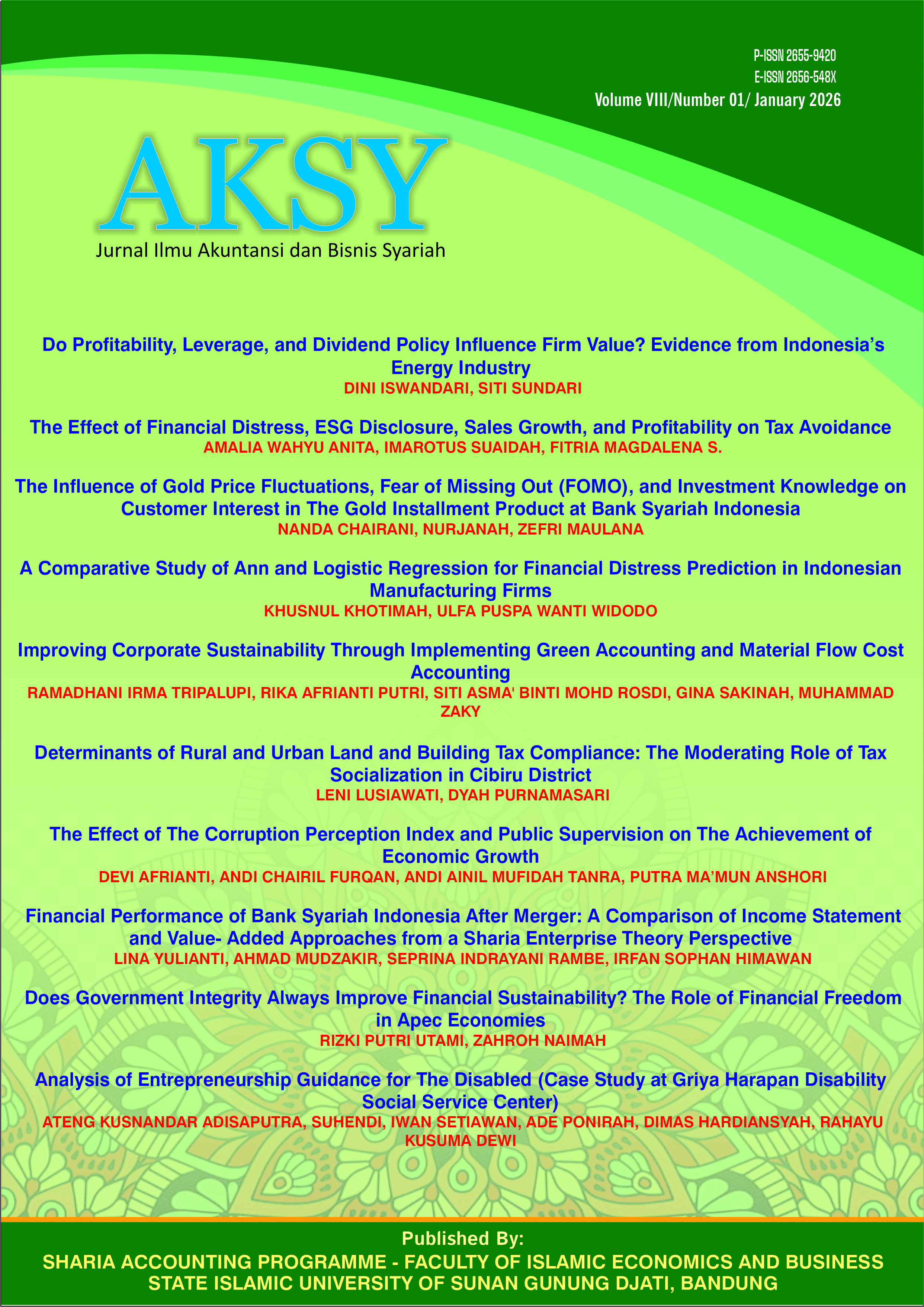
DOES GOVERNMENT INTEGRITY ALWAYS IMPROVE FINANCIAL SUSTAINABILITY? THE ROLE OF FINANCIAL FREEDOM IN APEC ECONOMIES
DOI:
https://doi.org/10.15575/aksy.v8i1.53687Kata Kunci:
APEC Economies, Financial Freedom, Financial Sustainability, Fiscal Sustainability, Fiscal Transparency, Government Integrity, Public Sector AccountingAbstrak
This study examines whether government integrity consistently improves financial sustainability and explores the role of financial freedom in APEC economies. Financial sustainability is conceptualized as an accounting-based fiscal outcome reflecting governments’ capacity to manage long-term fiscal obligations transparently. Using panel data from 13 APEC member countries during 2010–2024, this study employs a fixed effects panel regression to control for unobserved country-specific heterogeneity. Government integrity and financial freedom are measured using indices from the Heritage Foundation, while financial sustainability is constructed as a composite index derived from key fiscal indicators. The results show that government integrity has a statistically significant but negative association with financial sustainability, suggesting that higher integrity enhances transparency and comprehensive recognition of fiscal obligations, which may initially worsen measured fiscal sustainability due to improved disclosure and accounting recognition effects rather than weaker fiscal discipline. Financial freedom does not exhibit a significant effect, indicating that financial market openness alone is insufficient to ensure sustainable public finances. GDP per capita positively influences financial sustainability.
Referensi
Afonso, A., & Jalles, J. T. (2015). Fiscal sustainability: A panel assessment for advanced economies. Applied Economics Letters, 22(11), 925–929. https://doi.org/10.1080/13504851.2014.987913
Afonso, A., & Silva, J. (2024). Institutions, fiscal discipline, and debt sustainability: Evidence from European countries. Journal of Policy Modeling, 46(2), 310–327. https://doi.org/10.1016/j.jpolmod.2023.11.004
Aimon, H., Kurniadi, A. P., Sentosa, S. U., & Yahya, Y. (2024). What is the Relationship Between Financial Stability and Economic Growth in APEC? International Journal of Sustainable Development and Planning, 19(7), 2691–2698. https://doi.org/10.18280/ijsdp.190725
Anjarwi, A. W. (2025). Tax burden and poverty in lower-middle-income countries: The moderating role of fiscal freedom. Development Studies Research, 12(1), 2466511. https://doi.org/10.1080/21665095.2025.2466511
Batuo, M., Mlambo, K., & Asongu, S. (2018). Linkages between financial development, financial instability, financial liberalisation and economic growth in Africa. Research in International Business and Finance, 45, 168–179. https://doi.org/10.1016/j.ribaf.2017.07.148
Bohn, H. (1998). The Behavior of U. S. Public Debt and Deficits. The Quarterly Journal of Economics, 113(3), 949–963. https://doi.org/10.1162/003355398555793
Boţa-Avram, C., Groşanu, A., Răchişan, P. R., & Gavriletea, M. D. (2018). The bidirectional causality between country-level governance, economic growth, and sustainable development. Sustainability, 10(2), 502. https://doi.org/10.3390/su10020502
Bui, D. (2018). How Financial Freedom and Integration Change Public Debt Impact on Financial Development in the Asia‐Pacific: A Panel Smooth Transition Regression Approach. Australian Economic Review, 51(4), 486–501. https://doi.org/10.1111/1467-8462.12279
Cervelló-Royo, R., Devece, C., & Blanco-González Tejero, C. (2023). Economic freedom influences economic growth and unemployment: An analysis of the Eurozone. Economic Research-Ekonomska Istraživanja, 36(2), 2175007. https://doi.org/10.1080/1331677X.2023.2175007
Chen, C., & Neshkova, M. I. (2020). The effect of fiscal transparency on corruption: A panel cross‐country analysis. Public Administration, 98(1), 226–243. https://doi.org/10.1111/padm.12620
Croce, E., Juan-Ramón, V. H., & Rother, P. (2003). Primary surplus behavior and risks to fiscal sustainability in emerging market countries. IMF Staff Papers, 50(1), 1–46.
Dabla-Norris, E., Allen, R., Zanna, L. F., Prakash, T., Kvintradze, E., Lledo, V., Yackovlev, I., & Gollwitzer, S. (2010). Budget institutions and fiscal performance in low-income countries (IMF Working Paper No. WP/10/80). International Monetary Fund.
Duan, C., Soh, W. N., Ong, T. S., & Abdul Rahim, N. B. (2025). Evidence from financial freedom moderating the relationship between government intervention and financial stability. Finance Research Letters, 72, 106556. https://doi.org/10.1016/j.frl.2024.106556
Economou, F. (2019). Economic freedom and asymmetric crisis effects on FDI inflows: The case of four South European economies. Research in International Business and Finance, 49, 114–126. https://doi.org/10.1016/j.ribaf.2019.02.011
Fernández-Rodríguez, E., García-Fernández, R., & Martínez-Arias, A. (2023). Institutional determinants of the effective tax rate in G7 and BRIC countries. Economic Systems, 47(2), 101079. https://doi.org/10.1016/j.ecosys.2023.101079
Frimpong, S., Yusuf, M. A., Boateng, E., Ankomah, K., & Abeka, M. J. (2023). Financial inclusion, economic freedom and financial stability in sub‐Saharan Africa. Thunderbird International Business Review, 65(4), 429–441. https://doi.org/10.1002/tie.22341
Ghosh, A. R., Kim, J. I., Mendoza, E. G., Ostry, J. D., & Qureshi, M. S. (2013). Fiscal fatigue, fiscal space and debt sustainability in advanced economies. The Economic Journal, 123(566), F4–F30. https://doi.org/10.1111/ecoj.12010
Heritage Foundation. (2024). 2024 Index of economic freedom. https://www.heritage.org/index
Hidayat, R., & Firmansyah, A. (2021). Good governance and public financial accountability: Evidence from Indonesia. Jurnal Ilmu Akuntansi dan Bisnis Syariah, 3(2), 157–172.
Idrus, A. (2024). Exploring Public Finance Policies: A Qualitative Inquiry into Fiscal Policy Analysis, Government Financial Management, and Public Sector Financial Health. Golden Ratio of Finance Management, 4(2), 87–99. https://doi.org/10.52970/grfm.v4i2.481
International Monetary Fund. (2019). Fiscal Monitor: How to Mitigate Climate Change. Washington, D.C.
International Monetary Fund. (2020). Fiscal monitor: Policies to support people during the COVID-19 pandemic. International Monetary Fund.
Khan, M. A., Khan, M. A., Khan, M. A., Haddad, H., Al-Ramahi, N. M., & Sherfudeen, N. (2023). RETRACTED: Country-level institutional quality and financial system efficiency: An international evidence. PLOS ONE, 18(8), e0290511. https://doi.org/10.1371/journal.pone.0290511
Kusumasari, B., Munajat, M. E., & Fauzi, F. Z. (2023). Measuring global pandemic governance: How countries respond to COVID-19. Journal of Management and Governance, 27(2), 603–629. https://doi.org/10.1007/s10997-022-09647-4
Montes, G. C., & Paschoal, P. C. (2016). Corruption: What are the effects on government effectiveness? Empirical evidence considering developed and developing countries. Applied Economics Letters, 23(2), 146–150. https://doi.org/10.1080/13504851.2015.1058900
Muslim, M., Bata Ilyas, Muh. F. G., & Sani, A. (2024). Analysis of Fiscal Policy and Financial Sustainability in Improving the Country’s Economic Stability. Vifada Management and Social Sciences, 2(2), 36–55. https://doi.org/10.70184/yessman2024
North, D. C. (1990). Institutions, institutional change and economic performance. Cambridge University Press.
OECD. (2017). Public integrity handbook. OECD Publishing.
Oman, C. P., & Arndt, C. (2006). Uses and Abuses of Governance Indicators. OECD. https://doi.org/10.1787/9789264026865-en
Onofrei, M., Toader, T., Vatamanu, A. F., & Oprea, F. (2021). Impact of Governments’ Fiscal Behaviors on Public Finance Sustainability: A Comparative Study. Sustainability, 13(7), 3739. https://doi.org/10.3390/su13073739
Onyele, K., Onyekachi-Onyele, C., & Ikwuagwu, E. B. (2024). An Empirical Analysis on Institutional Quality, Fiscal Policy and Debt Sustainability in Sub-Saharan Africa (SSA). Journal of Governance Risk Management Compliance and Sustainability, 4(2), 16–31. https://doi.org/10.31098/jgrcs.v4i2.2178
Rahman, A., & Pratama, A. (2022). Institutional quality and fiscal performance in public sector accounting. Jurnal Ilmu Akuntansi dan Bisnis Syariah, 4(1), 45–60.
Sarpong-Kumankoma, E., Abor, J. Y., Aboagye, A. Q. Q., & Amidu, M. (2021). Economic freedom, competition and bank stability in Sub-Saharan Africa. International Journal of Productivity and Performance Management, 70(7), 1510–1527. https://doi.org/10.1108/IJPPM-06-2019-0310
Scott, W. R. (2014). Institutions and organizations: Ideas, interests, and identities (4th ed.). Sage Publications.
Senturk, N. K., Bayraktar, Y., Recepoglu, M., Ozyilmaz, A., & Balsalobre-Lorente, D. (2025). The effects of sub-components of economic freedom on load capacity factor: Empirical analysis for MENA countries. Journal of Environmental Management, 380, 124956. https://doi.org/10.1016/j.jenvman.2025.124956
Simo-Kengne, B. D., & Bitterhout, S. (2023). Corruption’s effect on BRICS countries’ economic growth: A panel data analysis. Journal of Economics, Finance and Administrative Science, 28(56), 257–272. https://doi.org/10.1108/JEFAS-04-2021-0041
Tekdemir, N., & Yeşil, E. (2025). An Empirical Investigation on the Relationship between Fiscal Transparency and Institutional Quality. Bulletin of Economic Theory and Analysis, 10(1), 233–256. https://doi.org/10.25229/beta.1589338
The Heritage Foundation. (2024). Index of Economic Freedom – Financial Freedom and Government Integrity.
Ullah, S., Ullah, A., & Zaman, M. (2024). Nexus of governance, macroeconomic conditions, and financial stability of banks: A comparison of developed and emerging countries. Financial Innovation, 10(1), 30. https://doi.org/10.1186/s40854-023-00542-x
World Bank. (2022). Enhancing government effectiveness and accountability. World Bank Publications.
World Bank. (2023). Worldwide Governance Indicators & World Development Indicators.
Yang, L., Hu, W., Su, Z., & Qiao, J. (2024). Impact of Anti-Corruption on the Sustainability of Local Government Debt in China: The Moderating Role of Fiscal Transparency. Sustainability, 16(21), 9507. https://doi.org/10.3390/su16219507
Yang, Z., Vitenu-Sackey, P. A., Hao, L., & Tao, Y. (2023). Economic freedom, inclusive growth, and financial development: A heterogeneous panel analysis of developing countries. PLOS ONE, 18(7), e0288346. https://doi.org/10.1371/journal.pone.0288346
Zeqiraj, V., Sohag, K., & Hammoudeh, S. (2022). Financial inclusion in developing countries: Do quality institutions matter? Journal of International Financial Markets, Institutions and Money, 81, 101677. https://doi.org/10.1016/j.intfin.2022.101677
Unduhan
Diterbitkan
Cara Mengutip
Terbitan
Bagian
Citation Check
Lisensi
Hak Cipta (c) 2026 Jurnal Ilmu Akuntansi dan Bisnis Syariah (AKSY)

Artikel ini berlisensiCreative Commons Attribution-ShareAlike 4.0 International License.
Lisensi Creative Commons
Jurnal Ilmu Akuntansi dan Bisnis Syariah are licensed under Attribution-ShareAlike 4.0 International