
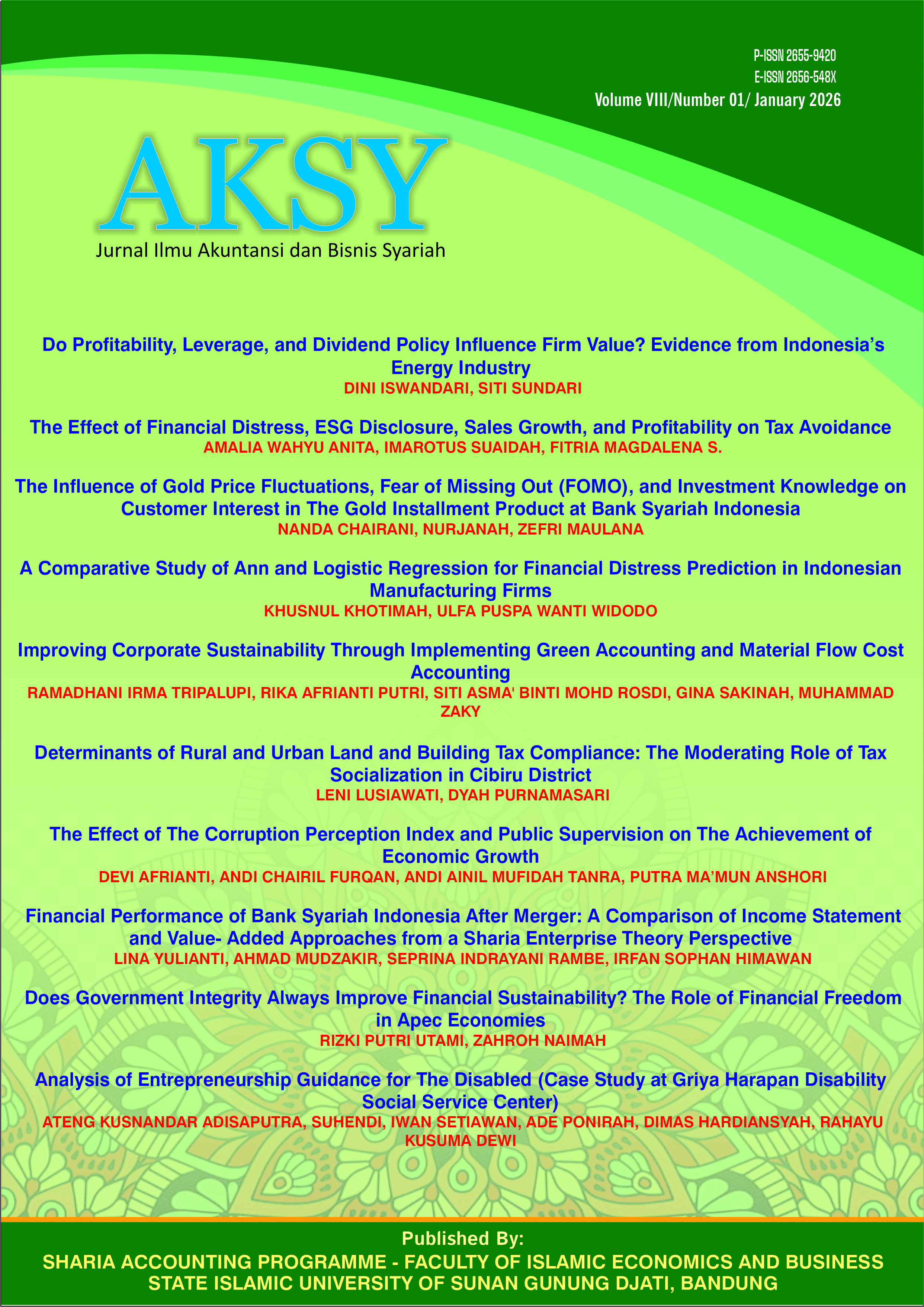
FINANCIAL PERFORMANCE OF BANK SYARIAH INDONESIA AFTER MERGER: A COMPARISON OF INCOME STATEMENT AND VALUE- ADDED APPROACHES FROM A SHARIA ENTERPRISE THEORY PERSPECTIVE
DOI:
https://doi.org/10.15575/aksy.v8i1.53886Kata Kunci:
Bank Syariah Indonesia, Financial Performance, Islamic Banking, Income Statement Approach, Value Added Approach, Sharia Enterprise TheoryAbstrak
This study examines the financial performance of Bank Syariah Indonesia (BSI) after the merger by comparing the Income Statement Approach and the Value-Added Approach from the perspective of Sharia Enterprise Theory. The merger of three state-owned Islamic banks represents a strategic transformation that requires a comprehensive performance evaluation beyond conventional profit-based measures. Using secondary data from BSI’s annual financial statements for the period 2020-2024, this study analyses profitability and efficiency indicators, including Return on Assets (ROA), Return on Equity (ROE), Net Profit Margin (NPM), and the Operating Expenses to Operating Income Ratio (BOPO). A paired sample t-test is employed to examine differences between the two performance measurement approaches. The results indicate that BSI experienced short-term performance adjustments in the early post-merger period, followed by gradual improvements in profitability and operational efficiency. The Value-Added Approach consistently produces higher profitability ratios than the Income Statement Approach, reflecting its broader measurement scope that captures value creation and distribution to multiple stakeholders. Statistically significant differences are found for ROA, ROE, and NPM, while no significant difference is observed for BOPO. Practically, the findings provide insights for Islamic bank management in evaluating post-merger performance, support regulators in promoting performance assessment aligned with Sharia principles, and highlight the relevance of value-added-based measurement for enhancing stakeholder accountability in Islamic banking institutions.
Referensi
Antonio, M. S. (2001). Islamic banking: Theory and practice. Jakarta: Gema Insani Press.
Awalia, A. P., Marliyah, M., & Ilhamy, M. L. (2023). Analysis of financial performance assessment using the economic value added (EVA) method (study at Bank Muamalat Indonesia 2019-2021). Indonesian Journal of Economics and Management, 3(3), 618-629.
Bahri, M., St‐Pierre, J., & Sakka, O. (2011). Economic value added: a useful tool for SME performance management. International Journal of Productivity and Performance Management, 60(6), 603-621.
Bukenya, M. (2014). Quality of accounting information and financial performance of Uganda’s public sector. American Journal of Research Communication, 2(5), 183-203.
Fitriani, N., & Puspitasari, R. (2021). Financial performance comparison of Islamic banks using income statement and value-added approaches. Jurnal Ilmiah Akuntansi Kesatuan, 9(2), 335–346. https://doi.org/10.xxxx/jiak.v9i2.xxx
Haller, A., & van Staden, C. (2014). The value added statement–an appropriate instrument for Integrated Reporting. Accounting, Auditing & Accountability Journal, 27(7), 1190-1216.
Hameed, S., Alrazi, B., & Mohd Rashid, H. (2015). Islamic corporate social responsibility. Journal of Islamic Accounting and Business Research, 6(2), 168–187. https://doi.org/10.1108/JIABR-06-2013-0029
Haron, R., & Ibrahim, K. (2019). Post-merger performance of Islamic banks: Evidence from Southeast Asia. Asian Journal of Business and Accounting, 12(2), 1–27.
Ismail, A. G., & Razak, S. A. (2018). Efficiency and performance of Islamic banks after mergers. Journal of Islamic Monetary Economics and Finance, 4(1), 1–22. https://doi.org/10.21098/jimf.v4i1.732
Jakub, S., Viera, B., & Eva, K. (2015). Economic value added as a measurement tool of financial performance. Procedia economics and finance, 26, 484-489.
Jakub, S., Viera, B., & Eva, K. (2015). Economic value added as a measurement tool of financial performance. Procedia economics and finance, 26, 484-489.
Kamarudin, F., Hue, C. Z., Sufian, F., & Mohamad Anwar, N. A. (2017). Does productivity of Islamic banks endure progress or regress? Humanomics, 33(1), 84–118. https://doi.org/10.1108/H-08-2016-0069
Lee, C. C. (2023). Analyses of the operating performance of information service companies based on indicators of financial statements. Asia Pacific Management Review, 28(4), 410-419.
Malgwi, A. A., & Dahiru, H. (2014). Balanced Scorecard financial measurement of organizational performance: A review. IOSR Journal of Economics and Finance, 4(6), 1-10.
Marchini, P. L., & D’este, C. (2015). Comprehensive income and financial performance ratios: which potential effects on RoE and on firm's performance evaluation?. Procedia Economics and Finance, 32, 1724-1739.
Nasim, A., & Solihati, S. Y. (2019, May). Comparison Analysis of Sharia Banking Financial Performance Using Income Statement Approach and Value Added Statement Approach. In 1st International Conference on Economics, Business, Entrepreneurship, and Finance (ICEBEF 2018) (pp. 85-87). Atlantis Press.
Nugroho, L., Utami, W., & Doktoralina, C. M. (2021). Post-merger performance and efficiency of Islamic banks. Journal of Islamic Accounting and Business Research, 12(4), 567–583. https://doi.org/10.1108/JIABR-01-2020-0024
Page, A., & Katz, R. A. (2010). Is social enterprise the new corporate social responsibility. Seattle UL Rev., 34, 1351.
Please, K., Tarigan, A. A., & Yafiz, M. (2022). Iwan Triyuwono's Thought About The Concept Of Sharia Enterprise Theory In The Development Of Sharia Accounting Theory In Indonesia. Al-Masharif: Jurnal Ilmu Ekonomi dan Keislaman, 10(1), 127-142.
Rahman, A. A., & Rosman, R. (2020). Efficiency of Islamic banks: A comparative analysis before and after mergers. International Journal of Islamic and Middle Eastern Finance and Management, 13(4), 645–662. https://doi.org/10.1108/IMEFM-03-2019-0112
Rahman, L. F., & Putri, C. (2024). Comparative analysis of Bank Syariah Indonesia’s financial performance using income statement and value added statement approaches. Jurnal Profiet, 5(1), 233–246.
Rahmi, W. L., & Nasution, Y. S. J. (2023). Correction of Sharia Value Added Concept: Considering Theoretical Basic Concepts of Accounting Financial Reports. Indonesian Interdisciplinary Journal of Sharia Economics (IIJSE), 6(3), 2104-2117.
Rosly, S. A., & Abu Bakar, M. A. (2003). Performance of Islamic and mainstream banks in Malaysia. International Journal of Social Economics, 30(12), 1249–1265. https://doi.org/10.1108/03068290310500652
Ruddin, P. (2020). Corporate social responsibility of Islamic banking based on Sharia Enterprise Theory. Jurnal Akuntansi STIE Muhammadiyah Palopo, 4(2), 31–42.
Salma Sairally, B. (2013). Evaluating the corporate social performance of Islamic financial institutions: an empirical study. International Journal of Islamic and Middle Eastern Finance and Management, 6(3), 238-260.
Sari, S. I., Hamzah, H., & Syachbrani, W. (2025). Perbandingan Kinerja Keuangan Berdasarkan Income Statement Approach dan Value Added Approach pada PT. Bank Syariah Indonesia Tbk. J-CEKI: Jurnal Cendekia Ilmiah, 4(2), 1872-1882.
Siniak, N., & Lozanoska, D. K. (2019). A review of the application of the concept of economic and smart sustainable value added (SSVA) in industries performance evaluations. BRAIN. Broad Research in Artificial Intelligence and Neuroscience, 10(1), 129-136.
Suaidi, S. (2025). Bridging institutional and regulatory gaps: Enhancing sharia compliance in islamic financial institutions in indonesia. El-Uqud: Jurnal Kajian Hukum Ekonomi Syariah, 3(1), 23-39.
Triyuwono, I. (2012). Akuntansi syariah: Perspektif, metodologi, dan teori. Jakarta: Rajawali Pers.
Unduhan
Diterbitkan
Cara Mengutip
Terbitan
Bagian
Citation Check
Lisensi
Hak Cipta (c) 2026 Jurnal Ilmu Akuntansi dan Bisnis Syariah (AKSY)

Artikel ini berlisensiCreative Commons Attribution-ShareAlike 4.0 International License.
Lisensi Creative Commons
Jurnal Ilmu Akuntansi dan Bisnis Syariah are licensed under Attribution-ShareAlike 4.0 International