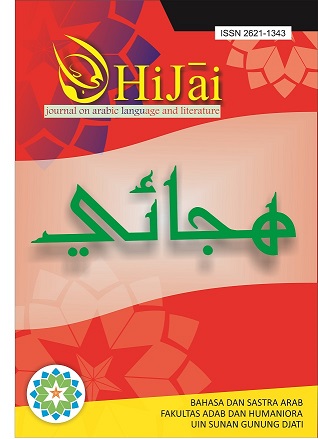
ADAWATUL ISTIFHAM DALAM NOVEL ‘ALA MAIDATIN DA’ISY KARYA ZAHRA ‘ABDULLAH (Kajian Ilmu Nahwu dan Ma’ani)
DOI:
https://doi.org/10.15575/hijai.v8i2.12221Keywords:
arabic linguistics, ‘ala maidatin dai’sy, zahra ‘abdullah, adawatul istifham, nahwu, ma’aniAbstract
This study examines Adawāt al-Istifhām in the sentences contained in a novel titled ‘Alā Mā’idatin Dā’ish by Zahra ‘Abdullah. A total of 166 words categorized as Adawāt al-Istifhām were found, spread across various sentences. The purpose of this research is to describe the forms and meanings of Adawāt al-Istifhām from the perspective of ‘Ilm al-Ma‘ānī, as well as their I‘rāb Maḥallī from the perspective of ‘Ilm al-Naḥw. This study applies a qualitative descriptive method with a library research design. The data sources of this research consist of sentences in the novel ‘Alā Mā’idatin Dā’ish that contain Adawāt al-Istifhām. Data collection was carried out through comprehensive reading of the identified data, which was then analyzed using existing theoretical approaches, classified, and interpreted thoroughly before presenting the conclusions. The results of the study are as follows: (1) The Adawāt al-Istifhām found in the novel ‘Alā Mā’idatin Dā’ish by Zahra ‘Abdullah consist of ten (10) forms, namely: limādhā (لماذا), hal (هل), hamzah (أ), ayna (أين), mādhā (ماذا), kam (كم), kayfa (كيف), matā (متى), mā (ما), and man (من). (2) Their meanings are both literal (ḥaqīqī) and figurative (majāzī), including: amazement, prohibition, persuasion, wishing, equivalence, denial, command, transformation, reprimand, belittlement, warning, delaying, explanation, arrogance, and comparison. (3) The I‘rāb Maḥallī includes: having no syntactic position, occupying the position of jarr, functioning as an adverb of place (ẓarf makān), as a subject (mubtada’), and as a fronted predicate (khabar muqaddam). This research provides opportunities for other researchers to use it as a reference and comparison for future studies.
Keywords: Alā Mā’idatin Dā’ish, Zahra ‘Abdullah, Adawāt al-Istifhām, Nahw, Ma‘ānī
References
Al-Bidkhusani, Muhammad Anwar. 1996. “Al-Balagah Ash-Shafiyah.” Karachi: Baitul ‟Ilmi.
Al-Harabi, ‟Abdul Aziz bin ‟Ali. 2011. Al-Balagah Al-Muyassaroh. Beirut: Dar Ibn Hazm.
Al-Hasyimi. 1999. Jawahirul Balahah. Beirut: Maktabah Asriyyah.
Amin, ‟Ali Jarim dan Mustafa. 1993. An Nahwu Al- Wadih : Juz 2. Kairo: Dar Al-Ma‟arif.
Eberhard, David M. 2020. “Ethonologue: Languages of the World (23rd Edition).” 2020.
Ghani, Aiman Amin ‟Abdul. 2010. An-Nahwu Al-Kafi. Kairo: Dar At- Taufiqiyyah Lilturas.
Harahap, Nursia. 2014. “Penelitiaan Kepustakaan.” Iqra’ 08 (01): 68–73. Latief, Abdul Said. 2014. Ensiklopedi Komplit Menguasai Bahasa Arab Sistem 4 x 24 Jam. Yogyakarta: Mitra Pustaka.
Ma‟sum, Ali. 2007. Istifham Dalam Al-Qu’ran. Jakarta. http://http//repository.uinjkt.ac.id/dspace/bitstream/123456789/45707/1/ Ali Ma%27sum_Istifham dalam Al-quran.pdf.
Massih, George Mitri Abdul. 1981. Qawaidul Lugah Al-Arabiyyah. Beirut: Libanon Nasyirun.
Mayu, Qadri. 2000. Al-Ma’in Fil Balagah. Edited by ‟Alamul Kitab. Beirut.
Nasif, Hafni dkk. 2006. Ad-Durus An-Nahwiah. Kuwait: Dar Ilafi Ad- Dualiyah.
Rahman, Anwar Abd. 2010. “Sejarah Ilmu Nahwu Dan Perkembangannya.” Al-Maqoyis X (35): 98–109.
Rappe. 2016. “Konsep Al-Mu‟rab Wa Al-Mabni Dalam Bahasa Arab.” Shaut Al-Arabiyyah.
Sari, Ana Wahyuning. 2017. “Journal of Arabic Learning and Teaching” 6 (1): 16–20.
Supriyadi. 2016. “Community of Practioners : Solusi Alternatif Berbagi Pengetahuan Antar Pustakawan.” Lentera Pustaka 2 (2): 83–93.
Downloads
Published
How to Cite
Issue
Section
Citation Check
License
Copyright (c) 2025 Miftahul Khoer

This work is licensed under a Creative Commons Attribution-NonCommercial-ShareAlike 4.0 International License.
For Authors:
1. Author's Copyright:
Upon publication, the copyright of the article is retained by the author(s). This means that the authors hold the exclusive right to use, reproduce, and distribute their own work.
2. User Rights and License:
The articles published in Hijai: Journal on Arabic Language and Literature are made available to the public under the terms of the Creative Commons Attribution 4.0 International License (CC BY 4.0). This license allows anyone to copy, redistribute, remix, transform, and build upon the material for any purpose, even commercially, provided that appropriate credit is given to the original author(s) and the primary source, a link to the license is provided, and an indication if changes were made.
3. Author's Rights without Restrictions:
As the copyright holder, authors are permitted to enter into separate, additional contractual arrangements for the non-exclusive distribution of the journal's published version of their work (e.g., depositing it in an institutional repository, publishing it in a book, or sharing it on a personal website), with an acknowledgment of its initial publication in Hijai: Journal on Arabic Language and Literature.
For Readers and Users:
1. You are free to:
- Share — copy and redistribute the material in any medium or format.
- Adapt — remix, transform, and build upon the material for any purpose, even commercially.
2. Under the following terms:
- Attribution — You must give appropriate credit, provide a link to the license, and indicate if changes were made. You may do so in any reasonable manner, but not in any way that suggests the licensor endorses you or your use.