About the Journal
Focus and Scope
This journal publishes high-quality, original research articles that use rigorous theoretical and methodological approaches to study the English language, literature, and the arts. The journal aims to advance scholarly discussions on how meaning, representation, and values are constructed, interpreted, and negotiated across diverse cultural and communicative contexts.
The journal welcomes interdisciplinary and critical perspectives of English studies that engage with contemporary theories and practices in literary studies, linguistics, and discourse analysis, particularly in relation to both written and spoken forms of communication.
The scope of the journal includes, but is not limited to:
1. Literary analysis and textual interpretation
2. Contemporary and classical literary theories
3. Postcolonial literature
4. Digital literature and new media narratives
5. Gender and feminist literary studies
6. Theoretical and applied linguistics
7. Critical discourse analysis and discourse studies
8. Pragmatics and meaning in interaction
9. Sociolinguistics and language in social contexts
10. Multilingualism and language diversity
11. Contrastive linguistics
12. Translation and interpreting studies
13. Literacy studies and language education in diverse contexts
The journal particularly encourages contributions that demonstrate theoretical innovation, methodological rigor, and relevance to global academic discourse.
Peer Review Process
Some policies in the review of the journal CALL:
- Reviewers will review any submitted paper.
- The review process uses double-blind review, meaning reviewer and author identities are concealed from each other.
- In the review process, reviewers consider the correspondence of the title, abstract, discussion (findings), and conclusions. Reviewers also assess the paper's novelty, scientific impact, and references.
Open Access Policy
This journal provides immediate open access to its content on the principle that making research freely available to the public supports a greater global exchange of knowledge.
Publication Ethics
CALL (E-ISSN 2723-2417) is a peer-reviewed journal that addresses criticism and appraisal of language and literature. This journal focuses on analyzing texts through theories from linguistics, applied linguistics, literary analysis, discourse analysis, and critical theories.
Ethical Guideline for Journal Publication
Publishing an article in a peer-reviewed CALL journal is an essential building block in developing a coherent and respected network of knowledge. It directly reflects the quality of the authors' work and the institutions that support them. Peer-reviewed articles support and embody the scientific method. Therefore, it is essential to agree on standards of expected ethical behavior for all parties involved in publishing: the author, the journal editor, the peer reviewer, the publisher, and the society.
English Literature, Faculty of Adab and Humaniora, UIN Sunan Gunung Djati Bandung, as publisher of CALL, takes its duties of guardianship over all stages of publishing exceptionally seriously, and we recognize our ethical and other responsibilities. We are committed to ensuring that advertising, reprints, or additional commercial revenue does not affect or influence editorial decisions. In addition, the English Literature Study Program UIN Sunan Gunung Djati Bandung and the Editorial Board will assist with communications with other journals and publishers when useful and necessary.
Publication decisions
The editor of CALL is responsible for deciding which of the articles submitted to the journal should be published. The validation of the work in question and its importance to researchers and readers must always drive such decisions. The editors may be guided by the policies of the journal's editorial board and constrained by such legal requirements as shall then be in force regarding libel, copyright infringement, and plagiarism. The editors may confer with other editors or reviewers in making this decision.
Fair play
An editor at any time evaluates manuscripts for their intellectual content without regard to race, gender, sexual orientation, religious belief, ethnic origin, citizenship, or political philosophy of the authors.
Confidentiality
The editor and any editorial staff must not disclose any information about a submitted manuscript to anyone other than the corresponding author, reviewers, potential reviewers, other editorial advisers, and the publisher, as appropriate.
Disclosure and conflicts of interest
Unpublished materials disclosed in a submitted manuscript must not be used in an editor's research without the express written consent of the author.
Duties of Reviewers
Contribution to Editorial Decisions
Peer review assists the editor in making editorial decisions and, through editorial communications with the author, may also help the author in improving the paper.
Promptness
Any selected referee who feels unqualified to review the research reported in a manuscript or knows that its prompt review will be impossible should notify the editor and excuse himself from the review process.
Confidentiality
Any manuscripts received for review must be treated as confidential documents. They must not be shown to or discussed with others except as authorized by the editor.
Standards of Objectivity
Reviews should be conducted objectively. Personal criticism of the author is inappropriate. Referees should express their views clearly with supporting arguments.
Acknowledgment of Sources
Reviewers should identify relevant published work that has not been cited by the authors. Any statement that an observation, derivation, or argument reported should be accompanied by the appropriate citation. A reviewer should also call to the editor's attention any substantial similarity or overlap between the manuscript under consideration and any other published paper of which they have personal knowledge.
Disclosure and Conflict of Interest
Privileged information or ideas obtained through peer review must be kept confidential and not used for personal advantage. Reviewers should not consider manuscripts in which they have conflicts of interest resulting from competitive, collaborative, or other relationships or connections with any of the authors, companies, or institutions connected to the papers.
Duties of Authors
Reporting standards
Authors of reports of original research should present an accurate account of the work performed as well as an objective discussion of its significance. Underlying data should be represented accurately in the paper. A paper should contain sufficient detail and references to permit others to replicate the work. Fraudulent or knowingly inaccurate statements are unethical and unacceptable.
Data Access and Retention
Authors are asked to provide the raw data in connection with a paper for editorial review, and should be prepared to provide public access to such data (consistent with the ALPSP-STM Statement on Data and Databases), if practicable, and should in any event be prepared to retain such data for a reasonable time after publication.
Originality and Plagiarism
The authors should ensure that they have written entirely original work and that, if the authors have used the works or words of others, this has been appropriately cited or quoted.
Multiple, Redundant or Concurrent Publication
An author should not, in general, publish manuscripts describing essentially the same research in more than one journal or primary publication. Submitting the same paper concurrently to more than one journal constitutes unethical publishing behavior and is unacceptable.
Acknowledgment of Sources
Proper acknowledgment of others' work must always be given. Authors should cite publications that have been influential in determining the nature of the reported work.
Authorship of the Paper
Authorship should be limited to those who have made a significant contribution to the conception, design, execution, or interpretation of the reported study. All those who have made significant contributions should be listed as co-authors. Where there are others who have participated in certain substantive aspects of the research project, they should be acknowledged or listed as contributors. The corresponding author should ensure that all appropriate co-authors and no inappropriate co-authors are included on the paper and that all co-authors have seen and approved the final version of the article and have agreed to its submission for publication.
Fundamental errors in published works
When an author discovers a significant error or inaccuracy in his/her own published work, it is the author's obligation to promptly notify the journal editor or publisher and cooperate with the editor to retract or correct the paper.
Plagiarism Check
Every submitted paper will go through plagiarism screening by Turnitin.
Revision Guide
The authors are required to respond to the review results from the Reviewers that have been sent and decided by the Editor. The Editor's decision is usually the result of the Reviewer's recommendation. In OJS, the decision to be accepted by the Author is as follows:
- Accept Submission means the Reviewer recommends that the manuscript is suitable for acceptance without any improvement.
- Revision Required means the Reviewer recommends that the manuscript needs minor improvements without having to re-review it
- Resubmit for Review means the Reviewer recommends that the manuscript needs to be reviewed again by the Reviewer. This is because major revisions are needed
- Decline Submission means the Reviewer recommends that the manuscript be rejected. Usually, it relates to the quality of the manuscript.
To respond to the Reviewer/Editor's review results, the author logs in to the journal's website using the previously created account. The method is as follows:
Indexing
CALL is indexed by:
Affiliation
This journal is affiliated with several professional organizations:
1. LITA (List of LITA Journals)(MoU)
2. TEFLIN (List of TEFLIN journals) (MoA)
F.A.Q for Author
Q: How do I submit articles to the CALL journal?
A: To be able to submit articles, you must first register. After registering, log in, click New Submission, and follow the 5 steps. For a more complete guide, please open the page:
https://journal.uinsgd.ac.id/index.php/jcall/about/submissions#authorGuidelines
Q: I have registered, but when I log in, I can't find the New Submission menu
A: Maybe you forgot to check the author menu when registering. To be able to activate it, please contact our admin at jcall@uinsgd.ac.id and/or SMS / WA / TLP +6285715329861
Q: How do I know the status of the article I submitted?
A: To find out the status of the article you submitted, please log in and check the status of the article. For further information, read the following guide
https://journal.uinsgd.ac.id/index.php/jcall/about/editorialPolicies#custom-2
Q: What should I do if I accept the 'Revision Required' article decision?
A: Please refer to the following guide: https://journal.uinsgd.ac.id/index.php/jcall/about/editorialPolicies#custom-2
Q: How do I upload the revised articles I submitted?
A: Please refer to the following guide: https://journal.uinsgd.ac.id/index.php/jcall/about/editorialPolicies#custom-2
For other questions, please contact our admin via jcall@uinsgd.ac.id and/or SMS / WA / TLP +6285715329861
Sponsors
This journal is affiliated with:
1. Linguistics and Literature Association (LITA)
2.English Studies Association in Indonesia (ESAI)
3. Masyarakat Linguistik Indonesia (MLI)
4. TEFLIN
Journal History
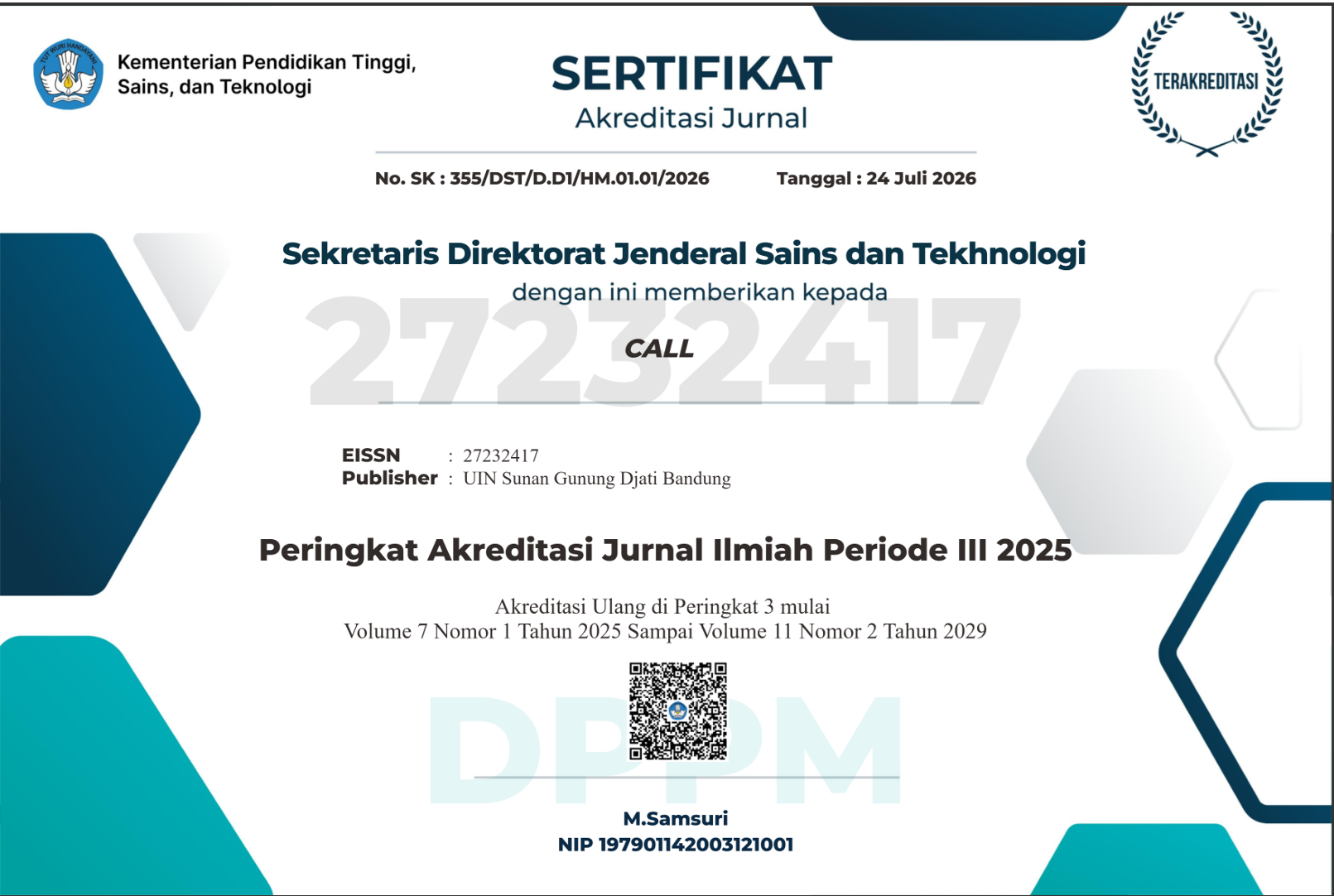
CALL is a journal established to promote academic articles on critical theory, arts, language, and literature as core issues in English Literature at the Faculty of Adab and Humanities, State Islamic University Sunan Gunung Djati Bandung. To develop the academic landscape in particular and contribute to linguistics and literature disciplines, CALL provides critical thought and sophisticated work on current issues in those disciplines. Based on the Decree of the Director General of Higher Education, Research and Technology, Ministry of Education, Culture, Research and Technology of the Republic of Indonesia, regarding the Accreditation Ranking of Scientific Journals Period I 2024, Director General of Higher Education, Research and Technology No. 72/E/KPT/2024, CALL is indexed by Sinta Kemdikbud with the third grade (Sinta 3).