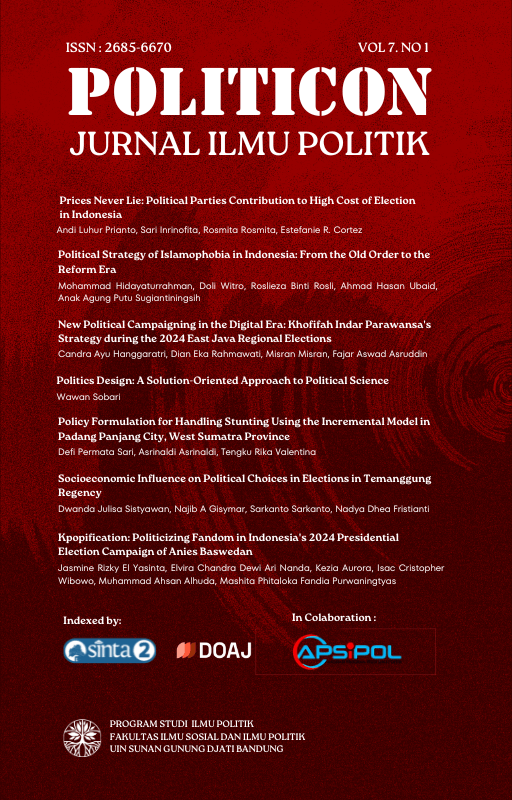
Kpopification: Politicizing Fandom in Indonesia's 2024 Presidential Election Campaign of Anies Baswedan
Keywords:
Indonesian presidential election, Kpop fans culture, Anies Baswedan, youth politics, political campaign, digital cultureAbstract
References
Adinugroho, B., Prisanto, G. F., Irwansyah, I., & Ernungtyas, N. F. (2019). Media Sosial Dan Internet Dalam Ketelibatan Informasi Politik Dan Pemilihan Umum. Representamen, 5(02). https://doi.org/10.30996/representamen.v5i02.2943
Andersen, K., Ohme, J., Bjarnøe, C., Bordacconi, M. J., Albæk, E., & De Vreese, C. H. (2021). Generational Gaps in Political Media Use and Civic Engagement. Taylor & Francis. https://doi.org/10.4324/9781003111498
Andini, A. N., & Akhni, G. N. (2021). Exploring Youth Political Participation: K-Pop Fan Activism in Indonesia and Thailand. Global Focus, 1(1), 38–55.
Arpandi, A. (2023). Media Online dalam Meningkatkan Partisipasi Politik Masyarakat pada Pemilihan Umum (Pemilu). Edu Society: Jurnal Pendidikan, Ilmu Sosial Dan Pengabdian Kepada Masyarakat, 3(1), 843–855. https://doi.org/10.56832/edu.v3i1.293
Christabella, M., & Sari, W. P. (2022). Pengaruh EPIC Model terhadap Pembentukan Perilaku Konsumtif Generasi Z (Studi Iklan Racun Shopee Pada Aplikasi TikTok). Prologia, 6(2), 280–287. https://doi.org/10.24912/pr.v6i2.15455
Dean, J. (2017). Politicising fandom. British Journal of Politics and International Relations, 19(2), 408–424. https://doi.org/10.1177/1369148117701754
Dean, J., & Andrews, P. (2021). Celebritization from Below: Celebrity, Fandom, and Anti-Fandom in British Politics. New Political Science, 43(3), 320–338. https://doi.org/10.1080/07393148.2021.1957602
Dimock, M. (2019). Defining generations: Where Millennials end and Generation Z begins. https://www.pewresearch.org/fact-tank/2019/01/17/where-millennials-end-and-generation-z-begins/
Fajardin, M. A. (2023, March 5). Perjalanan Karier Politik Anies Baswedan hingga Menuju Pilpres 2024. Sindonews, 1. https://nasional.sindonews.com/read/1038559/12/perjalanan-karier-politik-anies-baswedan-hingga-menuju-pilpres-2024-1677956590?showpage=all
Fatimah, S. (2018). Kampanye sebagai Komunikasi Politik: Esensi dan Strategi dalam Pemilu. Resolusi: Jurnal Sosial Politik, 1(1), 5–16. https://doi.org/10.32699/resolusi.v1i1.154
Gautama, S. A., & Kusuma, C. (2024). Pengaruh Komunikasi Pemasaran Politik Terhadap Keputusan Memilih Generasi Milenial. PAEDAGOGY : Jurnal Ilmu Pendidikan Dan Psikologi, 3(4), 218–228. https://doi.org/10.51878/paedagogy.v3i4.2719
Gracia, M. S. (2020). The Effectiveness of Political Campaign on Instagram to Influence Vote Intention. COMMENTATE: Journal of Communication Management, 1(1), 72. https://doi.org/10.37535/103001120206
Gumelar, S. A., Almaida, R., & Laksmiwati, A. A. (2021). Dinamika psikologis fangirl k-pop. Cognicia, 9(1), 17–24. https://doi.org/10.22219/cognicia.v9i1.15059
Illahi, S. K., & Andarini, S. (2022). Pengaruh Brand Image dan Brand Awareness terhadap Brand Loyalty pada Pengguna Provider Telkomsel di Surabaya. Reslaj : Religion Education Social Laa Roiba Journal, 4(6), 1684–1697. https://doi.org/https://doi.org/10.47467/reslaj.v4i6.1206
Jenkins, H. (2004). The Cultural Logic of Media Convergence. International Journal of Cultural Studies, 7(1), 33–43. https://doi.org/10.1177/1367877904040603
Jenkins, H. (2006). Convergence culture: where old and new media collide. NYU Press.
Jenkins, H. (2014). Participatory Culture: From Co-Creating Brand Meaning to Changing the World. GfK Marketing Intelligence Review, 6. https://doi.org/10.2478/gfkmir-2014-0096
Kellner, D. M. (2020). Media Culture: Cultural Studies, Identity, and Politics in the Contemporary Moment. Routledge. https://doi.org/https://doi.org/10.4324/9780429244230
Kozinets, R. (2017). Netnography: Radical participative understanding for a networked communications society. In C. Willig & W. Stainton-Rogers (Eds.), The SAGE Handbook of Qualitative Research in Psychology (p. 374). SAGE Publications.
Kozinets, R. V, & Gretzel, U. (2024). Netnography evolved: New contexts, scope, procedures and sensibilities. Annals of Tourism Research, 104, 103693. https://doi.org/https://doi.org/10.1016/j.annals.2023.103693
Kurniasih, K. P., Mansoor, A. Z., & Mustikadara, I. S. (2024). Kajian Kampanye Organik Kpopfication “Aniesbubble†di Platform Twitter_2024. Retorika: Jurnal Komunikasi, Sosial, Dan Ilmu Politik, 1(3), 1–13.
Litt, E., & Hargittai, E. (2016). The Imagined Audience on Social Network Sites. Social Media and Society, 2(1). https://doi.org/10.1177/2056305116633482
Livingstone, S. (2015). Active Audiences? The Debate Progresses But Is Far From Resolved. Communication Theory, 25(4), 439–446. https://doi.org/10.1111/comt.12078
Lundy, J., Jenkins, A., & Van den Bulck, H. (2020). Fandom. In The International Encyclopedia of Media Psychology (pp. 1–5). https://doi.org/https://doi.org/10.1002/9781119011071.iemp0214
Maulidania, D. N. (2024). Struktur Kepribadian Pada Realitas Kampanye Politik Pemilihan Osis Dalam Film Carnivale. Action Research Literate, 8(1). https://doi.org/10.46799/arl.v8i1.246
Nur, E. (2020). Tanggapan Generasi Z Terhadap Pemanfaatan Media Sosial Dalam Mendukung Keterlibatan Dalam Pemilu Legislatif 2019. Jurnal Penelitian Pers Dan Komunikasi Pembangunan, 24(2), 117–131. https://doi.org/10.46426/jp2kp.v24i2.122
O’Sullivan, J., & Fortunati, L. (2021). Media Convergence. In G. Balbi, N. Ribeiro, V. Schafer, & C. Schwarzenegger (Eds.), Digital Roots: Historicizing Media and Communication Concepts of the Digital Age (pp. 41–58). De Gruyter. https://doi.org/10.7551/mitpress/14966.003.0003
Parry-Giles, T. (2022). Political Communication. In C. S. Beck (Ed.), Communication in the 2020s: Viewing Our World Through the Eyes of Communication Scholars (pp. 125–132). Routledge. https://doi.org/https://doi.org/10.4324/9781003220466
Priana, A., & Wijayanti, V. (2020). Efektivitas Iklan Baliho Grace Natalie Dalam Meningkatkan Citra Diri Sebagai Ketua Umum Partai Solidaritas Indonesia Tahun 2019. Commed : Jurnal Komunikasi Dan Media, 4(2), 108–122. https://doi.org/10.33884/commed.v4i2.1652
Putra, Y. S. (2016). THEORITICAL REVIEW: TEORI PERBEDAAN GENERASI. Among Makarti, 9(18), 123–134.
Robin, P., Alvin, S., & Hasugian, T. (2022). Gen-Z Perspective on Politics: High Interest, Uninformed, and Urging Political Education. Jurnal Ilmu Sosial Dan Ilmu Politik (JISIP), 11(3), 183–189. https://doi.org/10.33366/jisip.v11i3.2550
Rohma, M. N. (2024). Bagaimana aktivisme digital penggemar k-pop di indonesia mewarnai pemilu 2024. The Conversation Indonesia. https://theconversation.com/bagaimana-aktivisme-digital-penggemar-k-pop-di-indonesia-mewarnai-pemilu-2024-220778
Saputro, R. H., Anggoro, T., Muslim, S., Wardani, I. U., Fatmawati, E., Yusuf, M., Prasetyo, D., & Yusuf, M. A. (2023). Gaining Millenial and Generation Z Vote: Social Media Optimization by Islamic Political Parties. Res Militaris, 13(1), 323–336.
Sartikasari, S., Hardi, R., & Hartaman, N. (2021). Efektivitas Kampanye Politik Di Media Sosial Pada Pemilihan Kepala Daerah Tahun 2018 Di Kecamatan Sajoanging Kabupaten Wajo. KYBERNOLOGY : Journal of Government Studies, 1(1), 16–33. https://journal.unismuh.ac.id/index.php/kybernology
Shatto, B., & Erwin, K. (2016). Moving on From Millennials: Preparing for Generation Z. J Contin Educ Nurs, 47(6), 253–254. https://doi.org/10.3928/00220124-20160518-05
Stever, G. S. (2021). Processes of Audience Involvement. In G. S. Stever, D. C. Giles, J. D. Cohen, & M. E. Myers (Eds.), Understanding Media Psychology (1st editio, p. 22). Routledge.
Tambunan, T. U., Yuniman Zebua, & Junita Lubis. (2023). Pengaruh Fasilitas, Pelayanan, Harga Dan Pemberian Diskon Terhadap Kepuasan Pelanggan (Studi Kasus Pada Warnet @N-Kom Net). JEMSI (Jurnal Ekonomi, Manajemen, Dan Akuntansi), 9(3), 642–649. https://doi.org/10.35870/jemsi.v9i3.1099
Wang, Y., Zhao, H., Lu, Z., & Wattenhofer, R. (2021). Idols that You Decide: Understanding the Phenomenon and Practices of Fan-Idol Crowdfunding. SSRN Electronic Journal, 1(1). https://doi.org/10.2139/ssrn.3843034
Wang, Z. (2020). The Complicated Digital Fandom: Empowerment and Exploitation of Fans in Digital Media Era. Humanities and Social Sciences, 8(2), 45. https://doi.org/10.11648/j.hss.20200802.11
Yahya, A. N. (2024, February 10). Survei LSI: Mayoritas Responden Anggap Prabowo-Gibran Kontestan Paling Jujur. Kompas.Com, 1. https://nasional.kompas.com/read/2024/02/10/18073971/survei-lsi-mayoritas-responden-anggap-prabowo-gibran-kontestan-paling-jujur
Downloads
Published
How to Cite
Issue
Section
Citation Check
License
Copyright (c) 2025 Jasmine Rizky El Yasinta, Elvira Chandra Dewi Ari Nanda, Kezia Aurora, Isac Cristopher Wibowo, Muhammad Ahsan Alhuda, Mashita Phitaloka Fandia Purwaningtyas

This work is licensed under a Creative Commons Attribution-ShareAlike 4.0 International License.
Authors who publish with this journal agree to the following terms:
- Authors retain copyright and grant the journal right of first publication with the work simultaneously licensed under a Creative Commons Attribution-ShareAlike 4.0 International License that allows others to share the work with an acknowledgment of the work's authorship and initial publication in this journal.
- Authors are able to enter into separate, additional contractual arrangements for the non-exclusive distribution of the journal's published version of the work (e.g., post it to an institutional repository or publish it in a book), with an acknowledgment of its initial publication in this journal.
- Authors are permitted and encouraged to post their work online (e.g., in institutional repositories or on their website) prior to and during the submission process, as it can lead to productive exchanges, as well as earlier and greater citation of published work (See The Effect of Open Access).


.jpg)