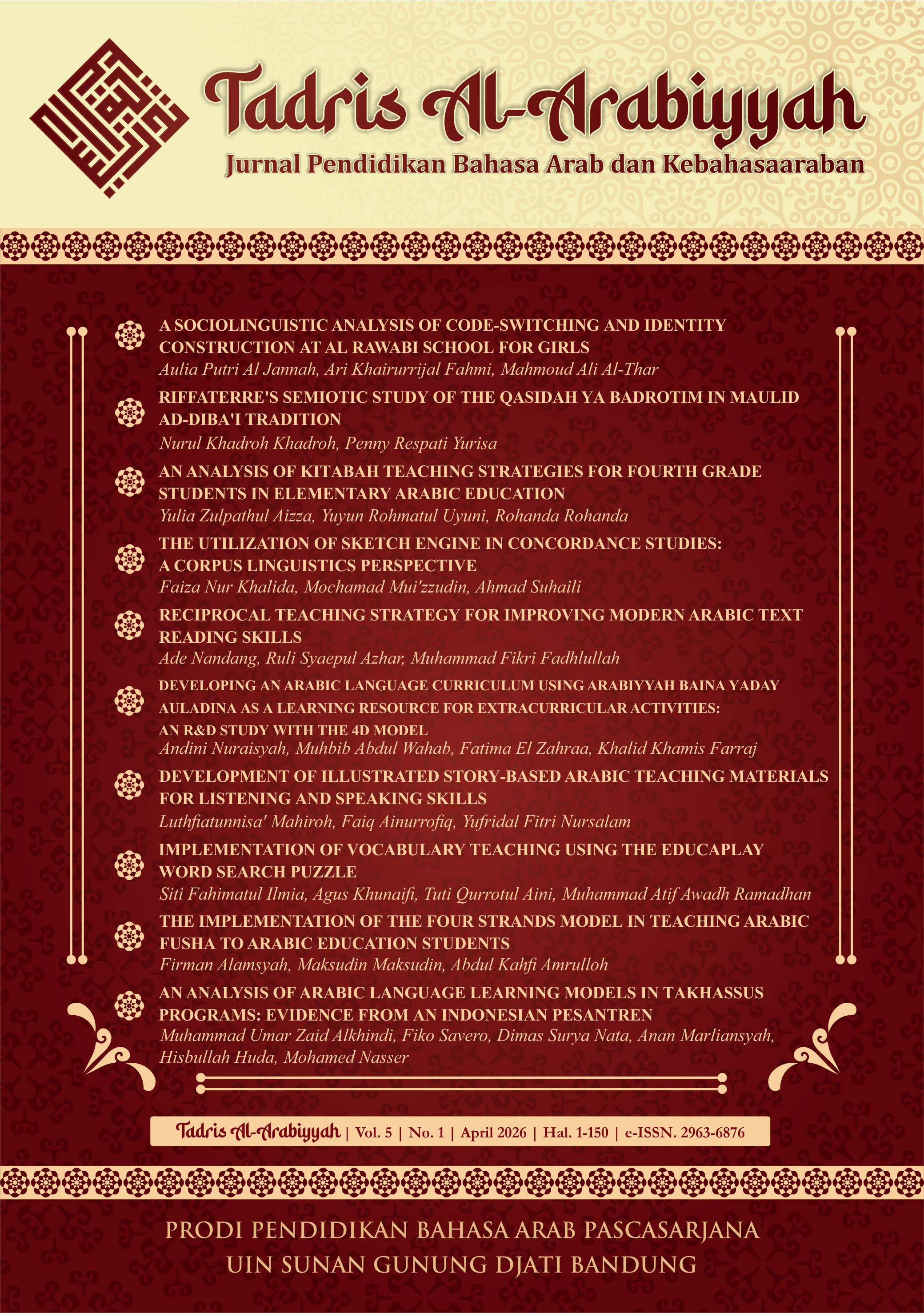
A Sociolinguistic Analysis of Code-Switching and Identity Construction at Al Rawabi School for Girls
DOI:
https://doi.org/10.15575/ta.v5i1.54639Keywords:
Arabic-English, Code-switching, Digital media, Social identityAbstract
Research on code-switching in Arabic media has largely focused on linguistic forms and educational background. In contrast, the role of high-prestige language varieties in constructing social hierarchy among adolescents in global digital media remains underexplored. This study addresses this gap by examining code-switching practices in the first season of the Netflix series Al Rawabi School for Girls. The study aims to analyze how Arabic-English code-switching functions as a socio-pragmatic resource for identity negotiation, power expression, and group differentiation among teenage girls. This research employs Qualitative Content Analysis (QCA) supported by Dell Hymes' SPEAKING framework and Tajfel and Turner's Social Identity Theory. A total of 83 instances of code-switching were identified and analyzed to examine the relationship between linguistic choices and social positioning. The findings reveal that code-switching is not merely an indicator of bilingual proficiency but primarily a symbolic strategy for constructing in-group solidarity and reinforcing out-group exclusion. English is associated with power, modernity, and social dominance, while Arabic serves as a marker of relational positioning and contextual identity negotiation. Among the observed data, patterns of linguistic behavior consistently reflect identity construction shaped by peer-group dynamics and media representation. This study contributes to sociolinguistic theory by demonstrating how linguistic globalization in digital media contexts facilitates the emergence of language-based social stratification and identity performance among Arab adolescents.
References
Akhtar, S., Baig, F. Z., Aslam, M. Z., Khan, T., Tayyaba, S., & Iqbal, Z. (2020). Code-Switching and Identity: A Sociolinguistic Study of Hanif's Novel Our Lady of Alice Bhatti. International Journal of English Linguistics, 10(1), 364–371. https://doi.org/10.5539/ijel.v10n1p364
Al-Issa, A., & Sulieman, H. (2024). Arabic or English? Multilingual Users' Preferences in Dubai ATM Transactions. Frontiers in Communication, 9, 1355632. https://doi.org/10.3389/fcomm.2024.1355632
Al-Murshidi, R. D. E., & Mahdi, M. A. H. (2025). The Representation of Middle Eastern Women in Aladdin Movie (2019): A Critical Discourse Analysis. Majallah Al-Bahits, 44(3), 541–559. https://doi.org/10.63797/bjh.v44i3.3975
Al-Musthofa, W. F., & D'Angelo, J. F. (2024). Code Code-Switching in Bilingual Education: Cognitive and Social Implications. Interling : International Journal of English Language Teaching, Literature and Linguistics, 2(2), 58–62. https://doi.org/10.55210/interling.v2i2.1791
Alrwaita, N., Meteyard, L., Houston-Price, C., & Pliatsikas, C. (2022). Is There an Effect of Diglossia on Executive Functions? An Investigation among Adult Diglossic Speakers of Arabic. Languages, 7(4), 312. https://doi.org/10.3390/languages7040312
Arsidi, D. A., Indriani, K. S., & Adni, N. P. (2023). Code-Switching in The Youtube Video of Nessie Judges. ULIL ALBAB: Jurnal Ilmiah Multidisiplin, 2(10), 4844–4850. https://doi.org/10.56799/jim.v2i10.2254
Atay, S. (2019). Multilingualism and Cinema. 2(1), 140–163. https://doi.org/10.5281/ZENODO.3471756
Daoud, R., Alrashdan, I., & Altakhaineh, A. R. M. (2025). Negation in Ammani Arabic: A Sociolinguistic Study. Jordan Journal of Modern Languages & Literatures, 17(4), 919–939. https://doi.org/10.47012/jjmll.17.4.4
Dunn, R., Clayton, E., Wolverson, E., & Hilton, A. (2022). Conceptualising Comorbidity and Multimorbidity in Dementia: A Scoping Review and Syndemic Framework. Journal of Multimorbidity and Comorbidity, 12, 26335565221128432. https://doi.org/10.1177/263355652211284
Fahmi, A. K. (2019). Absurditas Albert Camus dalam Novel Terjemahan Karya Zuriyati Mencari Perempuan Yang Hilang. Hortatori: Jurnal Pendidikan Bahasa Dan Sastra Indonesia, 3(2), 81–90. https://doi.org/10.30998/jh.v3i2.219
Fahri, M., Mahfuzo, M. R., & Badry, A. (2025). Foreign Language Enjoyment, Self-Efficacy, and Willingness to Communicate: Evidence from Arabic Language Education Students. Tadris Al-’Arabiyyah: Jurnal Pendidikan Bahasa Arab Dan Kebahasaaraban, 4(2), 144–156. https://doi.org/10.15575/ta.v4i2.49443
Hoffmann, C. (2014). Introduction to Bilingualism. Routledge. https://doi.org/10.4324/9781315842035
Indah, Y. S., & Rachmawati, D. L. (2025). Code-Switching, Code-Mixing, and Stylistic Identity in the Teen Drama Asmara Gen-Z. Indonesian Teaching English to Speakers of Other Languages Journal, 2(2), 265–279. https://doi.org/10.30587/inatesol.v2i2.11026
Jacquemet, M. (2015). Language in the Age of Globalization. In The Routledge Handbook of linguistic anthropology (pp. 329–347). Routledge.
Ja'far, H., & Hasanah, M. (2024). Code-switching in Arabic Teaching: Vygotsky's Sociocultural Theory Perspective. ALSUNIYAT: Jurnal Penelitian Bahasa, Sastra, Dan Budaya Arab, 7(2), 465–490. https://doi.org/10.17509/alsuniyat.v7i2.69630
Jarrah, M., Emaish, N., Ali, S., Al-Shawashreh, E., Al-Jabali, Y., & Kasasbeh, B. (2024). On The Social Use Of 'Urban Ammani Arabic' By Adult Female Speakers in the Amman Metropolitan Area. Journal of Intercultural Communication, 24(4), 23–37. https://doi.org/10.36923/jicc.v24i4.946
Lestari, S. W., Muassomah, M., & Yurisa, P. R. (2023). Campur Kode dalam Film Arab Alrabawi School For Girls Karya Tima Shomali: Bentuk dan Faktor yang Mempengaruhi (Kajian Sosiolinguistik). Al-Fathin: Jurnal Bahasa Dan Sastra Arab, 6(01), 50–66. https://doi.org/10.32332/al-fathin.v6i01.6256
Ma, R., & Wang, X. (2024). Cultural Representation in Transnational Cinema: A Study of Eastern Cultural Symbols and Identity in Western Films. Humanities, 3(4), 59–64. https://doi.org/10.57237/j.ha.2024.04.001
Maduwani, J. S., Yulianti, W., & Yustanto, H. (2024). Alih Kode dan Campur Kode dalam Interaksi Jual Beli di Pasar Johar. Translation and Linguistics (Transling), 4(1), 34–48. https://doi.org/10.20961/transling.v4i1.85764
Makrifah, N., & Intan Sari, D. (2023). The Representative Meaning of Longing in Mahmoud Darwish's "Ila Ummi" Poem Viewed from a Semantic Approach. Tadris Al-’Arabiyyah: Jurnal Pendidikan Bahasa Arab Dan Kebahasaaraban, 2(2), 140–155. https://doi.org/10.15575/ta.v2i2.26114
Malkawi, M., Hudaib, S., & Al-Harahsheh, A. (2025). Subtitling Jordanian Cultural Expressions into English on Netflix: A Case Study of AlRawabi School for Girls Season 2. Humanities and Social Sciences Communications, 12(1), 1586. https://doi.org/10.1057/s41599-025-05877-7
Manel, M., Hassan, A., & Buriro, H. A. (2019). Learners' Attitudes Towards Teachers' Switching to the Mother Tongue. The Case of Secondary School Learners in Algeria. Indonesian TESOL Journal, 1(1), 9–26. https://doi.org/10.24256/itj.v1i1.550
Mashaqba, B., Huneety, A., Al-Haq, S. A.-A., & Dardas, Y. (2023). Attitude towards Jordanian Arabic dialects: A sociolinguistic perspective. Jordan Journal of Modern Languages & Literatures, 15(3), 959–980. https://doi.org/10.47012/jjmll.15.3.12
Maszein, H., Suwandi, S., & Sumarwati, S. (2019). Alih Kode dan Campur Kode Dalam Interaksi Pembelajaran Bahasa Indonesia di SMA Negeri 7 Surakarta. BASASTRA: Jurnal Bahasa, Sastra, Dan Pengajarannya, 7(2), 62–71. https://doi.org/10.20961/basastra.v7i2.37780
Mayring, P. (2019). Qualitative Content Analysis: Demarcation, Varieties, Developments. Forum: Qualitative Social Research, 20(3). https://doi.org/10.17169/fqs-20.3.3343
Muhajir, M., & Karomah, S. (2021). Arabic Language Education Program at Islamic Boarding School Ibnul Qoyyim Putri Yogyakarta: Study of Code Mixing, Code Switching, and Interference. Jurnal Pendidikan Islam, 10(2), 181–218. https://doi.org/10.14421/jpi.2021.102.181-218
Muna, Z. T., Fadhilah, F. N., Rachmawati, A. E., & Setiyawan, A. (2024). Exploring Challenges in Learning Arabic as a Second Language: A Study of Code-Switching and Code-Mixing. Ta’lim al-’Arabiyyah: Jurnal Pendidikan Bahasa Arab & Kebahasaaraban, 8(1), 103–116. https://doi.org/10.15575/jpba.v8i1.32905
Musthafa, I., & Hermawan, A. (2018). Metodologi Penelitian Bahasa Arab: Konsep Dasar Strategi Metode Teknik. Remaja Rosdakarya.
Najib Halim, F., Masri’ah, M., & Nurwahidah, N. (2022). Application Of a Communicative Approach In Learning Arabic to Improve Students' Skills in Speaking Arabic. Tadris Al-’Arabiyyah: Jurnal Pendidikan Bahasa Arab Dan Kebahasaaraban, 1(2), 149–162. https://doi.org/10.15575/ta.v1i2.21049
Nazri, S. N. A., & Kassim, A. (2023). Issues and Functions of Code-switching in Studies on Popular Culture: A Systematic Literature Review. International Journal of Language Education and Applied Linguistics, 13(2), 7–18. https://doi.org/10.15282/ijleal.v13i2.9585
O'Connor, C., & Joffe, H. (2020). Intercoder Reliability in Qualitative Research: Debates and Practical Guidelines. International Journal of Qualitative Methods, 19, 1609406919899220. https://doi.org/10.1177/1609406919899220
Rodriguez Tembras, V. (2024). Two Languages, One Goal: Code-Switching in Doctor–Patient Communication in the Galician Healthcare System. Languages, 9(6), 209. https://doi.org/10.3390/languages9060209
Roushdy, N. (2023). "It's just Arabic!": Linguistic Anxiety and Identity Negotiations in Egypt's International Schools. Revue Des Mondes Musulmans et de La Méditerranée, 154, 105–124. https://doi.org/10.4000/remmm.20198
Setyawati, K. A. (2022). Ethnography of Communication: The analysis of Dell Hymes' SPEAKING Model in the Communication Among the Infertility Husband and Wife. Linguistics Initiative, 2(1), 59–69. https://doi.org/10.53696/27753719.2131
Shahzadi, I. (2025). Negotiating Social Identities: The Role of Code-Switching and Code-Mixing in ESL Classrooms in Pakistan. South Asian Journal of Arts, Humanities and Society, 1(1), 21–29. Retrieved from https://journals.usa.edu.pk/sajahs/article/view/3
Turner, J. C., Brown, R. J., & Tajfel, H. (1979). Social Comparison and Group Interest in In-Group Favouritism. European Journal of Social Psychology, 9(2), 187–204. https://doi.org/10.1002/ejsp.2420090207
Zaheer, S. U. H., Muhammad, A. M., Shams, S., & Alia, B. (2025). English Code-Switching in Arabic Discourse: A Study of Linguistic and Cultural Influence. Journal of Applied Linguistics and TESOL (JALT), 8(3), 1887–1897. https://doi.org/10.63878/jalt1188
Downloads
Published
How to Cite
Issue
Section
Citation Check
License
Copyright (c) 2026 Aulia Putri Al Jannah, Ari Khairurrijal Fahmi, Mahmoud Ali Al-Thar

This work is licensed under a Creative Commons Attribution-ShareAlike 4.0 International License.