
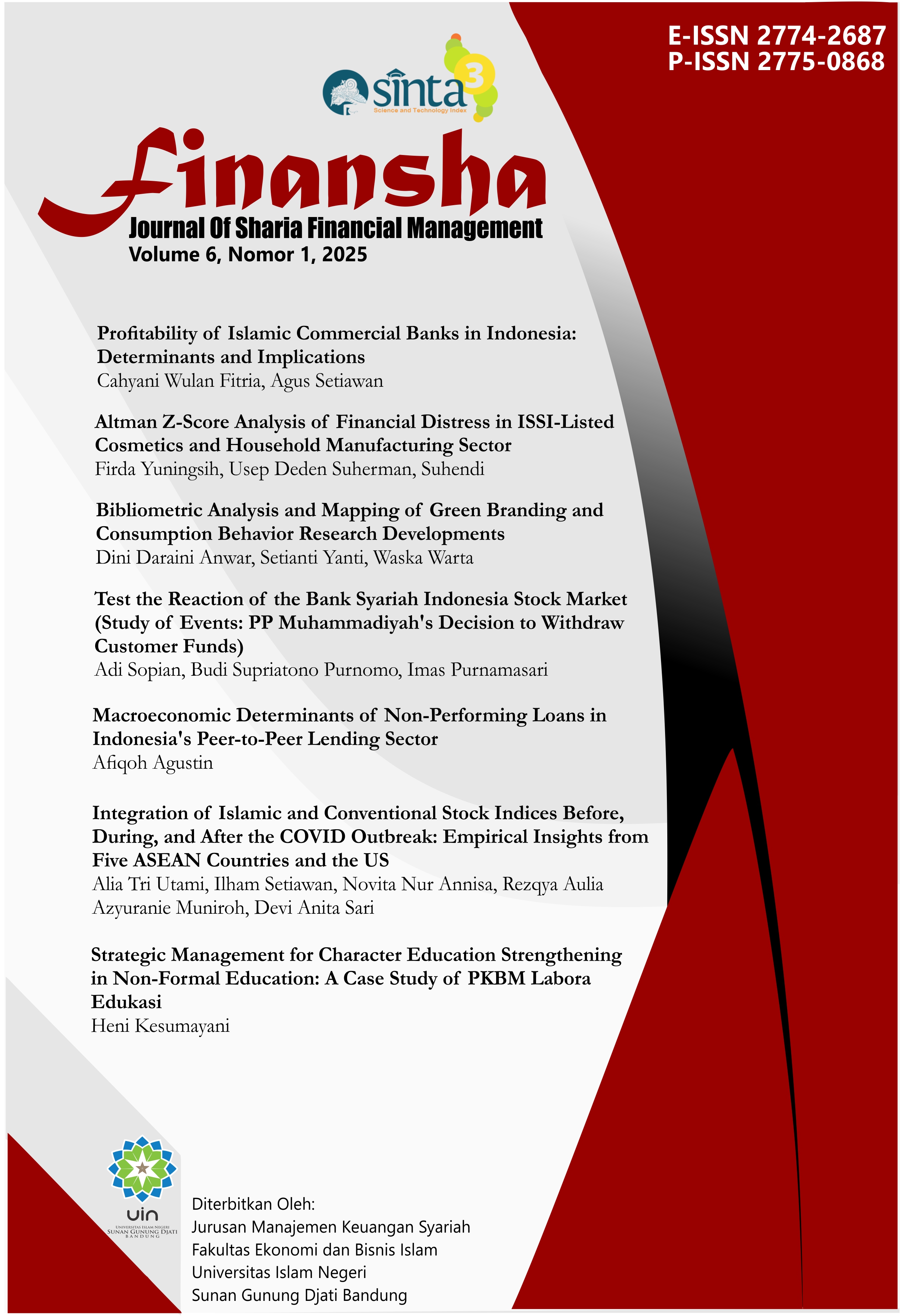
INTEGRATION OF ISLAMIC AND CONVENTIONAL STOCK INDICES BEFORE, DURING, AND AFTER COVID OUTBREAK: EMPIRICAL INSIGHTS FROM FIVE ASEAN COUNTRIES AND THE US
DOI:
https://doi.org/10.15575/fjsfm.v6i1.41635Keywords:
Market Integration, Islamic Capital Markets, ASEAN, DJIA, Portofolio Diversification.Abstract
This study aims to examine the long-term integration among Islamic capital markets in five ASEAN countries namely Indonesia (ISSI), Malaysia (FTSE-MB), Thailand (FTSE-SET), Singapore (FTSE-SGX), and the Philippines (MSCI-PH) along with the U.S. stock market (DJIA) before, during, and after the COVID outbreak. Utilizing a quantitative approach, the study analyzed daily closing prices from November 2018 (a year before the COVID-19 outbreak) to May 2024 (a year following the COVID-19 outbreak). We employed the Johansen cointegration test and the Vector Error Correction Model (VECM) to assess market cointegration. Results reveal that all ASEAN Islamic indices exhibit significant cointegration with the Dow Jones Industrial Average (DJIA). The FTSE-SET and MSCI-PH indices show a strong positive correlation with the DJIA; in contrast, the ISSI and FTSE-SGX indices display a negative correlation, suggesting potential diversification benefits for investors. The Granger Causality Test further identifies causal linkages between certain ASEAN indices and the DJIA. These findings underscore the influence of global dynamics on ASEAN Islamic markets, despite their unique characteristics. The results advocate for portfolio diversification and the formulation of adaptive economic policies to enhance the stability of ASEAN Islamic markets amid global financial volatility.
References
Abbes, M. B., & Trichilli, Y. (2015). Islamic stock markets and potential diversification benefits. Borsa Istanbul Review, 15(2), 93–105. https://doi.org/10.1016/j.bir.2015.03.001
Bekaert, G., & Harvey, C. R. (1995). Time-varying world market integration. The Journal of Finance, 50(2), 403. https://doi.org/10.2307/2329414
Dash, S. R., & Maitra, D. (2022). The COVID-19 pandemic uncertainty, investor sentiment, and global equity markets: Evidence from the time-frequency co-movements. The North American Journal of Economics and Finance, 62, 101712. https://doi.org/10.1016/j.najef.2022.101712
De La Torre, A., & Schmukler, S. L. (2007). Emerging capital markets and globalization: The Latin American experience. Stanford University Press.
Engle, R. F., & Granger, W. J. (1987). Co-integration and error correction: Representation, estimation, and testing. Econometrica, 55, 251–276.
Granger, C. W. J. (1969). Investigating causal relations by econometric models and cross-spectral methods. Econometrica, 37(3), 424–438.
Hasan, M. B., Rashid, M. M., Shafiullah, M., & Sarker, T. (2022). How resilient are Islamic financial markets during the COVID-19 pandemic? Pacific Basin Finance Journal, 74, 101817. https://doi.org/10.1016/j.pacfin.2022.101817
Hassan, K., & Mahlknecht, M. (2011). Islamic capital markets: Products and strategies. John Wiley & Sons.
Hkiri, B., Hammoudeh, S., Aloui, C., & Yarovaya, L. (2017). Are Islamic indexes a safe haven for investors? An analysis of total, directional, and net volatility spillovers between conventional and Islamic indexes and importance of crisis periods. Pacific-Basin Finance Journal, 43, 124–150. https://doi.org/10.1016/j.pacfin.2017.03.001
Iqbal, Z., & Mirakhor, A. (2011). An introduction to Islamic finance: Theory and practice. John Wiley & Sons.
Johansen, S. (1988). Statistical analysis of cointegration vectors. Journal of Economic Dynamics and Control, 12, 231–254. https://doi.org/10.1016/0165-1889(88)90041-3
Kamaludin, K., Sundarasen, S., & Ibrahim, I. (2021). COVID-19, Dow Jones, and equity market movement in ASEAN-5 countries: Evidence from wavelet analyses. Heliyon, 7(1), e05851. https://doi.org/10.1016/j.heliyon.2020.e05851
Karim, B. A., & Karim, Z. A. (2012). Integration of ASEAN-5 stock markets: A revisit. Asian Academy of Management Journal of Accounting and Finance, 8(2), 21–41.
Majdoub, J., & Mansour, W. (2014). Islamic equity market integration and volatility spillover between emerging and US stock markets. The North American Journal of Economics and Finance, 29, 452–470. https://doi.org/10.1016/j.najef.2014.06.011
Majid, M. S. A., Meera, A. K. M., Omar, M. A., & Aziz, H. A. (2009). Dynamic linkages among ASEANâ€5 emerging stock markets. International Journal of Emerging Markets, 4(2), 160–184. https://doi.org/10.1108/17468800910945783
Muharam, H., Anwar, R. J., & Robiyanto, R. (2019). Islamic stock market and sukuk market development, economic growth, and trade openness (the case of Indonesia and Malaysia). Verslas Teorija Ir Praktika, 20, 196–207. https://doi.org/10.3846/btp.2019.19
Otoritas Jasa Keuangan. (2021). Market update pasar modal syariah Indonesia. Packag Magazine, 6(4), 14.
Pardal, P., Dias, R., Šuleř, P., Teixeira, N., & Krulický, T. (2020). Integration in Central European capital markets in the context of the global COVID-19 pandemic. Equilibrium. Quarterly Journal of Economics and Economic Policy, 15, 627–650. https://www.economic-policy.pl
Qizam, I., Ardiansyah, M., & Qoyum, A. (2020). Integration of Islamic capital market in ASEAN-5 countries: Preliminary evidence for broader benefits from the post-global financial crisis. Journal of Islamic Accounting and Business Research, 11(3), 811–825.
Sadiq, M., Hsu, C. C., Zhang, Y., & Chien, F. (2021). COVID-19 fear and volatility index movements: Empirical insights from ASEAN stock markets. Environmental Science and Pollution Research, 28, 67167–67184. https://doi.org/10.1007/s11356-021-15064-1
Securities Commission Malaysia. (n.d.). Malaysian Islamic Capital Market Bi-Annual Bulletin.
Youssef, M., Mokni, K., & Ajmi, A. N. (2021). Dynamic connectedness between stock markets in the presence of the COVID-19 pandemic: Does economic policy uncertainty matter? Financial Innovation, 7(1). https://doi.org/10.1186/s40854-021-00227-3
Downloads
Published
How to Cite
Issue
Section
Citation Check
License
Authors who publish with this journal agree to the following terms:
- Authors retain copyright and grant the journal right of first publication with the work simultaneously licensed under a Creative Commons Attribution License that allows others to share the work with an acknowledgment of the work's authorship and initial publication in this journal.
- Authors are able to enter into separate, additional contractual arrangements for the non-exclusive distribution of the journal's published version of the work (e.g., post it to an institutional repository or publish it in a book), with an acknowledgment of its initial publication in this journal.
- Authors are permitted and encouraged to post their work online (e.g., in institutional repositories or on their website) prior to and during the submission process, as it can lead to productive exchanges, as well as earlier and greater citation of published work (See The Effect of Open Access).