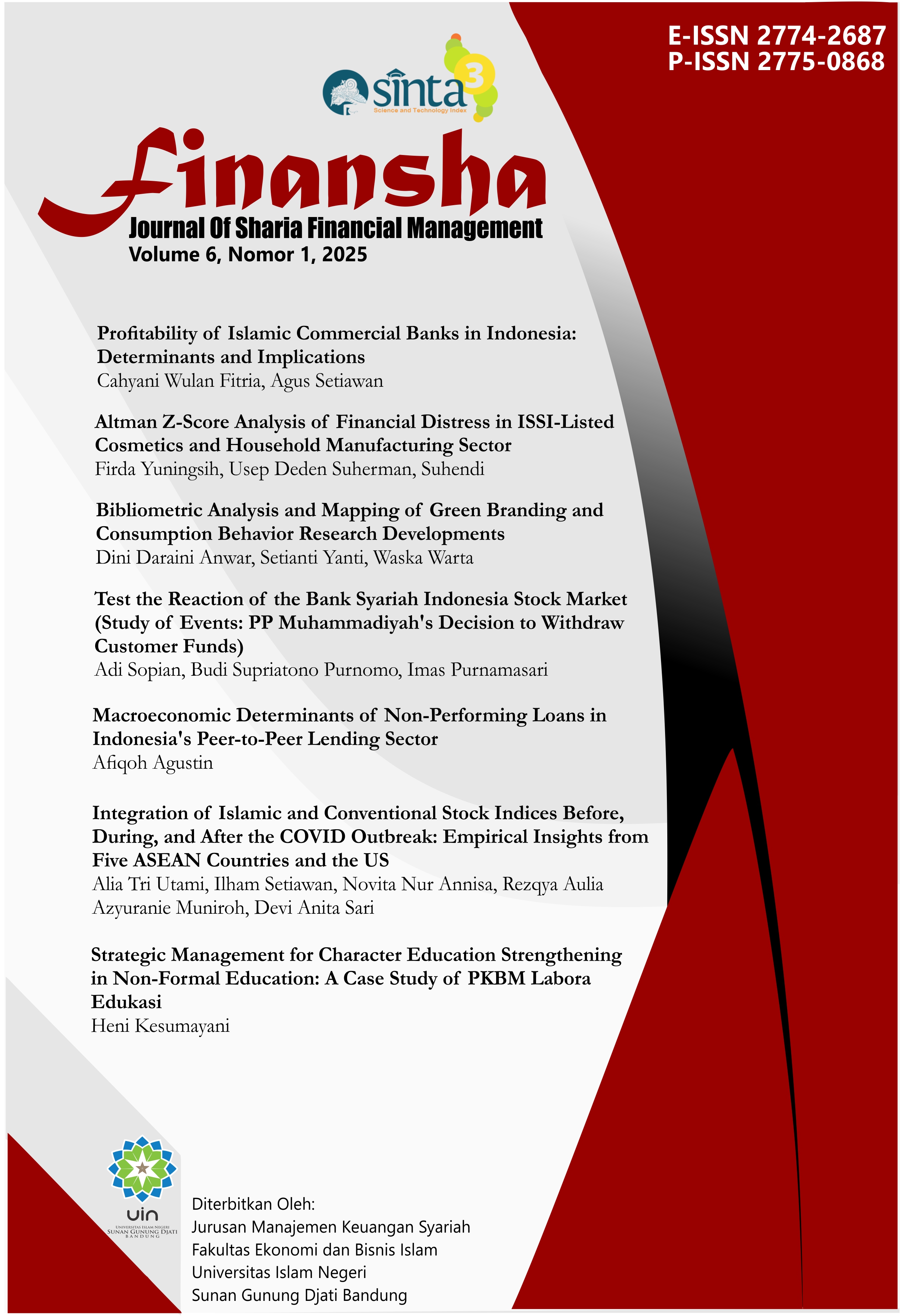
MACROECONOMIC DETERMINANTS OF NON-PERFORMING LOANS IN INDONESIA'S PEER-TO-PEER LENDING SECTOR
DOI:
https://doi.org/10.15575/fjsfm.v6i1.45136Abstract
The emergence of peer-to-peer (P2P) lending as a fintech innovation in Indonesia’s digital financial ecosystem has played a pivotal role in reshaping credit distribution, yet it has also coincided with a notable rise in non-performing loans (NPLs). While much of the existing literature focuses on traditional banking sectors, this study introduces a novel approach by concentrating exclusively on P2P lending—a relatively under-researched domain in Indonesia—in relation to macroeconomic dynamics. Specifically, it quantitatively investigates the impact of key macroeconomic indicators—economic growth, the benchmark interest rate (BI Rate), and the unemployment rate—on the occurrence of NPLs within P2P platforms. Utilizing quarterly time series data spanning from Q1 2020 to Q4 2024, sourced from Statistics Indonesia (BPS) and the Financial Services Authority (OJK), the study employs multiple linear regression analysis. The findings reveal that the three macroeconomic variables jointly exert a statistically significant effect on NPLs (F-test = 0.002). However, on an individual basis, only economic growth demonstrates a significant negative influence (p = 0.000), whereas the BI Rate and unemployment rate do not yield significant effects (p = 0.208 and 0.488, respectively). This research underscores the heightened sensitivity of P2P lending to shifts in economic performance and contributes to the academic discourse by highlighting the importance of developing adaptive, fintech-specific credit risk models in response to evolving macroeconomic conditions.
References
Badan Pusat Statistik. (2023). Berita resmi statistik: Keadaan ketenagakerjaan Indonesia Februari 2023. https://www.bps.go.id
Bienefeld, M., & Godfrey, M. (1975). Measuring Unemployment and the Informal Sector: Some Conceptual and Statistical Problems. Institute of Development Studies Bulletin, 7(3), 4–10. https://doi.org/10.1111/j.1759-5436.1975.mp7003002.x
Brankas. (2024). Peer-to-peer lending: Credit scoring and risk assessment in a decentralized environment. https://blog.brankas.com/Peer-to-Peer-Lending
Development, A. (2024). Outlook.
Ginting, A. M. (2017). Pengaruh makroekonomi terhadap non performing loan (NPL) di Indonesia: Studi non performing loan perbankan. Jurnal Ekonomi dan Kebijakan Publik, 7(2), 159. https://doi.org/10.22212/jekp.v7i2.669
Downloads
Published
How to Cite
Issue
Section
Citation Check
License
Authors who publish with this journal agree to the following terms:
- Authors retain copyright and grant the journal right of first publication with the work simultaneously licensed under a Creative Commons Attribution License that allows others to share the work with an acknowledgment of the work's authorship and initial publication in this journal.
- Authors are able to enter into separate, additional contractual arrangements for the non-exclusive distribution of the journal's published version of the work (e.g., post it to an institutional repository or publish it in a book), with an acknowledgment of its initial publication in this journal.
- Authors are permitted and encouraged to post their work online (e.g., in institutional repositories or on their website) prior to and during the submission process, as it can lead to productive exchanges, as well as earlier and greater citation of published work (See The Effect of Open Access).