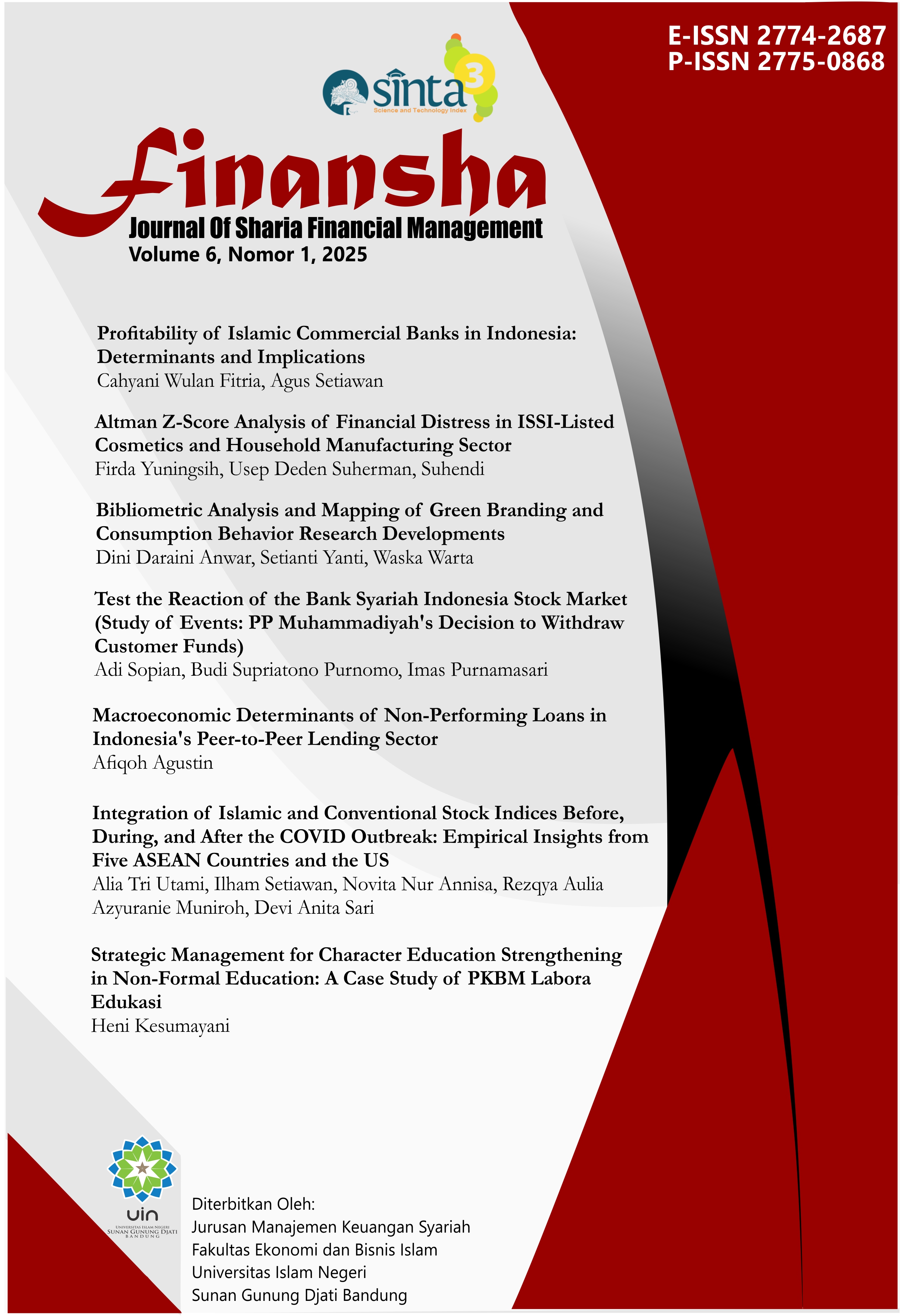
STRATEGIC MANAGEMENT FOR CHARACTER EDUCATION STRENGTHENING IN NON-FORMAL EDUCATION: A CASE STUDY OF PKBM LABORA EDUKASI
DOI:
https://doi.org/10.15575/fjsfm.v6i1.45181Keywords:
Character Education, Community Learning Center, Management, Strengthening ProgramAbstract
While character education has received increasing policy attention in Indonesia, limited research has examined how Pusat Kegiatan Belajar Masyarakat (PKBM), or Community Learning Centers—particularly those serving marginalized populations—strategically manage character development initiatives. This study investigates PKBM Labora Edukasi in Bogor, which employs a three-phase strategic model—planning, implementation, and evaluation—through contextual and collaborative approaches. Adopting a descriptive qualitative methodology, data were collected through in-depth interviews, participant observation, and document analysis to evaluate the implementation of the Character Education Strengthening Program (CESP). The program embeds character values into daily learning routines, utilizes tutors as role models, fosters partnerships with local Islamic boarding schools and private companies, and engages learners in context-based, experiential activities. The results indicate significant improvements in learner discipline, religiosity, civic engagement, and entrepreneurial mindset. These findings underscore the critical role of multi-stakeholder collaboration and contribute to the literature on strategic educational management by offering an adaptable framework for character education in resource-constrained, non-formal settings. The study highlights the potential for hybrid governance models to bridge national policy ambitions and grassroots realities, and it advocates for increased policy recognition and replication of such models in similar socio-educational contexts.
References
Febrianti, M., Saefullah, A., Nurhayati, N., & Tohhiroh, T. (2024). Implementasi konsep ESG (Environmental, Social, and Governance) dalam pengembangan ekonomi biru di kawasan Indo Pasifik: Studi kasus chairmanship Indonesia di ASEAN tahun 2023. Prosiding Seminar Nasional Ilmu Manajemen dan Bisnis, 32–41. https://prosiding.arimbi.or.id/index.php/PROSEMNASIMKB/article/view/4
Filiana, W., & Zainal, A. R. (2022). Tahapan perencanaan dalam kegiatan program kesetaraan Paket C PKBM Mekar Sari Kabupaten Kaur. Journal of Lifelong Learning, June, 1–7.
Hardani, U., Ustiawaty, J., Andriani, H., Istiqomah, R. R., Sukmana, D. J., Fardani, R., Auliya, N. H., & Utami, E. F. (2020). Metode penelitian kualitatif & kuantitatif. CV Pustaka Ilmu Group.
Hidayah, N., & Prayogo, M. S. (2022). Penguatan pendidikan karakter (PPK) dalam pembelajaran tematik kelas V sekolah dasar. Elementar: Jurnal Pendidikan Dasar, 2(2), 198–204. https://doi.org/10.15408/elementar.v2i2.29675
Ibrahim, A., Rifa’i, B., & Dewi, R. (2018). Pemberdayaan masyarakat melalui PKBM untuk meningkatkan keterampilan masyarakat miskin. Jurnal Pengembangan Masyarakat. http://jurnal.fdk.uinsgd.ac.id/index.php/tamkin/article/view/766
Indah Sari, H. (2023). Pemberdayaan masyarakat terhadap program keaksaraan fungsional di PKBM Daya. Jurnal Berita Sosial, 8, 1–14.
Kamilah, F., Pratiwi Ali, I., & Shomedran. (2023). Peningkatan kemampuan life skill warga belajar Paket C melalui program keterampilan (Studi kasus di PKBM Kusuma Bangsa Kabupaten Pali). Lifelong Education Journal, 3(1), 24–30. https://doi.org/10.59935/lej.v3i1.174
Muljono, P., & Hanafi, D. N. T. (2017). Pengembangan program kecakapan hidup (life skills) untuk pemberdayaan masyarakat sekitar pesantren. Sosio Konsepsia. https://www.academia.edu/download/83352832/KPMpjm-Artik11-Pengembangan_20program....pdf
Mulyanto, A., Komara, E., & others. (2023). Penerapan kepemimpinan visioner dalam pengembangan kurikulum pendidikan kesetaraan. JIIP: Jurnal Ilmiah Ilmu Pendidikan. http://jiip.stkipyapisdompu.ac.id/jiip/index.php/JIIP/article/view/2073
Nind, M. (2017). The practical wisdom of inclusive research. Qualitative Research, 17(3), 278–288. https://doi.org/10.1177/1468794117708123
Peraturan Presiden Republik Indonesia. (2019). Peraturan Presiden Republik Indonesia Nomor 87 tahun 2019 tentang Penguatan Pendidikan Karakter.
Presiden Republik Indonesia. (2017). Peraturan Presiden Republik Indonesia Nomor 87 tahun 2017 tentang Penguatan Pendidikan Karakter.
Raco, J. (2010). Metode penelitian kualitatif: Jenis, karakteristik dan keunggulannya. PT Grasindo.
Rahman, A., Suhandi, A., Nurlaela, N., Yoseptri, R., Ratnawulan, T., & Premeilani. (2024). Peran PKBM dalam meningkatkan pendidikan di daerah pinggiran kota (Studi kasus pada PKBM Hidayah). Jurnal Pendidikan Luar Sekolah, 12(1), 395–407.
Rahmat, A., Agustin, L., Indriyani, I., Alfakihuddin, M. L. B., Nurhayati, S., Kiswondo, S., Amilia, E., Akbarudin, Saefullah, A., Saefuddin, R., & Mutolib, A. (2025). Characteristics of latosol soil after application of rice husk biochar in Bogor Regency, Indonesia. In K. Komariah, N. Hiramatsu, N. Uddin, & D. P. Ariyanto (Eds.), BIO Web of Conferences (Vol. 155, p. 01018). https://doi.org/10.1051/bioconf/202515501018
Roca-Puig, V., Beltrán-Martín, I., & others. (2021). Incorporating poverty in society into strategic human resource management. The International Journal of Human Resource Management. https://doi.org/10.1080/09585192.2019.1640764
Downloads
Published
How to Cite
Issue
Section
Citation Check
License
Authors who publish with this journal agree to the following terms:
- Authors retain copyright and grant the journal right of first publication with the work simultaneously licensed under a Creative Commons Attribution License that allows others to share the work with an acknowledgment of the work's authorship and initial publication in this journal.
- Authors are able to enter into separate, additional contractual arrangements for the non-exclusive distribution of the journal's published version of the work (e.g., post it to an institutional repository or publish it in a book), with an acknowledgment of its initial publication in this journal.
- Authors are permitted and encouraged to post their work online (e.g., in institutional repositories or on their website) prior to and during the submission process, as it can lead to productive exchanges, as well as earlier and greater citation of published work (See The Effect of Open Access).