
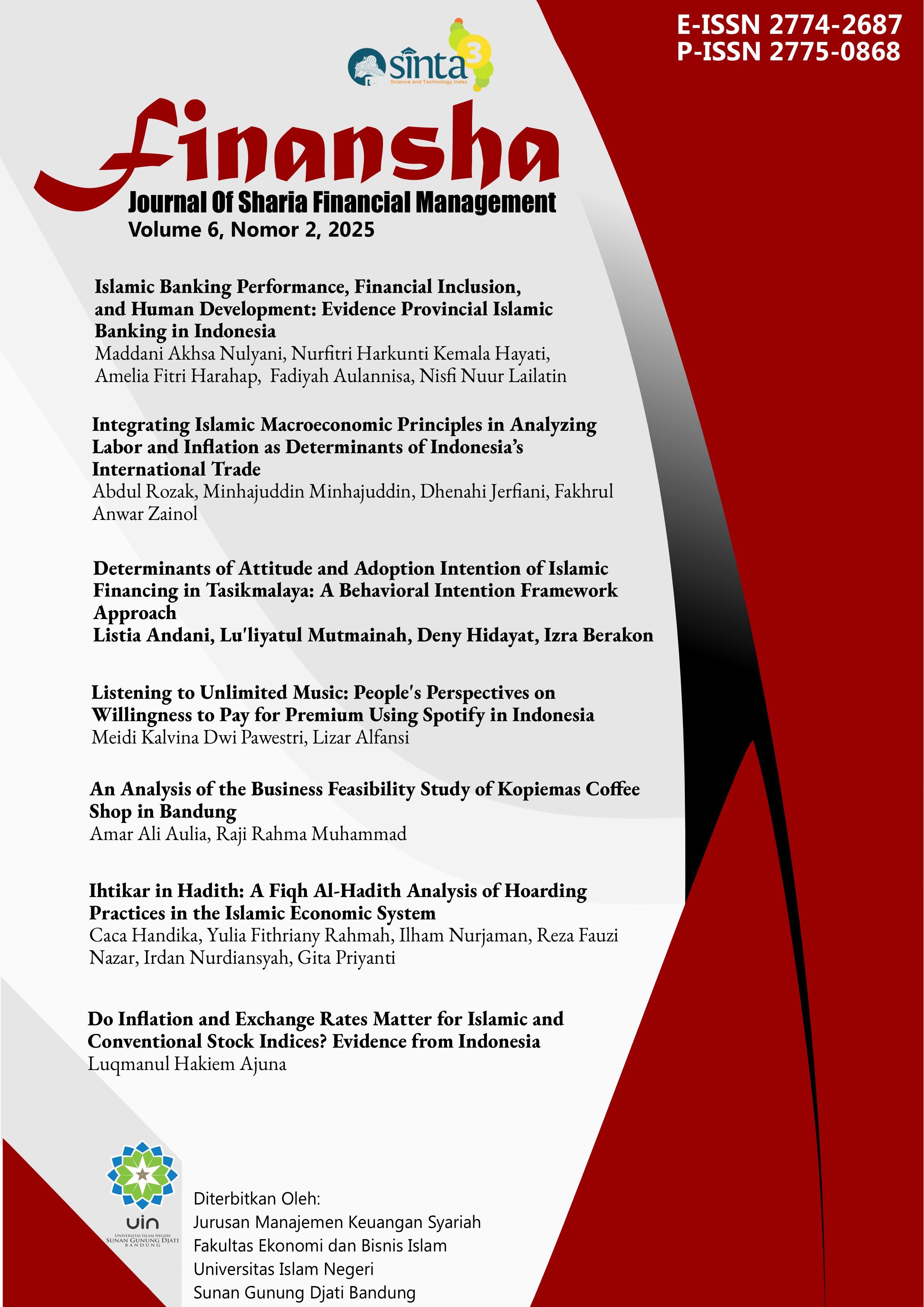
DO INFLATION AND EXCHANGE RATES MATTER FOR ISLAMIC AND CONVENTIONAL STOCK INDICES? EVIDENCE FROM INDONESIA
DOI:
https://doi.org/10.15575/fjsfm.v6i2.50349Keywords:
Arbitrage Pricing Theory, Composite Stock Price Index, Exchange Rate, Indonesian Sharia Stock Index (ISSI), InflationAbstract
Stock Index (ISSI) and the Indonesia Composite Stock Price Index (IHSG). Employing a quantitative approach, the study utilizes monthly secondary data from 2014 to 2023 obtained from the Indonesia Stock Exchange, Bank Indonesia, and the Central Bureau of Statistics. Multiple linear regression analysis is applied to assess both partial and simultaneous effects of macroeconomic variables on Islamic and conventional stock market indices. The empirical results reveal that inflation does not have a significant effect on either ISSI or IHSG. In contrast, the rupiah exchange rate exerts a significant influence on both indices, indicating that exchange rate movements play a more dominant role in shaping stock market performance than inflation. These findings suggest that, within the Indonesian context, exchange rate dynamics constitute a key source of systematic risk affecting both Islamic and conventional equity markets. The results provide empirical support for the Arbitrage Pricing Theory by highlighting the unequal influence of macroeconomic factors on asset prices. This study contributes to the literature by offering comparative evidence on the sensitivity of Islamic and conventional stock markets to macroeconomic conditions in an emerging economy.
References
Abaidoo, R., & Agyapong, E. K. (2024). Commodity prices, inflation, and inflation uncertainty among emerging economies. Journal of Economic and Administrative Sciences, 40(3), 622–640.
Abbate, A., Eickmeier, S., & Prieto, E. (2023). Financial shocks and inflation dynamics. Macroeconomic Dynamics, 27(2), 350–378.
Al Amin, I., & Sholahuddin, M. (2023). The effect of inflation, interest rates, and USD exchange rate on the Indonesian Sharia Stock Index (ISSI) during 2019–2022. International Journal of Applied Finance and Business Studies, 11(1), 50–58.
Amal, M. A., & Musthofa, M. W. (2023). The impact of the Dow Jones Islamic Market, interest rate, rupiah exchange rate, and inflation on the Indonesian Sharia Stock Index during 2018–2022. Jurnal Ekonomi Syariah Teori dan Terapan, 10(2).
Bahloul, S., Mroua, M., & Naifar, N. (2017). The impact of macroeconomic and conventional stock market variables on Islamic index returns under regime switching. Borsa Istanbul Review, 17(1), 62–74.
Boediono. (2019). Ekonomi makro. BPFE.
Canarella, G., & Miller, S. M. (2016). Inflation persistence and structural breaks: The experience of inflation-targeting countries and the USA. Journal of Economic Studies, 43(6), 980–1005.
Demir, F., & Razmi, A. (2022). The real exchange rate and development theory, evidence, issues, and challenges. Journal of Economic Surveys, 36(2), 386–428.
Dewi, N. F., & Fauzan, A. (2023). The relationship between exchange rate, inflation, foreign exchange reserves, export, and import in Indonesia: A vector error correction model approach. In Proceedings of the 3rd International Seminar on Science and Technology (ISSTEC 2021) (Vol. 2720, Article 020025). AIP Publishing.
Dinata, G. A., & Yusbardini, Y. (2025). The influence of rupiah exchange rate, world oil prices, and inflation on the Composite Stock Price Index (IHSG). In Proceedings of the Tarumanagara International Conference on the Applications of Social Sciences and Humanities (TICASH 2024) (pp. 72–81). Atlantis Press.
Fama, E. F., & Schwert, G. W. (1977). Asset returns and inflation. Journal of Financial Economics, 5(2), 115–146.
Handriani, M. S., Isnurhadi, I., Yuliani, Y., & Sulastri, S. (2021). The effect of inflation rate, rupiah exchange rate, world oil prices, and world gold prices on the Indonesian Sharia Stock Index (ISSI). International Journal of Business, Economics and Management, 4(2), 363–371.
Harsono, A. R. (2018). Pengaruh inflasi, suku bunga, dan nilai tukar rupiah terhadap Indeks Harga Saham Gabungan [Undergraduate thesis, Universitas Brawijaya]. https://repository.ub.ac.id/162675/
Ilham, K. R., & Nyoman, S. I. A. (2019). The influence of world stock index, BI rate, and Fed rate through IHSG on exchange rates in Indonesia (2006–2015). Russian Journal of Agricultural and Socio-Economic Sciences, 93(9), 216–226.
Katmas, E., & Indarningsih, N. A. (2022). The effect of BI interest rate, exchange rate, and inflation on the Indonesian Sharia Stock Index (ISSI). Indonesian Interdisciplinary Journal of Sharia Economics, 5(2), 768–782.
Krugman, P. R., & Obstfeld, M. (2018). International economics: Theory and policy (11th ed.). Pearson.
Laksono, R. (2024). Analysis of the influence of macroeconomic factors on long-term and short-term fluctuations of the Indonesian stock exchange using the ECM approach. Technium Social Sciences Journal, 63, 162–173.
Mankiw, N. G. (2018). Prinsip-prinsip ekonomi (7th ed., Indonesian trans.). Salemba Empat.
Marpaung, N. N., & Pangestuti, I. R. D. (2024). Macroeconomic factors and the Jakarta Stock Exchange: A comparative analysis pre- and during the COVID-19 pandemic. SAGE Open, 14(2), 21582440241247894.
Naifar, N. (2016). Do global risk factors and macroeconomic conditions affect global Islamic index dynamics? A quantile regression approach. The Quarterly Review of Economics and Finance, 61, 29–39.
Nugroho, I., Hidayatullah, M. S., & Jayanti, A. A. (2023). The effect of inflation, exchange rate, and BI rate on the Indonesian Sharia Stock Index. Journal of Islamic Economics and Finance Studies, 4(1), 114–132.
Otieno, D. A., Ngugi, R. W., & Muriu, P. W. (2019). The impact of inflation rate on stock market returns: Evidence from Kenya. Journal of Economics and Finance, 43(1), 73–90.
Priyono, A. A., & Kartiko, A. (2021). The effect of COVID-19, rupiah exchange rate, and inflation on the Indonesian Sharia Stock Index. Indonesian Interdisciplinary Journal of Sharia Economics, 4(1), 313–336.
Rapach, D. E. (2002). The long-run relationship between inflation and real stock prices. Journal of Macroeconomics, 24(3), 331–351.
Reinganum, M. R. (1981). The arbitrage pricing theory: Some empirical results. The Journal of Finance, 36(2), 313–321.
Salvatore, D. (2015). International economics (11th ed.). Wiley.
Shapiro, A. C. (1975). Exchange rate changes, inflation, and the value of the multinational corporation. The Journal of Finance, 30(2), 485–502.
Umar, Z., Kenourgios, D., Naeem, M., Abdulrahman, K., & Al Hazaa, S. (2020). The inflation hedging capacity of Islamic and conventional equities. Journal of Economic Studies, 47(6), 1377–1399.
Vikaliana, R. (2017). Effect of inflation, interest rate (BI rate), and rupiah exchange rate on the Indonesian Composite Index. The Management Journal of Binaniaga, 2(1), 41–52.
Wijayanti, N., Trisnafi, K., & Adlan, M. A. (2025). The impact of macroeconomic variables on the Jakarta Islamic Index and LQ45 Index. El-Kahfi: Journal of Islamic Economics, 6(1), 197–208.
Yildirim, Z., & Ivrendi, M. (2016). Exchange rate fluctuations and macroeconomic performance: Evidence from four fast-growing emerging economies. Journal of Economic Studies, 43(5), 678–698.
Yunanto, M., & Medyawati, H. (2021). The impact of exchange rate, Bank Indonesia certificates, and global indexes on the Composite Stock Price Index (IHSG). The Journal of Asian Finance, Economics and Business, 8(6), 651–660.
Downloads
Published
How to Cite
Issue
Section
Citation Check
License
Authors who publish with this journal agree to the following terms:
- Authors retain copyright and grant the journal right of first publication with the work simultaneously licensed under a Creative Commons Attribution License that allows others to share the work with an acknowledgment of the work's authorship and initial publication in this journal.
- Authors are able to enter into separate, additional contractual arrangements for the non-exclusive distribution of the journal's published version of the work (e.g., post it to an institutional repository or publish it in a book), with an acknowledgment of its initial publication in this journal.
- Authors are permitted and encouraged to post their work online (e.g., in institutional repositories or on their website) prior to and during the submission process, as it can lead to productive exchanges, as well as earlier and greater citation of published work (See The Effect of Open Access).