
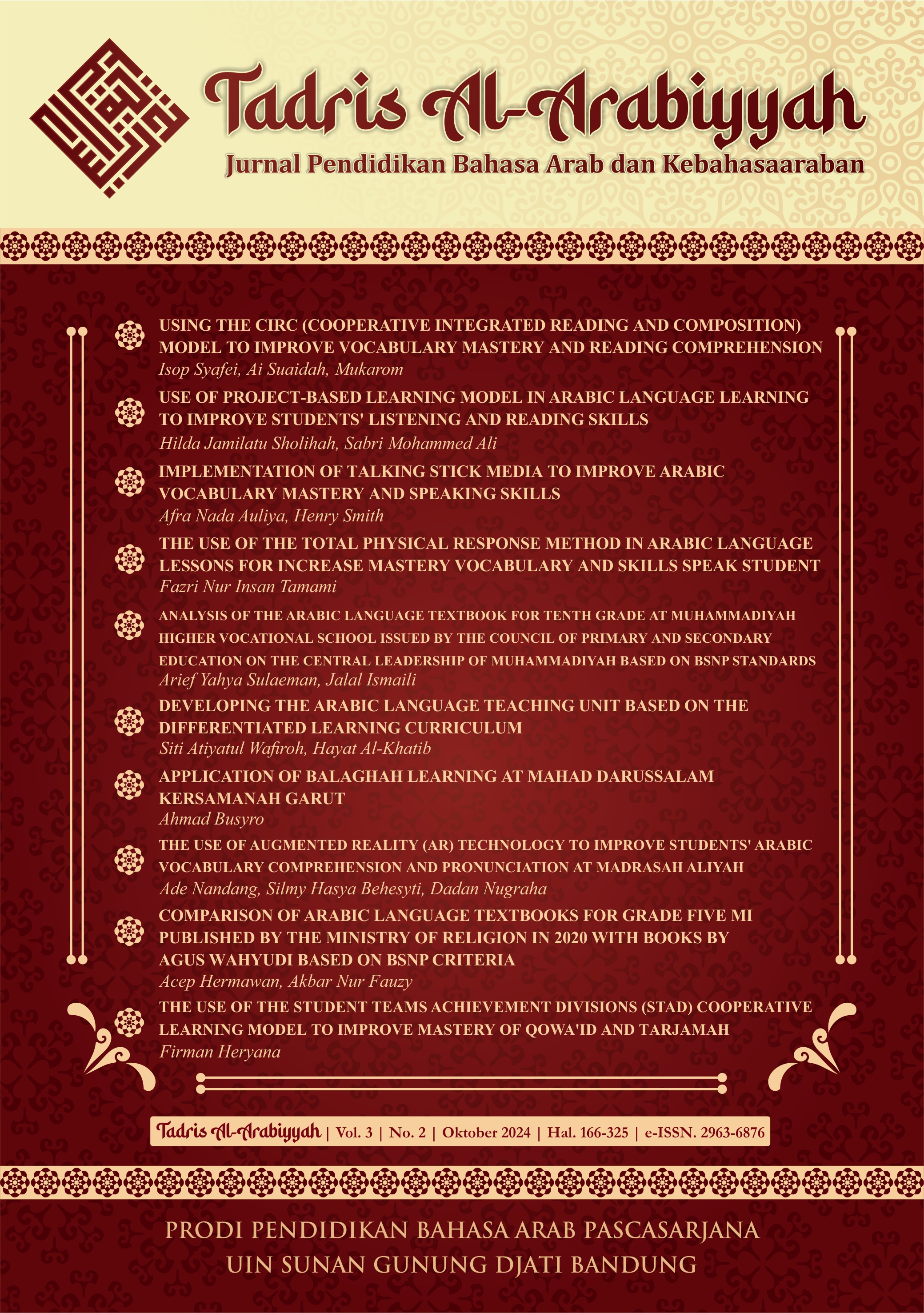
Developing the Arabic Language Teaching Unit Based on the Differentiated Learning Curriculum
DOI:
https://doi.org/10.15575/ta.v3i2.39430Abstract
The Arabic language affiliation modules prepared by the teacher are an effective means of effective and efficient but meaningful learning. Away from the teaching module, which is part of the independent detailed model, to develop abilities that include four language skills, namely listening, speaking, reading, watching, as well as writing and presentation. Specialized modules that are not specialized in facilitating and meeting the requirements of diverse students in learning files and are ready for self-learning learning. Outstanding learning is a series of continuous teacher-oriented orientation that is geared towards student fundamentals as is greater in the teaching unit. Arabic teachers in educational schools are still struggling to create Arabic language teaching modules that adapt to standalone application and are still learning advanced skills from experiential and productive content. Therefore, it is necessary to develop Arabic language teaching modules based on a university approach to differentiated learning that is able to meet the basic requirements of students. The aim of this research is to develop the unit of teaching Arabic language in independent models. MTS Al-Guami, where lawyer units are supplied, has begun to implement an independent curriculum. The model of the research methodology used in this research is Model 4 which goes through four stages which are the development of harmful bacteria and the dissemination. The results of this research state that: Arabic language teaching modules are a river on technology Differentiated learning can meet the basic needs of students and is suitable for use as pedagogical aids in learning Arabic; experienced subjects are rated as super implementable; expert assessment results are rated as exceptionally feasible; interactive assessment results by students are rated as highly implemented; the impact of teaching on meeting students' needs is rated as super modular Implementation.
References
Ade Sintia Wulandari. (2022). Literature Review: Pendekatan Berdiferensiasi Solusi Pembelajaran dalam Keberagaman. JURNAL PENDIDIKAN MIPA, 12(3), 682–689. https://doi.org/10.37630/jpm.v12i3.620
Amalia Alfina Siagian, S. (2023). Urgensi Modul Ajar Pada Kurikulum Merdeka Dalam Pembelajaran Bahasa Arab di Madrasah Ibtidaiah (MI). https://doi.org/10.5281/ZENODO.10437206
Amelia Nurhusni, F., & Nugraha, D. (2023). Implementasi Pendidikan Prenatal dalam Upaya Menumbuhkan Kecintaan pada Al-Qur’an. AL-KAINAH: Journal of Islamic Studies, 2(1), 12–27. https://doi.org/10.69698/jis.v2i1.111
Ardiansyah, A. A., Mukarom, & Nugraha, D. (2024). ANALYSIS OF RELIGIOUS MODERATION UNDERSTANDING AMONG UNIVERSITY STUDENTS IN WEST JAVA. Jurnal Harmoni. https://doi.org/10.32488/harmoni.v23i2.771
Belanisa, F., Amir, F. R., & Sudjani, D. H. (2022). E-modul Interaktif Sebagai Media Pembelajaran Bahasa Arab Untuk Meningkatkan Motivasi Murid. Tatsqifiy: Jurnal Pendidikan Bahasa Arab, 3(1), 1–12. https://doi.org/10.30997/tjpba.v3i1.4754
BSNP, -. BSNP Panduan Penyusunan Kurikulum tingkat satuan pendidikan jenjang pendidikan dasar dan menengah. Jakarta: Badan Standar Nasional Pendidikan, 2006. https://repositori.kemdikbud.go.id/9206/.
Dahlan, A. Z., Lutfiani, Y., & Nugraha, D. (2024). Urgensi Asbab Al-Nuzul dalam Memahami Ayat Pendidikan. Hamalatul Qur’an : Jurnal Ilmu Ilmu Alqur’an, 5(2), 674–685. https://doi.org/10.37985/hq.v5i2.283
DAY2_Buku Carol Ann Tomlinson—How to Differentiate Instruction in Academically Diverse Classrooms-ASCD (2017).pdf. (n.d.).
DifferentiatedInstructionStrategiesKit.pdf. (n.d.).
Ekawati, D., & Arifin, A. (2022). Pendekatan dalam Pembelajaran Bahasa Arab: Teori, Konsep, dan Implementasi. An Nabighoh, 24(1), 111. https://doi.org/10.32332/an-nabighoh.v24i1.4818
Faiz, A., Pratama, A., & Kurniawaty, I. (2022). Pembelajaran Berdiferensiasi dalam Program Guru Penggerak pada Modul 2.1. Jurnal Basicedu, 6(2), 2846–2853. https://doi.org/10.31004/basicedu.v6i2.2504
Fauzia, R., & Hadikusuma Ramadan, Z. (2023). Implementasi Pembelajaran Berdiferensiasi Dalam Kurikulum Merdeka. Jurnal Educatio FKIP UNMA, 9(3), 1608–1617. https://doi.org/10.31949/educatio.v9i3.5323
Herwina, W. (2021). OPTIMALISASI KEBUTUHAN MURID DAN HASIL BELAJAR DENGAN PEMBELAJARAN BERDIFERENSIASI. Perspektif Ilmu Pendidikan, 35(2), 175–182. https://doi.org/10.21009/PIP.352.10
Maulida, U. (2022). PENGEMBANGAN MODUL AJAR BERBASIS KURIKULUM MERDEKA. Tarbawi : Jurnal Pemikiran Dan Pendidikan Islam, 5(2), 130–138. https://doi.org/10.51476/tarbawi.v5i2.392
Moleong, L. J. Metodologi Penelitian Kualitatif. Bandung: PT Remaja Rosdakarya, 2017.
Mutaqi, I., & Dwi Nurcahyaningtias, N. (2021). Peran Bahan Ajar Dalam Pembelajaran Bahasa Arab. Mahira, 1(1), 63–72. https://doi.org/10.55380/mahira.v1i1.121
Nur Budiono, A., & Hatip, M. (2023). Asesmen Pembelajaran Pada Kurikulum Merdeka. Jurnal Axioma : Jurnal Matematika Dan Pembelajaran, 8(1), 109–123. https://doi.org/10.56013/axi.v8i1.2044
Nugraha, D. (2020). Mafhum Syir’ah wa Minhaj wa Wijhah fi Al-Qur’an Al-Karim. Ta’lim al-’Arabiyyah: Jurnal Pendidikan Bahasa Arab & Kebahasaaraban, 3(1), 75–87. https://doi.org/10.15575/jpba.v3i1.7453
Nurhusni, F. A., Muslih, H., Erihardiana, M., & Nugraha, D. (2023). EVALUASI PELAKSANAAN KURIKULUM MERDEKA MENCAKUP MEDIA, METODE DAN EVALUASI PADA PEMBELAJARAN AL-QUR’AN DAN HADIS DI SMP ISLAM AL-ALAQ. Seroja : Jurnal Pendidikan, 2(5), 347–355. https://doi.org/10.572349/seroja.v2i5.1528
Rahman, R. A., Huda, M., Astina, C., & Faida, F. (2023). Adaptasi Kurikulum Merdeka Belajar Mata Pelajaran Bahasa Arab di SMP Takhassus Al-Qur’an Wonosobo. Lisanan Arabiya: Jurnal Pendidikan Bahasa Arab, 6(2), 265–284. https://doi.org/10.32699/liar.v6i2.3707
Downloads
Published
How to Cite
Issue
Section
Citation Check
License
Copyright (c) 2024 Siti Atiyatul Wafiroh

This work is licensed under a Creative Commons Attribution-ShareAlike 4.0 International License.