
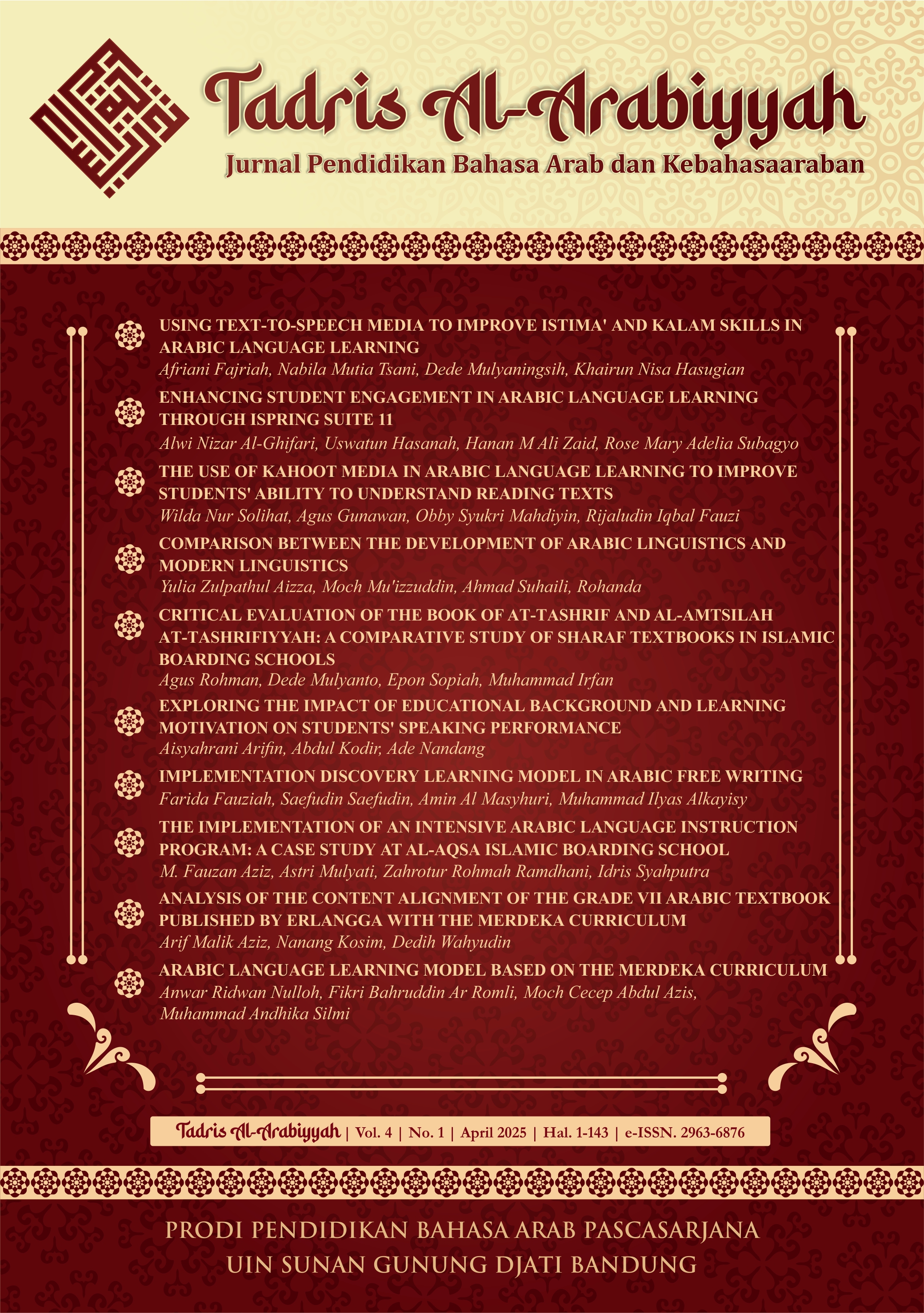
Using Text-to-Speech Media to Improve Istima' and Kalam Skills in Arabic Language Learning
DOI:
https://doi.org/10.15575/ta.v4i1.44854Keywords:
Arabic Learning, Istima' and Kalam Skills, Media, Text-to-SpeechAbstract
This study investigates the effectiveness of Text-to-Speech (TTS) media in enhancing Arabic listening (istima’) and speaking (kalam) skills among grade XI students at Madrasah Aliyah Negeri (MAN) Cimahi. Employing a quasi-experimental design, the research compared student performance in experimental and control groups before and after the integration of TTS media in the learning process. Pre-test results indicated marginally higher average scores in the experimental group compared to the control group. Following the intervention, the experimental group demonstrated significant improvement, particularly in speaking skills, achieving an average score of 85.72, compared to 84.89 in the control group. Conversely, listening skills showed a slight advantage for the control group post-intervention. Statistical analysis confirmed that the use of TTS media significantly enhanced students’ speaking and listening abilities, with a more pronounced effect on speaking proficiency. These findings suggest that TTS media is an effective tool for supporting the development of Arabic language skills, especially in improving oral communication.
References
Alm, A. (2013). Extensive Listening 2.0 with Foreign Language Podcasts. Innovation in Language Learning and Teaching, 7(3), 266–280. https://doi.org/10.1080/17501229.2013.836207
Alzamil, J. (2021). Listening Skills: Important but Difficult to Learn. Arab World English Journal, 12(3), 366–374. https://doi.org/10.24093/awej/vol12no3.25
Amrouche, A., Falek, L., & Teffahi, H. (2017). Design and Implementation of a Diacritic Arabic Text-To-Speech System. International Arab Journal of Information Technology (IAJIT), 14(4), 488-494. Retrieved from https://iajit.org/portal/PDF/%20Vol%2014,%20No.%204/10086.pdf.
Ardiansyah, A. A. (2021). Ta’lim al-Hiwar al-‘Arabiyyah bi Istikhdami Wasilati al-Rusum al-Hazaliyah. Al-Tadris: Jurnal Pendidikan Bahasa Arab, 9(2), 189–215. https://doi.org/10.21274/tadris.2021.9.2.189-215
Binti Jasni, N. S., & Ardiansyah, A. A. (2020). Arabic Learning Based On E-Learning Using Arabic Teacher Website In The Pandemic Era Of Covid-19. Ta’lim al-’Arabiyyah: Jurnal Pendidikan Bahasa Arab & Kebahasaaraban, 4(2), 122–137. https://doi.org/10.15575/jpba.v4i2.8601
Bozorgian, H., & Pillay, H. (2013). Enhancing Foreign Language Learning through Listening Strategy Delivered in L1: An Experimental Study. International Journal of Instruction, 6(1), 106-122. Retrieved from https://dergipark.org.tr/en/pub/eiji/issue/5138/70019.
Brunow, D. A., & Cullen, T. A. (2021). Effect of Text-to-Speech and Human Reader on Listening Comprehension for Students with Learning Disabilities. Computers in the Schools, 38(3), 214–231. https://doi.org/10.1080/07380569.2021.1953362
Chemnad, K., & Othman, A. (2023). Advancements in Arabic Text-to-Speech Systems: A 22-Year Literature Review. IEEE Access, 11(1), 30929–30954. https://doi.org/10.1109/ACCESS.2023.3260844
Field, A. (2024). Discovering Statistics Using IBM SPSS Statistics. Sage Publications Limited.
Lai, C., Hu, X., & Lyu, B. (2018). Understanding the Nature of Learners’ Out-of-Class Language Learning Experience with Technology. Computer Assisted Language Learning, 31(1–2), 114–143. https://doi.org/10.1080/09588221.2017.1391293
Li, R. (2023). Effects of Mobile-Assisted Language Learning on EFL Learners’ Listening Skill Development. Educational Technology & Society, 26(2), 36–49. https://doi.org/10.30191/ETS.202304_26(2).0003
Mufidah, I., Khoiriyah, S., & Ainiy, N. (2025). Implementation of Arabic Language Learning Media in Islamic Universities: Benefits and Problems. Journal of Arabic Language Learning and Teaching (JALLT), 3(1), 59–68. https://doi.org/10.23971/jallt.v3i1.254
Mulyanto, D., Wahyudi, M., Ridho, A. M. A., & Zaki, M. (2024). Utilization of Artificial Intelligence with Text-To-Speech Technology Based on Natural Language Processing to Enhance Arabic Listening Skills for Non-Native Speakers. Alsinatuna, 10(1), 44–58. https://doi.org/10.28918/alsinatuna.v10i1.7952
Munir, D. R., Julianti, J., & Maftuhah, M. (2023). Upaya Meningkatkan Kemampuan Berbicara Bahasa Arab Siswa dengan Menggunakan Metode Audiolingual. Tadris Al-’Arabiyyah: Jurnal Pendidikan Bahasa Arab Dan Kebahasaaraban, 2(2), 241–254. https://doi.org/10.15575/ta.v2i2.28839
Musthafa, I., & Hermawan, A. (2018). Metodologi Penelitian Bahasa Arab: Konsep Dasar Strategi Metode Teknik. Remaja Rosdakarya.
Musthafa, I., & Saprudin, A. (2022). Penggunaan Media Google Meet Sebagai Media Pembelajaran Bahasa Arab di MTs Al Ghozali Jatibarang. Tadris Al-’Arabiyyah: Jurnal Pendidikan Bahasa Arab Dan Kebahasaaraban, 1(2), 227–238. https://doi.org/10.15575/ta.v1i2.19565
Raffoul, S., & Jaber, L. (2023). Text-to-Speech Software and Reading Comprehension: The Impact for Students with Learning Disabilities. Canadian Journal of Learning and Technology, 49(2), 1–18. https://doi.org/10.21432/cjlt28296
Ramdhan, M. (2021). Metode Penelitian. Cipta Media Nusantara.
Rebai, I., & Ben Ayed, Y. (2015). Text-To-Speech Synthesis System with Arabic Diacritic Recognition System. Computer Speech & Language, 34(1), 43–60. https://doi.org/10.1016/j.csl.2015.04.002
Saepurrohman, A., Sunarya, Y., & Majid, M. N. (2023). Higher Order Thinking (HOTS) Skills Assessment Model in Arabic Language Skills Learning in Madrasah. Tadris Al-’Arabiyyah: Jurnal Pendidikan Bahasa Arab Dan Kebahasaaraban, 2(1), 1–15. https://doi.org/10.15575/ta.v2i1.24150
Siregar, Z. U., Zainuddin, N., Ardiansyah, A. A., & Ruhani, N. (2024). Utilizing Complementary Cards with Formulate Share Listen Create Media to Enhance Arabic Text Understanding. ALSUNIYAT: Jurnal Penelitian Bahasa, Sastra, Dan Budaya Arab, 7(2), 235–249. https://doi.org/10.17509/alsuniyat.v7i2.73110
Stodden, R. A., Roberts, K. D., Takahashi, K., Park, H. J., & Stodden, N. J. (2012). Use of Text-to-speech Software to Improve Reading Skills of High School Struggling Readers. Procedia Computer Science, 14, 359–362. https://doi.org/10.1016/j.procs.2012.10.041
Widyana, A., Jerusalem, M. I., & Yumechas, B. (2022). The Application of Text-to-Speech Technology in Language Learning: A Systematic Review. In N. Haristiani, Y. Yulianeta, Y. Wirza, W. Gunawan, A. A. Danuwijaya, E. Kurniawan, D. Darmawangsa, S. Suharno, N. Nafisah, E. D. A. Imperiani, A. H. Lubis, B. Hermawan, & E. R. Fauzy (Eds.), Proceedings of the Sixth International Conference on Language, Literature, Culture, and Education (ICOLLITE 2022) (Vol. 722, pp. 85–92). Atlantis Press SARL. https://doi.org/10.2991/978-2-494069-91-6_14
Wood, S. G., Moxley, J. H., Tighe, E. L., & Wagner, R. K. (2018). Does Use of Text-to-Speech and Related Read-Aloud Tools Improve Reading Comprehension for Students With Reading Disabilities? A Meta-Analysis. Journal of Learning Disabilities, 51(1), 73–84. https://doi.org/10.1177/0022219416688170
Young, M. C., Courtad, C. A., Douglas, K. H., & Chung, Y.-C. (2019). The Effects of Text-to-Speech on Reading Outcomes for Secondary Students With Learning Disabilities. Journal of Special Education Technology, 34(2), 80–91. https://doi.org/10.1177/0162643418786047
Downloads
Published
How to Cite
Issue
Section
Citation Check
License
Copyright (c) 2025 Afriani Fajriah, Nabila Mutia Tsani, Dede Mulyaningsih, Khairun Nisa Hasugian

This work is licensed under a Creative Commons Attribution-ShareAlike 4.0 International License.