
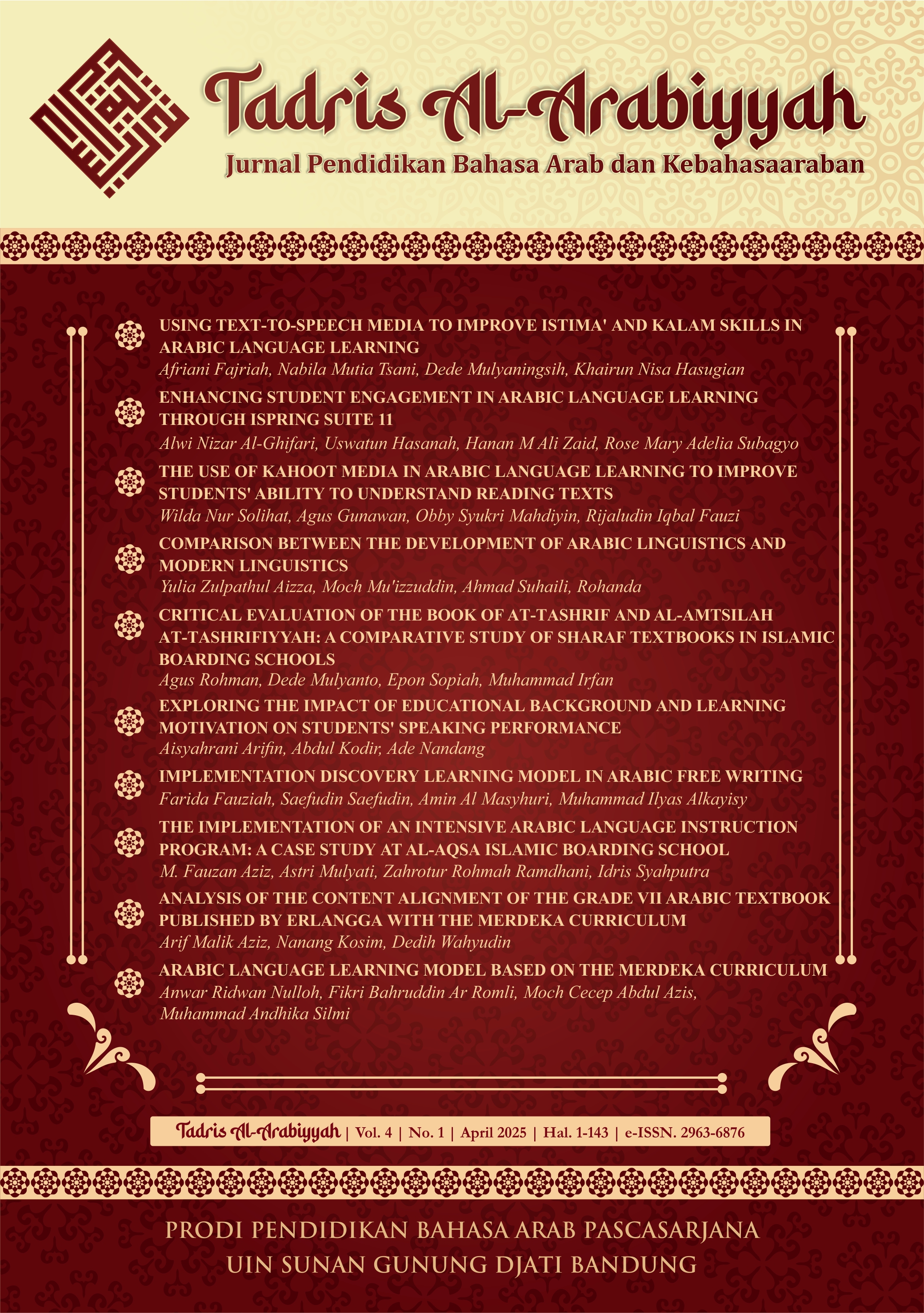
The Use of Kahoot Media in Arabic Language Learning to Improve Students' Ability to Understand Reading Texts
DOI:
https://doi.org/10.15575/ta.v4i1.44856Keywords:
Arabic Learning, Kahoot Media, Reading Materials, Student ComprehensionAbstract
This study aims to determine the effectiveness of Kahoot media in Arabic language instruction in improving students' reading skills. It employed a quasi-experimental method with a pre-test and post-test design involving a single experimental group. The participants were seventh-grade students at SMP Al-Azhar Cairo Bandung. The primary focus of this study was to compare students' reading abilities before and after the implementation of the interactive media Kahoot and to evaluate whether it was more effective than traditional teaching methods. The results indicated that students' reading skills before using Kahoot were relatively low, with an average score of 50.8, which falls into the 50–59 category based on interpretation criteria. After the implementation of Kahoot, a significant improvement was observed, with the average score rising to 82.4, classified as "good" (80–90). And 65% of students reached a reading proficiency level considered moderate. A hypothesis test revealed that the calculated t-value (25.32) was greater than the critical t-value (2.06), indicating that the improvement was statistically significant. These findings demonstrate that Kahoot effectively enhances students' reading skills in Arabic. Future research is encouraged to explore the impact of Kahoot on other Arabic language skills, such as listening, speaking, and writing, as well as to assess its long-term effectiveness across different educational levels.
References
Alawadhi, A., & Abu-Ayyash, E. A. (2021). Students' Perceptions of Kahoot!: An Exploratory Mixed-Method Study in EFL Undergraduate Classrooms in the UAE. Education and Information Technologies, 26(4), 3629–3658. https://doi.org/10.1007/s10639-020-10425-8
Alfan, A. A. (2025). Peningkatan Penguasaan Kosakata Bahasa Arab Siswa Melalui Penggunaan Aplikasi Kahoot. Journal of Arabic Education and Linguistics. Journal of Arabic Education and Linguistics, 4(2), 45–59. https://doi.org/10.24252/jael.v4i2.52859
Aprilia, A., Sulistyaningsih, S., & Musyarofah, L. (2023). The Use of Kahoot to Improve Students' Narrative Text Reading Comprehension. International Journal of English and Applied Linguistics (IJEAL), 3(2), 100–108. https://doi.org/10.47709/ijeal.v3i2.2402
Ardiansyah, A. A., & Muhammad, A. (2020). Implementation of Integrative Arabic Grammar (Nahwu & Sharaf) Curriculum in Islamic Boarding School. Izdihar : Journal of Arabic Language Teaching, Linguistics, and Literature, 3(3), 211–228. https://doi.org/10.22219/jiz.v3i3.13264
Fajar, A., & Julianti, J. (2023). The Effectiveness of Using Kahoot in Teaching Arabic at Junior High School. Kalimatuna: Journal of Arabic Research, 2(1), 71–82. https://doi.org/10.15408/kjar.v2i1.34203
Febriani, S. R., & Anasruddin, A. (2020). Technology For Four Skills Arabic In The Era Emergency Of Covid-19 In Indonesia. Ta’lim al-’Arabiyyah: Jurnal Pendidikan Bahasa Arab & Kebahasaaraban, 4(1), 1–11. https://doi.org/10.15575/jpba.v4i1.8221
Fiani, I. N., Ahsanuddin, M., & Morhi, R. (2021). The Effectiveness of Using Kahoot! Application as An Evaluation Tool in Arabic Vocabulary Learning at Madrasah Ibtidaiyah. Izdihar : Journal of Arabic Language Teaching, Linguistics, and Literature, 4(2), 243–256. https://doi.org/10.22219/jiz.v4i2.17186
Fikri, A., Aflisia, N., & Harisah, H. (2023). The Effectiveness Of Problem Based Learning In Improving Arabic Reading Skills. Ijaz Arabi Journal of Arabic Learning, 6(2), 495–502. https://doi.org/10.18860/ijazarabi.v6i2.17392
Hamid, A., Aishah, S. N., Johari, S. K., Zulhaimi, N. A., & Sapan, N. S. (2020). Resolving Arabic-Language Text Reading Errors Among University Students Through Project-Based Learning (PBL). International Journal of Humanities, Philosophy and Language, 3(10), 90–105. https://doi.org/10.35631/IJHPL.310008
Hamidah, H., Wahdah, N., Mubarak, M. R., & Syukriansyah, A. (2023). Identity Exploration of Arabic Teachers: The Efforts to Become a Driving Teacher. Ta’lim al-’Arabiyyah: Jurnal Pendidikan Bahasa Arab & Kebahasaaraban, 7(2), 221–236. https://doi.org/10.15575/jpba.v7i2.24100
Hasan, A. M., Sari, R. R., & A’yuni, Q. (2020). Creative Teaching in Arabic Language Learning (Using Kahoot, Socrative and Google Form). IJ-ATL (International Journal of Arabic Teaching and Learning), 4(2), 171-183. Retrieved from https://ejournal.unuja.ac.id/index.php/ij-atl/article/view/1570.
Ilmudinulloh, R., Bustomi, A., & Pratiwi, W. R. (2024). The Development of Kahoot-Based Learning Media Cooperative Learning to Improve Learning Motivation. Edudeena: Journal of Islamic Religious Education, 8(2), 128–144. https://doi.org/10.30762/ed.v8i2.2893
Inka, N., Suparmanto, S., Ma’arif, S., Nurhidayati, V., & Mujiburrahman, M. (2024). Penggunaan Metode Kahoot Sebagai Media Evaluasi Pembelajaran KosaKata Bahasa Arab. Ta’bir Al-’Arabiyyah: Jurnal Pendidikan Bahasa Arab Dan Ilmu Kebahasaaraban, 2(1), 25-35. Retrieved from https://journal.albadar.ac.id/index.php/Attabirat/article/view/178.
Li, J., & Li, Q. (2015). Comparative Study between Traditional Grammar and Modern Linguistics. Proceedings of the International Conference on Education, Management, Commerce and Society, 1, 279–283. https://doi.org/10.2991/emcs-15.2015.59
Mahmudah, S. (2018). Media Pembelajaran Bahasa Arab. An Nabighoh, 20(01), 129–138. https://doi.org/10.32332/an-nabighoh.v20i01.1131
Mira, M., Syihabudin, S., & Nurbayan, Y. (2020). Evaluation Of Arabic Learning Using The Kahoot Application In The Pandemic Era Of Covid-19. Ta’lim al-’Arabiyyah: Jurnal Pendidikan Bahasa Arab & Kebahasaaraban, 4(2), 153–164. https://doi.org/10.15575/jpba.v4i2.8930
Musthafa, I., & Hermawan, A. (2018). Metodologi Penelitian Bahasa Arab: Konsep Dasar Strategi Metode Teknik. Remaja Rosdakarya.
Novita, A.-Z. T., & Tatang, T. (2024). Pengaruh Media Pembelajaran Kahoot terhadap Minat Belajar Bahasa Arab Siswa Kelas 12 Agama di MAN 1 Lahat. Jurnal Pendidikan Tambusai, 8(2), 17432–17437. https://doi.org/10.31004/jptam.v8i2.14840
Plump, C. M., & LaRosa, J. (2017). Using Kahoot! in the Classroom to Create Engagement and Active Learning: A Game-Based Technology Solution for eLearning Novices. Management Teaching Review, 2(2), 151–158. https://doi.org/10.1177/2379298116689783
Riantimun, A. F., Hasanul Mutawakkilin, Adella Ira Wanti, Danial Hilmi, & Okita Fatma Marliana. (2024). Pemanfaatan Aplikasi Kahoot Sebagai Media Pembelajaran Bahasa Arab Interaktif. Shaut al Arabiyyah, 11(2), 352–369. https://doi.org/10.24252/saa.v11i2.44090
Riwanda, A., Ridha, M., & Islamy, M. I. (2021). Increasing Arabic Vocabulary Mastery Through Gamification; is Kahoot! Effective? LISANIA: Journal of Arabic Education and Literature, 5(1), 19–35. https://doi.org/10.18326/lisania.v5i1.19-35
Downloads
Published
How to Cite
Issue
Section
Citation Check
License
Copyright (c) 2025 Wilda Nur Solihat, Agus Gunawan, Obby Syukri Mahdiyin, Rijaludin Iqbal Fauzi

This work is licensed under a Creative Commons Attribution-ShareAlike 4.0 International License.