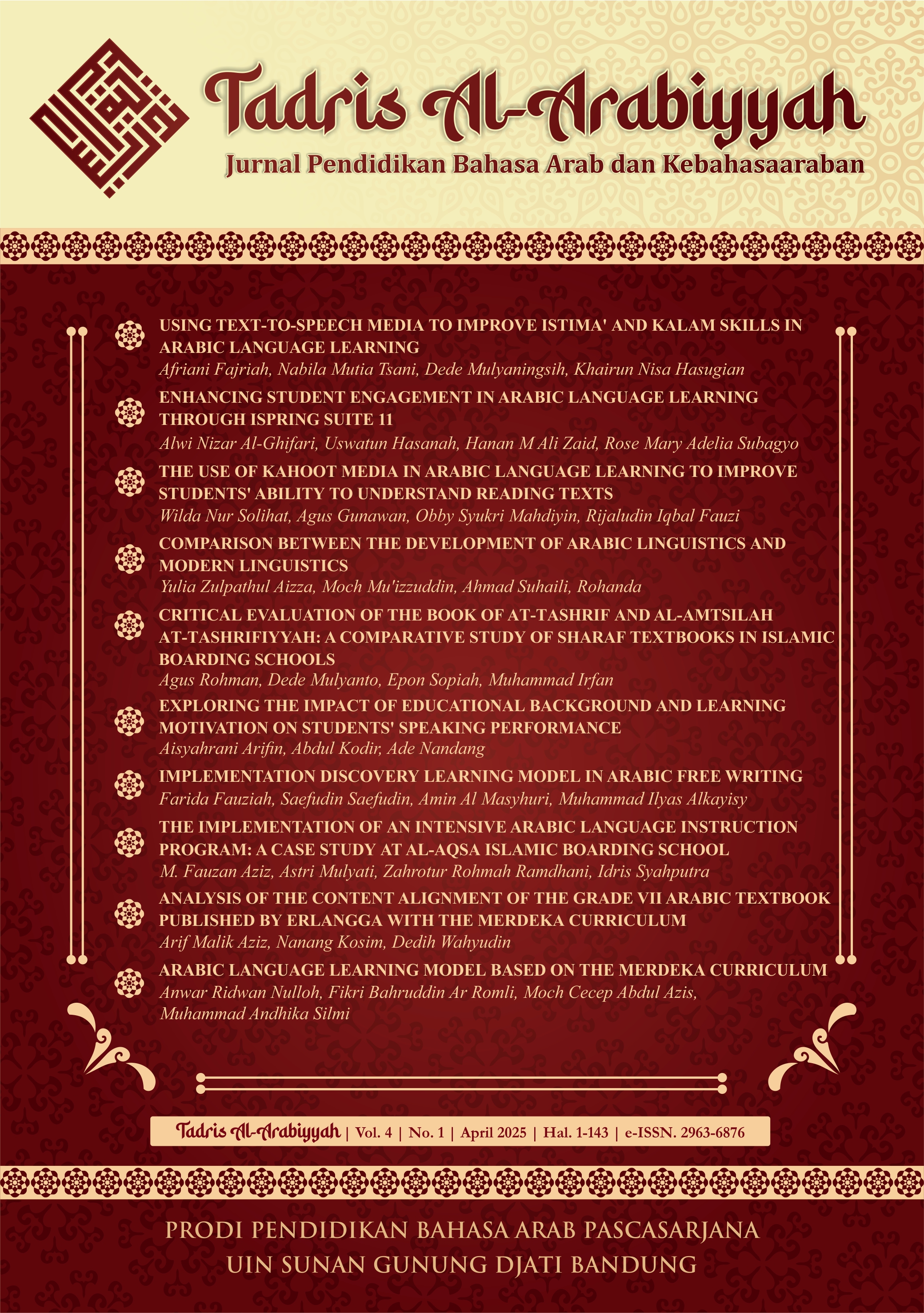
The Implementation of an Intensive Arabic Language Instruction Program: A Case Study at Al-Aqsa Islamic Boarding School
DOI:
https://doi.org/10.15575/ta.v4i1.44921Keywords:
Arabic Language, Communication, Intensive Learning, Islamic Boarding SchoolAbstract
This study aims to analyze the effectiveness of the intensive Arabic language program at Pondok Modern Al-Aqsha, Jatinangor, West Java, in enhancing students' proficiency in Arabic. The research is grounded in the significance of Arabic language mastery for understanding religious texts in Islamic boarding schools (pesantren). Employing a qualitative method with a descriptive approach, the study involves direct observation, in-depth interviews with teachers and students, and analysis of curriculum-related documents. The findings reveal that the intensive program—which includes lessons in grammar, morphology, conversation, and classical Islamic texts—significantly improves students' communication skills and comprehension of Arabic texts. The communicative teaching methods used, such as simulations, group discussions, audiovisual media, and contextual learning, play a crucial role in accelerating language acquisition. Key factors contributing to the program's success include the dedication of the management and instructors, a well-structured curriculum, and a supportive learning environment. The study recommends optimizing contextual approaches and strengthening continuous evaluation to enhance program effectiveness further. These findings are expected to serve as a reference for other Islamic educational institutions in designing similar intensive Arabic programs.
References
Abd Satar, H., & Yusoff, N. M. R. N. (2019). Improvement of Lower Secondary Arabic Language Teaching and Learning through the Implementation of Classroom Based Assessments (PBD). Creative Education, 10(12), 2555-2563. https://doi.org/10.4236/ce.2019.1012183
Aflisia, N., & Harahap, P. (2019). Eksisten Bi’ah Lughawiyah Sebagai Media Berbahasa Arab dalam Meningkatkan Kemampuan Muhadatsah Mahasiswa Prodi Pendidikan Bahasa Arab IAIN Curup. Lisanul’Arab: Journal of Arabic Learning and Teaching, 8(1), 40–55. https://doi.org/10.15294/la.v8i1.32545
Albariki, A. Y., & Sunarto, S. (2020). The Effect of Islamic Boarding School Environment and Student Learning Interest on Student Learning Outcomes in Social Sciences Subjects. The Indonesian Journal of Social Studies, 3(1), 31–36. https://doi.org/10.26740/ijss.v3n1.p31-36
Alfataftah, G. I., & Jarrar, A. G. (2018). Developing Languages to Face Challenges of Globalization and Clash of Civilizations: Arabic Language as an Example. Journal of Education and Learning, 7(4), 247–253. https://doi.org/10.5539/jel.v7n4p247
Alyafei, I. A. A. (2024). Continuous Assessment Skills used by Arabic Language Female Teachers of Basic Education in Oman. JASS, 9(1), 109-122. https://doi.org/10.53542/jass.v9i1.2619
Amin, I., Ritonga, M., Sobhan, S., & Kumar, T. (2022). Implementation of Activity-Based Language Week Program in Improving Arabic Communication Skills at Ma’had al-Jami’ah. Izdihar: Journal of Arabic Language Teaching, Linguistics, and Literature, 5(1), 45–58. https://doi.org/10.22219/jiz.v5i1.19911
Amirudin, N. (2017). Problematika Pembelajaran Bahasa Arab. Tamaddun: Jurnal Pendidikan Dan Pemikiran Keagamaan, 7(2), 1–12. http://dx.doi.org/10.30587/tamaddun.v0i0.66
Aprizal, A. P. (2021). Urgensi pembelajaran bahasa Arab dalam pendidikan Islam. Jurnal Pendidikan Guru, 2(2), 87–93. https://doi.org/10.47783/jurpendigu.v2i2.232
Ardiansyah, A. A. (2022). Metode Penelitian Pendidikan. Pustaka Setia.
Ardiansyah, A. A., Musthafa, I., & Hermawan, A. (2023). Analysis of The Dialogical Narration in The Story of Prophet Yusuf in The Quran. Ta’lim al-’Arabiyyah: Jurnal Pendidikan Bahasa Arab & Kebahasaaraban, 7(2), 278–298. https://doi.org/10.15575/jpba.v7i2.25684
Arifin, A. (2017). Peranan Permainan Bahasa Dalam Proses Kegiatan Belajar Mengajar Mata Pelajaran Bahasa Arab. An Nabighoh, 19(2), 302–318. https://doi.org/10.32332/an-nabighoh.v19i2.1005
Asy’ari, H. (2016). Keistimewaan Bahasa Arab Sebagai Bahasa Al-Qur’an. Nidhomul Haq: Jurnal Manajemen Pendidikan Islam, 1(1), 21–28. https://doi.org/10.31538/ndh.v1i1.5
Chalista, et al. (2024). Developing Arabic Language Learning Assessment Tools Using the Competition Application in Secondary School. Alsuniyat, 7(2), 382-394. https://doi.org/10.17509/alsuniyat.v7i2.69424
Fatoni, A. (2019). Arabic Learning for Academic Purposes. Izdihar: Journal of Arabic Language Teaching, Linguistics, and Literature, 2(2), 149–164. https://doi.org/10.22219/jiz.v2i2.10096
Firdaus, D., Ainin, M., & Siregar, H. H. (2023). Menakar Al Maharah Al Lughawiyah Dalam KMA 183 Dengan Standar ACTFL. Shaut al Arabiyyah, 11(1), 1–18. https://doi.org/10.24252/saa.v11i1.29255
Fudhaili, A., Muawanah, E., & Khairiyah, F. (2022). Implementation Management Arabic Incentive Program in Markaz al-Lughah al-‘Arabiyah Annuqayah Madura. Kalimatuna: Journal of Arabic Research, 1(2), 265–280. https://doi.org/10.15408/kjar.v1i2.28250
Guettaoui, K. B., & Febriani, S. R. (2024). Implementation of Arabic Learning based on Contextual Approach and Contextual Textbook for Higher Education. Al Ittijah, 14(2), 122-132. https://doi.org/10.32678/alittijah.v14i2.6860
Hikmawati, S. A. (2019). Pendekatan dan Model-Model Pengembangan Kurikulum Bahasa Arab pada Madrasah/Sekolah di Indonesia. Muhadasah: Jurnal Pendidikan Bahasa Arab, 1(2), 203–218. Retrieved from https://ejournal.iaiskjmalang.ac.id/index.php/muhad/article/view/97.
Isbah, F., Rosyid, M. F., & Tamama, N. U. (2024). Evaluation Implementation of the Arabic Language Intensification Program (PIBA) in Islamic Higher Education. Arabiyatuna, 8(2), 731–756. https://doi.org/10.29240/jba.v8i2.11129
Isbah, F., Rosyid, M. F., & Tamama, N. U. (2024). Evaluation Implementation of the Arabic Language Intensification Program (PIBA) in Islamic Higher Education. Arabiyatuna: Jurnal Bahasa Arab, 8(2), 731–756. https://doi.org/10.29240/jba.v8i2.11129
Iswanto, R. (2017). Pembelajaran Bahasa Arab Dengan Pemanfaatan Teknologi. Arabiyatuna: Jurnal Bahasa Arab, 1(2), 139–152. http://dx.doi.org/10.29240/jba.v1i2.286
Lubis, A., Mufidah, N., & Amrullah, A. M. K. (2024). Effective Program Management in Arabic Intensive Courses: A Case Study. Al Idarah, 14(2), 143-152. https://doi.org/10.24042/alidarah.v14i2.20848
Lubis, A., Mufidah, N., & Amrullah, A. M. K. (2024). Effective Program Management in Arabic Intensive Courses: A Case Study. Al-Idarah: Jurnal Kependidikan Islam, 14(2), 143–152. https://doi.org/10.24042/alidarah.v14i2.20848
Mardan Hamza, A. S., & Khaleel, A. I. (2024). Continuous Assessment Skills of Arabic Language Teachers in Intermediate Stage. Journal of the College of Basic Education, 29(122), 64–39. https://doi.org/10.35950/cbej.v29i122.11033
Muhammad, M., & Setyawan, C. E. (2021). Peran Bahasa Arab dalam Menghadapi Paradigma Pendidikan di Indonesia Era Society 5.0. Ihtimam: Jurnal Pendidikan Bahasa Arab, 4(2), 183–193. https://doi.org/10.36668/jih.v4i2.314
Mukmin, Hidayah, N., & Amelina, N. (2024). Evaluasi Program Intensif Bahasa Arab pada Kelas Akselerasi di Pondok Pesantren. Naskhi, 6(1), 38-47. https://doi.org/10.47435/naskhi.v6i1.2570
Musthafa, I., & Hermawan, A. (2018). Metodologi Penelitian Bahasa Arab: Konsep Dasar Strategi Metode Teknik. Remaja Rosdakarya.Rahmah, U. F. (2019). Program Pembelajaran Bahasa Arab Di SMP Plus Al-Aqsha Jatinagor Sumedang. An Nabighoh, 21(02), 255–266. https://doi.org/10.32332/an-nabighoh.v21i02.1680
Ridwan, M. F., Qomaruddin, F., Mulachela, A. R. S., & Umar Al Faruq. (2024). Linguistic Intelligence Development Strategy Through Student Activities: A Case Study in Intensive Arabic Language Learning. Izdihar: Journal of Arabic Language Teaching, Linguistics, and Literature, 7(2), 145–160. https://doi.org/10.22219/jiz.v7i2.32216
Roviin, R. (2020). Manajemen Program Kursus Intensif Bahasa Arab: Studi pada Metode Mustaqilli. Al Tanzim, 4(2), 236-246. https://doi.org/10.33650/al-tanzim.v4i2.1237
Sa’diyah, H., & Abdurahman, M. (2021). Pembelajaran Bahasa Arab di Indonesia: Penelitian Terhadap Motivasi Belajar Bahasa Asing. Lisanan Arabiya: Jurnal Pendidikan Bahasa Arab, 5(1), 51–69. https://doi.org/10.32699/liar.v5i1.1665
Samin, S. M., Zulkifli, A., & Supriady, H. (2023). Konsep Lingkungan Bahasa Arab Informal Untuk Perguruan Tinggi. Al-Hikmah: Jurnal Agama Dan Ilmu Pengetahuan, 20(1), 29–38. https://doi.org/10.25299/al-hikmah:jaip.2023.vol20(1).12026
Wahab, M. A. (2014). Peran Bahasa Arab dalam Pengembangan Ilmu dan Peradaban Islam. Arabiyat: Jurnal Pendidikan Bahasa Arab Dan Kebahasaaraban, 1(1), 1–20. https://doi.org/10.15408/a.v1i1.1127
Downloads
Published
How to Cite
Issue
Section
Citation Check
License
Copyright (c) 2025 M. Fauzan Aziz, Astri Mulyati, Zahrotur Rohmah Ramdhani, Idris Syahputra

This work is licensed under a Creative Commons Attribution-ShareAlike 4.0 International License.