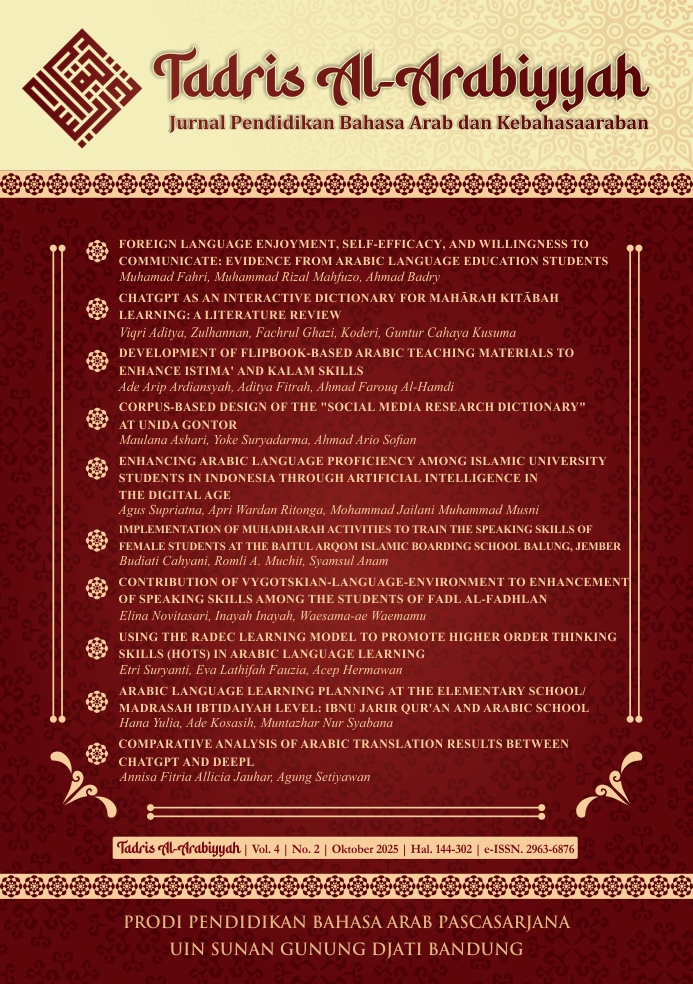
Comparative Analysis of Arabic Translation Results Between ChatGPT and Deepl
DOI:
https://doi.org/10.15575/ta.v4i2.46575Keywords:
AI Based Machine Translation, Arabic Linguistic Analysis, ChatGPT, DeeplAbstract
The rapid advancement of artificial intelligence (AI) has significantly transformed translation studies, yet challenges persist in achieving semantic precision and syntactic fidelity in Arabic translation. While ChatGPT and DeepL are among the most widely used AI translation systems, comparative linguistic analyses of their Arabic translation performance remain underexplored. This study investigates both systems' morphological, syntactic, and semantic accuracy through a descriptive–comparative library research design. Data were drawn from Arabic academic texts in Qirā’ah al-Nuṣūṣ, analyzed using a back-translation technique and linguistic equivalence framework. The findings show that ChatGPT tends to generate more communicative and contextually adaptive outputs aligned with dynamic equivalence. In contrast, DeepL demonstrates more substantial formal and lexical precision consistent with formal equivalence principles. These results suggest that both systems offer complementary strengths that can enhance Arabic translation pedagogy and computational linguistics research. The study introduces a back-translation-based linguistic evaluation model that bridges Arabic linguistic complexity with computational precision, filling a notable gap in AI-assisted Arabic translation research.
References
Abdelhalim, S. M., Alsahil, A. A., & Alsuhaibani, Z. A. (2025). Artificial Intelligence Tools and Literary Translation: A Comparative Investigation of ChatGPT and Google Translate from Novice and Advanced EFL Student Translators’ Perspectives. Cogent Arts & Humanities, 12(1), 1–20. https://doi.org/10.1080/23311983.2025.2508031
Abidah, N. K. K., Hikmawatib, R., & Erawanto, V. (2024). ChatGPT in Indonesia-Arabic Translation: A Quality Analysis. Al-Arabi: Journal of Teaching Arabic as a Foreign Language, 8(1), 33–52. http://dx.doi.org/10.17977/um056v8i1p33-52
Alkhawaja, L., Ibrahim, H., Ghnaim, F., & Awwad, S. (2020). Neural Machine Translation: Fine-Grained Evaluation of Google Translate Output for English-to-Arabic Translation. International Journal of English Linguistics, 10(4), 43-60. https://doi.org/10.5539/ijel.v10n4p43
Arju, S., Husein, M. F., Sa’adah, B., & Rejeki, A. M. (2025). Analisis Keakuratan Hasil Terjemahan ChatGPT Menggunakan Teknik Back Translation. El-Tsaqafah: Jurnal Jurusan PBA, 24(1), 41–54. https://doi.org/10.20414/tsaqafah.v24i1.10604
Baharuddin, B., Amin, M., Thohir, L., & Wardana, L. A. (2022). Penerapan Teori Terjemahan pada Editing Hasil Terjemahan Google Translate pada Teks Akademik oleh Mahasiswa Universitas Mataram. Jurnal Ilmiah Profesi Pendidikan, 6(4), 816–824. https://doi.org/10.29303/jipp.v6i4.390
Deng, M., & Fan, X. (2025). Post-Editing Efficiency And Quality Assessment: A Comparative Analysis of Google Translate and DeepL. IOSR Journal of Humanities and Social Science, 30(1), 10–24. https://doi.org/10.9790/0837-3001021024
Elhamayed, S. A., & Nour, M. (2025). Overview of Deep Learning and Large Language Models in Machine Translation: A Special Perspective on The Arabic Language. Journal of Electrical Systems and Information Technology, 12(1), 27. https://doi.org/10.1186/s43067-025-00211-2
Eljazouli, A., & Azmi, N. (2024). Linguistic and Terminological Complexities in Post-Editing English-Arabic Machine Translations. International Journal of Language and Literary Studies, 6(3), 16–29. https://doi.org/10.36892/ijlls.v6i3.1775
ElSabagh, A. A., Azab, S. S., & Hefny, H. A. (2025). A Comprehensive Survey on Arabic Text Augmentation: Approaches, Challenges, and Applications. Neural Computing and Applications, 37(10), 7015–7048. https://doi.org/10.1007/s00521-025-11020-z
Fadli, M. R. (2021). Memahami Desain Metode Penelitian Kualitatif. Humanika, Kajian Ilmiah Mata Kuliah Umum, 2(1), 33–54. https://doi.org/10.21831/hum.v21i1.%252038075
Farsia, L., & Sarair. (2023). Dynamic Equivalence: Translation Theory. Jurnal Dedikasi Pendidikan, 7(2), 719–726. https://doi.org/10.30601/dedikasi.v7i2.4037
Hermawan, A., Odang, O., Abdul Manan, W., & Alsuhili, B. A. A. M. (2024). Translation of Majaz Mursal in Mushaf Sundawi and Lenyepaneun Holy Verse. Ta’lim al-’Arabiyyah: Jurnal Pendidikan Bahasa Arab & Kebahasaaraban, 8(2), 294–312. https://doi.org/10.15575/jpba.v8i2.40779
Hu, K., & Li, X. (2023). The Creativity and Limitations of AI Neural Machine Translation. Babel. Revue Internationale de La Traduction / International Journal of Translation, 69(4), 546 - 563. https://doi.org/10.1075/babel.00331.hu
Kadaoui, K., Magdy, S., Waheed, A., Khondaker, M. T. I., El-Shangiti, A. O., Nagoudi, E. M. B., & Abdul-Mageed, M. (2023). Evaluation of Bard and ChatGPT on Machine Translation of Ten Arabic Varieties. Proceedings of the The First Arabic Natural Language Processing Conference, 52–75. https://doi.org/10.48550/arXiv.2308.03051
Khalid, S. M., Sanusi, A., Maulana, D., Tatang, T., & Al Farisi, M. Z. (2021). The Analysis of Semantic Grammatical Errors in Various Arabic Translations. Arabi: Journal of Arabic Studies, 6(1), 15-25. https://doi.org/10.24865/ajas.v6i1.315
Kusumo, D. W., & Wardani, D. K. (2019). Ragam Penelitian Dalam Studi Penerjemahan. JLT: Jurnal Linguistik Terapan, 9(1), 21–31. Retrieved from https://jurnal.polinema.ac.id/index.php/jlt/article/view/165
Makrifah, N., & Intan Sari, D. (2023). The Representative Meaning of Longing in Mahmoud Darwish’s “Ila Ummi” Poem Viewed from a Semantic Approach. Tadris Al-’Arabiyyah: Jurnal Pendidikan Bahasa Arab Dan Kebahasaaraban, 2(2), 140–155. https://doi.org/10.15575/ta.v2i2.26114
Ma’rifah, S. N., Syihabuddin, S., & Rinaldi Supriadi. (2025). Analisis Kualitas Terjemahan dalam Qasidat Al-Burdah: Studi Komparatif antara Terjemahan Abdullah Azzam bin Azlan dan DeepL Translator. Jurnal Onoma: Pendidikan, Bahasa, Dan Sastra, 11(3), 3632–3646. https://doi.org/10.30605/onoma.v11i3.6775
McNamee, P., & Duh, K. (2023). An Extensive Exploration of Back-Translation in 60 Languages. Findings of the Association for Computational Linguistics: ACL 2023, 8166–8183. https://doi.org/10.18653/v1/2023.findings-acl.518
Moneus, A. M., & Sahari, Y. (2024). Artificial Intelligence and Human Translation: A Contrastive Study Based on Legal Texts. Heliyon, 10(6), 1–14. https://doi.org/10.1016/j.heliyon.2024.e28106
Nugraheni, Y. M., & Sutrisno, A. (2024). DeepL VS. ChatGPT: Machine Translation Evaluation. Prologue: Journal on Language and Literature, 10(2), 411–426. https://doi.org/10.36277/jurnalprologue.v10i2.174
Nurcahyani, F. D., Adika, D., & Widyasari. (2024). Translating the Untranslatable: DeepL and ChatGPT on Academic Idioms. Linguistik Terjemahan Sastra (LINGTERSA), 5(2), 85–93. https://doi.org/10.32734/lingtersa.v5i2.15086
Rahmouni, K. (2025). Exploring the Use of ChatGPT in Teaching Arabic Case Endings: Effectiveness, Challenges and Recommendations. Journal of Educational Technology and Innovation, 6(4), 1–20. https://doi.org/10.61414/jeti.v6i4.198
Robbani, A. S., Atmantika, Z. H., & Bhavani, S. G. A. E. (2023). The Use of ChatGPT among Arabic Language and Literature Students: Opportunities and Challenges. Insyirah: Jurnal Ilmu Bahasa Arab Dan Studi Islam, 6(2), 203–215. https://doi.org/10.26555/insyirah.v6i2.9440
Sabrina, Fadhillah, M., Chawdri, F. O., Safara, C., & Juniarti, L. (2025). Contrastive Analysis of DeepL Translation vs. Google Translate’s Performance in Rendering Academic Texts: Insights from EFL Learners. Jurnal Serambi Ilmu, 26(1), 73–82. https://doi.org/10.32672/jsi.v26i1.2502
Saimin, A. A., Supriadi, R., & Al Farisi, M. Z. (2024). Analisis Kesalahan Penerjemahan Teks Bahasa Indonesia ke dalam Bahasa Arab pada ChatGPT (Studi Analisis Morfologi dan Sintaksis). Jurnal Naskhi Jurnal Kajian Pendidikan Dan Bahasa Arab, 6(2), 1–12. https://doi.org/10.47435/naskhi.v6i1.2668
Satori, A., Suparno, D., Aqil Assyauqi, W., Wahidah, W., Anas, M., Rokhim, M., & Zakaizak, F. M. F. (2023). Linguistic Discoveries: Tracing Grammatical Errors in the Translation of Qasas Al-Nabiyyin by Abu Hasan Ali Hasani Nadwi. Ta’lim al-’Arabiyyah: Jurnal Pendidikan Bahasa Arab & Kebahasaaraban, 7(2), 250–260. https://doi.org/10.15575/jpba.v7i2.26666
Shiddiq, J., Nadhif, M. F., Kholis, M. N., & Jum’ah, A. (2024). Hasil Terjemahan ChatGPT: Analisis Akurasi, Akseptabilitas dan Keterbacaan pada Berita Sky News Arabia. Al-Jawhar: Journal of Arabic Language, 2(2), 172–190. https://doi.org/10.69493/ajoal.v2i2.61
Siyam, F. F., Hidayat, R., Rochmat, C. S., Maulaya, R. D., Avilya, A., & Maulidi, M. B. (2024). Accuracy Analysis of Artificial Intelligence in Arabic Language Translation and Grammatical Rule Mapping. Jurnal Al Bayan: Jurnal Jurusan Pendidikan Bahasa Arab, 16(2), 558–576. https://doi.org/10.24042/albayan.v16i2.24588
Sudiansyah, Manalu, H. F., & Anggraeni, D. (2021). The Analysis of Formal Equivalence and Dynamic Equivalence in Translated Subtitle in Little Women Movie. Mediova: Journal of Islamic Media Studies, 1(2), 125–137. https://doi.org/10.32923/medio.v1i2.1916
Sun, R. (2024). Evaluating the Translation Accuracy of ChatGPT and DeepL Through the Lens of Implied Subjects. Arab World English Journal for Translation and Literary Studies, 8(4), 41–53. https://doi.org/10.24093/awejtls/vol8no4.5
Zhang, W., Li, A. W., & Wu, C. (2025). University Students’ Perceptions of Using Generative AI in Translation Practices. Instructional Science, 53(4), 633–655. https://doi.org/10.1007/s11251-025-09705-y
Downloads
Published
How to Cite
Issue
Section
Citation Check
License
Copyright (c) 2025 Annisa Fitria Allicia Jauhar, Agung Setiyawan

This work is licensed under a Creative Commons Attribution-ShareAlike 4.0 International License.