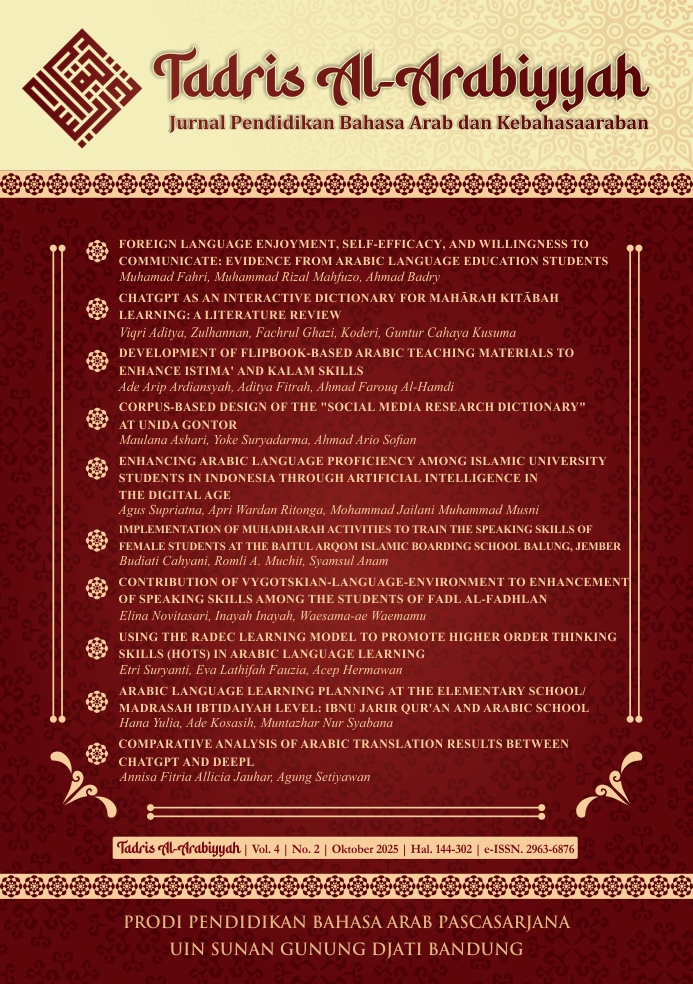
Enhancing Arabic Language Proficiency Among Islamic University Students in Indonesia Through Artificial Intelligence in the Digital Age
DOI:
https://doi.org/10.15575/ta.v4i2.49066Keywords:
kecerdasan buatan, pembelajaran bahasa Arab, perguruan tinggi Islam, era digitalAbstract
This study aims to explore the role of Artificial Intelligence (AI) in enhancing Arabic language proficiency among students of Islamic universities in Indonesia within the context of rapid digital transformation. The research highlights the urgency of adopting modern educational tools to improve Arabic learning outcomes, especially in higher education environments where Arabic serves as the primary language for Islamic sciences. Employing a descriptive-analytical method through an extensive literature review, the study examines key AI applications in Arabic language learning, such as chatbots, machine translation, speech recognition, and adaptive assessment platforms. The findings indicate that AI can increase student engagement, provide personalized linguistic support tailored to individual needs, and foster intrinsic motivation. Moreover, AI technologies facilitate the acquisition of essential language skills—listening, reading, grammar, and writing—within a dynamic academic environment. However, challenges remain regarding digital infrastructure and limited specialized training for faculty members. The study recommends systematic and sustainable integration of AI into Arabic language programs at Islamic universities, accompanied by teacher training workshops and policy updates aligned with digital era demands.
References
Amaliza. (2023). Sistem Pengajaran Cerdas Bahasa Arab Berbasis AI. Jurnal Pendidikan Bahasa Arab, 2(2), 30–45.
Applefield, J. M., Huber, R., & Moallem, M. (2000). Constructivism in theory and practice: Toward a better understanding. The High School Journal, 84(2), 35–53.
Conferences, S. H. S. (2024). Integrating Artificial Intelligence into the Arabic Language Teaching Plan at Universitas Islam Riau. SHS Conferences.
EJ-Lang. (2024). The Contribution of Artificial Intelligence to Learning the Arabic Language.
Fahmi, A., & Adhimah, D. K. (2025). Potensi Pemanfaatan Artificial Intelligence Pada Pembelajaran Bahasa Arab: Perspektif Pengembangan Karakter di Madrasah. Ihtimam: Jurnal Pendidikan Bahasa Arab.
Fatmawati, & others. (2024). Personalisasi Pembelajaran Bahasa Arab melalui AI. Jurnal Edutech Arab, 4(1), 50–65.
Garba, M. A., & Hassan, A. R. (2024). Use of AI in Learning Arabic Language by Non-Arabic Speakers. IJRISS, 8(2), 45–51.
Hadi, M., & Qohar, H. A. (2024). Peran Artificial Intelligence dalam Meningkatkan Pembelajaran Interaktif Bahasa Arab. Ranah Research: Journal of Multidisciplinary Research and Development, 6(6), 3010–3017. https://doi.org/10.38035/rrj.v6i6
Hadi, M., Qohar, H. A., Riau, U. I., Hamim, N., Supriyanto, A., Sari, F. M., Rohmawaty, others, Amaliza, Simon, N., Rahmah, S., Conferences, S. H. S., Fatmawati, others, Keumalawati, C., & Hossam, A. (2024). Peran Artificial Intelligence dalam Meningkatkan Pembelajaran Interaktif Bahasa Arab. SHS Web of Conferences, 190(1), 3012. https://doi.org/10.38035/rrj.v6i6
Hamim, N., Supriyanto, A., & Sari, F. M. (2024). Optimalisasi Penggunaan ChatGPT untuk Keterampilan Menulis Bahasa Arab. SHS Web of Conferences, 190, 3012.
Humairoh, H. (2018). Motivasi Mahasiswa Dalam Belajar Bahasa Arab Antara Harapan dan Tantangan (Studi Kasus Mahasiswa Prodi Sastra Arab, Universitas Al-Azhar Indonesia). Dzihni: Journal on Arabic Education, Linguistics, and Literary Studies, 1(2), 56–68. https://ejournal.unia.ac.id/index.php/dzihni/article/download/1944/1220
Keumalawati, C., & Hossam, A. (2024). Adaptive Learning Technologies in Arabic Language Learning: Impacts and Challenges. International Journal of Language and Ubiquitous Learning, 5(2), 110–125.
Khatimah, N., & Rahmawati, R. (2025). Literature Review: Penggunaan Teknologi Artificial Intelligence dalam Pembelajaran Bahasa Arab di Era Society 5.0. Lugawiyyat: Jurnal Bahasa Arab Dan Pendidikan Bahasa Arab.
Krashen, S. D. (1982). Principles and Practice in Second Language Acquisition. Pergamon Press.
Nusantara, J. O. (2023). Strategi Penggunaan Chatbot Artificial Intelligence dalam Pembelajaran Bahasa Arab di Perguruan Tinggi. Jurnal Oase Nusantara, 2(2), 79–89. https://ejurnal.kptk.or.id/oase/article/download/32/22
Riau, U. I. (2024a). Laporan Kajian dan Implementasi AI di Lingkungan Perguruan Tinggi Islam.
Riau, U. I. (2024b). Planning and strategy for integrating AI tools in Arabic learning.
Rohmawaty, & others. (2024). Integrasi NLP dalam Pengajaran Bahasa Arab Modern. Jurnal Linguistik Arab, 7(1), 100–115.
Siemens, G. (2005). Connectivism: A learning theory for the digital age. International Journal of Instructional Technology and Distance Learning, 2(1), 3–10.
Simon, N., & Rahmah, S. (2025). Urgensi Artificial Intelligence (AI) dalam Pembelajaran Bahasa Arab. Al-Mutsla: Jurnal Ilmu-Ilmu Keislaman, 7(1), 241–259. https://doi.org/10.46870/jstain.v7i1.1660
Downloads
Published
How to Cite
Issue
Section
Citation Check
License
Copyright (c) 2025 Agus Supriatna, Apri Wardan Ritonga, Mohammad Jailani Muhammad Musni

This work is licensed under a Creative Commons Attribution-ShareAlike 4.0 International License.