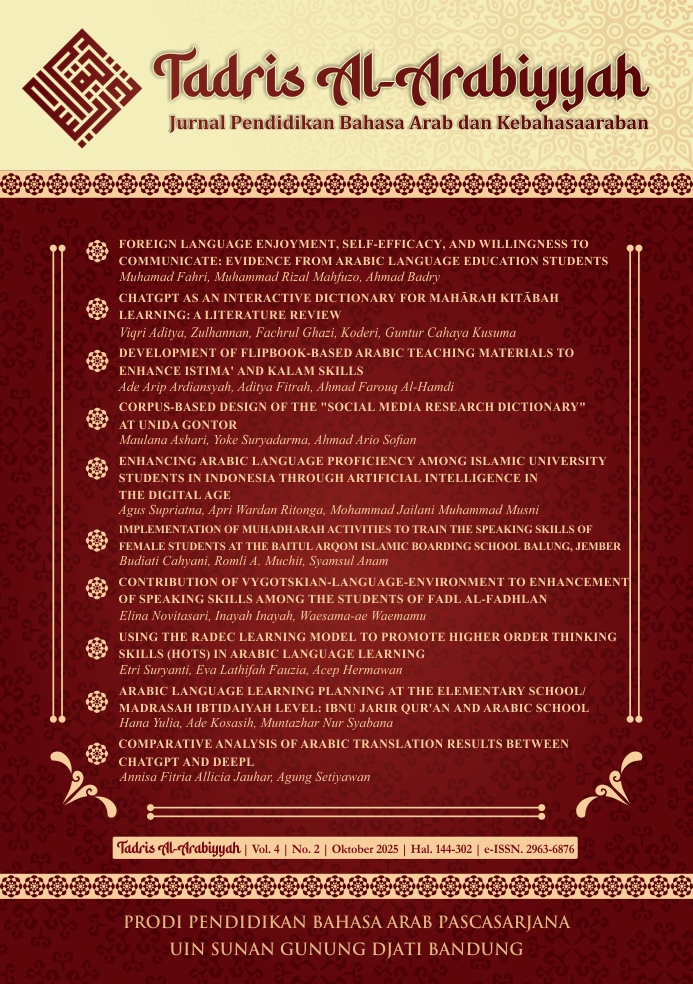
Foreign Language Enjoyment, Self-Efficacy, and Willingness to Communicate: Evidence from Arabic Language Education Students
DOI:
https://doi.org/10.15575/ta.v4i2.49443Keywords:
Arabic language, Foreign language enjoyment, Self-efficacy, Willingness to communicateAbstract
Developing learners’ communicative proficiency in Arabic requires not only linguistic competence but also a strong psychological disposition, particularly the willingness to communicate (WTC). Previous studies have highlighted the roles of foreign language enjoyment (FLE) and self-efficacy (SE) in fostering WTC, yet empirical evidence in the context of Arabic language learning remains scarce. This study aims to examine the structural relationships among FLE, SE, and WTC among undergraduate students of Arabic Language Education. A quantitative design was adopted using path analysis through the SmartPLS application. Data were collected from 101 participants using three validated instruments: the Short Form of the FLE Scale, the Generalized Self-Efficacy Scale, and the Arabic WTC Scale. The findings reveal that FLE exerts a significant positive effect on SE (β = 0.52, p < .01). However, SE does not significantly predict WTC (β = 0.11, p > .05), indicating that learners’ confidence alone does not guarantee communicative willingness. These results suggest that WTC is influenced by additional factors such as communicative contexts, classroom dynamics, and affective barriers. The study underscores the need for pedagogical interventions that integrate emotional engagement and contextualized communicative practices to strengthen Arabic learners’ WTC.
References
Aryadoust, V., & Raquel, M. (2019). Quantitative Data Analysis for Language Assessment (Vol. 2). Routledge. https://doi.org/10.4324/9781315187808
Botes, E., Dewaele, J., & Greiff, S. (2021). The development and validation of the short form of the Foreign Language Enjoyment Scale. The Modern Language Journal, 105(4), 858–876. https://doi.org/10.1111/modl.12741
Cheng, L., & Xu, J. (2022). Chinese English as a Foreign Language Learners' Individual Differences and Their Willingness to Communicate. Frontiers in Psychology, 13, 883664. https://doi.org/10.3389/fpsyg.2022.883664
Dewaele, J.-M., & MacIntyre, P. D. (2016). Foreign Language Enjoyment and Foreign Language Classroom Anxiety: The Right and Left Feet of the Language Learner. In P. D. MacIntyre, T. Gregersen, & S. Mercer (Eds.), Positive psychology in SLA (pp. 215–236). Multilingual Matters. https://doi.org/10.21832/9781783095360-010
Elahi Shirvan, M., Khajavy, G. H., MacIntyre, P. D., & Taherian, T. (2019). A Meta-Analysis of L2 Willingness to Communicate and its Three High-Evidence Correlates. Journal of Psycholinguistic Research, 48(6), 1241–1267. https://doi.org/10.1007/s10936-019-09656-9
Fahri, M., Arrahman, F. P., Albantani, A. M., Mahfuzo, M. R., & Muslimin, M. I. (2024). Investigating the Validity and Reliability of WTC Construct in L2 Arabic: A Case Study. Ta’lim al-’Arabiyyah: Jurnal Pendidikan Bahasa Arab & Kebahasaaraban, 8(1), 1–17. https://doi.org/10.15575/jpba.v8i1.35023
Guo, H., Gao, W., & Shen, Y. (2022). L2 Enjoyment of English as a Foreign Language Students: Does Teacher Verbal and Non-Verbal Immediacy Matter? Frontiers in Psychology, 13, 897698. https://doi.org/10.3389/fpsyg.2022.897698
Jin, S., & Lee, H. (2022). Willingness to Communicate and its High-Evidence Factors: A Meta-Analytic Structural Equation Modeling Approach. Journal of Language and Social Psychology, 41(6), 716–745. https://doi.org/10.1177/0261927X221092098
Lan, G., Zhao, X., & Gong, M. (2023). Motivational Intensity and Willingness to Communicate in L2 Learning: A Moderated Mediation Model of Enjoyment, Boredom, and Shyness. System, 117, 103116. https://doi.org/10.1016/j.system.2023.103116
Lee, J. S., & Chen Hsieh, J. (2019). Affective variables and Willingness to Communicate of EFL Learners in in-Class, Out-of-Class, and Digital Contexts. System, 82, 63–73. https://doi.org/10.1016/j.system.2019.03.002
Lee, J. S., & Drajati, N. A. (2020). Willingness to Communicate in Digital and Non-Digital EFL Contexts: Scale Development and Psychometric Testing. Computer Assisted Language Learning, 33(7), 688–707. https://doi.org/10.1080/09588221.2019.1588330
Lee, J. S., Lee, K., & Chen Hsieh, J. (2022). Understanding Willingness to Communicate in L2 Between Korean and Taiwanese Students. Language Teaching Research, 26(3), 455–476. https://doi.org/10.1177/1362168819890825
Lee, J. S., & Lu, Y. (2023). L2 Motivational Self System and Willingness to Communicate in the Classroom and Extramural Digital Contexts. Computer Assisted Language Learning, 36(1–2), 126–148. https://doi.org/10.1080/09588221.2021.1901746
Lv, X., Ren, W., & Li, L. (2021). Pragmatic Competence and Willingness to Communicate Among L2 Learners of Chinese. Frontiers in Psychology, 12, 797419. https://doi.org/10.3389/fpsyg.2021.797419
Macintyre, P. D., Clément, R., Dörnyei, Z., & Noels, K. A. (1998). Conceptualizing Willingness to Communicate in a L2: A Situational Model of L2 Confidence and Affiliation. The Modern Language Journal, 82(4), 545–562. https://doi.org/10.1111/j.1540-4781.1998.tb05543.x
Mahmoodi, M.-H., & Moazam, I. (2014). Willingness to communicate (WTC) and L2 achievement: The case of Arabic language learners. Procedia – Social and Behavioral Sciences, 98, 1069–1076. https://doi.org/10.1016/j.sbspro.2014.03.518
McCroskey, J. C. (2009). Willingness to Communicate, Communication Apprehension, and Self-Perceived Communication Competence: Conceptualizations and Perspectives. In Avoiding communication: Shyness, reticence, and communication apprehension (pp. 75–108). Hampton Pr.
McCroskey, J. C., & Baer, J. E. (1985). Willingness to Communicate: The Construct and its Measurement [Conference Presentation]. Annual Convention of the Speech Communication Association, Denver, CO, United States. https://files.eric.ed.gov/fulltext/ED265604.pdf
Novrianto, R., Marettih, A. K. E., & Wahyudi, H. (2019). Validitas konstruk instrumen General Self-Efficacy Scale versi Indonesia. Jurnal Psikologi, 15(1), 1. https://doi.org/10.24014/jp.v15i1.6943
Parikh, P. (2001). The use of Language. CSLI Publications.
Pasban, M. A., & Haddad Narafshan, M. (2020). The Relationship Between Learners' Academic Goal Motives and L2 (Second Language) Willingness to Communicate in English Language Classes: A look at Academic Goal Motives' Orientations. Cogent Psychology, 7(1), 1824307. https://doi.org/10.1080/23311908.2020.1824307
Peng, J.-E., & Woodrow, L. (2010). Willingness to Communicate in English: A Model in the Chinese EFL Classroom Context. Language Learning, 60(4), 834–876. https://doi.org/10.1111/j.1467-9922.2010.00576.x
Rahman, N. F. (2018). Motivasi Belajar Bahasa Arab (Studi Kasus Mahasiswa PBA IAIN Palangka Raya 2017/2018). Jurnal Al Bayan: Jurnal Jurusan Pendidikan Bahasa Arab, 10(1). https://doi.org/10.24042/albayan.v10i01.2593
Sato, M., & Dussuel Lam, C. (2021). Metacognitive Instruction with Young Learners: A Case of Willingness to Communicate, L2 use, and Metacognition of Oral Communication. Language Teaching Research, 25(6), 899–921. https://doi.org/10.1177/13621688211004639
Schwarzer, R., & Jerusalem, M. (1995). Generalized self-efficacy scale. In J. Weinman, S. Wright, & M. Johnston (Eds.), Measures in health psychology: A user's portfolio. Causal and control beliefs (pp. 35–37).
Ushioda, E. (2009). Motivation and Good Language Learners. In C. Griffiths (Ed.), Lessons from good language learners (pp. 19–34). Cambridge University Press.
Valenzuela, S., & Bachmann, I. (2017). P Path analysis. In J. Matthes, C. S. Davis, & R. F. Potter (Eds.), The international Encyclopedia of Communication Research Methods (1st ed., pp. 1–9). Wiley. https://doi.org/10.1002/9781118901731.iecrm0181
Downloads
Published
How to Cite
Issue
Section
Citation Check
License
Copyright (c) 2025 Muhamad Fahri, Muhammad Rizal Mahfuzo, Ahmad Badry

This work is licensed under a Creative Commons Attribution-ShareAlike 4.0 International License.