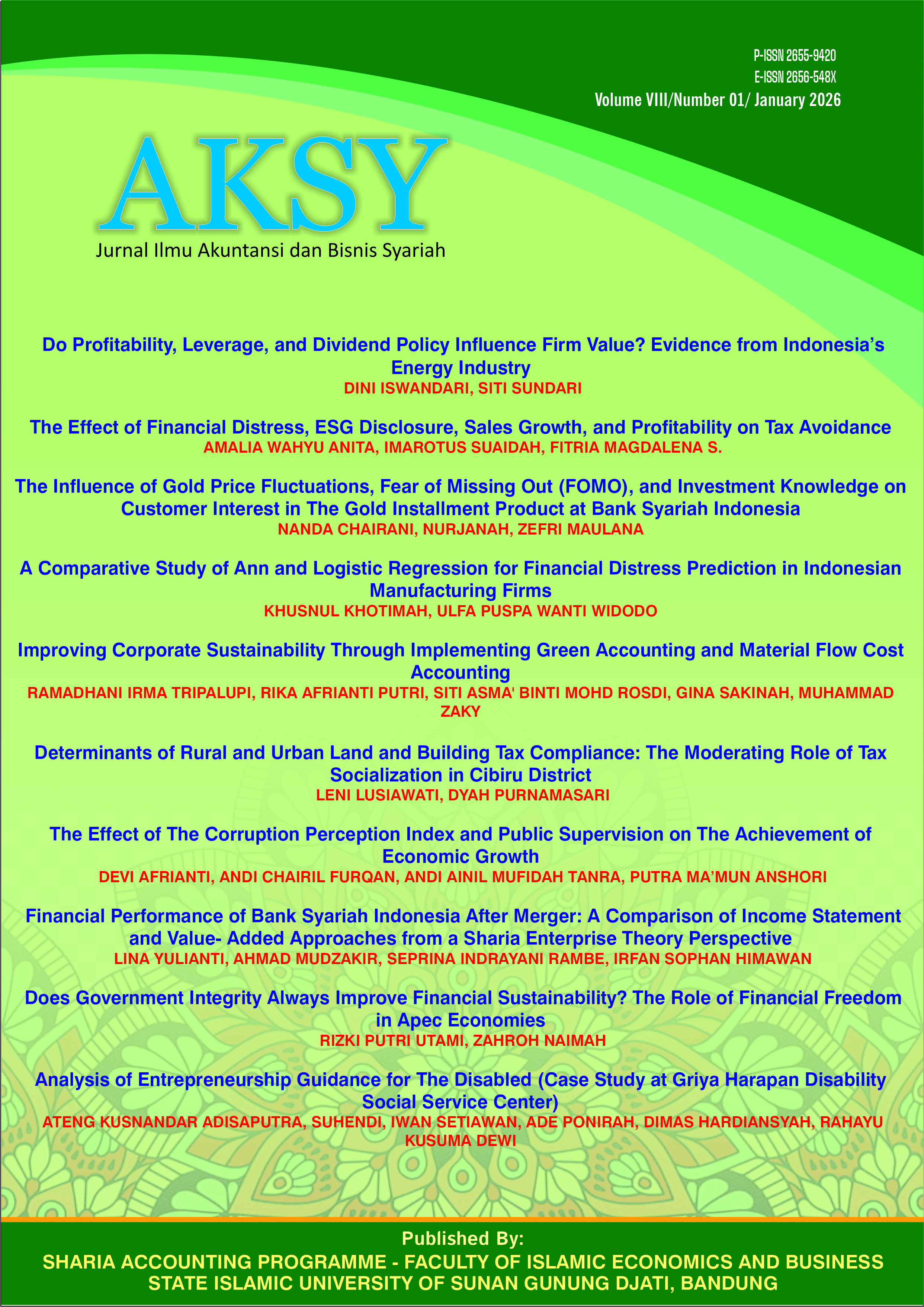
IMPROVING CORPORATE SUSTAINABILITY THROUGH IMPLEMENTING GREEN ACCOUNTING AND MATERIAL FLOW COST ACCOUNTING
DOI:
https://doi.org/10.15575/aksy.v8i1.51905Kata Kunci:
Corporate Sustainability, Green Accounting, Material Flow Cost AccountingAbstrak
This study aims to analyse how the implementation of green accounting and material flow cost accounting (MFCA) can enhance corporate sustainability in mining companies listed on the Indonesian Sharia Stock Index (ISSI). Green accounting is measured through the PROPER program, while MFCA is proxied by factory area and production output. The study uses a quantitative approach and purposive sampling from companies listed on the ISSI for the 2021-2023 period. The results show that green accounting does not have a significant effect on improving corporate sustainability. MFCA, measured by factory area, shows no significant relationship in improving corporate sustainability. In contrast, MFCA, proxied by production output, has a significant positive effect on corporate sustainability. Meanwhile, green accounting and MFCA have a substantial impact on improving corporate sustainability. The study's results indicate that the simultaneous approach is more effective at supporting sustainability. The synergy between green accounting and MFCA helps companies formulate sustainable business strategies by ensuring compliance, thereby driving innovation and competitive advantage through transparency, environmental accountability, resource efficiency, and waste reduction.
Referensi
Abdullah, M. W., & Amiruddin, H. (2020). Efek Green Accounting terhadap Material Flow Cost Accounting dalam Meningkatkan Keberlangsungan Perusahaan. Jurnal Ekonomi dan Keuangan, 166–186. https://doi.org/10.24034/j25485024.y2020.v4.i2.4145.
Ambarita, J. P., & Kartika, I. N. (2015). Pengaruh Luas Lahan, Pnggunaan Pestisida, Tenaga Kerja, Pupuk Terhadap Produksi Kopi di Kecamatan Pekutatan Kabupaten Jembrana. E-Jurnal Ekonomi Pembangunan Universitan Udayana, 746-872.
Angelin, N., & Ulfah, Y. (2024). The Effect of Material Flow Cost Accounting on Company Sustainability: Moderating Role of Green Accounting in Consumer Goods Industry Companies. International Journal of Advances in Social Sciences and Humanities, 3(1), 27-43.
Burritt, R., & Christ, K. (2016). Industry 4.0 and Environmental Accounting: A New Revolution?. Asian Journal of Sustainability and Social Responsibility, 1(1), 23-38.
Dewata, E. J., Sari, Y., & Jumarni, E. (2018). Pengaruh Biaya Lingkungan, Kepemilikan Asing dan Political Cost terhadap Kinerja Perusahaan Pertambangan di Indonesia. Jurnal AKSI (Akuntansi dan Sistem Informasi) , 122–132.
Faizah, B. S. (2020). Penerapan Green Accounting terhadap Kinerja Keuangan. Jurnal Riset Akuntansi Kontemporer, 94–99 https://doi.org/10.23969/jrak.v12i2.2779.
Julianitasari, I. (2023). Pengaruh Material Flow Cost Accounting dan Green Accounting terhadap Corporate Sustainability pada Perusahaan Manufaktur yang Terdaftar di BEI Tahun 2020 – 2022. Jakarta: Universitas Islam Negeri Syarif Hidayatullah.
Juniah, R., Dalimi, R., Suparmoko, M., & Moersidik, S. S. (2013). Dampak Pertambangan Batubara terhadap Kesehatan Masyarakat Sekitar Pertambangan Batubara (Kajian Jasa Lingkungan Sebagai Penyerap Karbon). Indonesian Journal of Health Ecology, 12(2), 80463.
Khotimah, T. A. (2022). Pengaruh Green Accounting dan Material Flow Cost Accounting terhadap Corporate Sustainabilty. Bandar Lampung.
Laoye, B., Olagbemide, P., Ogunnusi, T., & Akpor, O. (2025). Heavy Metal Contamination: Sources, Health Impacts, and Sustainable Mitigation Strategies With Insights from Nigerian Case Studies. F1000Research, 14, 134.
Loen, M. (2018). Penerapan Green Accounting dan Material Flow Cost Accounting (MFCA)Terhadap Sustainable Development. Jurnal Akuntansi & Bisnis Krisnadwipayana, 1-13.
Madyasari, A. Y., & Yuliani. (2023). Tantangan Etika dalam Bisnis Internasional yang Penuh Persaingan di Era Globalisasi. AL-IQTISHAD : JURNAL EKONOMI, 238-251.
May, S. P., Zamzam, I., Syahdan, R., & Zainuddin, Z. (2023). Pengaruh Implementasi Green Accounting, Material Flow Cost Accounting dan Environmental Performance terhadap Sustainable Development. Owner: Riset dan Jurnal Akuntansi, 7(3), 2506-2517.
Mubarokah, R. Z., Tripalupi, R. I., & Muslih, R. A. (2024). Pengaruh Green Accounting terhadap ROA pada Perusahaan Farmasi yang Terdaftar di ISSI Tahun 2018-2023 . IJEN: Indonesian Journal of Economy and Education Economy , 330-342 .
Pitriani, N. (2022). Pengaruh Penerapan Green accounting dan Material Flow Cost Accounting terhadap Keberlangsungan Perusahaan (Studi Empiris Pada Perusahaan Farmasi Yang Terdaftar Di Bursa Efek Indonesia). Samarinda: Universitas Mulawarman Samarinda.
Pramesti, K. D., & Wahyuni, M. A. (2023). Pengaruh Penerapan Green Accounting dan Material Flow Cost Accounting terhadap Corporate Sustainability (Studi Empiris Perusahaan Tekstil dan Garmen yang Terdaftar di Bursa Efek Indonesia). JIMAT (Jurnal Ilmiah Mahasiswa Akuntansi) Undiksha, 14(03), 779-787.
Prasetyowati, N. (2023). Pengaruh Green Accounting, Material Flow Cost Accounting, dan Ukuran Perusahaan terhadap Kinerja Perusahaan pada Perusahaan Pertambangan yang Terdaftar di BEI Tahun 2019- 2021.
Rakesa, P. R. C., & Werastuti, D. N. S. (2022). Pengaruh Penerapan Green Accounting dan Material Flow Cost Accounting terhadap Corporate Sustainability: Studi Empiris Pada Perusahaan Tekstil dan Garmen yang Terdaftar di Bursa Efek Indonesia. JIMAT (Jurnal Ilmiah Mahasiswa Akuntansi) Undiksha, 13(04), 1141-1152.
Selpiyanti, & Fakhroni, Z. (2020). Pengaruh Implementasi Green Accounting dan Material Flow Cost Accounting terhadap Sustainable Development dengan Studi Kasus pada Perusahaan Kelapa Sawit Terdaftar di Bursa Efek.
Setiawan, I. (2023). The Significance of Corporate Social Responsibility in Sustainable Development: an Analysis From an Islamic Law Perspective. Journal of Law and Sustainable Development, 1-23.
Statistik, B. P. (2024, Juli 25). Tabel Statistik. Diambil kembali dari Ekspor Hasil Minyak Menurut Negara Tujuan Utama, 2000-2023: https://www.bps.go.id/id/statistics-table/1/MTAxMiMx/ekspor-hasil-minyak-menurut-negara-tujuan-utama--2000-2015
Sugiyono. (2021). Metode Penelitian Kuantitatif dan R&D (Edisi 2). Bandung: Alfabeta.
Tajelawi, O. A., & Garbharran, H. L. (2015). MFCA: An Environmental Management Accounting Technique for Optimal Resource Efficiency In Production Processes. International Scholarly and Scientific Research & Innovation, 9(11), 3699-3704.
Tripalupi, R. I., Yulianti, L., Effendi, R., Ruhimat, I., & Putri, R. A. (2024). Implementation of Green Accounting: An Analysis of The Islamic Perspective and Its Environmental: Social Economic Implication. International Conference on Islamic Economics (ICIE), 201-211.
Utami,L. B., Iwin Arnova, I., Herawati, H. (2025). Pengaruh Penerapan Green Accounting, Kinerja Lingkungan, dan Corporate Social Responsibility terhadap Nilai Perusahaan. Jurnal Publikasi Ekonomi dan Akuntansi, 5(3), 21-39.
Abdullah, M. W., & Amiruddin, H. (2020). Efek Green Accounting terhadap Material Flow Cost Accounting dalam Meningkatkan Keberlangsungan Perusahaan. Jurnal Ekonomi dan Keuangan, 166–186. https://doi.org/10.24034/j25485024.y2020.v4.i2.4145.
Ambarita, J. P., & Kartika, I. N. (2015). Pengaruh Luas Lahan, Penggunaan Pestisida, Tenaga Kerja, Pupuk Terhadap Produksi Kopi di Kecamatan Pekutatan Kabupaten Jembrana. E-Jurnal Ekonomi Pembangunan Universitan Udayana, 746-872.
Angelin, N., & Ulfah, Y. (2024). The Effect of Material Flow Cost Accounting on Company Sustainability: Moderating Role of Green Accounting in Consumer Goods Industry Companies. International Journal of Advances in Social Sciences and Humanities, 3(1), 27-43.
Burritt, R., & Christ, K. (2016). Industry 4.0 and Environmental Accounting: A New Revolution?. Asian Journal of Sustainability and Social Responsibility, 1(1), 23-38.
Dewata, E. J., Sari, Y., & Jumarni, E. (2018). Pengaruh Biaya Lingkungan, Kepemilikan Asing dan Political Cost terhadap Kinerja Perusahaan Pertambangan di Indonesia. Jurnal AKSI (Akuntansi dan Sistem Informasi) , 122–132.
Faizah, B. S. (2020). Penerapan Green accounting terhadap Kinerja Keuangan. Jurnal Riset Akuntansi Kontemporer, 94–99 https://doi.org/10.23969/jrak.v12i2.2779.
Julianitasari, I. (2023). Pengaruh Material Flow Cost Accounting dan Green Accounting terhadap Corporate Sustainability pada Perusahaan Manufaktur yang Terdaftar di BEI Tahun 2020 – 2022. Jakarta: Universitas Islam Negeri Syarif Hidayatullah.
Juniah, R., Dalimi, R., Suparmoko, M., & Moersidik, S. S. (2013). Dampak Pertambangan Batubara terhadap Kesehatan Masyarakat Sekitar Pertambangan Batubara (Kajian Jasa Lingkungan Sebagai Penyerap Karbon). Indonesian Journal of Health Ecology, 12(2), 80463.
Khotimah, T. A. (2022). Pengaruh Green Accounting dan Material Flow Cost Accounting terhadap Corporate Sustainabilty. Bandar Lampung.
Laoye, B., Olagbemide, P., Ogunnusi, T., & Akpor, O. (2025). Heavy Metal Contamination: Sources, Health Impacts, and Sustainable Mitigation Strategies With Insights from Nigerian Case Studies. F1000Research, 14, 134.
Loen, M. (2018). Penerapan Green Accounting dan Material flow Cost Accounting (MFCA) terhadap Sustainable Development. Jurnal Akuntansi & Bisnis Krisnadwipayana, 1-13.
Madyasari, A. Y., & Yuliani. (2023). Tantangan Etika dalam Bisnis Internasional yang Penuh Persaingan di Era Globalisasi. AL-IQTISHAD : JURNAL EKONOMI, 238-251.
May, S. P., Zamzam, I., Syahdan, R., & Zainuddin, Z. (2023). Pengaruh Implementasi Green Accounting, Material Flow Cost Accounting dan Environmental Performance terhadap Sustainable Development. Owner: Riset dan Jurnal Akuntansi, 7(3), 2506-2517.
Mubarokah, R. Z., Tripalupi, R. I., & Muslih, R. A. (2024). Pengaruh Green Accounting terhadap ROA pada Perusahaan Farmasi yang Terdaftar di ISSI Tahun 2018-2023 . IJEN: Indonesian Journal of Economy and Education Economy , 330-342 .
Pitriani, N. (2022). Pengaruh Penerapan Green Accounting dan Material flow Cost Accounting terhadap Keberlangsungan Perusahaan (Studi Empiris Pada Perusahaan Farmasi yang Terdaftar Di Bursa Efek Indonesia). Samarinda: Universitas Mulawarman Samarinda.
Pramesti, K. D., & Wahyuni, M. A. (2023). Pengaruh Penerapan Green Accounting dan Material Flow Cost Accounting terhadap Corporate Sustainability (Studi Empiris Perusahaan Tekstil Dan Garmen Yang Terdaftar Di Bursa Efek Indonesia). JIMAT (Jurnal Ilmiah Mahasiswa Akuntansi) Undiksha, 14(03), 779-787.
Prasetyowati, N. (2023). Pengaruh Green accounting, Material Flow Cost Accounting, dan Ukuran Perusahaan terhadap Kinerja Perusahaan pada Perusahaan Pertambangan yang Terdaftar di BEI Tahun 2019- 2021.
Rakesa, P. R. C., & Werastuti, D. N. S. (2022). Pengaruh Penerapan Green Accounting dan Material Flow Cost Accounting terhadap Corporate Sustainability: Studi Empiris pada Perusahaan Tekstil dan Garmen yang Terdaftar di Bursa Efek Indonesia. JIMAT (Jurnal Ilmiah Mahasiswa Akuntansi) Undiksha, 13(04), 1141-1152.
Selpiyanti, & Fakhroni, Z. (2020). Pengaruh Implementasi Green Accounting dan Material flow Cost Accounting terhadap Sustainable Development dengan studi Kasus pada Perusahaan Kelapa Sawit terdaftar di Bursa Efek.
Setiawan, I. (2023). The Significance of Corporate Social Responsibility in Sustainable Development: an Analysis From an Islamic Law Perspective. Journal of Law and Sustainable Development, 1-23.
Statistik, B. P. (2024, Juli 25). Tabel Statistik. Diambil kembali dari Ekspor Hasil Minyak Menurut Negara Tujuan Utama, 2000-2023: https://www.bps.go.id/id/statistics-table/1/MTAxMiMx/ekspor-hasil-minyak-menurut-negara-tujuan-utama--2000-2015
Sugiyono. (2021). Metode Penelitian Kuantitatif dan R&D (Edisi 2). Bandung: Alfabeta.
Tajelawi, O. A., & Garbharran, H. L. (2015). MFCA: An Environmental Management Accounting Technique for Optimal Resource Efficiency In Production Processes. International Scholarly and Scientific Research & Innovation, 9(11), 3699-3704.
Tripalupi, R. I., Yulianti, L., Effendi, R., Ruhimat, I., & Putri, R. A. (2024). Implementation of Green Accounting: an Analysis of The Islamic Perspective and Its Environmental: Social Economic Implication. International Conference on Islamic Economics (ICIE), 201-211.
Utami,L. B., Iwin Arnova, I., Herawati, H. (2025). Pengaruh Penerapan Green Accounting, Kinerja Lingkungan, dan Corporate Social Responsibility terhadap Nilai Perusahaan. Jurnal Publikasi Ekonomi dan Akuntansi, 5(3), 21-39.
Werastuti, D. N. S., Putri, R. L., Risfandy, T., & Dewi, T. R. (2023). The Determinants of Company Value: Green Accounting, CSR, and Profitability. AFRE (Accounting and Financial Review), 6(1), 115-126.
Yuniar , V., Rosmanidar, E., & Putri, N. S. (2024). Pengaruh Green Accounting dan Material Flow Cost Accounting terhadap Corporate Sustainability (Studi pada PT. Unilever Indonesia dan PT. Coca ColaAmatil Indonesia). Jurnal Penelitian Multidisiplin Terpadu, 8(9), 119-125.
Unduhan
Diterbitkan
Cara Mengutip
Terbitan
Bagian
Citation Check
Lisensi
Hak Cipta (c) 2026 Jurnal Ilmu Akuntansi dan Bisnis Syariah (AKSY)

Artikel ini berlisensiCreative Commons Attribution-ShareAlike 4.0 International License.
Lisensi Creative Commons
Jurnal Ilmu Akuntansi dan Bisnis Syariah are licensed under Attribution-ShareAlike 4.0 International