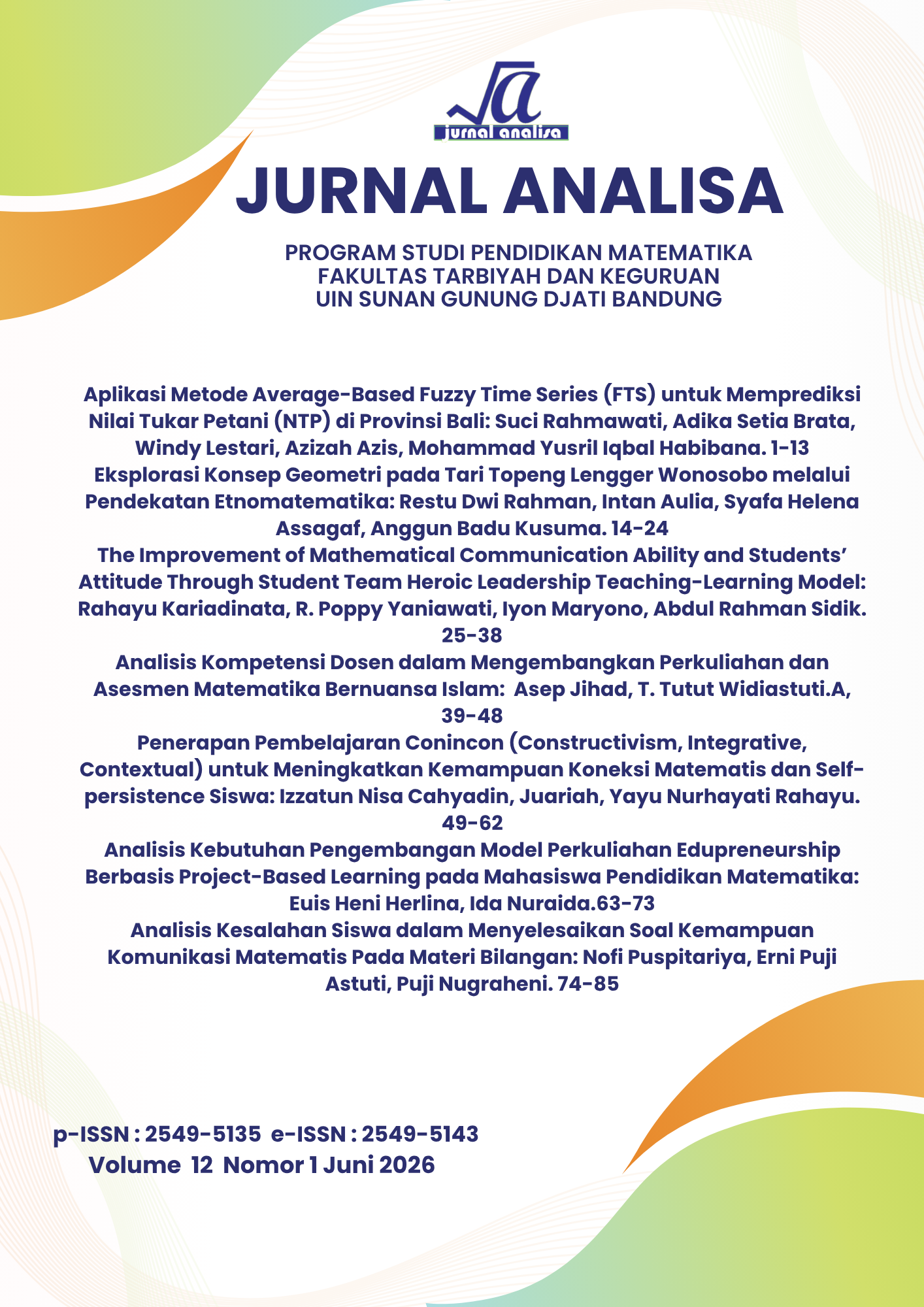
Analisis Kebutuhan Pengembangan Model Perkuliahan Edupreneurship Berbasis Project-Based Learning pada Mahasiswa Pendidikan Matematika
DOI:
https://doi.org/10.15575/ja.v12i1.57081Abstrak
Studi ini bertujuan memetakan kebutuhan mahasiswa sebagai basis empiris perancangan model perkuliahan Wirausaha Bidang Pendidikan Matematika berbasis Project-Based Learning (PjBL) di Program Studi S1 Pendidikan Matematika UIN Sunan Gunung Djati Bandung. Analisis kebutuhan merupakan tahap pertama (Fase 1) dalam desain penelitian Design-Based Research (DBR). Data dikumpulkan melalui survei terstruktur terhadap 51 mahasiswa dari sembilan kelas pada Juni 2026, menggunakan instrumen enam bagian yang mencakup penilaian kondisi aktual perkuliahan, kebutuhan fitur pembelajaran, kebutuhan kompetensi edupreneurship, hambatan pengembangan jiwa wirausaha, dan preferensi produk edukasi matematika. Hasil penelitian menunjukkan bahwa: (1) kondisi aktual perkuliahan dinilai cukup baik (rata-rata B = 3,50/4,00), namun aspek persiapan konkret menjadi pengusaha (B6 = 3,16) berada pada kategori kritis; (2) kebutuhan tertinggi mencakup proyek nyata pengembangan produk (C1 = 3,78) dan bimbingan terstruktur (C4 = 3,73); (3) gap kompetensi terbesar terdapat pada pemasaran (D5 = 3,84) dan manajemen proyek (D4 = 3,82) yang belum terlayani secara praktis; serta (4) hambatan utama bersifat sistemik, yaitu keterbatasan modal (45,1%), padatnya waktu kuliah (43,1%), dan kebuntuan ide (41,2%). Temuan ini menghasilkan lima rekomendasi prioritas redesain perkuliahan berbasis PjBL Gold Standard yang berorientasi pada produk edukasi nyata terkoneksi ke pengguna.
Kata kunci: Analisis kebutuhan; Design-Based Research; edupreneurship; pendidikan matematika; Project-Based Learning
Referensi
Anderson, T., & Shattuck, J. (2012). Design-based research: A decade of progress in education research? Educational Researcher, 41(1), 16–25. https://doi.org/10.3102/0013189X11428813
Anwar, I., & Saleem, I. (2019). Exploring entrepreneurial characteristics among university students: An evidence from India. Asia Pacific Journal of Innovation and Entrepreneurship, 13(3), 282–295. https://doi.org/10.1108/apjie-07-2018-0044
Bacigalupo, M., Kampylis, P., Punie, Y., & Van den Brande, G. (2016). EntreComp: The entrepreneurship competence framework. Publications Office of the European Union. https://doi.org/10.2791/593884
Bagis, A. A. (2022). Building students’ entrepreneurial orientation through entrepreneurial intention and workplace spirituality. Heliyon, 8(11), e11310. https://doi.org/10.1016/j.heliyon.2022.e11310
Dweck, C. S. (2017). Mindset: Changing the way you think to fulfil your potential (Updated ed.). Robinson.
Fayolle, A., & Redford, D. T. (Eds.). (2014). Handbook on the entrepreneurial university. Edward Elgar Publishing.
Han, S., Capraro, R., & Capraro, M. M. (2015). How science, technology, engineering, and mathematics (STEM) project-based learning (PBL) affects high, middle, and low achievers differently: The impact of student factors on achievement. International Journal of Science and Mathematics Education, 13(5), 1089–1113. https://doi.org/10.1007/s10763-014-9526-0
Jaenudin, R., & Priti, P. (2025). Transformasi edupreneurship: Studi empiris program mahasiswa wirausaha terhadap minat berwirausaha mahasiswa pendidikan ekonomi Universitas Sriwijaya. JPEK (Jurnal Pendidikan Ekonomi dan Kewirausahaan), 9(1), 299–310.
Krajcik, J., & Shin, N. (2014). Project-based learning. In R. K. Sawyer (Ed.), The Cambridge handbook of the learning sciences (2nd ed., pp. 275–297). Cambridge University Press.
Larmer, J., Mergendoller, J., & Boss, S. (2015). Setting the standard for project based learning: A proven approach to rigorous classroom instruction. ASCD.
Lumpkin, G. T., & Bacq, S. (2019). Civic wealth creation: A new view of stakeholder engagement and societal impact. Academy of Management Perspectives, 33(4), 383–404. https://doi.org/10.5465/amp.2017.0060
McKenney, S., & Reeves, T. C. (2019). Conducting educational design research (2nd ed.). Routledge.
Mwasalwiba, E. S. (2010). Entrepreneurship education: A review of its objectives, teaching methods, and impact indicators. Education + Training, 52(1), 20–47. https://doi.org/10.1108/00400911011017663
Palmér, H., & Johansson, M. (2018). Combining entrepreneurship and mathematics in primary school–what happens? Education Inquiry, 9(4), 331–346. https://doi.org/10.1080/20004508.2018.1461497
Plomp, T. (2013). Educational design research: An introduction. In T. Plomp & N. Nieveen (Eds.), Educational design research (pp. 11–50). SLO Netherlands Institute for Curriculum Development.
Purwanti, K. L., Adriyani, Z., Afifa, E. L. N., & Nurhalisa, S. (2025). Character education through project-based learning: The implementation of the Pancasila student profile and Rahmatan lil Alamin project in an Islamic elementary school. Journal of Integrated Elementary Education, 5(2), 145–160.
Rahayu, S., Wiyono, B. B., & Lisnawati, S. (2022). Pendidikan kewirausahaan di perguruan tinggi: Tantangan dan peluang dalam era revolusi industri 4.0. Jurnal Pendidikan dan Kebudayaan, 7(1), 45–62. https://doi.org/10.24832/jpnk.v7i1.2234
Rauf, R., Wijaya, H., & Tari, E. (2021). Entrepreneurship education based on environmental insight: Opportunities and challenges in the new normal era. Cogent Arts & Humanities, 8(1), 1945756. https://doi.org/10.1080/23311983.2021.1945756
Reeves, T. C. (2006). Design research from a technology perspective. In J. Van den Akker, K. Gravemeijer, S. McKenney, & N. Nieveen (Eds.), Educational design research (pp. 52–66). Routledge.
Rehman, N., Huang, X., Mahmood, A., AlGerafi, M. A. M., & Javed, S. (2024). Project-based learning as a catalyst for 21st-century skills and student engagement in the math classroom. Heliyon, 10(22), e39988. https://doi.org/10.1016/j.heliyon.2024.e39988
Samsul, P., Djafar, S., & Nurwijaya, S. (2025). Problem-Project based learning model for improving entrepreneurship character and reasoning ability of mathematics education students. Jurnal Riset Pendidikan Matematika, 12(2), 163–182. https://doi.org/10.21831/jrpm.v12i2.88122
Viyanti, V., Rosidin, U., & Shintya, R. E. (2022). Collaborative and problem-solving instruments in project-based physics learning. Indonesian Journal of Science and Mathematics Education, 5(1), 96–108. https://doi.org/10.24042/ijsme.v5i1.11636
Wibowo, A., & Suharto, D. G. (2021). Faktor-faktor yang memengaruhi minat berwirausaha mahasiswa: Studi pada perguruan tinggi di Jawa Tengah. Jurnal Riset Pendidikan Ekonomi, 6(1), 1–14.
Unduhan
Diterbitkan
Cara Mengutip
Terbitan
Bagian
Lisensi
Hak Cipta (c) 2026 Euis Heni Herlina, Ida Nuraida

Artikel ini berlisensiCreative Commons Attribution-ShareAlike 4.0 International License.
Authors who publish in Jurnal Analisa agree to the following terms:
1. Authors retain copyright and grant the journal right of first publication with the work simultaneously licensed under a Attribution-ShareAlike 4.0 International (CC BY-SA 4.0) License that allows others to share the work with an acknowledgment of the work's authorship and initial publication in this journal.
2. Authors are able to enter into separate, additional contractual arrangements for the non-exclusive distribution of the journal's published version of the work (e.g., post it to an institutional repository or publish it in a book), with an acknowledgment of its initial publication in this journal.
3.Authors are permitted and encouraged to post their work online (e.g., in institutional repositories or on their website) prior to and during the submission process, as it can lead to productive exchanges, as well as earlier and greater citation of published work (See The Effect of Open Access).