
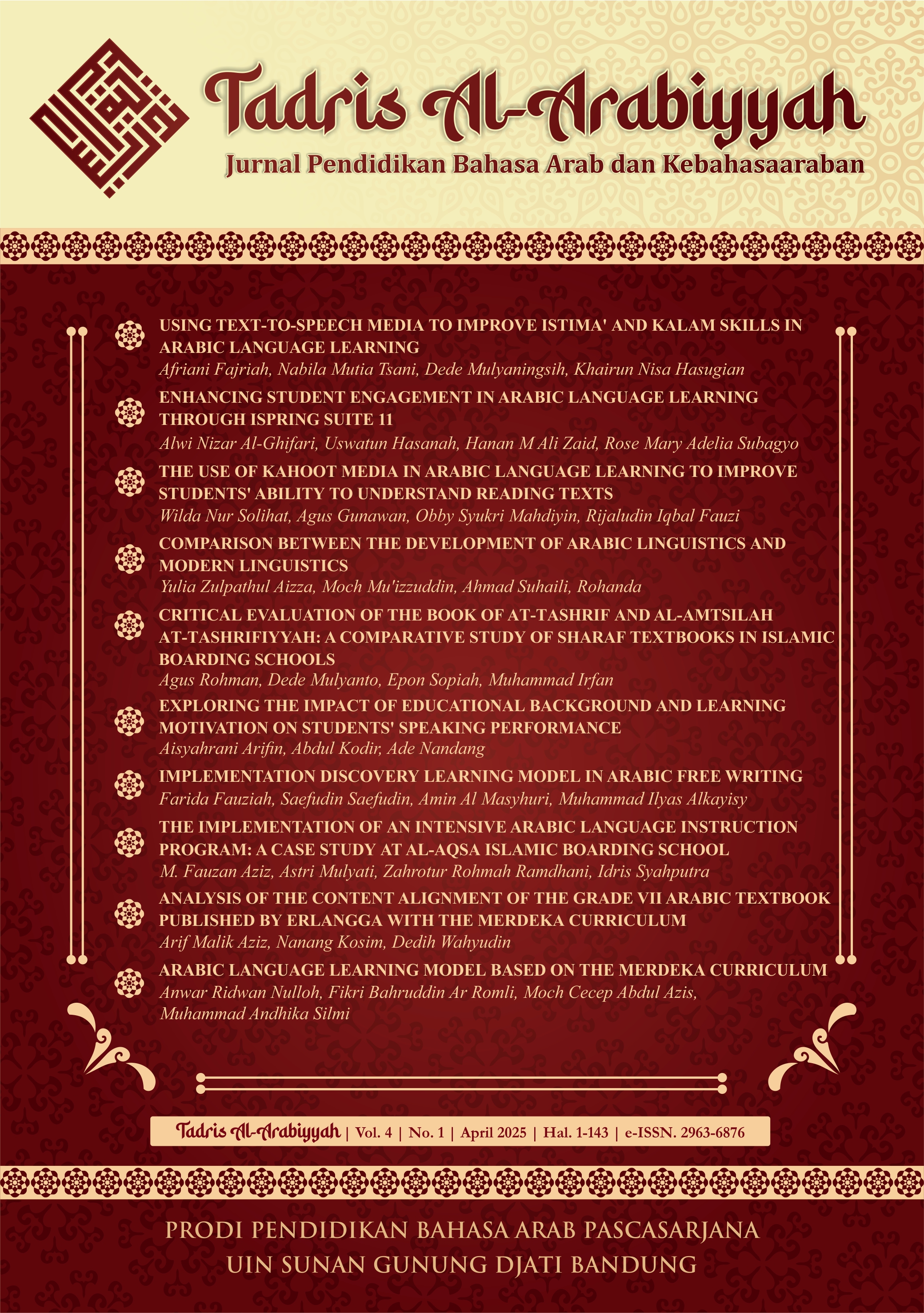
Analysis of The Content Alignment of The Grade VII Arabic Textbook Published by Erlangga with The Merdeka Curriculum
DOI:
https://doi.org/10.15575/ta.v4i1.44923Keywords:
Arabic textbook, Content analysis, Learning assessment, Merdeka CurriculumAbstract
Content analysis of textbooks is essential to ensure that the material aligns with the curriculum, improves the quality of learning, and meets students' needs. Therefore, the researcher hopes this study can assist educators in selecting appropriate textbooks for implementing the Merdeka Curriculum. This study aims to assess the alignment of learning objectives, content, material presentation, and assessment/evaluation of learning in the 7th-grade Arabic textbook by Erlangga with the Merdeka Curriculum. The research approach used is qualitative. The method employed is content analysis, and the research type is descriptive qualitative research. Data collection was carried out using the documentation technique. Data analysis was done in three stages: data reduction, presentation, and conclusion. The findings of the study indicate: (1) There is no alignment between the learning objectives of the 7th-grade Arabic textbook by Erlangga and the Merdeka Curriculum in terms of the formulation; (2) The content in the 7th-grade Arabic textbook by Erlangga aligns with the Merdeka Curriculum in all three components—Content Requirements, Content Load, and Content Feasibility; (3) The presentation of the material in the textbook aligns with the Merdeka Curriculum in terms of Presentation Techniques and Presentation Support, except for the absence of guidelines for using the book and a glossary/index; (4) The assessment/evaluation in the 7th-grade Arabic textbook by Erlangga is fully in line with the Merdeka Curriculum, including HOTS questions, activity sheets, and worksheets
References
Alfikri, M. Y., Handayani, S., & Chanifudin, C. (2023). Tantangan dan peluang implementasi Kurikulum Merdeka di madrasah. HEMAT: Journal of Humanities Education Management Accounting and Transportation, 1(2), 1–12. https://doi.org/10.57235/hemat.v1i2.2816
Annur, S., Oktarina, W., Divy, E. O., et al. (2024). Tantangan dan strategi pembelajaran Kurikulum Merdeka di MA Muhajirin. CDJ, 4(2), 1–12. https://doi.org/10.31004/cdj.v4i2.12951
Asy’ari, H., Naifah, & Setyawan, C. E. (2024). Arabic Curriculum Design in The Merdeka Curriculum from The Perspective of ACTFL Standards. Mantiqu Tayr: Journal of Arabic Language, 4(1), 213–231. https://doi.org/10.25217/mantiqutayr.v4i1.4001
Fasabbikh, F., & Anwar, N. (2024). Analisis Buku Teks Bahasa Arab Praktis untuk SMP/MTs Kelas VII Berdasarkan Kelayakan BSKAP. JIIP: Jurnal Ilmiah Ilmu Pendidikan, 7(4), 3702–3710. https://doi.org/10.54371/jiip.v7i4.4061
Fatimatuzzahrah, F., Sakinah, L., & Alyasari, S. A. (2023). Problematika implementasi Kurikulum Merdeka di sekolah. JUBPI, 2(1), 43–53. https://doi.org/10.55606/jubpi.v2i1.2339
Febriani, S. R., Bedra, K. G., & Rahmawati, R. (2022). The Critical Analysis of Hiwar in Madrasah Ibtidaiyyah Textbook based on Core Competencies in the Republic of Indonesia. Al-Ta’rib: Jurnal Ilmiah Program Studi Pendidikan Bahasa Arab IAIN Palangka Raya, 10(2), 185–198. https://doi.org/10.23971/altarib.v10i2.4486
Downloads
Published
How to Cite
Issue
Section
Citation Check
License
Copyright (c) 2025 Arif Malik Aziz, Nanang Kosim, Dedih Wahyudin

This work is licensed under a Creative Commons Attribution-ShareAlike 4.0 International License.