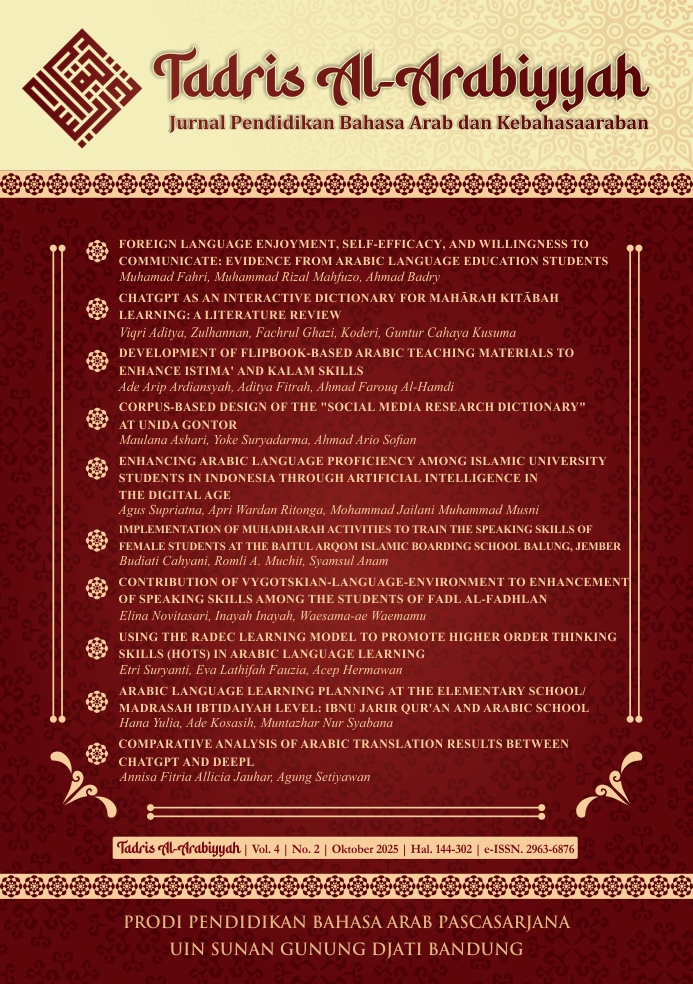
Using the RADEC Learning Model to Promote Higher Order Thinking Skills (HOTS) in Arabic Language Learning among Grade 8 Students at As-Salam Middle School for Quran Memorization Bogor
DOI:
https://doi.org/10.15575/ta.v4i2.51103Keywords:
Pembelajaran Bahasa Arab, Keterampilan Berpikir Tingkat Tinggi (HOTS), Model Pembelajaran RADECAbstract
The challenges of 21st century education require students to have critical, analytical, and creative thinking skills, which are classified as high-level thinking skills. However, Arabic language learning at As-Salam Qur'an Junior High School in Bogor is still dominated by memorization methods and basic knowledge and skills. This is the background of the low level of thinking skills of students. Therefore, an innovative learning model is needed to improve students' high-level thinking skills, one of which is the RADEC (Read, Answer, Discuss, Explain, Create) learning model. The purpose of this study is to examine the application of the RADEC model in Arabic language learning and measure its effectiveness in improving students' high-level thinking skills. In addition, this study also aims to compare learning outcomes between classes that use the RADEC model and classes that use the regular learning model. The basic concept of this research is based on the theory of social constructivism which emphasizes the importance of active and collaborative learning. The RADEC model consists of five stages: reading to gain initial understanding, answering questions based on high thinking skills, discussing answers in groups, explaining the results of the discussion in front of the class, and creating new products or solutions based on their understanding. Each stage is designed to develop HOTS skills according to Bloom's revised taxonomic theory, i.e. student analysis, evaluation, and creation. The research method used was a quasi-experimental method with a nonequivalent control group design. Class VIII C as an experimental class and class VIII D as a control class. Data is collected through observation and tests. Data analysis was carried out with the help of IBM SPSS Statistics 29. The results of the study show that the Read stage in the RADEC model in Arabic learning needs to be prepared by the teacher and the RADEC model will be easier to accept if students complete the previous material. The RADEC learning model and the regular learning model are effective in improving students' high-level thinking skills. However, the average posttest score of the experimental class was higher than that of the control class, with the N-Gain test result of 0.5057 for the experimental class and 0.03834 for the control class. Statistical tests showed that there was a significant difference between the learning outcomes of the two classes. The conclusion of this study is that the RADEC model can be used as an alternative innovative learning model to improve students' HOTS in Arabic language learning.
References
Agmita, N., Suyana, I., & Feranie, S. (2021). DESAIN LKPD BERBASIS MASALAH UNTUK MELATIHKAN KETERAMPILAN ABAD 21. Journal of Teaching and Learning Physics, 6(2), 90–99. https://doi.org/10.15575/jotalp.v6i2.10984
Agriyana, R. K. (2020). Higher Order Thinking Skills Siswa Sekolah Dasar Melalui Pembelajaran Read-Answer-Discuss-Explain-And Create Pada Materi Daur Air. UPI.
Anderson, L. W., & Krathwohl, D. R. (2017). A Taxonomy for Learning, Teaching, and Assessing: A Revision of Bloom’s Taxonomy of Educational Objectives (A. Prihantoro, Trans.; 1st ed.). Pustaka Pelajar.
Bandura, A. (1977). Social Learning Theory. Prentice-Hall.
Brookhart, S. M. (2010). How to assess higher-order thinking skills in your classroom. ASCD.
Daryanto, D., & Karim, S. (2017). Pembelajaran Abad 21. Penerbit Gava Media.
Dharma, S. (2023). Studi Literatur: Pemanfaatan Model Radec Terhadap Keterampilan Berpikir Tingkat Tinggi dalam Pembelajaran PKN di Sekolah Dasar. 06(01).
Ennis, R. H. (1985). A Logical Basis for Measuring Critical Thinking Skills. Educational Leadership, 43(2). https://ascd.org/el/articles/a-logical-basis-for-measuring-critical-thinking-skills
Flavell, J. H. (1979). Metacognition and Cognitive Monitoring: A New Area of Cognitive-Developmental Inquiry. American Psychologist, 34(10). https://eric.ed.gov/?id=EJ217109
Guilford, J. P. (1967). The Nature of Human Intelligence. McGraw-Hill. https://archive.org/details/natureofhumanint0000jpgu
Ilham S, M., Kune, S., & Rukli, R. (2020). The Effect of Radec’s Learning Model Assisted by Zoom Application on Science Critical Thinking Ability during Covid-19 Pandemic Era. Indonesian Journal of Primary Education, 4(2), 174–183. https://doi.org/10.17509/ijpe.v4i2.29262
Kilbane, C. R., & Milman, N. B. (2014). Teaching models: Designing instruction for 21st century learners. Pearson.
Kusumaningpuri, A. R., & Fauziati, E. (2021). Model Pembelajaran RADEC dalam Perspektif Filsafat Konstruktivisme Vygotsky. Jurnal Papeda: Jurnal Publikasi Pendidikan Dasar, 3(2), 103–111. https://doi.org/10.36232/jurnalpendidikandasar.v3i2.1169
Mia Titin Yulianti, Qomario, & Nureva. (2023). Pengaruh Model Pembelajaran RADEC (Read, Answer, Discuss, Explain and Create) terhadap Hasil Belajar. FingeR: Journal of Elementary School, 2(1), 33–40. https://doi.org/10.30599/finger.v2i1.458
Piaget, J. (1970). Science of Education and the Psychology of the Child. Orion Press. https://archive.org/details/scienceofeducati0000piag_e0m2
Pratama, Y. A. (2019). Pengaruh Model Pembelajaran RADEC dan Inkuiri Terhadap Keterampilan Berpikir Tingkat Tinggi Mahasiswa PGSD Pada Perkuliahan IPA [Tesis]. UPI.
Pratama, Y. A., Sopandi, W., & Hidayah, Y. (2019). Model Pembelajaran Radec (Read-Answer-Discuss-Explain And Create): Pentingnya Membangun Keterampilan Berpikir Kritis Dalam Konteks Keindonesiaan. Indonesian Journal of Learning Education and Counseling, 2(1). https://doi.org/10.31960/ijolec.v2i1.99
Pratama, Y. A., Sopandi, W., Hidayah, Y., & Trihatusti, M. (2020). Pengaruh model pembelajaran RADEC terhadap keterampilan berpikir tingkat tinggi siswa sekolah dasar. JINoP (Jurnal Inovasi Pembelajaran), 6(2). https://doi.org/10.22219/jinop.v6i2.12653
Rifa Hanifa Mardhiyah, Sekar Nurul Fajriyah Aldriani, Febyana Chitta, & Muhamad Rizal Zulfikar. (2021). Pentingnya Keterampilan Belajar di Abad 21 sebagai Tuntutan dalam Pengembangan Sumber Daya Manusia. Lectura : Jurnal Pendidikan, 12(1), 29–40. https://doi.org/10.31849/lectura.v12i1.5813
Rohmawatiningsih, W., Rachman, I., & Yayoi, K. (2021). The implementation of RADEC learning model in thematic learning to increase the concept understanding of electrical phenomenon. Momentum: Physics Education Journal, 121–131. https://doi.org/10.21067/mpej.v5i2.5412
Scoular, C. (2020). Analysis of 21st century skills integration as applied in the Philippines K to 12 program. Final report.
Siregar, L. S., Wahyu, W., & Sopandi, W. (2020). Polymer learning design using Read, Answer, Discuss, Explain and Create (RADEC) model based on Google Classroom to develop student’s mastery of concepts. Journal of Physics: Conference Series, 1469(1), 012078. https://doi.org/10.1088/1742-6596/1469/1/012078
Slavin, R. E. (2012). Educational Psychology: Theory and Practice (10th ed.). Pearson.
Tulljanah, R., & Amini, R. (2021). Model Pembelajaran RADEC sebagai Alternatif dalam Meningkatkan Higher Order Thinking Skill pada Pembelajaran IPA di Sekolah Dasar: Systematic Review. Jurnal Basicedu, 5(6), 5508–5519. https://doi.org/10.31004/basicedu.v5i6.1680
Vygotsky, L. S. (1978). Mind in Society: The Development of Higher Psychological Processes. Harvard University Press. https://archive.org/details/mindinsocietydev0000vygo
Yulianti, Y., Lestari, H., & Rahmawati, I. (2022). PENERAPAN MODEL PEMBELAJARAN RADEC TERHADAP PENINGKATAN KEMAMPUAN BERPIKIR KRITIS SISWA. Jurnal Cakrawala Pendas, 8(1). https://doi.org/10.31949/jcp.v8i1.1915
Zakiah, L., & Lestari, I. (2019). Berpikir Kritis dalam Konteks Pembelajaran. Erzatama Karya Abadi.
Downloads
Published
How to Cite
Issue
Section
Citation Check
License
Copyright (c) 2025 Etri Suryanti, Eva Lathifah Fauzia, Acep Hermawan

This work is licensed under a Creative Commons Attribution-ShareAlike 4.0 International License.