
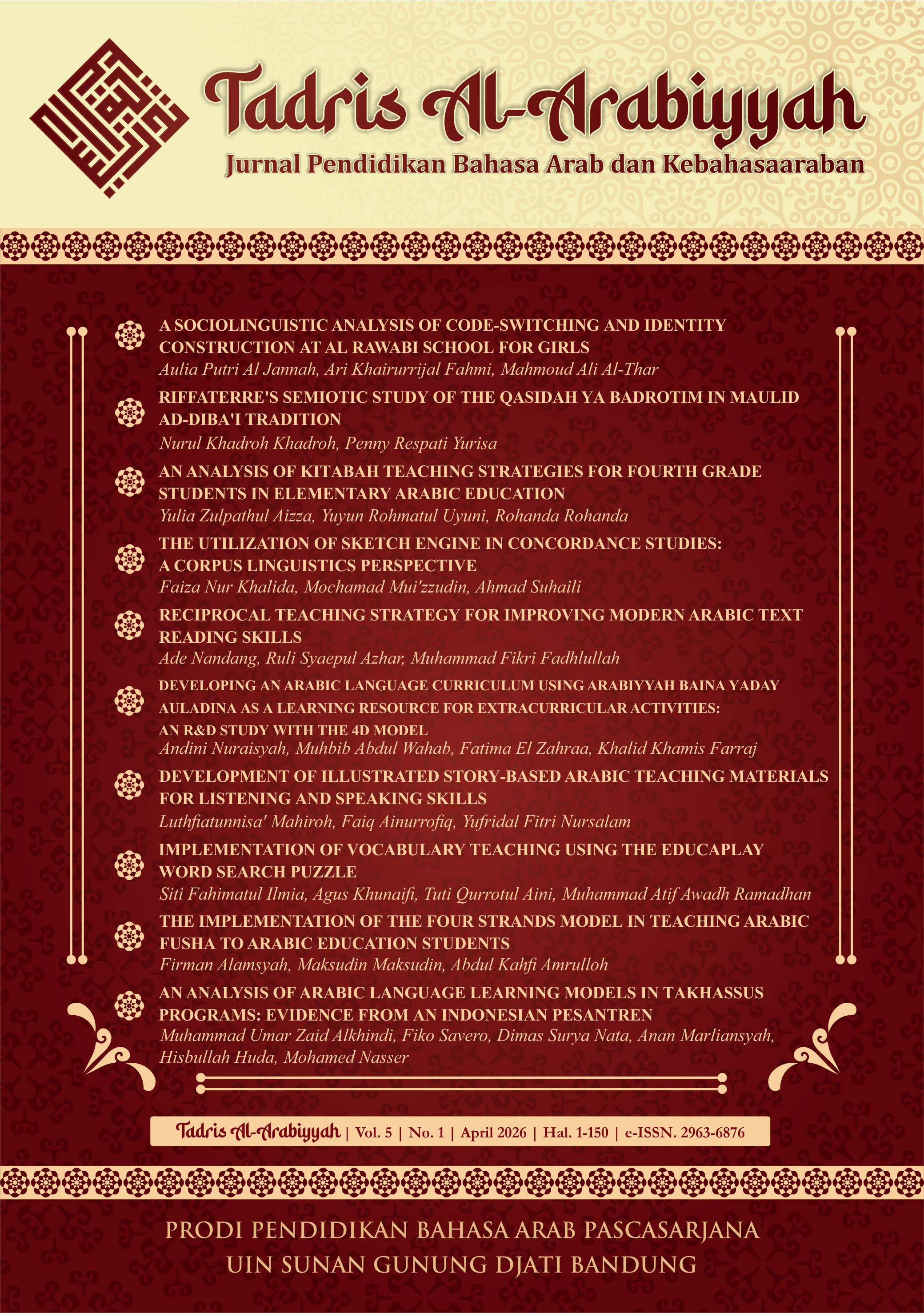
Implementation of Vocabulary Teaching Using the Educaplay Word Search Puzzle
DOI:
https://doi.org/10.15575/ta.v5i1.54606Keywords:
الكلمات الرئيسية : تعليم المفردات، Educaplay، اللغة العربيةAbstract
This study aims to describe the application of Arabic vocabulary learning using the digital media Educaplay Word Search Puzzle at Madrasah Tsanawiyah Negeri 2 Semarang City and analyze the activities and responses of students during the learning process. This study uses a descriptive qualitative approach with the research subjects of an Arabic teacher and grade VII students who are directly involved in learning activities. Data collection techniques include observation of the learning process, interviews with teachers and students, and documentation as supporting data. Data analysis is carried out through the stages of data reduction, data presentation, and drawing conclusions. The results of the study show that the use of Educaplay Word Search Puzzle media can create an interactive, collaborative, and participatory learning atmosphere. Students are actively involved in recognizing vocabulary, paying attention to Arabic letter patterns, and applying the mufradat found in the preparation of simple sentences. Digital game-based learning also encourages increased learning motivation, group cooperation, and the creation of a more meaningful vocabulary learning process. Thus, Educaplay Word Search Puzzle can be a relevant alternative digital media in supporting Arabic vocabulary learning at the madrasah level.
References
Annas, A., Salsabila, S. A., & Febriyanto, M. (2025). Kurikulum Merdeka dan Relevansinya dalam Pembelajaran Bahasa Arab di Era Modern. El-Khuwailid: Journal of Multidisciplinary Studies, 1(2), 117–128. https://doi.org/https://doi.org/10.63826/el-khuwailid.v1i2.13
Arnianti. (2019). Teori Perkembangan Bahasa. PENSA : Jurnal Pendidikan Dan Ilmu Sosial, 1(1), 139–152. Retrieved from https://ejournal.stitpn.ac.id/index.php/pensa
Asosiasi Penyelenggara Jasa Internet Indonesia. (2023). Survei Internet Indonesia 2023. Retrieved November 23, 2025, from https://apjii.or.id/survei
Cahyani, N. R., & Adityas, M. T. (2024). Improving young learners ’ vocabulary through Educaplay. International Undergraduate Conference on English Education (IUCEE), 3(1), 65–70. https://doi.org/https://doi.org/10.12928/iucee2024.v3i1.14656
Fatiha, S. A., & Amin, N. F. (2025). Pemanfaatan Media Educaplay Sebagai Upaya Meningkatkan Minat Belajar Bahasa Arab Siswa Kelas XIMAN 2 Polewali Mandar. JIIC: Jurnal Intelek Insan Cendekia, 2(10), 3047–7824. Retrieved from https://jicnusantara.com/index.php/jiic
Fatmawati. (2025). Efektivitas Penggunaan Media Digital Interaktif dalam Meningkatkan Kemampuan Membaca Teks Arab Mahasiswa. Al Urwatul Wutsqa: Kajian Pendidikan Islam, 5(1), 26–37. Retrieved from https://journal.unismuh.ac.id/index.php/alurwatul%0A
Furoidah, A. (2023). Media Pembelajaran dan Peran Pentingnya dalam Pengajaran dan Pembelajaran Bahasa Arab. Jiluna Arabiyah: Jurnal Bahasa Arab Dan Pendidikan Bahasa Arab, 1(1), 8–16. https://doi.org/10.61181/jilunaarabiyah.v1i1.352
Halim, H. A., Qomaruddin, F., & Rosyad, M. S. (2023). Application Of Demonstration Methods To Learning Arabic Language In MAS Taman Sidoarjo Islamic Boarding School. Journal of English Education and Technology, 3(4), 357–367. Retrieved from http://jeet.fkdp.or.id/index.php/jeet/issue/current
Hastuti, N., & Kayyimah, N. (2024). Problematika Guru dalam Mengembangkan Media Pembelajaran Berbasis Multimedia di MTs Nurul Ihsan. Jurnal Edusiana : Jurnal Ilmu Pendidikan, 2(2), 209–219. https://doi.org/https://doi.org/10.70437/edusiana.v2i2.1106
Johann Chevalère, Lazarides, R., Yun Seon, H., Henke, A., Lazarides, C., Pinkwart, N., & Hafner, V. V. (n.d.). Do Instructional Strategies Considering Activity Emotions Reduce Students’ Boredom In a Computerized Open-Ended Learning Environment? Computers & Education, 2023(196). https://doi.org/https://doi.org/10.1016/j.compedu.2023.104741.
Lisa, A. A., & Muthohar, S. (2024). Strategi Game Based Learning Dalam Pembelajaran PAI Untuk Meningkatkan Keterampilan 4C + S Siswa. Didaktika: Jurnal Kependidikan, 13(001), 125–138. https://doi.org/https://doi.org/10.58230/27454312.1492
Maimunah, S., & Kusmiyati. (2025). Dampak Pembelajaran Berbasis Game terhadap Motivasi Belajar Siswa Kelas V UPTD SDN Pendabah 3. Edukasi Elita: Jurnal Inovasi Pendidikan, 2(1), 72–81. https://doi.org/https://doi.org/10.62383/edukasi.v2i1.942
Masrop, N. A. M., Ishak, H., Zainuddin, G., Ramlan, S. R., Sahrir, M. S., & Hashim, H. (2019). Digital Games Based Language Learning for Arabic Literacy Remedial Creative Education. Creative Education, 10(12). Retrieved from https://www.scirp.org/journal/paperinformation?paperid=96824
Miles, H., & Saldana. (2014). Qualitative Data Analysis: A Methods Sourcebook. SAGE Publications.
Moleong, L. J. (2019). Metodologi Penelitian Kualitatif. Bandung: Rosdakarya.
Mufid, M., & Anwar, M. S. (2024). The Impact of Comprehension Skills Among Students in the Arabic Language and Literature Program Study at UNUGIRI. Jurnal Bahasa Arab Dan Pendidikan Bahasa Arab, 5(2). https://doi.org/10.4108/eai.15-11-2019.2296256>4
Musthafa, I., & Saprudin, A. (2022). Penggunaan Media Google Meet Sebagai Media Pembelajaran Bahasa Arab di MTs Al Ghozali Jatibarang. Tadris Al-’Arabiyyah: Jurnal Pendidikan Bahasa Arab Dan Kebahasaaraban, 1(2), 227–238. https://doi.org/10.15575/ta.v1i2.19565
Nandang, A., Behesyti, S. H., & Nugraha, D. (2024). The Use of Augmented Reality (AR) Technology to Improve Students’ Arabic Vocabulary Comprehension and Pronunciation at Madrasah Aliyah. Tadris Al-’Arabiyyah: Jurnal Pendidikan Bahasa Arab Dan Kebahasaaraban, 3(2), 274–291. https://doi.org/10.15575/ta.v3i2.39432
Ngarifah, I. (2023). Analisis Minat Belajar Siswa Sekolah Menengah Pertama Terhadap Pelajaran Bahasa Arab. Al-Tadris: Jurnal Pendidikan Bahasa Arab, 11(1), 177–193.
Nita, O. (2024). Penguasaan Kosakata dengan Keterampilan Menulis Cerpen. Jurnal KIBASP (Kajian Bahasa, Sastra Dan Pengajaran), 8(1), 46–59. https://doi.org/https://doi.org/10.31539/kibasp.v8i1.10572 PENGUASAAN
Nulloh, A. R., Bahruddin, F., Romli, A., Cecep, M., Azis, A., & Silmi, M. A. (2025). Arabic Language Learning Model Based on the Merdeka Curricullum. Tadris Al-‘Arabiyyah: Jurnal Pendidikan Bahasa Arab Dan Kebahasaaraban, 4(1), 129–143. https://doi.org/10.15575/ta.v4i1.44922
Nur, F., Tamami, I., Hermawan, A., Islam, U., Sunan, N., & Djati Bandung, G. (2023). Perkembangan Teknologi Media Pembelajaran Bahasa Arab. Jurnal Pendidikan Bahasa Arab, 4(2), 158–178. https://doi.org/https://doi.org/10.52166/alf.v4i2.4795
O’Malley, J. M., & Chamot, A. U. (1990). Learning Strategies in Second Language Acquisition. Melbourne: Cambridge University Press.
Rachmawati, M., & Liza, F. (2024). Arabic Speaking Skill Using the Educaplay “Froggy Jumps” Application. ALSUNIYAT: Jurnal Penelitian Bahasa, Sastra, Dan Budaya Arab, 7(1), 223–234. https://doi.org/http://doi.org/10.17509/alsuniyat.v7i1.67521
Rahman, A. A., & Muallim, M. (2025). Digital Gamification for Vocabulary Growth : Evaluating Educaplay for EFL Learners in a Boarding School Setting. Studies in Language, Education, and Culture (SeLEC), 1(1), 27–34. https://doi.org/https://doi.org/10.56303/selec.v1i1.403
Rusmana, F. S. A. (2023). Istikhdām Lu’bah Al-Alghāz Al-‘Arabiyyah Wa Tartīb Al- Jumlah Fī Ta’līm Al-Lughah Al-‘Arabiyyah Litarqiyah Mahārah Kitābah. Tadris Al- ‘ Arabiyyah: Jurnal Pendidikan Bahasa Arab Dan Kebahasaaraban 2, 2(1), 91–103. https://doi.org/10.15575/ta.v2i2.24831
Saepurrohman, A., Sunarya, Y., & Majid, M. N. (2023). Higher Order Thinking (HOTS) Skills Assessment Model in Arabic Language Skills Learning in Madrasah. Tadris Al-’Arabiyyah: Jurnal Pendidikan Bahasa Arab Dan Kebahasaaraban, 2(1), 1–15. https://doi.org/10.15575/ta.v2i1.24150
Sugiyono. (2012). Metode Penelitian Kuantitatif, Kualitatif Dan R&D. Bandung: Alfabeta.
Tunas, K. O., Daniel, R., & Pangkey, H. (2024). Kurikulum Merdeka : Meningkatkan Kualitas Pembelajaran dengan Kebebasan dan Fleksibilitas. Journal on Education, 06(04), 22031–22040. Retrieved from http://jonedu.org/index.php/joe%0AKurikulum
Vargas-Saritama, A., & Espinoza-Celi, V. (2024). Educaplay as a tool to potentiate English vocabulary retention and learning Educaplay como herramienta para potencializar el. European Public & Social Innovation Review, 1–16. https://doi.org/https://doi.org/10.31637/epsir-2024-614
Wardani, I., & Lubis, Y. (2024). the Use of Mondly Application To Increase Senior High School Students’ Vocabulary Mastery. Exposure : Jurnal Pendidikan Bahasa Inggris, 13(1), 46–53. https://doi.org/10.26618/exposure.v13i1.14216
Wilkins, D. A. (1972). Linguistics in Language Teaching. London: Edward Arnold.
Downloads
Published
How to Cite
Issue
Section
Citation Check
License
Copyright (c) 2026 Siti Fahimatul Ilmia, Agus Khunaifi, Tuti Qurrotul Aini, Muhammad Atif Awadh Ramadhan

This work is licensed under a Creative Commons Attribution-ShareAlike 4.0 International License.