ADDITIONAL MENU

About the Journal
Atthulab: Islamic Religion Teaching and Learning Journal is a peer-reviewed, open-access scholarly journal dedicated to advancing research, theory, and practice in the field of Islamic Religious Education (Pendidikan Agama Islam). Published by the Laboratory of Islamic Education, Faculty of Tarbiyah and Teacher Training, UIN Sunan Gunung Djati Bandung, Indonesia, in collaboration with the Perkumpulan Sarjana Pendidikan Islam Indonesia (PSPII), the journal provides an academic platform for researchers, lecturers, teachers, and educational practitioners to disseminate original research and innovative scholarly works.
The journal focuses on the study of Islamic education across formal, non-formal, and informal educational settings. It welcomes research on Islamic Religious Education in schools, madrasah, Islamic boarding schools (pesantren), Qur’anic learning institutions (TPQ), mosque-based education, higher education, and community-based Islamic learning programs. Atthulab particularly emphasizes the teaching and learning dimensions of Islamic education, including curriculum development, instructional design, learning innovation, educational technology, assessment and evaluation, student learning outcomes, and teacher professionalism.
In addition, the journal accommodates studies on Tafsir Tarbawy, Hadith Tarbawy, Islamic educational philosophy, character and moral education, educational leadership and management, Islamic educational psychology, and the integration of Islamic values within contemporary educational practices. The journal also encourages interdisciplinary and multidisciplinary approaches that connect Islamic education with broader social science perspectives, such as sociology of education, anthropology of Islam, multicultural education, educational policy, education and development, digital learning, science education in Islamic institutions, and issues of diversity and social transformation.
Atthulab welcomes empirical research articles, theoretical studies, systematic literature reviews, and scholarly discussions written in English. The journal encourages contributions that offer critical insights, methodological rigor, educational innovation, and contextual solutions to contemporary challenges in Islamic education at local, national, and global levels. Through its commitment to academic excellence and international engagement, Atthulab aims to contribute to the development of transformative, inclusive, and quality Islamic education in diverse educational contexts.
Topics of interest include, but are not limited to:
- Islamic Religious Education (PAI)
- Teaching and Learning in Islamic Education
- Curriculum Development and Evaluation
- Instructional Design and Learning Innovation
- Educational Technology and Digital Learning
- Teacher Professional Development
- Student Learning Outcomes and Assessment
- Character Education and Moral Development
- Tafsir Tarbawy and Hadith Tarbawy
- Islamic Educational Philosophy and Thought
- Educational Leadership and Management
- Pesantren Education
- Madrasah Education
- Qur’anic Learning and TPQ Education
- Higher Education and Islamic Studies
- Islamic Educational Psychology
- Sociology and Anthropology of Islamic Education
- Educational Policy and Reform
- Multicultural and Inclusive Education
- Science and STEM Education in Islamic Institutions
- Community-Based and Mosque-Based Education
- Islamic Education and Social Transformation
- Comparative and International Islamic Education
- Systematic Literature Reviews in Islamic Education
Publication Frequency: Januari-Juni and Juli-Desember
Print ISSN: 2503-5282
Online ISSN: 2598-0971
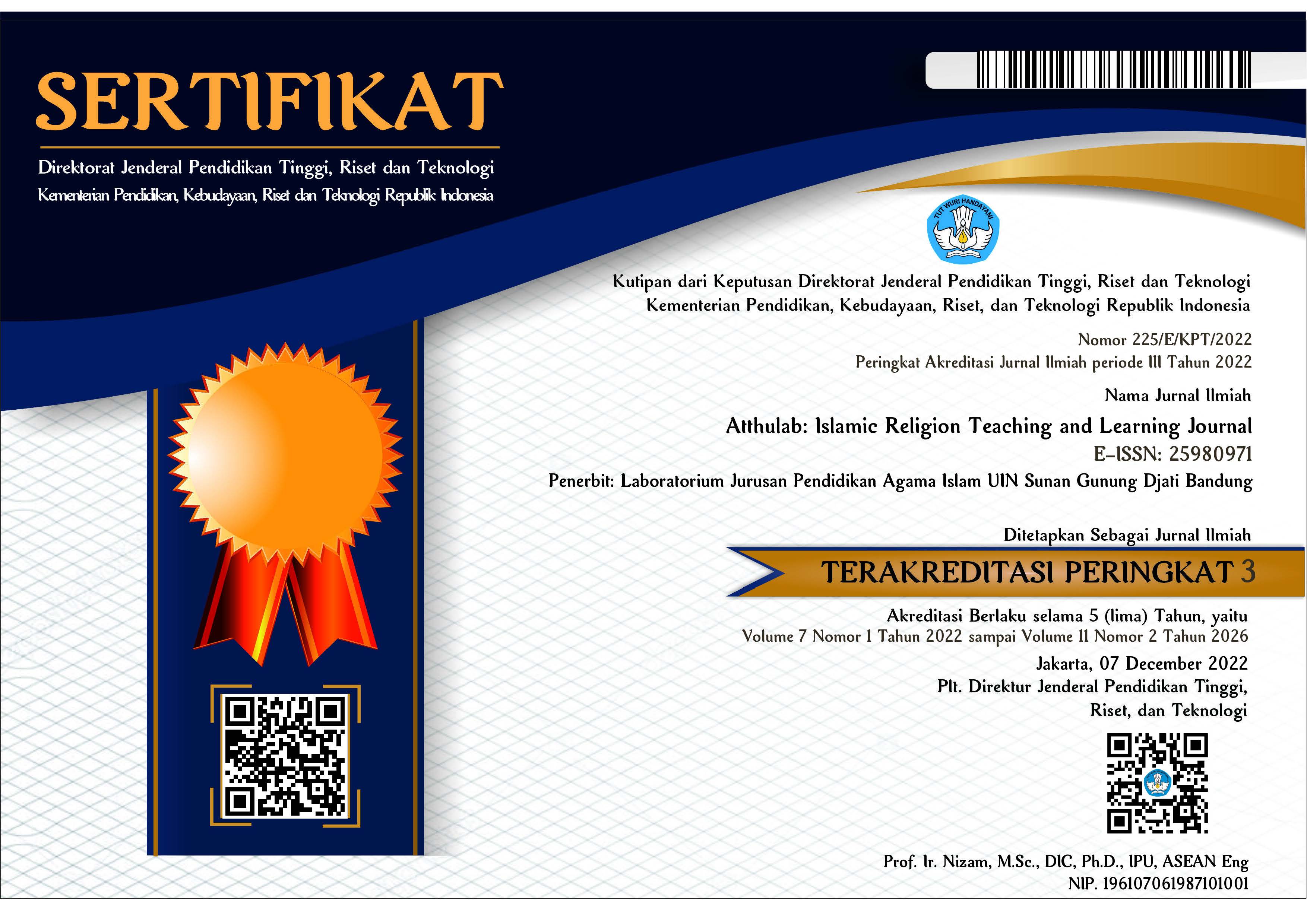
Sinta: Grade 3
Current Issue
Vol. 11 No. 1 (2026): Atthulab: Islamic Religion Teaching and Learning Journal
Atthulab Journal Vol. 11 No. 1 (2026) contains 9 papers written by 32 authors from 10 institutions in 3 countries, namely Indonesia (Universitas Pendidikan Indonesia, UIN Sunan Gunung Djati Bandung, Ma’had Aly Hasyim Asy’ari Tebuireng, STAI Pelabuhan Ratu, Universitas Islam Negeri Siber Syekh Nurjati Cirebon, STIS As-Sa’adah Sukasari Sumedang, Universitas Buana Perjuangan Karawang, Universitas Islam Nusantara, and Universitas Muhammadiyah Malang), Malaysia (International Islamic University of Malaysia), and Australia (Queensland University). This edition highlights contemporary developments in Islamic Religious Education, including cognitive assessment, gamification and project-based learning, inquiry-based pedagogy, spiritual resilience, digital ethics, student agency in Quranic recitation assessment, curriculum development, character education, and religious moderation in multicultural communities. One prominent theme is the integration of innovative pedagogical approaches with Islamic values to foster students’ intellectual development, moral character, spiritual resilience, and social responsibility. These studies emphasize the importance of contextual learning strategies, reflective practices, digital ethics, and inclusive education in responding to contemporary educational challenges. Collectively, the contributions seek to strengthen the quality of Islamic education by integrating knowledge, faith, character formation, and religious moderation while preparing learners to participate responsibly in an increasingly digital and pluralistic society.
Published:
2026-04-01
Articles
Atthulab: Islamic Religion Teaching and Learning Journal is Indexed by: