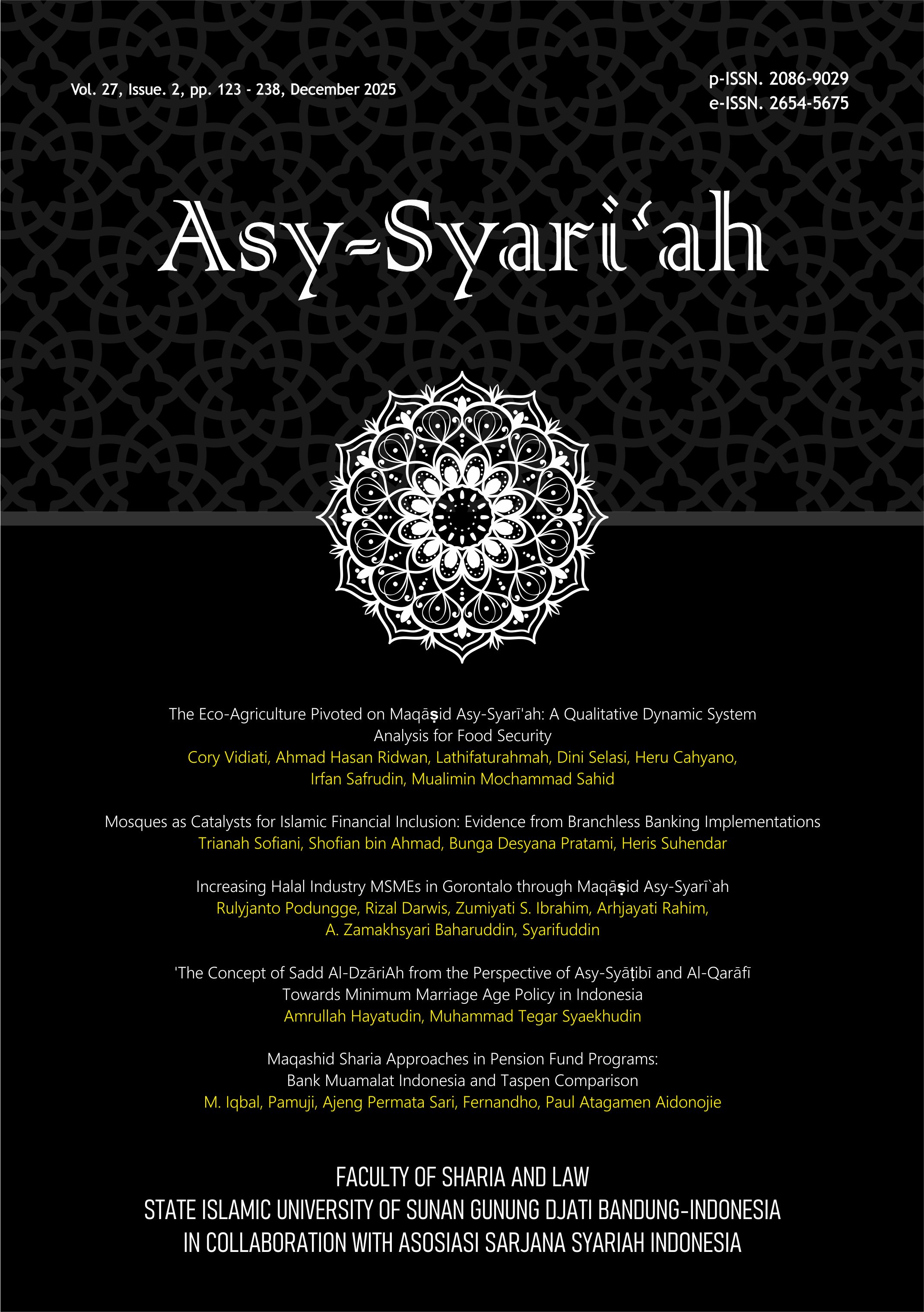
The Eco-Agriculture Pivoted on Maqāṣid Asy-Syarī’ah: A Qualitative Dynamic System Analysis for Food Security
DOI:
https://doi.org/10.15575/as.v27i2.38920Keywords:
eco-agriculture, innovation ecosystem, maqasid asy-syari’ah, qualitative analysis of dynamic systemAbstract
This study aims to create a sustainable and innovative agricultural ecosystem by emphasising the importance of human effort in critically assessing and sustaining their lives amid unpredictable natural conditions. By employing a dynamic qualitative approach and developing a reproducible analysis model, we gathered primary data through observations and interviews in Sarwadadi Village, Talun, Cirebon, alongside secondary data from online research publications. The findings revealed strong collaboration among farmers, local government, academics, and agricultural experts; the potential for eco-friendly and productive land use; and the establishment of a conceptual model for the qualitative dynamics of environmental conservation (fiqh al-bī’ah), which includes system analysis, problem identification, and interventions aimed at achieving desired outcomes for the future of eco-agriculture. However, this study does have its limitations, notably the omission of Vensim model analysis, which requires quantitative data.
References
Aboukhousa, Heba Ahmed, Mohamed Abdelgalil Hassan, Lahcen Elouazzani, and Mohamed Abouelfadl Badran. “Empowering Environmental Sustainability: Islamic Values and Their Synergy with the SDGs.” Journal of Cultural Analysis and Social Change 10, no. 3 (2025): 37 – 50. https://doi.org/10.64753/jcasc.v10i3.2375.
Aboul-Enein, Basil H. “‘The Earth Is Your Mosque’: Narrative Perspectives of Environmental Health and Education in the Holy Quran.” Journal of Environmental Studies and Sciences 8, no. 1 (2018): 22 – 31. https://doi.org/10.1007/s13412-017-0444-7.
Downloads
Published
How to Cite
Issue
Section
Citation Check
License
Copyright (c) 2025 Cory Vidiati, Ahmad Hasan Ridwan, Lathifaturahmah, Dini Selasi, Heru Cahyano, Irfan Safrudin, Mualimin Mochammad Sahid

This work is licensed under a Creative Commons Attribution-ShareAlike 4.0 International License.
The author whose published manuscript approved the following provisions:
- Authors retain copyright and grant the journal right of first publication with the work simultaneously licensed under a Attribution-ShareAlike 4.0 International (CC BY-SA 4.0) License that allows others to share the work with an acknowledgment of the work's authorship and initial publication in this journal.
- Authors are able to enter into separate, additional contractual arrangements for the non-exclusive distribution of the journal's published version of the work (e.g., post it to an institutional repository or publish it in a book), with an acknowledgment of its initial publication in this journal.
- Authors are permitted and encouraged to post their work online (e.g., in institutional repositories or on their website) prior to and during the submission process, as it can lead to productive exchanges, as well as earlier and greater citation of published work (See The Effect of Open Access).