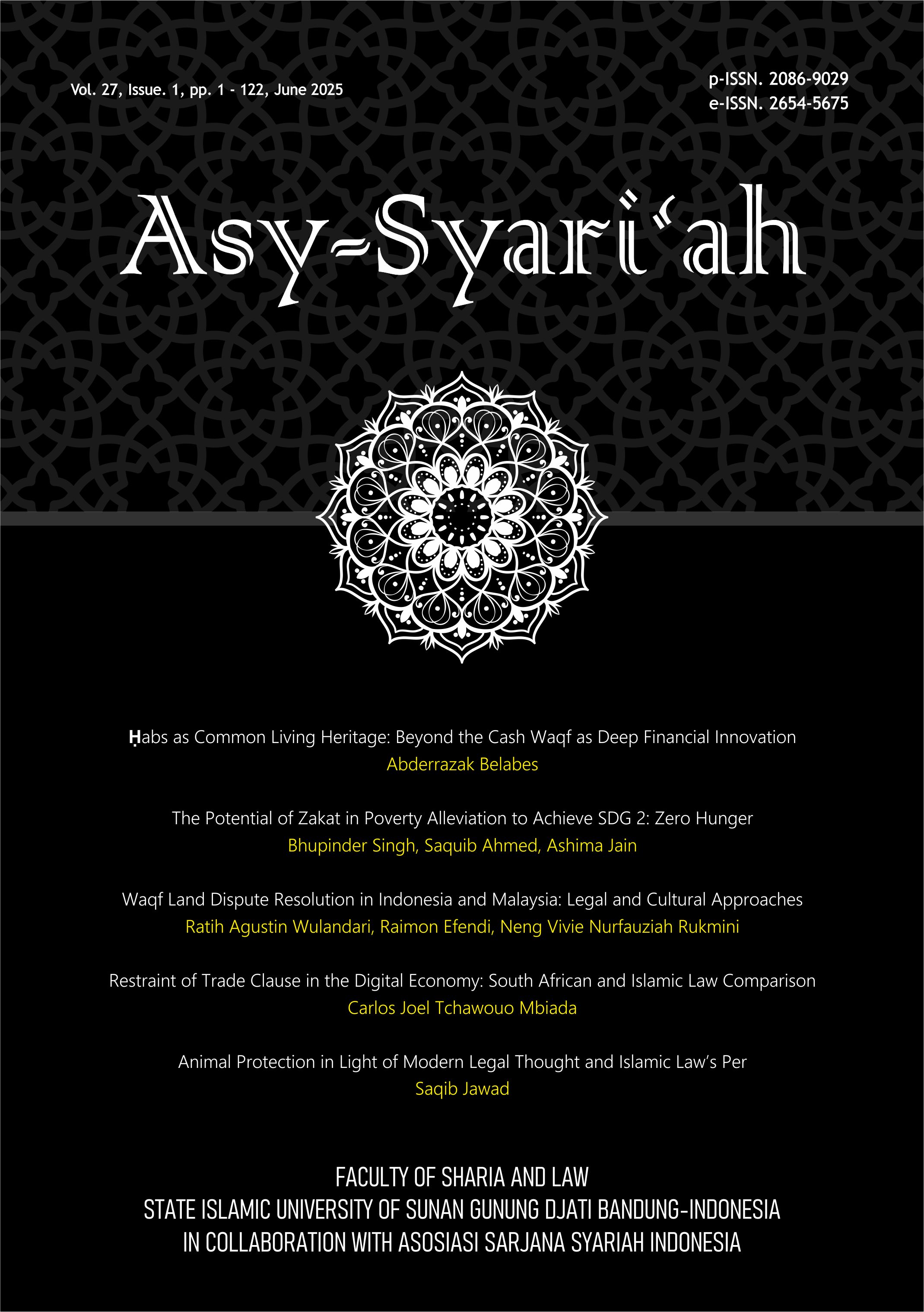
Waqf Land Dispute Resolution in Indonesia and Malaysia: Legal and Cultural Approaches
DOI:
https://doi.org/10.15575/as.v27i1.44202Keywords:
cultural values, Indonesia, legal system, Malaysia, waqf land disputes.Abstract
Abstract: Dispute resolution in the waqf land context is a matter of particular legal complexity; thus, it requires special attention. This research aims to provide a comparative analysis of waqf land dispute resolution mechanisms in Indonesia and Malaysia, with a focus on the role of local cultural values and Islamic legal norms. The present research employs a normative legal research approach, which involves the identification of legal rules, principles and doctrines to provide a resolution to the legal issues under consideration. The results indicate that the resolution of waqf land disputes in Indonesia and Malaysia uses divergent legal and cultural approaches. Despite the adherence to the Islamic waqf principle, there are discernible discrepancies in the dispute resolution methods, legal structures and cultural influences exhibited by these two nations. The influence of local cultural values on the two nations is evident. Indonesia places significant value on deliberation, cooperation and social sustainability, whereas Malaysia places greater emphasis on negotiation, mediation and economics. This research aims to provide tangible insights into institutional reforms and digital innovations in waqf governance and expand comparative analyses to other Islamic jurisdictions, thereby enriching the global discourse on waqf legal practices and dispute resolution.
References
Abdull Manaf, A. W., Hua Siong, W., & Abdul Razak, H. “Legal Barriers and Opportunities in The Digital Transformation of Waqf Management in Malaysia: A Critical Analysis.” AZKA International Journal of Zakat & Social Finance 6, no. 1 (2023): 1–15. https://doi.org/10.51377/azjaf.vol6no1.202.
Abdullah, Junaidi, and Nur Qodin. “Penyelesaian Sengketa Wakaf Dalam Hukum Positif.” ZISWAF : Jurnal Zakat Dan Wakaf 1, no. 1 (2014): 37–54. https://doi.org/10.21043/ziswaf.v1i1.1524.
Afisna, Fajri Aulia, Yaswirman, and Yasniwati. “Pengelolaan Tanah Wakaf Untuk Usaha Produktif Dalam Kesejahteraan Sosial Oleh Nazhir Wakaf Menurut Undang-Undang No. 41 Tahun 2004 Tentang Wakaf.” UNES Law Review 6, no. 1 (2023): 1324–34. https://doi.org/10.31933/unesrev.v6i1.928.
Agama, Direktorat Jenderal Badan Peradilan. “Gencar Melaksanakan Bimbingan Teknis Bagi Tenaga Teknis Peradilan, Ditjen Badilag Hadirkan YM. Dr. H. Abdul Manaf Sebagai Narasumber.” Mahkamah Agung Republik Indonesia, 2022. https://www.pa-penajam.go.id/berita-badilag/922-gencar-melaksanakan-bimbingan-teknis-bagi-tenaga-teknis-peradilan-ditjen-badilag-hadirkan-ym-dr-h-abdul-manaf-sebagai-narasumber.
Ali Azizan, Norfaridah, Amirul Afif Muhamat, Sharifah Faigah Syed Alwi, Husniyati Ali, and Amalia Qistina Casteneda Abdullah. “Revitalising Waqf (Endowment) Lands for Agribusiness: Potentials of the Anchor Company Models.” Journal of Agribusiness in Developing and Emerging Economies 12, no. 3 (May 2022): 345–70. https://doi.org/10.1108/JADEE-05-2021-0128.
Arifin, Firdaus, I Gde Pantja Astawa, Ihsanul Maarif, Dewi Sulastri, and Mohd Kamarulnizam Abdullah. “Recognition of Customary Norms Within the Framework of Indonesian Legal Positivism.” Khazanah Hukum 7, no. 1 (April 7, 2025): 92–104. https://doi.org/10.15575/kh.v7i1.39409.
Azha, Latiff, Sayin Baharuddin, Sayurno, S.S. Salahuddin, M. Rani Afandi, and Hamid Afifah H. “The Practice and Management of Waqf Education in Malaysia.” Procedia - Social and Behavioral Sciences 90, no. InCULT 2012 (2013): 22–30. https://doi.org/10.1016/j.sbspro.2013.07.061.
Aziz bin Sulaiman, Abdul, dan Noor Hidayah binti Zainuddin, Fakulti Pengurusan dan Teknologi Maklumat, Universiti Sultan Azlan Shah, Bandar DiRaja Kuala Kangsar, Perak Darul Ridzuan, and Malaysia Emel. “Kanun Tanah Wakaf Negara: Adakah Satu Keperluan: National Waqf Land Code: Is It Necessary.” Journal of Fatwa Management and Research 28, no. 3 (September 30, 2023): 129–47. https://doi.org/10.33102/JFATWA.VOL28NO3.546.
Benda-Beckmann, Keebet Von. “Balancing Islam, ADAT and the State: Comparing Islamic and Civil Courts in Indonesia.” In The Power of Law in a Transnational World: Anthropological Enquiries, 211–30. Germany: Berghahn Books, 2009.
Christiani, Theresia Anita. “Normative and Empirical Research Methods: Their Usefulness and Relevance in the Study of Law as an Object.” Procedia - Social and Behavioral Sciences 219 (2016): 201–7. https://doi.org/10.1016/j.sbspro.2016.05.006.
Dungga, Weny Almoravid;, and Lucyane Muhtar, Mohamad Hidayat; Djaafar. “The Assessment of Indonesia’s Religious Courts in Resolving Shari’ah Banking Disputes According to the Principles of Justice.” Manchester Journal of Transnational Islamic Law & Practice Vol 19, no. Issue 3 (2023): 179–93. https://www.electronicpublications.org/stuff/997.
Dungga, Weny Almoravid, Mohamad Hidayat Muhtar, and Lucyane Djaafar. “The Assessment of Indonesia’s Religious Courts in Resolving Shari’ah Banking Disputes According to the Principles of Justice.” Manchester Journal of Transnational Islamic Law and Practice 19, no. 3 (January 1, 2023): 179–93. https://www.scopus.com/record/display.uri?eid=2-s2.0-85175021124&origin=scopusAI.
Ghazali, Noor Azimah, Ibrahim Sipan, Mohammad Tahir Sabit Haji Mohammad, and Muhammad Arif Ab Aziz. “New Framework for the Management of Waqf Land Registration System in Malaysia.” International Journal of Islamic and Middle Eastern Finance and Management 14, no. 3 (2020): 625–40. https://doi.org/10.1108/IMEFM-04-2019-0172.
Downloads
Published
How to Cite
Issue
Section
Citation Check
License
Copyright (c) 2025 Ratih Agustin Wulandari, Raimon Efendi, Neng Vivie Nurfauziah Rukmini

This work is licensed under a Creative Commons Attribution-ShareAlike 4.0 International License.
The author whose published manuscript approved the following provisions:
- Authors retain copyright and grant the journal right of first publication with the work simultaneously licensed under a Attribution-ShareAlike 4.0 International (CC BY-SA 4.0) License that allows others to share the work with an acknowledgment of the work's authorship and initial publication in this journal.
- Authors are able to enter into separate, additional contractual arrangements for the non-exclusive distribution of the journal's published version of the work (e.g., post it to an institutional repository or publish it in a book), with an acknowledgment of its initial publication in this journal.
- Authors are permitted and encouraged to post their work online (e.g., in institutional repositories or on their website) prior to and during the submission process, as it can lead to productive exchanges, as well as earlier and greater citation of published work (See The Effect of Open Access).