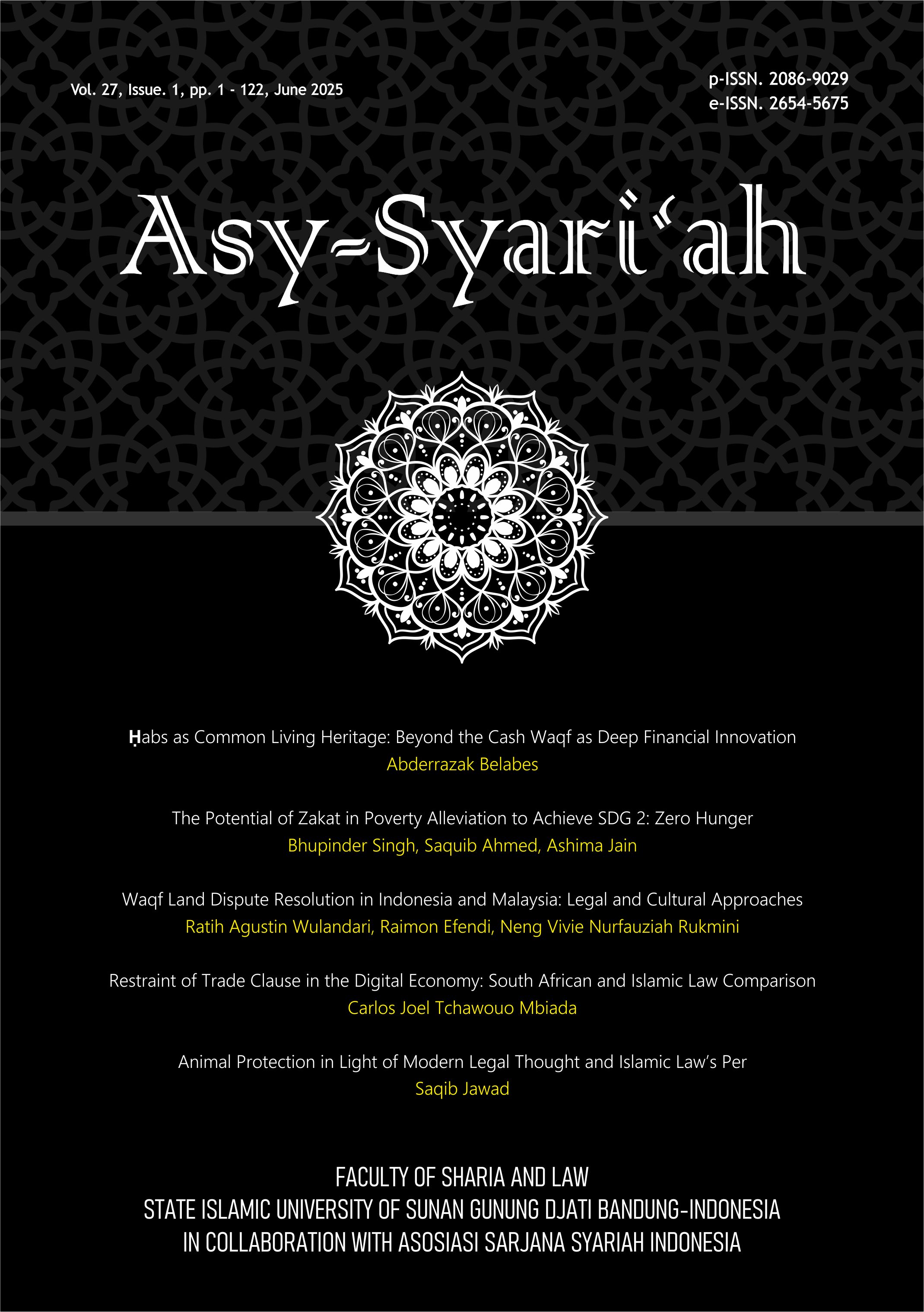
Ḥabs as Common Living Heritage: Beyond the Cash Waqf as Deep Financial Innovation
DOI:
https://doi.org/10.15575/as.v27i1.44466Keywords:
cash waqf, economic life, financial innovationAbstract
Abstract: This conceptual exploration examines the deep meaning of ḥabs as a common living heritage extending beyond mainstream financial interpretations that consider private waqf an innovation of Islam and cash waqf being the best innovation in private waqf. Through the conceptual-hermeneutic approach, Rizq (divine provision) precedes human notions of ownership and city organisation, with the first ḥabs being Bayt (House of Allah) built by Ādam. This research highlights the spiritual relevance of the sacred milieu of Makkah and critiques modern economic concepts that prioritise material growth and individual ownership over the holistic understanding of life and divine provision inherent to the deep meaning of ḥabs. Finally, this research advocates for a re-evaluation of how we perceive wealth, ownership and societal well-being considering ḥabs as a dynamic, connected living system.
References
Al-Jawziyyah, Muḥammad Ibn Qayyim. Uddat Al-Ṣābirīn Wa Zakhīrat Al-Shākirīn [The Provisions of the Patient and the Ammunition of the Grateful]. Makkah: Dar Alam al-Fawaid, 2009.
Al-Mutīʿī, Muḥammad Bakhīt. Nizām Al-Waqf Wa Al-Istidlāl ʿalayh [The Waqf System and Evidence for It]. Kuwait: Majalat al-Wa’y al-Islami, 2013.
Al-ʿAsqalānī, Ibn Hajar, and Aḥmad. Fatḥ Al-Bārī Sharh Saḥīḥ Al-Bukhārī [Victory of the Creator Commentary on a Collection of Authentic Aḥādīth Compiled by Al-Bukhārī]. Beirut: Dar Jutub al-Ilmiya, 2021.
Alarnaut, Muhammad Muwaffaq. “Naḥwa Dawr Fā’il Li-Al-Awqāf Fi Ḥayāt Al-Mujtma’iyāh Al-Muslimah Al-Mu’āṣirah” [Toward an Active Role of Awqāf in the Life of Contemporary Muslim Societies].” Journal of King Abdulaziz University: Islamic Economics 31, no. 3 (2018): 43. https://doi.org/10.4197/Islec.31-3.2.
Antonio, Muhammad Syafi’i. “Cash Waqf Dan Anggaran Pendidikan Umat [Cash Waqf and Community Education Budget].” Republika, Indonesia, 2002. https://www.ijbs.unimas.my/volume-11-20/volume-18-s1-2017/334-muslim-attitude-towards-participation-in-cash-waqf-antecedents-and-consequences.
Ayub, Muhammad, Khurram Khan, and Muhammad Ismail. Waqf in Islamic Economics and Finance. London: Routledge, 2024. https://doi.org/10.4324/9781003477549.
Belabes, Abderrazak. Al-Farāhīdī’s Notion of Maʿāsh Associating ‘What We Live from’ and ‘What We Live in.’” In Economic Life beyond Economics. Economic Life beyond Economics. London: Routledge, 2024. https://doi.org/10.4324/9781003287063.
———. “Conceptualizing Money Creation as a Ḥabs in Debt Market.” Journal of Islamic Economics Lariba 10, no. 2 (December 29, 2024): 839–54. https://doi.org/10.20885/jielariba.vol10.iss2.art11.
———. “Features and Characteristics of the Writings on Islamic Financial Engineering in English and French.” Journal of Humanities and Social Studies, no. 55 (in Arabic) (2020): 281–320.
———. “Islamic Finance, Artificial Intelligence, and the Debt Embedded in the Ex Nihilo Monetary Creation System.” International Journal of Multidisciplinary Research and Analysis 08, no. 02 (February 11, 2025): 485–91. https://doi.org/10.47191/ijmra/v8-i02-08.
———. “The Forgotten History of the Waqf: The Kaʿaba.” Islamic History and Literature 2, no. 3 (September 30, 2024): 137–49. https://doi.org/10.62476/ihl23137.
———. “The Methodological Paradox in the Mainstream Economic Discourse.” Journal of King Abdulaziz University: Islamic Economics 32, no. 3 (2019): 87–104. https://doi.org/10.4197/Islec.32-3.4.
———. “The Quadriptych of Rizq, Ḥabs, Maʿāsh, and ʿUmrān.” Invest Journal of Sharia & Economic Law 5, no. 1 (May 11, 2025): 90–108. https://doi.org/10.21154/invest.v5i1.10404.
Bulut, Mehmet, Bora Altay, and Cem Korkut. The Evolution of Islamic Financial Industry from the Ottoman Cash Waqf to Modern Islamic Banks. London: Palgrave Macmillan, 2024. https://link.springer.com/book/10.1007/978-3-031-51318-3.
Çilingir, Hamdi. “Repositioning Waqfs in the New Economic Order.” In Institutional Islamic Economics and Finance, 41–49. London: Routledge, 2022. https://doi.org/10.4324/9781003227649-4.
Delahaye, Jean-Paul. “En Mathématiques, Le Tout Est-Il Vraiment plus Que La Somme de Ses Parties?”.” Pour La Science 477, no. 28 June (2017). https://www.pourlascience.fr/sr/logique-calcul/en-mathematiques-le-tout-est-il-vraiment-plus-que-la-somme-de-ses-parties-9716.php.
Girard, René. Mensonge Romantique et Vérité Romanesque [Romantic Lie and Novelstic Truth]. Paris: Grasset, 1961.
Godelier, Maurice. Aux Fondements Des Sociétés Humaines [At the Foundations of Human Societies]. Paris: Albin Michel, 2007.
———. L’énigme Du Don [The Enigma of the Gift]. Paris: Flammarion, 1996.
Guin, Le, and Ursula K. The Left Hand of Darkness. New York: Granada, 1969.
Hashmi, Eiman Ahmad Mohammad Khaleel Al. “Waqf as a Financing Tool and Its Role in Achieving SDGs and Foreseeing the Future.” In Wealth Management and Investment in Islamic Settings, 333–55. Singapore: Springer Nature Singapore, 2022. https://doi.org/10.1007/978-981-19-3686-9_19.
Ḥazm, Ibn, and Muḥammad. Al-Muḥallaʾ Bi-Al-Athār [The Adorned Treatise]. Cairo: Maktabat Dar al-Turath, 2005.
Jafar, Ahmad, Hafsa Ibrahim, and Rizwan Malik. “Waqf: From Classical Charitable System to Modern Financial Tool.” International Journal of Ethics and Systems, May 7, 2025. https://doi.org/10.1108/IJOES-10-2024-0354.
Kahf, Monzer. Al-Waqf Al-Islāmī [The Islamic Waqf]. Beirut & Damascus: Dar al-Fikr al-Mu’asir & Dar al-Fikr, 2006.
———. “The Role of Waqf in Improving the Ummah Welfare.” In Paper Presented to the International Seminar on Waqf as a Private Legal Body, Organized by the Islamic University of North Sumatra, Medan, Indonesia 6-7 January, 3–4. Medan, Indonesia, 2003.
Kahf, Monzer, and Amiirah Nabee Mohomed. “Cash Waqf: An Innovative Instrument of Personal Finance in Islamic Banking.” Journal of Islamic Economics, Banking and Finance 13, no. 3 (2017): 13–29.
Kathīr, Ibn, and Ismāʿīl. Al-Bidāyah Wa Al-Nihāyah [The Beginning and the End]. Beirut: Dar Ihya’ al-Turath al-’Arabi, 1988.
Khatib, Mazen El. “Waqf in Shariah: Basic Rules and Applications.” In Islamic Wealth Management. Edward Elgar Publishing, 2017. https://doi.org/10.4337/9781786439390.00027.
Lévi-Strauss, Claude. “La Politique Étrangère d’une Société Primitive.” Politique Étrangère 14, no. 2 (1949): 139–152. https://sciencespo.hal.science/hal-01022579v1.
Mandaville, Jon Elliott. “Usurious Piety: The Cash Waqf Controversy in the Ottoman Empire.” International Journal of Middle East Studies 10, no. 3 (1979): 289–308. http://www.jstor.org/stable/162140.
Mauss, Marcel. The Gift The Form and Reason for Exchange in Archaic Societies. London: Routledge, 2024. https://doi.org/10.4324/9781003572350.
Oberauer, Norbert. “Early Doctrines on Waqf Revisited: The Evolution of Islamic Endowment Law in the 2nd Century AH.” Islamic Law and Society 20, no. 1–2 (2013): 1–47. https://doi.org/10.1163/15685195-0001A0001.
Piketty, Thomas. Capital and Ideology. Cambridge, Massachusetts: Harvard University Press, 2020.
Saee. Mawsū’at Fatāwa Al-Waqf [The Encyclopedia of Fatawa’ on Waqf]. Riyadh: Publications of Saee for Awqaf Development, 2025. https://journals.iium.edu.my/intdiscourse/index.php/id/article/view/1263.
Schmidt, Karl. “Zuerst Kam Der Tempel, Dann Die Stadt, Vorläufiger Bericht Zu Den Grabungen Am Göbekli Tepe Und Am Gürcütepe 1995–1999.” Istanbuler Mitteilungen 50 (2000): 5–41. https://pascal-francis.inist.fr/vibad/index.php?action=getRecordDetail&idt=14210956.
Shukor, Syadiyah Abdul, Intan Fatimah Anwar, Hisham Sabri, and Sumaiyah Abd Aziz. “Waqif Satisfaction: Antecedents and Consequences.” Advanced Science Letters 23, no. 5 (May 1, 2017): 4852–55. https://doi.org/10.1166/asl.2017.8926.
Thatcher, Margaret. “Interview for Woman’s Own (‘no Such Thing [as Society]’),” 1987. https://www.margaretthatcher.org/document/106689.
Zarqa, Muhammad Anas. “Islamization of Economics: The Concept and Methodology.” Journal of King Abdulaziz University-Islamic Economics 16, no. 1 (2003): 3–42. https://doi.org/10.4197/islec.16-1.1.
Downloads
Published
How to Cite
Issue
Section
Citation Check
License
Copyright (c) 2025 Abderrazak Belabes

This work is licensed under a Creative Commons Attribution-ShareAlike 4.0 International License.
The author whose published manuscript approved the following provisions:
- Authors retain copyright and grant the journal right of first publication with the work simultaneously licensed under a Attribution-ShareAlike 4.0 International (CC BY-SA 4.0) License that allows others to share the work with an acknowledgment of the work's authorship and initial publication in this journal.
- Authors are able to enter into separate, additional contractual arrangements for the non-exclusive distribution of the journal's published version of the work (e.g., post it to an institutional repository or publish it in a book), with an acknowledgment of its initial publication in this journal.
- Authors are permitted and encouraged to post their work online (e.g., in institutional repositories or on their website) prior to and during the submission process, as it can lead to productive exchanges, as well as earlier and greater citation of published work (See The Effect of Open Access).