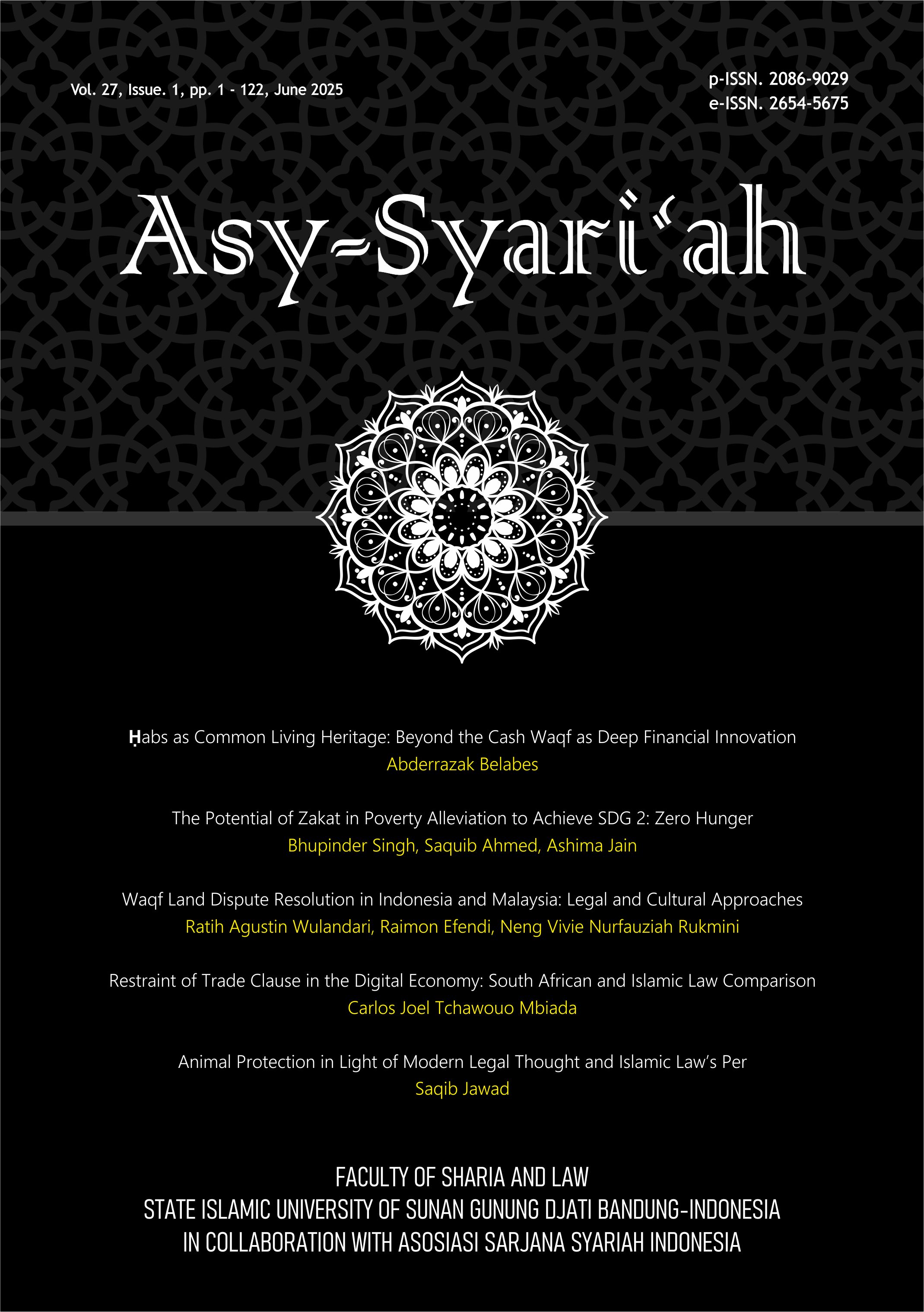
The Potential of Zakat in Poverty Alleviation to Achieve SDG 2: Zero Hunger
DOI:
https://doi.org/10.15575/as.v27i1.44588Keywords:
food security, sustainable development, zakat, zero hungerAbstract
Abstract: Zakat is part of the five pillars of Islam which is considered significant in poverty alleviation in addition to the promotion of social justice and economic redistribution. Therefore, this study aims to examine the role of zakat in alleviating poverty in order to achieve Sustainable Development Goal (SDG) 2: Zero Hunger with a specific focus on food security. The trend is associated with the importance of a robust social safety net that meets the basic sustenance needs of all members of society. This shows the possibility of zakat serving as a continuous mechanism of wealth redistribution from an Islamic perspective. A literature review with a case study method was used to explore successful zakat practices in Muslim-majority countries to effectively alleviate hunger, support small-scale farmers, and enhance social welfare. It was concluded that zakat could be effectively integrated into contemporary economic and social policies to play a meaningful role in improving food security and promoting sustainable poverty alleviation. The process could further serve as a contribution to the achievement of SDG 2.
References
Abdalla, Reem A., Hassan Kamal Alaaraj, and Gulnar Sadat Mulla. “The Contribution of Islamic Banking and Finance to the Sustainable Development Goals of 2030.” In Sustainable Innovations in Management in the Digital Transformation Era, 249–61. London: Routledge, 2024. https://doi.org/10.4324/9781003450238-25.
Abdul Majid, Abdul Halim, Selamah Maamor, Hafizah Zainal, Rabiatul Adawiyah Che Halim, Mohd Fitri Yusoff, Nik Safiah Nik Abdullah, and Rosylin Mohd Yusof. “The Ummah Economic Development Zone: An Innovative Community Development Initiative by Lembaga Zakat Negeri Kedah.” PaperASIA 40, no. 6b (December 11, 2024): 331–39. https://doi.org/10.59953/paperasia.v40i6b.293.
———. “The Ummah Economic Development Zone: An Innovative Community Development Initiative by Lembaga Zakat Negeri Kedah.” Paper ASIA 40, no. 6b (December 11, 2024): 331–39. https://doi.org/10.59953/paperasia.v40i6b.293.
AHMAD, Nehaluddin, Zheimie H. Zamri, and Abdul Hakim Iskandar. “Legal, Regulatory, and Economic Dimensions of Poverty Alleviation Strategies in Brunei Darussalam: An Examination towards Achieving the Global SDGs.” Communications of International Proceedings, 2024. https://doi.org/10.5171/2024.4314524.
Ahmadi Mega Asri Lestari, Abd Rahman, and Abdul Azis. “Implementation of the Islamic Food Bank Concept in an Effort to Solve the Global Problem of Hunger and Food Insecurity,” 2024. https://www.ijassjournal.com/2024/V7I4/41466639121.pdf.
Ainur, Rosyidah, Mukhlis Imam, Sugeng Hadi Utomo, and Agung Nugroho. “The Role of Zakat and Waqf in Achieving Sustainable Development Goals (SDGs): A Global Perspective.".” In Proceeding of International Conference on Finance Business and Banking, 2024.
Alam, Md. Mahmudul, Norazlina Abd Wahab, M. Ashraf Al Haq, and Siti Aznor Ahmad. “Sustainable Development Status of Zakat Recipients: Empirical Investigation Based on Malaysia’s Kedah State.” J. for Global Business Advancement 14, no. 5 (2021): 612. https://doi.org/10.1504/JGBA.2021.123544.
Alami, Fathoni Nur, and Wily Mohammad. “Applying the Principles of Maqasid Al-Shariah to Address Poverty and Hunger in Indonesia.” Cognitionis Civitatis et Politicae 1, no. 2 (2024): 57–68. https://doi.org/10.70177/politicae.v1i2.1115.
Alhabshi, Syed Musa, and Isnan Hari Mardika. “Integrating Social Business for Sustainable Impact: A Systematic Literature Review in the Context of Waqf.” Journal of Islamic Finance 13, no. 2 (2024): 149–159. https://journals.iium.edu.my/iiibf-journal/index.php/jif/article/view/931.
Allah Pitchay, Anwar, Masyitah Abdul Rahman, and Zubir Azhar. “Alleviating Financial Education Debt through Zakah: Proposing HOPE Model to Public Higher Education Institution.” Qualitative Research in Financial Markets, December 16, 2024. https://doi.org/10.1108/QRFM-01-2024-0021.
Ardo, Adam Muhammad, Adamu Abubakar Muhammad, Muhammad Bello Adam, and Zuwaira Jibril Muhammad. “The Legal Framework of Waqf and Its Role in Modern Economic Development in Nigeria.” Ahlika: Jurnal Hukum Keluarga Dan Hukum Islam 1, no. 2 (2024): 162–178. https://doi.org/10.70742/ahlika.v1i2.109.
Ariawan, Ariawan, Loso Judijanto, M. Yusuf Bahtiar, Farida Akbarina, and Muhammad Syafri. “The Role of Sharia Economics in Supporting the Realization of Sustainable Development Goals and Islamic Development.” ProBisnis : Jurnal Manajemen 15, no. 1 (February 29, 2024): 87–91. https://doi.org/10.62398/probis.v15i1.412.
Asyifa, Laily Nur, Nasrul Fahmi Zaki Fuadi, Muhammad Hasbi Zaenal, and Saekhu. “Pursuing Sustainable Development Goals (SDGs) Through Integrating the Role of Zakat and Its Contribution in Islamic Finance: Evidence From Indonesia.” Innovative Ventures and Strategies in Islamic Business, December 18, 2024, 51–78. https://doi.org/10.4018/979-8-3693-3980-0.ch003.
Batubara, Randi Hadamean, and Utary Evy Cahyani. “The Contribution of ZIS (Zakat, Infaq, & Sadaqah) to Poverty Alleviation in North Sumatra Province.” Islamic Economics Methodology 3, no. 1 (September 18, 2024). https://doi.org/10.58968/iem.v3i1.530.
Bohari, Najwatul Nadhirah, Nur Qurratuain Mardhiah Mohamad Zamri, Mohammad Firdaus Mohammad Hatta, and Nor Irvoni Mohd Ishar. “Tabarru’ Taste: A Centralized Hub for Unifying Shariah-Compliant Efforts to Alleviate Poverty Through Food Redistribution.” Journal of International Business, Economics and Entrepreneurship 10, no. 1 (March 31, 2025): 1–15. https://doi.org/10.24191//jibe.v10i1.3564.
Dirie, Khadar Ahmed, Md Mahmudul Alam, and Selamah Maamor. “Islamic Social Finance for Achieving Sustainable Development Goals: A Systematic Literature Review and Future Research Agenda.” International Journal of Ethics and Systems 40, no. 4 (December 2, 2024): 676–98. https://doi.org/10.1108/IJOES-12-2022-0317.
Erni, Erni, Artis Artis, and Rahman Rahman. “Zakat Management Practices and Sustainable Development in Indonesia.” Sinergi International Journal of Islamic Studies 2, no. 1 (February 29, 2024): 24–37. https://doi.org/10.61194/ijis.v2i1.129.
Fatwa, Nur, and Miqdam Awwali Hashri. “Islamic Social Financing of The National Zakat Amil Agency Program for Support Ensures the Availability and Sustainable Management of Water and Sanitation for All (Case Study of Islamic Boarding Schools Riyadul Awamil Indonesia).” International Journal of Religion 5, no. 11 (June 27, 2024): 2096–2102. https://doi.org/10.61707/1rxkhs42.
Gundogdu, Ahmet Suayb. “Poverty, Hunger and Inequality in the Context of Zakat and Waqf.” Darulfunun Ilahiyat 30, no. 1 (June 30, 2019): 49–64. https://doi.org/10.26650/di.2019.30.1.0005.
Hidayat, M. Fahmi, and Fauziyah Latiefa Salsabila. “Kontribusi Zakat Untuk Ketahanan Pangan Dan Pengentasan Stunting: Tinjauan Literatur Sistematis.” IHTIYATH : Jurnal Manajemen Keuangan Syariah 8, no. 1 (June 30, 2024): 46–66. https://doi.org/10.32505/ihtiyath.v8i1.8536.
Jallow, Mamadou Salieu. “The Impact of Distributed Zakat on Sustainable Economic Development in Indonesia: A VECM Approach.” Jurnal Ekonomi Syariah, Akuntansi Dan Perbankan (JESKaPe 8, no. 1 (n.d.): 66–93.
Jamal, Mulyono, Agung Lia Handayani, and Ainun Amalia Zuhroh. “Revitalising The Regulation of Zakat Institutions in Indonesia to Achieve Economic Justice.” Al Iqtishadiyah Jurnal Ekonomi Syariah Dan Hukum Ekonomi Syariah 9, no. 2 (February 29, 2024): 52. https://doi.org/10.31602/iqt.v9i2.12848.
Jedidia, Khoutem Ben, and Mohamed Ghroubi. “Islamic Finance and SDGs: Bibliometric Review and Future Research Agenda.” Journal of Chinese Economic and Business Studies, December 26, 2024, 1–34. https://doi.org/10.1080/14765284.2024.2445959.
Kaweesa, Yusuf, and Romzie Rosman. “An Analysis of the Linkage between Islamic Economics, Sustainability, and Islamic Financial System.” In Islamic Finance and Sustainable Development, 78–90. London: Routledge, 2025. https://doi.org/10.4324/9781003505570-6.
Khoiri, Ahmad. “- Management of Zakat, Infaq, and Shadaqah (ZIS) Funds in Driving Poverty Alleviation to Achieve Sustainable Development Goals (SDGs): A Case Study of BAZNAS Kediri City.” Journal of Development Research 8, no. 2 (November 20, 2024): 82–90. https://doi.org/10.28926/jdr.v8i2.395.
Khoiriyah, Hani Atul. “Revolutionizing Islamic Curriculum in Enabling Sustainable Futures through SDGs.” Journal of Educational Management Research 3, no. 2 (August 26, 2024): 101–15. https://doi.org/10.61987/jemr.v3i2.434.
Kunhibava, Sherin, Aishath Muneeza, Maryam Binti Khalid, Zakariya Mustapha, and Thong Ming Sen. Islamic Social Finance. Singapore: Springer Nature Singapore, 2024. https://doi.org/10.1007/978-981-97-1410-0.
Maftuhin, Arif. “Islam, SDGs, and the Role of Islamic Philanthropy: A Literature Review and Critical Considerations.” In IDACON-International Da’wah Conference, 1–10, 2024. https://conference.uin-suka.ac.id/index.php/idacon/article/view/1467.
Maina, Newton Kahumbi. “Crop Diseases, Pests and Food Insecurity in Africa: An Islamic Perspective.” In Religion, Climate Change, and Food Security in Africa, 167–179. Cham: Springer Nature Switzerland, 2024. https://link.springer.com/chapter/10.1007/978-3-031-50392-4_10.
Mazroatus Saadah, and Uswatun Hasanah. “The Common Goals of BAZNAS’ Zakat and Sustainable Development Goals (SDGs) According to Maqasid Al-Sharia Perspective.” AL-IHKAM: Jurnal Hukum & Pranata Sosial 16, no. 2 (December 31, 2021): 302–26. https://doi.org/10.19105/al-lhkam.v16i2.4990.
Mohamed, Ariza, and Abdullah Abbas. “A Community Model and Role of Zakat in Reducing Stunting in Children.” AZKA International Journal of Zakat & Social Finance, March 31, 2024, 123–34. https://doi.org/10.51377/azjaf.vol5no1.158.
Muhammad, Adamu Abubakar, Hamza Abubakar Hussaini, and Adam Muhammad Ardo. “Reviving Zakat and Waqf Institutions for Sustainable Community Developmentin Gombe State, Nigeria.” Indonesian Journal for Islamic Studies 2, no. 2 (July 31, 2024): 47–54. https://doi.org/10.58723/ijfis.v2i2.230.
Mustaqim, Dede Al Mustaqim. “Development of Corporate-Based ZISWAF Fundraising Model in Realizing SDGs from Maqashid Syariah Perspective.” International Economic and Finance Review 3, no. 1 (March 31, 2024): 31–50. https://doi.org/10.56897/iefr.v3i1.46.
Muttaqin, Zainal, and Mohammad Dendi Abdul Nasir. “Can Zakat Contribute to Achieving Sustainable Development Goals? A Case Study on Java Island, Indonesia.” Jurnal Ekonomi Syariah Teori Dan Terapan 11, no. 1 (February 29, 2024): 35–53. https://doi.org/10.20473/vol11iss20241pp35-53.
Noreen, Umara. “Mapping of FinTech Ecosystem to Sustainable Development Goals (SDGs): Saudi Arabia’s Landscape.” Sustainability 16, no. 21 (October 28, 2024): 9362. https://doi.org/10.3390/su16219362.
Omar, Pg Mohd Faezul Fikri Ag, and Ashurov Sharofiddin. Emergence of Zakat in Sustainability. 1st Editio. London: Routledge, 2024.
Prasojo, Lailatis Syarifah, and Muhfiatun. “Harmonizing Sustainable Development Goals and Maqasid Shariah: A Strategic Framework for Indonesian Islamic Banks (Case Study on Bank Syariah Indonesia).” Journal of Islamic Finance (JIF) 13, no. 2 (2024): 116–17. https://journals.iium.edu.my/iiibf-journal/index.php/jif/article/view/928.
Rahmadhani, Putri, and Ade Nur Rohim. “Constructing Model of Integrated Zakat and Waqf Empowerment for Achieving Food Security and Poverty Alleviation.” Iqtishadia: Jurnal Ekonomi Dan Perbankan Syariah 11, no. 2 (2024): 192–211. https://doi.org/10.19105/iqtishadia.v11i2.15574.
Retnowati, May Shinta, M. Asror Yusuf, Meitria Cahyani, Iman Nur Hidayat, and Musta’an Al Faruqi. “Accelerating SDGs to Alleviate Poverty: Synergy Between National Amil Zakat Agency (BAZNAS) and Islamic Financial Institutions (IFI).” AL-IKTISAB: Journal of Islamic Economic Law 8, no. 2 (November 16, 2024): 173–86. https://doi.org/10.21111/aliktisab.v8i2.12889.
Rosyidi, Luthfi Nur, Puji Sucia Sukmaningrum, and Tika Widiastuti. “Bibliometric Analysis of Zakat Research for Supporting SDGs.” Jurnal Ekonomi Dan Bisnis Islam (Journal of Islamic Economics and Business) 10, no. 1 (June 30, 2024): 165–89. https://doi.org/10.20473/jebis.v10i1.54251.
Sarea, Adel, ed. Impact of Zakat on Sustainable Economic Development. Advances in Electronic Government, Digital Divide, and Regional Development. IGI Global, 2021. https://doi.org/10.4018/978-1-7998-3452-6.
Satriawan, Dedi, and . Rahmat. “The Role of Sharia Economy in Poverty Reduction in Indonesia.” In KnE Social Sciences, 396–404, 2024. https://doi.org/10.18502/kss.v9i16.16259.
Shafia, Inas Ainun, Ulya Nuril Fajri, Syahirah Nazwa Putri, and Rizki Dian Nursita. “. “Local Perspectives on Achieving Sustainable Development Goals: The Role of Pesantren in Social Empowerment and Alleviating Poverty in Sleman”.” Jisiera: The Journal of Islamic Studies and International Relations 7, no. 1 (April 30) (2024): 97–120. https://journal.insiera.org/index.php/jisiera/article/view/88.
Siregar, Kardina Engelina. “Optimizing the Role of Waqf in Sustainable Development through an Islamic Education Perspective: A Comprehensive Literature Study.” RISALAH IQTISADIYAH: Journal of Sharia Economics 3, no. 1 (June 30, 2024): 1–9. https://doi.org/10.59107/ri.v3i1.58.
Smolo, Edib, Irum Saba, Norashikin Ismail, and Ziyaad Mahomed. “Integrating Islamic Finance Into the Sustainable Development Goals (SDGs).” In The Future of Islamic Finance, 65–82. Emerald Publishing Limited, 2024. https://doi.org/10.1108/978-1-83549-906-120241005.
Sumai, S, A N Mutmainnah, Nurhamdah, and M Arsyad. “Role of Zakat in Poverty Reduction and Food Security.” IOP Conference Series: Earth and Environmental Science 343, no. 1 (October 1, 2019): 012254. https://doi.org/10.1088/1755-1315/343/1/012254.
Suryanto, Tulus, Pertiwi Utami, and Roslizawati Ahmad. “Aligning Sharia-Based Empowerment with SDGs: Addressing Poverty and Inequality in Coastal Regions.” Economica: Jurnal Ekonomi Islam 15, no. 1 (2024): 53–71. https://doi.org/10.21580/economica.2024.15.1.22935.
Tasgheer, Aqsa, Ehreem Fatima, and Syeda Aima Bokhari. “Global Hunger Crisis and Sustainable Development Goal: A Prophetic Approach of Food Security and Hunger Eradication.” Tanazur 5, no. 4 (a) (2024): 17–38. https://tanazur.com.pk/index.php/tanazur/article/view/439.
Thomas, Abdulkader. “Islamic Finance and Sustainable Development The Water, Food, Energy, and Climate Nexus.” In Routledge, 232. Taylor & Francis, 2025.
Wahyuni, Putri, and Ries Wulandari. “Zakat and Poverty Alleviation in Muslim Countries: A Biblioshiny Application.” Journal of Islamic Economics Lariba 10, no. 1 (March 16, 2024): 205–30. https://doi.org/10.20885/jielariba.vol10.iss1.art12.
Yasmeen, Kausar, Kashifa Yasmeen, and Salem Al Abri. “Islamic Framework for Sustainable Development.” International Journal of Islamic Finance and Sustainable Development 16, no. 4 (December 28, 2024). https://doi.org/10.55188/ijifsd.v16i4.978.
Yusuf, Tajudeen Olalekan, Lukman Raimi, and Abdullahi Audu Shuaib. “The Power of Faith-Based Finance (How Islamic Finance Supports the Achievement of the Sustainable Development Goals).” In Islamic Finance in the Modern Era, 300–325. Routledge, 2024.
Zain, Nor Razinah Mohd, Engku Rabiah Adawiah Engku Ali, Oumaima Tounchibine, and Raja Madihah Raja Alias. “SDGs and VBI (A META Analysis from Islamic Finance Perspective).” In Islamic Sustainable Finance, 41–50. London: Routledge, 2024. https://doi.org/10.4324/9781003395447-7.
Zunaidi, Arif, Fachrial Lailatul Maghfiroh, and Firman Setiawan. “Empowering Local Communities Through Zakat to Achieve Sustainable Development Goals.” IQTISHODUNA 20, no. 1 (April 30, 2024): 52–73. https://doi.org/10.18860/iq.v20i1.23771.
Downloads
Published
How to Cite
Issue
Section
Citation Check
License
Copyright (c) 2025 hupinder Singh, Saquib Ahmed, Ashima Jain

This work is licensed under a Creative Commons Attribution-ShareAlike 4.0 International License.
The author whose published manuscript approved the following provisions:
- Authors retain copyright and grant the journal right of first publication with the work simultaneously licensed under a Attribution-ShareAlike 4.0 International (CC BY-SA 4.0) License that allows others to share the work with an acknowledgment of the work's authorship and initial publication in this journal.
- Authors are able to enter into separate, additional contractual arrangements for the non-exclusive distribution of the journal's published version of the work (e.g., post it to an institutional repository or publish it in a book), with an acknowledgment of its initial publication in this journal.
- Authors are permitted and encouraged to post their work online (e.g., in institutional repositories or on their website) prior to and during the submission process, as it can lead to productive exchanges, as well as earlier and greater citation of published work (See The Effect of Open Access).