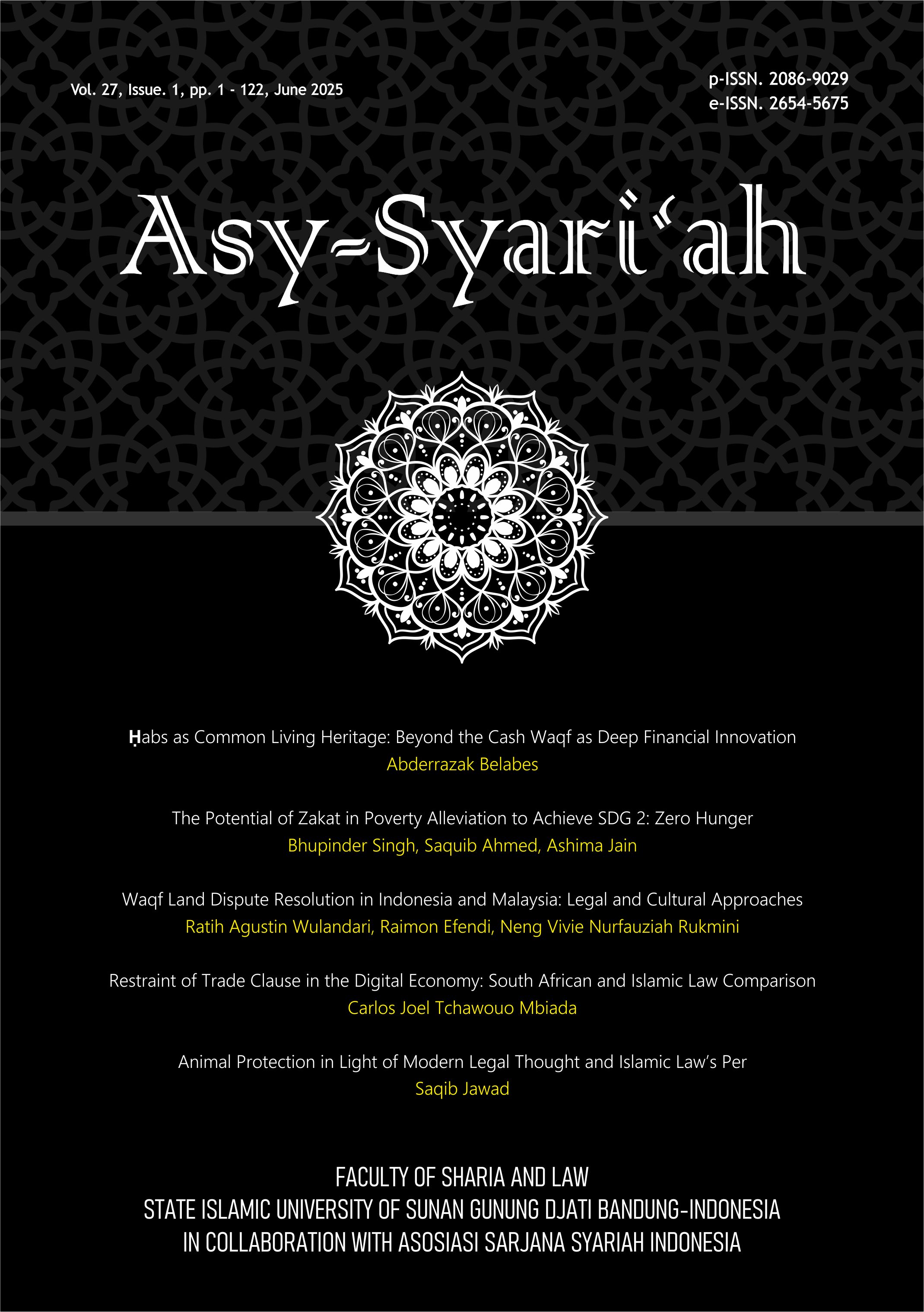
Animal Protection in Light of Modern Legal Thought and Islam Law’s Perspective
DOI:
https://doi.org/10.15575/as.v27i1.44597Keywords:
animal, rights, intellegent, violations, legislationAbstract
Abstract: Animals possess certain rights like human beings, including the right to life, liberty, health, well-being and reasonable abode. So far, only the right to life of animals has been given due consideration; however, unlike other inanimate objects, animals are emotional and intelligent beings who also deserve dignity and respect. Sometimes animals are killed without reason, which violates their right to life. Some of them, including chickens, pigs and cows, do not see outdoors except on their way to slaughterhouses, which violates their right to liberty. Business has been cited as justification, but mistreatment should be stopped at any cost by way of minimising the use of animals for industrial purposes and reducing their pain and suffering during this process. Available laws focus on the right to life of animals, while other rights, including the right to liberty, dignity and health, are ignored. While animals are emotional and intelligent beings, they are also entitled to all other rights associated with them, just like humans. Therefore, it is imperative that all other rights available for animals should also be protected. The paper argues that animals possess certain rights that are available to human beings and also intends to focus on the rights of animals on the basis of their emotional and intelligent characteristics using doctrinal and socio-legal research methodology. This paper further provides a comprehensive framework for the rights of animals that are ignored under available laws and to also suggest possible measures to implement the same.
References
Al-Hajjaj Al-Qushairi An-Naisaburi, Abul Husain Muslim. Sahih Muslim (in Arabic) [The Authentic Collection of Muslim], Hadith No. 84. Book. Vol. 34. Beirut: Daar ul Ihya il Turath, 1955.
Ali Imran, v. Forest Wildlife and Fishery Department, PLD 24 Lahore. (2020).
Allama Abdullah Yusuf Ali (tr). Qur’an, Surah Al-Isra (The Night Journey) 17:70 ‘The Holy Qur’an: Arabic Text, English Translation & Commentary.’ Lahore: Sh. Muhammad Ashraf, 1934.
———. Qur’an, Surah Al-Jathiyah (The Kneeling) 45:13. ‘The Holy Qur’an: Arabic Text, English Translation & Commentary.’ Lahore: Sh. Muhammad Ashraf, 1934.
Allen, Benjamin L, Christopher Bobier, Stuart Dawson, Peter J.S. Fleming, Jordan Hampton, David Jachowski, Graham I.H. Kerley, et al. “Why Humans Kill Animals and Why We Cannot Avoid It.” Science of The Total Environment 896 (October 2023): 165283. https://doi.org/10.1016/j.scitotenv.2023.165283.
An-Nasai, Abu Abd-ur-Rahman Ahmad ibn Shuayb ibn Ali ibn Sinan ibn Bahr Al-Khurasani. Sunan Al-Nasa’i (in Arabic) [The Collection of Nasa’i]. Halb: Maktabat ul Matboaat, 1986.
As-Sijistani, Abu-Dawud Sulaiman bin Al-Aash’ath Al-Azdi. Sunan Abu Dawud (in Arabic) [The Collection of Abu Dawud]. Beirut: Maktabat ul Asria, Book 15, hadith no. 86., n.d.
Bateson, Patrick. “Ethics and Behavioral Biology,” 211–33, 2005. https://doi.org/10.1016/S0065-3454(05)35005-4.
Beke, Roma. “To What Extent Should Non-Human Animals Have Legal Rights?” York Law Review 5 (2024). https://doi.org/10.15124/yao-bq0q-9m47.
Bladet Tromsø and Stensaas v. Norway Grand Chamber Judgment, ECtHR Application No. 21980/93. (1999).
Broom, Donald M. “Animal Board Invited Opinion Paper: The Use of Sustainability Scoring to Evaluate Food Production and Prepare for the Future.” Animal 16, no. 12 (December 2022): 100680. https://doi.org/10.1016/j.animal.2022.100680.
Broom, Donald M. Animal Welfare in the European Union. Rights and Constitutional Affairs. Vol. 14. Policy Department for Citizens’ Rights and Constitutional Affairs, 2017. http://www.europarl.europa.eu/supporting-analyses.
Downloads
Published
How to Cite
Issue
Section
Citation Check
License
Copyright (c) 2025 Saqib Jawad

This work is licensed under a Creative Commons Attribution-ShareAlike 4.0 International License.
The author whose published manuscript approved the following provisions:
- Authors retain copyright and grant the journal right of first publication with the work simultaneously licensed under a Attribution-ShareAlike 4.0 International (CC BY-SA 4.0) License that allows others to share the work with an acknowledgment of the work's authorship and initial publication in this journal.
- Authors are able to enter into separate, additional contractual arrangements for the non-exclusive distribution of the journal's published version of the work (e.g., post it to an institutional repository or publish it in a book), with an acknowledgment of its initial publication in this journal.
- Authors are permitted and encouraged to post their work online (e.g., in institutional repositories or on their website) prior to and during the submission process, as it can lead to productive exchanges, as well as earlier and greater citation of published work (See The Effect of Open Access).