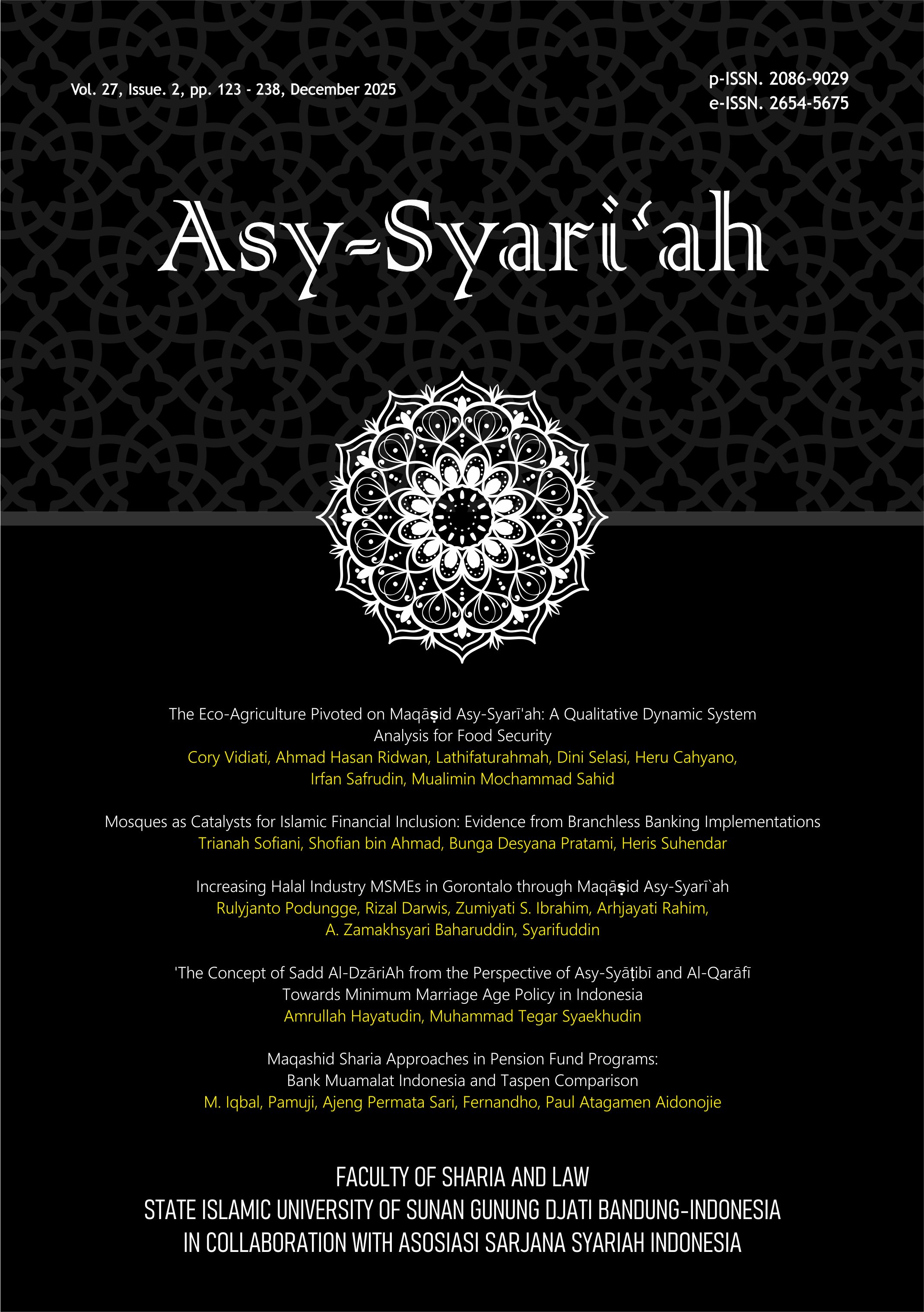
Mosques as Catalysts for Islamic Financial Inclusion: Evidence from Branchless Banking Implementations
DOI:
https://doi.org/10.15575/as.v27i2.48309Keywords:
Branchless Banking, Mosque, Sharia Financial InclusionAbstract
Islamic financial inclusion in Indonesia remains relatively low among the unbanked and underbanked populations, who have limited access to formal banking services. This condition necessitated Bank Syariah Indonesia to introduce a branchless banking initiative, known as BSI Smart, which is integrated with mosques to expand equitable access to Islamic financial services. Therefore, this study aimed to analyze the effectiveness of implementing a branchless banking policy integrated with mosques to increase Islamic financial inclusion. The analysis adopted qualitative methods, collecting data through interviews and questionnaires. Interviews were conducted with 10 informants selected purposively. Questionnaires were further administered to 100 respondents in rural areas and 100 in urban areas who were randomly selected. Correlating with the theories of Edwards and Metter-Horn, this study showed that implementing branchless banking policy through mosques remained ineffective due to inaccurate targeting, limited facilities and infrastructure, suboptimal communication, and the community's socio-economic conditions, which tended to favor informal financial institutions. The novelty of the analysis lay in the integration of mosques as centers for Islamic financial literacy and education, directly connected to BSI Smart agents. This allowed mosques to serve as places of worship and centers of economic empowerment for the community. Additionally, the model had the potential to become a new strategy in expanding the reach of Islamic banking that was more inclusive, sustainable, and in accordance with Islamic principles.
References
Admin. “Bank Syariah Indonesia Berikan Total Solution Ekosistem Masjid.” https://bsimaslahat.or.id/, 2023.
AFP. “Indonesia’s ‘mosque Hunters’ Count Them up One at a Time.” https://www.bangkokpost.com/, 2020.
Alawode, Abayomi A. “Malaysia - Islamic Finance and Financial Inclusion.” Malaysia, 2020.
Anderson, Rick. “The Target Group of Policy.” Local Government Studies 51, no. 3 (2025): 500–523. https://doi.org/10.1080/03003930.2024.2406267.
BI. “Laporan Ekonomi & Keuangan Syariah 2021.” Jakarta, 2021.
Bochel, Catherine, and Hugh Bochel. Making and Implementing Public Policy: Key Concepts and Issues. London: Bloomsbury Publishing, 2017.
BPS. “Jumlah Penduduk Menurut Agama.” Jakarta, 2024.
BSI. “BSI Agen Capai 103 Ribu, Volume Transaksi Tembus Rp31 T.” www.bankbsi.co.id, 2024.
———. “Laporan Tahunan 2021.” Jakarta, 2021.
Dermawan, Robby Tito, Nunuk Triwahyuningtyas, and Agus Kusmana. “Implementasi Pengukuran Indeks Inklusi Keuangan Perbankan Syariah Di Indonesia.” In Prosiding BIEMA (Business Management, Economic, and Accounting National Seminar), 1:1391–1406, 2020.
Dunn, William N. Public Policy Analysis: An Integrated Approach. New York: Routledge, 2015. https://doi.org/10.4324/9781315181226.
Erlando, Angga, Feri Dwi Riyanto, and Someya Masakazu. “Financial Inclusion, Economic Growth, and Poverty Alleviation: Evidence from Eastern Indonesia.” Heliyon 6, no. 10 (2020). https://doi.org/10.1016/j.heliyon.2020.e05235.
Faadilah, Indri, and Aldianto Ilham. “Prospek Pengembangan Perbankan Syariah Di Indonesia Dalam Era Digital.” Jurnal Kajian Dan Pengembangan Umat 7, no. 1 (2024): 20–29. https://doi.org/10.31869/jkpu.v7i1.5337.
Fatmariyanti, Yanti, and Anis Fauzi. “Public Policy By William Dunn: Analysis and Implementation.” Journal of Humanities and Social Studies 1, no. 1 (2023): 1–9.
Ginanjar, Adhitya. “Strategi Kolaborasi Branchless Bank Syariah Di Tengah Persaingan Dan Perubahan Teknologi.” Tauhidinomics: Journal of Islamic Banking and Economics 1, no. 2 (2015). https://doi.org/10.15408/thd.v1i2.8436.
Grin, John, and Henk Van de Graaf. “Implementation as Communicative Action: An Interpretive Understanding of Interactions between Policy Actors and Target Groups.” Policy Sciences 29, no. 4 (1996): 291–319. https://doi.org/10.1007/BF00138406.
Hamidi, Ichsan, Arip Hidayatul Fadillah, Abdul Bashir, Agung Saputra, and Waldi Novi Yarsah. “Islamic Financial Inclusion and Economic Growth: Empirical Evidence from Indonesia.” Indonesian Interdisciplinary Journal of Sharia Economics (IIJSE) 8, no. 1 (2025): 2887–2902. https://doi.org/10.31538/iijse.v8i2.6069.
Hana, Kharis Fadlullah, and Bagus Sirot Mustaqim. “Branchless Banking: Service Innovation Through Additive Models and Transformational Models at Bank Syariah Indonesia.” Wealth: Journal of Islamic Banking and Finance 2, no. 1 (2023): 13–28. https://doi.org/10.24090/wealth.v2i1.7694.
Hartawan, Rolifola Cahya, and Fitriyani Kosasih. “Implementation of the van Meter and van Horn Zoning System Policies Model.” International Journal Of Humanities Education and Social Sciences 2, no. 4 (2023). https://doi.org/10.55227/ijhess.v2i4.373.
Holle, Mohammad H, Binti Nur Asiyah, Zumaroh Zumaroh, Dwi Koerniawati, Syed Ismail Syed Mohamad, and Arifin Pellu. “The Relevance of Mosque Financial Inclusion and Economic Sustainability.” El-Qist: Journal of Islamic Economics and Business (JIEB) 13, no. 2 (2023): 178–89. https://doi.org/10.15642/elqist.2023.13.2.178-189.
Hudson, Bob, David Hunter, and Stephen Peckham. “Policy Failure and the Policy-Implementation Gap: Can Policy Support Programs Help?” Policy Design and Practice 2, no. 1 (2019): 1–14. https://doi.org/10.1080/25741292.2018.1540378.
Ifediora, Chuka, Kenechukwu Onochie Offor, Eze Festus Eze, Samuel Manyo Takon, Anthony Eboselume Ageme, Godwin Imo Ibe, and Josaphat U J Onwumere. “Financial Inclusion and Its Impact on Economic Growth: Empirical Evidence from Sub-Saharan Africa.” Cogent Economics & Finance 10, no. 1 (2022). https://doi.org/10.1080/23322039.2022.2060551.
Ilhami, Rizky, and Willya Achmad. “The Role of Actor Networks in Public Policy Formulation.” Lead Journal of Economy and Administration 2, no. 2 (2023): 91–97. https://doi.org/10.56403/lejea.v2i2.145.
Istyawan, Aryohaji. “Kemiskinan Perdesaan Dan Perkotaan: Sebuah Literature Review.” AKADEMIK: Jurnal Mahasiswa Humanis 5, no. 2 (2025): 973–86. https://doi.org/10.37481/jmh.v5i2.1365.
Kemenag. “Sistem Informasi Masjid Kementrian Agama Republik Indonesia.” kemenag.go.id, 2024.
Khanan, Khanan, and Pujiyono Pujiyono. “Aspek Yuridis Keberadaan Agen Dalam Model Branchless Banking Di Sistem Perbankan Indonesia.” Privat Law 4, no. 1 (2016): 13–20.
Knoepfel, Peter. Public Policy Resources. Bristol, UK: Policy Press, 2018. https://doi.org/10.56687/9781447345060.
Limanseto, Haryo. “Percepatan Implementasi Inklusi Keuangan Di Indonesia (Siaran Pers HM.02.04/151/SET.M.EKON.3/05/2025).” www.ekon.go.id, 2025.
Ma’rifah, Selah Nurul. “Optimalisasi Laku Pandai Berbasis Pondok Pesantren Dalam Mengembangkan Inklusi Keuangan Syariah.” In Indonesian Proceedings and Annual Conference of Islamic Law And Sharia Economic (IPACILSE), 1:157–64. Lirboyo: Universitas Islam Tribakti Lirboyo Kediri, 2023.
Manski, Charles F. “Communicating Uncertainty in Policy Analysis.” Proceedings of the National Academy of Sciences 116, no. 16 (2019): 7634–41. https://doi.org/10.1073/pnas.1722389115.
Mohammed, Essam Yassin, and Zenebe Bashaw Uraguchi. Financial Inclusion for Poverty Alleviation. New York: Taylor & Francis, 2017.
Muhrain. “BSI- DI Launching Digitalisasi Ekosistem Masjid Di Provinsi Aceh.” https://acehmonitor.com/, 2021.
Nastiti, Nur Dyah, and Rahmatina Awaliah Kasri. “The Role of Banking Regulation in the Development of Islamic Banking Financing in Indonesia.” International Journal of Islamic and Middle Eastern Finance and Management 12, no. 5 (2019): 643–62. https://doi.org/10.1108/IMEFM-10-2018-0365.
Natesan, Sarabjeet Dhody, and Rahul R Marathe. “The Importance of Being a Policy Implementer.” Public Administration Quarterly 41, no. 4 (2017): 612–42. https://doi.org/10.1177/073491491704100401.
Nurcahyani, Rifki. “Pengaruh Inklusi Keuangan, Literasi Keuangan Dan Kepercayaan Terhadap Keberlanjutan Laku Pandai Perbankan.” Universitas Islam Indonesia, 2025.
OJK&BPS. “Survei Nasional Literasi Dan Inklusi Keuangan Tahun 2024.” Jakarta, 2024.
OJK. “Layanan Keuangan Tanpa Kantor Dalam Rangka Keuangan Inklusif (Laku Pandai).” Jakarta, 2015.
———. “Survei Nasional Literasi Dan Inklusi Keuangan Tahun 2025.” Jakarta, 2025.
Pamungkas, SH, Mu’adil Faizin, and SA Ukkasah. “Integrating Maqasid Al-Shariah into Legal Policies for Hybrid Working: Enhancing Flexibility and Protecting Employee Rights in Indonesia.” Manchester Journal of Transnational Islamic Law & Practice, 2024 20, no. 3 (2024).
Peckham, Stephen, Bob Hudson, David Hunter, and Sam Redgate. “Policy Success: What Is the Role of Implementation Support Programmes?” Social Policy & Administration 56, no. 3 (2022): 378–93. https://doi.org/10.1111/spol.12771.
Permana, Iwan, and Uus Putria. “Implementation of Akad Al-Wakalah in Economic Transactions in Sharia Financial Institutions.” Amwaluna: Jurnal Ekonomi Dan Keuangan Syariah 6, no. 2 (2022): 201–13. https://doi.org/10.29313/amwaluna.v6i2.8462.
Pülzl, Helga, and Oliver Treib. “Implementing Public Policy.” In Handbook of Public Policy Analysis, 115–34. New York: Routledge, 2007. https://doi.org/10.4324/9781315093192.
Riyanto, Agus, and Seftia Azrianti. “Pengaturan Dan Pemilihan Badan Hukum Yang Tepat Untuk Mengelola Masjid Sebagai Tempat Ibadah.” PETITA 4, no. 2 (2022): 203–17. https://doi.org/10.33373/pta.v4i2.4972.
Santoso, Bedjo, and Khaliq Ahmad. “Islamic Microfinance Branchless Banking Model in Indonesia.” Intellectual Discourse 24 (2016): 409–33.
Sastiono, Prani, and Chaikal Nuryakin. “Inklusi Keuangan Melalui Program Layanan Keuangan Digital Dan Laku Pandai.” Jurnal Ekonomi Dan Pembangunan Indonesia 19, no. 2 (2019): 7. https://doi.org/10.21002/jepi.2019.15.
Sayekti, Nidya Waras, Ariesy Tri Mauleny, Sony Hendra Permana, and Achmad Chotib. “The Challenges of Bank Syariah Indonesia Post-Merger.” In 3rd Borobudur International Symposium on Humanities and Social Science 2021 (BIS-HSS 2021), 276–79. Atlantis Press, 2022. https://doi.org/10.2991/978-2-494069-49-7_46.
Sholihah, Nurlailiyah Aidatus, Fikry Ramadhan Suhendar, and Caswati Caswati. “Akad Wakalah Bil Ujroh Sebagai Solusi Transaksi Bisnis Di Era Digital.” In International Conference on Islamic Economic (ICIE), 2:272–86, 2023. https://doi.org/10.58223/icie.v2i2.266.
Sintha, Lis. “Branchless Banking as a Disruptive Innovation in Indonesia.” In 2nd Annual Conference on Blended Learning, Educational Technology and Innovation (ACBLETI 2020), 380–85. Atlantis Press, 2021. https://doi.org/10.2991/assehr.k.210615.074.
Soekanto, Soerjono. Legal Effectiveness and Role of Sanctions. Bandung: Remadja karya, 2019.
Sugiyono. Metode Penelitian Kualitatif, Kuantitatif, Dan R&D. Bandung: Alfabeta, 2018.
Sundqvist, Erik, Fredrik Backlund, and Diana Chroner. “What Is Project Efficiency and Effectiveness?” Procedia-Social and Behavioral Sciences 119 (2014): 278–87. https://doi.org/10.1016/j.sbspro.2014.03.032.
Sutmasa, Y. Gede. “Memastikan Efektivitas Implementasi Kebijakan Publik.” Jurnal Ilmiah Cakrawarti 4, no. 1 (2021): 25–36.
Trimono, Trimono, Muhammad Nashif Farid, and Mohammad Sufa Ammar Habibi. “Statistika Deskriptif Pada Analisis Ketimpangan Kemiskinan.” In Prosiding Seminar Nasional Sains Data, 3:253–59, 2023. https://doi.org/10.33005/senada.v3i1.120.
Usanto, Usanto. “Rancang Bangun Sistem Informasi Layanan Keuangan Tanpa Kantor Dalam Rangka Keuangan Inklusif.” JRIS: Jurnal Rekayasa Informasi Swadharma 1, no. 2 (2021): 60–66. https://doi.org/10.56486/jris.vol1no2.151.
Vedung, Evert. Public Policy and Program Evaluation. New York: Routledge, 2017.
Vong, John, Purnendu Mandal, and Insu Song. “Digital Banking for Alleviating Rural Poverty in Indonesia: Some Evidences.” Smart Technologies for Smart Nations: Perspectives from the Asia-Pacific Region, 2016, 3–18. https://doi.org/10.1007/978-981-287-585-3_1.
Widodo, Joko. Analisis Kebijakan Publik: Konsep Dan Aplikasi Analisis Proses Kebijakan Publik. Malang: Media Nusa Creative (MNC Publishing), 2021.
Yanuarwati, Wulan. “Mudahkan Transaksi Jamaah, BSI Smart Serentak Launching Di 50 Masjid.” https://www.krjogja.com/, 2021.
Yudiana, Fetria Eka. “Modifikasi Branchless Banking Pada Perbankan Syariah Di Indonesia Berdasarkan Kearifan Lokal.” Muqtasid: Jurnal Ekonomi Dan Perbankan Syariah 9, no. 1 (2018): 14–28. https://doi.org/10.18326/muqtasid.v9i1.14-28.
Yunus, Muhammad, Muhamad Maulana Darsono, and Mohamad Anton Athoillah. “Wakalah Bil Ujrah Agreement in Compilation of Sharia Economic Law, DSN-MUI Fatwa and Qanun.” Al-Afkar, Journal For Islamic Studies 6, no. 3 (2023): 389–99. https://doi.org/10.31943/afkarjournal.v6i3.800.
Downloads
Published
How to Cite
Issue
Section
Citation Check
License
Copyright (c) 2025 Trianah Sofiani, Shofian bin Ahmad, Bunga Desyana Pratami, Heris Suhendar

This work is licensed under a Creative Commons Attribution-ShareAlike 4.0 International License.
The author whose published manuscript approved the following provisions:
- Authors retain copyright and grant the journal right of first publication with the work simultaneously licensed under a Attribution-ShareAlike 4.0 International (CC BY-SA 4.0) License that allows others to share the work with an acknowledgment of the work's authorship and initial publication in this journal.
- Authors are able to enter into separate, additional contractual arrangements for the non-exclusive distribution of the journal's published version of the work (e.g., post it to an institutional repository or publish it in a book), with an acknowledgment of its initial publication in this journal.
- Authors are permitted and encouraged to post their work online (e.g., in institutional repositories or on their website) prior to and during the submission process, as it can lead to productive exchanges, as well as earlier and greater citation of published work (See The Effect of Open Access).