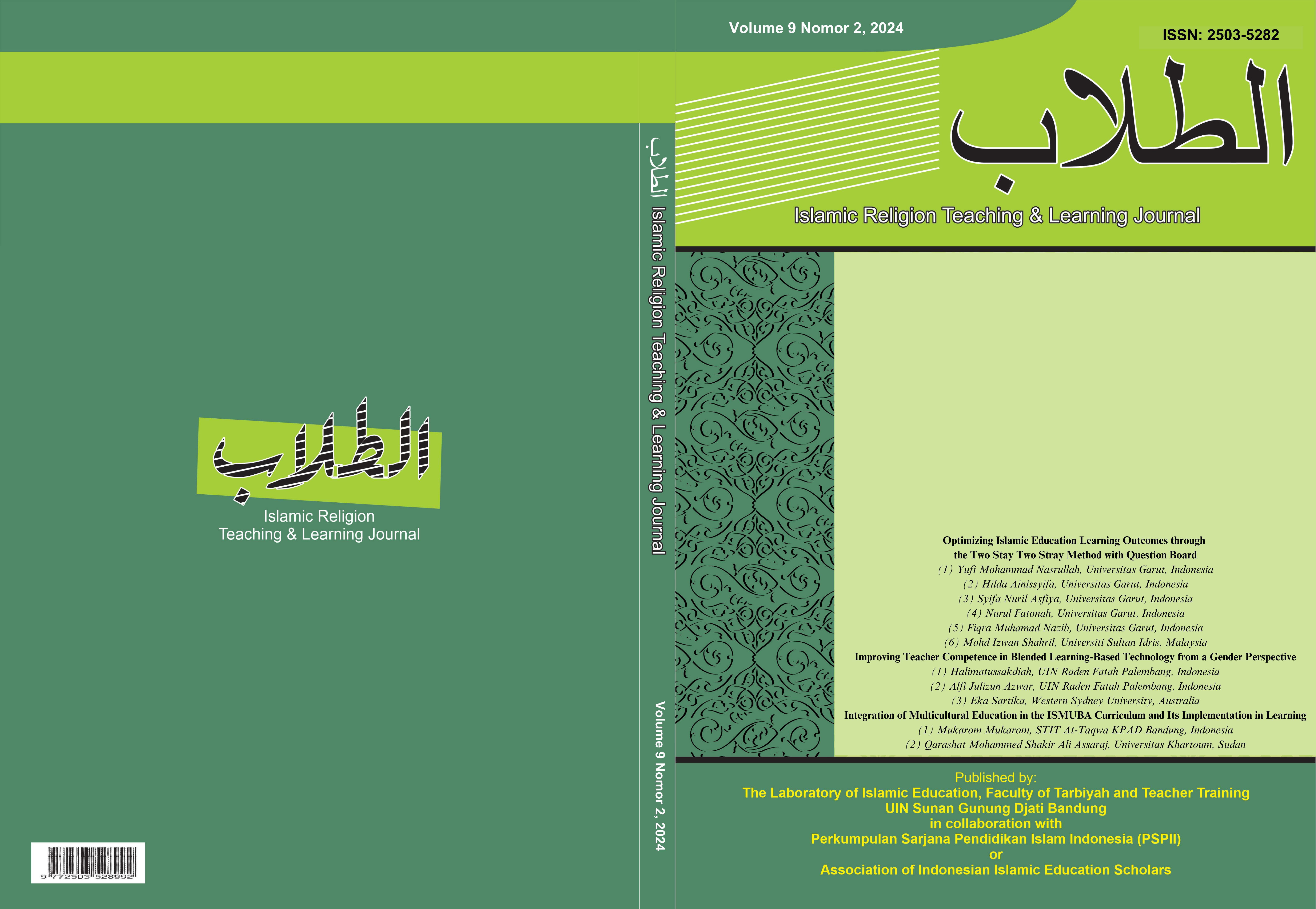
Optimizing Islamic Education Learning Outcomes through the Two Stay Two Stray Method with Question Board
DOI:
https://doi.org/10.15575/ath.v9i2.37057Keywords:
Islamic Religious Education, Question Board, Two Stay Two Stray MethodsAbstract
This study is grounded in the need to improve students’ learning outcomes in Islamic Religious Education (IRE), which are often hindered by monotonous teaching methods and limited student engagement. The objective of this research is to examine the effectiveness of the Two Stay Two Stray (TSTS) method supported by question board media in enhancing students’ understanding and achievement. This study employed a quantitative approach using a Classroom Action Research (CAR) design, involving 25 twelfth-grade students. Data were collected through pretest and posttest assessments, classroom observations, and student questionnaires. The findings reveal a significant improvement in learning outcomes, as indicated by the increase in mean scores from 73.8 in the pretest to 90.2 in the posttest. Statistical analysis shows that the t-count (4.30) exceeds the t-table (2.06), confirming a significant difference after the intervention. Furthermore, the implementation of TSTS encourages active participation, collaboration, and critical thinking, while the question board media supports students in understanding abstract religious concepts. This study contributes to the development of innovative and interactive learning strategies in Islamic education by integrating cooperative learning models with visual media to optimize student engagement and comprehension.
References
Abubakar, H. R. I. (2021). Pengantar metodologi penelitian. SUKA-Press UIN Sunan Kalijaga.
Aji, T. P., & Wulandari, S. S. (2021). Analisis Model Pembelajaran Kooperatif Tipe Two Stay Two Stray (TSTS) Terhadap Hasil Belajar Siswa. Journal of Office Administration : Education and Practice, 1(3), 340–350. https://doi.org/10.26740/joaep.v1n3.p340-350
Anggraeni, N. R. (2023). Pengaruh Penerapan Model Pembelajaran Two Stay Two Stray (TSTS) Terhadap Hasil Belajar PAI Peserta Didik di Kelas V UPT SDN 16 Pinrang Kec. Watang Sawitto Kab. Pinrang. Primer Edukasia Journal, 2(1), 61-76. https://doi.org/10.56406/jpe.v2i1.106
Apriakanti, D., Kusuma, M., & Nurhayati, M. (2020). The Effectiveness of Two Stay Two Stray (TSTS) Cooperative Learning Model in Improving Students ’Critical Thinking Skills. Journal of Science Education Research, 4(1), 40–43. https://doi.org/10.21831/jser.v4i1.34240
Apriliawati, D., Irawati, L., & Styati, E. W. (2017). The Effect Of Two Stay Two Stray (Tsts) Method On Recount Text Wrıtıng At The Eıghth Grade Students Of Smpn 2 Sawahan. English Teaching Journal, 5(2), 50–57. https://doi.org/http://doi.org/10.25273/etj.v5i2.5445
Damopolii, I., & Iwan, I. (2018). Penerapan Model Pembelajaran Kooperatif Two Stay Two Stray (TSTS) Mata Kuliah Mikrobiologi untuk Meningkatkan Aktivitas Belajar Mahasiswa Melalui Kegiatan Lesson Study Di Jurusan Pendidikan Biologi FKIP UNIPA. Jurnal Eksakta Pendidikan (Jep), 2(2), 209. https://doi.org/10.24036/jep/vol2-iss2/229
Dwiputeri, D. F., Suyana, I., & Novia, H. (2023). Implementation of cooperative learning model with Two Stay Two Stray (TSTS) type to improve student’s communication skills. Prosiding Seminar Nasional Fisika (SiNaFi) 9.0, 2(1), 107–112.
Fatchurahman, M. A. S. M., Adella, H., & Setiawan, M. A. (2022). Development of Animation Learning Media Based on Local Wisdom to Improve Student Learning Outcomes in Elementary Schools. International Journal of Instruction, 15(1), 55–72. Retrieved from https://e-iji.net/ats/index.php/pub/article/view/434
Fitri, A. A., & Pertiwi, F. N. (2023). Efektivitas Model Pembelajaran Two Stay Two Stray (TSTS) Berbasis Teacher and Peer Feedback terhadap Kemampuan Refleksi Peserta Didik. Jurnal Tadris IPA Indonesia, 3(3), 238–251. https://doi.org/10.21154/jtii.v3i3.2166
Hamid, A. (2020). Penerapan metode keteladanan sebagai strategi pembelajaran untuk meningkatkan hasil belajar pendidikan agama Islam. AL-FIKRAH: Jurnal Studi Ilmu Pendidikan dan Keislaman, 3(2), 154-169. https://doi.org/10.36835/al-fikrah.v3i2.70
Handriyani, E., & Abdillah, C. (2022). Implementasi Model Kooperatif Two Stay Two Stray (TSTS) Untuk Meningkatkan Kemampuan Kognitif IPA. Jurnal Pelita: Jurnal Pembelajaran IPA Terpadu, 2(2), 69–75. https://doi.org/10.54065/pelita.2.2.2022.203
Harisnur, F., & Suriana, S. (2022). Pendekatan, Strategi, Metode dan teknik Dalam Pembelajaran PAI di Sekolah Dasar. Genderang Asa: Journal of Primary Education, 3(1), 20–31. https://doi.org/10.47766/ga.v3i1.440
Ismawati, N., & Hindarto, N. (2021). Penerapan Model Pembelajaran Kooperatif Dengan Pendekatan Struktural Two Stay Two Stray Untuk Meningkatkan Hasil Belajar Siswa Kelas X SMA. Jurnal Pendidikan Fisika Indonesia, 7(1), 38–41. https://doi.org/10.15294/jpfi.v7i1.1067
Jailani, M., Widodo, H., & Fatimah, S. (2021). Pengembangan Materi Pembelajaran Pendidikan Agama Islam: Implikasinya Terhadap Pendidikan Islam. Al-Idarah: Jurnal Kependidikan Islam, 11(1), 145. https://doi.org/https://dx.doi.org/10.24042/alidarah.v11i1.8886
Juniantari, I. G. A. S., & Kusmariyatni, N. N. (2019). Pengaruh Model Pembelajaran Kooperatif Two Stay Two Stray Berbantuan Mind Mapping terhadap Hasil Belajar IPA. Jurnal Ilmiah Sekolah Dasar, 3(3), 378. https://doi.org/10.23887/jisd.v3i3.19478
Khudry, A. Al, Sri, M., Ari, L., Padang, U. N., Padang, K., Padang, U. N., & Padang, K. (2023). Peningkatan Hasil Belajar Peserta Didik Menggunakan Model Student Team Achievement Division ( STAD ) Pada Pembelajaran Tematik Terpadu diKelas V. Jurnal Elementaria Edukasia, 6(4), 2037–2050. https://doi.org/10.31949/jee.v6i4.7620
Kulsum, U., & Muhid, A. (2022). Pendidikan Karakter melalui Pendidikan Agama Islam di Era Revolusi Digital. Jurnal Intelektual: Jurnal Pendidikan Dan Studi Keislaman, 12(2), 157–170. https://doi.org/10.33367/ji.v12i2.2287
La Una, W. (2023). Implementation Of Two Stay Two Stray Cooperative Learning ( Tsts ) To Improve The Activity And Outcomes Of Science Learning By Class Viii Students Of Smp Negeri 12 Poleang Barat 2019 / 2020 Academic Year. Journal of Teaching and Education, 2(1), 59–71. https://doi.org/http://dx.doi.org/10.31327/jte.v2i1.1944
Lubis, M. A. (2018). Pengaruh Model Pembelajaran Kooperatif Tipe Two Stay Two Stray (Tsts) Dan Artikulasi Terhadap Hasil Belajar Siswa Pada Materi Ekosistem Di Sma Negeri 1 Sibabangun Kabupaten Tapanuli Tengah. Jurnal Biolokus, 1(2), 117. https://doi.org/10.30821/biolokus.v1i2.352
Lusiana, I. A., Setyosari, P., & Soetjipto, B. E. (2017). The Application of Two Stay Two Stray (TSTS) and Fan-N-Pick Learning Models to Improve Studentsâ Motivation and Learning Outcomes on Social studies Subject (A Study on the Fourth Grade students of SDN Tawun I Ngawi). International Journal of Academic Research in Progressive Education and Development, 6(3). https://doi.org/10.6007/ijarped/v6-i3/3138
Maskhuroh, L., & Bakar, H. A. (2019). Problematika Pembelajaran Pendidikan Agama Islam (Pai Qur-Any) Di Sma Primaganda Jombang. Ilmuna: Jurnal Studi Pendidikan Agama Islam, 1(1), 58–75. Retrieved from https://pondokjurnal.uwj.ac.id/index.php/ilmuna/article/view/103
Nafisah, D., & Sahlan, M. (2023). Spesifikasi Konsep Evaluasi pada Pengembangan Teknik Assesmen Kompetensi Sikap terhadap Pembelajaran PAI di SMP. MA’ALIM: Jurnal Pendidikan Islam, 4(2), 216–231. https://doi.org/10.21154/maalim.v4i2.6685
Nasution, B., & Zulkifli, N. (2023). Metode Pembelajaran dan Teknik Mengajar dalam Pendidikan Agama Islam (PAI) oleh Guru Pendidikan Agama Islam. Khazanah Pendidikan, 17(1), 142–153. https://doi.org/10.30595/jkp.v17i1.16027
Nilpa, W., & Ridwan, A. F. (2023). Pengaruh Model Pembelajaran Kooperatif Tipe Two Stay Two Stray Terhadap Pemahaman Konsep Matematis Siswa Kelas V SDN Cijambe. KRAKATAU (Indonesian of Multidisciplinary Journals), 1(1), 15-26. Retrieved from https://jurnal.desantapublisher.com/index.php/krakatau/article/view/98
Ningsih, S. R., Purwaningrum, J. P., & Sumaji. (2023). Pengaruh Model Pembelajaran Two Stay-Two Stray Berbantuan Media Mathcircle Terhadap Kemampuan Komunikasi Matematis Siswa. Jurnal Pendidikan Matematika, 14(2), 178–185. https://doi.org/https://doi.org/10.36709/jpm.v14i2.72
Permata, I., Vai, A., & Wedi, S. (2023). Penerapan Metode Pembelajaran Two Stay Two Stray (TSTS) untuk Meningkatkan Hasil Belajar Siswa pada Materi Budaya Hidup Sehat di Tingkat Sekolah Dasar Negeri 110 Pekanbaru. Journal on Education, 5(3), 6433–6439. https://doi.org/10.31004/joe.v5i3.1425
Prasetio, H. ., Suparno, S., & Nikensari, S. I. . (2023). The Influence of Learning Media Usability and Learning Motivation on Student Learning Outcomes In Economics Subject in the 2022/2023 Academic Year: Study on Class XI Students of Private High Schools at Sanggar 016 DKI Jakarta. International Journal of Multidisciplinary Research and Literature, 2(2), 182–194. https://doi.org/10.53067/ijomral.v2i2.104
Putri, C. A., Muhammadiyah, U., & Hamka, P. (2023). Pengaruh Model Pembelajaran RADEC berbasis STEAM terhadap Literasi Sains Siswa Kelas IV Sekolah Dasar. Jurnal Elementaria Edukasia, 6(3), 1162–1170. https://doi.org/10.31949/jee.v6i3.6280
Rachman, T. (2018). Teori Tentang Metode Two Stay Two Stray (Tsts) dan Motivasi Belajar. Angewandte Chemie International Edition, 6(11), 951-952.
Rafi, H., Suyoto, S., Sumarno, S., & Rumiarci, E. (2024). Peningkatan Hasil Belajar Siswa Melalui Model Problem Based Learning Pada PPKn SDN Sambirejo 02. Jurnal Edukasi: Kajian Ilmu Pendidikan, 9(2), 65–73. https://doi.org/10.51836/je.v9i2.644
Rahim, R., Syaifudin, S., & Nery, R. S. (2019). Model Pembelajaran Kooperatif Tipetwo Stay Two Stray (Tsts) Terhadap Hasil Belajar Siswa. Jurnal Penelitian Pendidikan Matematika, 1(1), 39. https://doi.org/10.32502/jp2m.v1i1.683
Rahmadania, S. (2021). Peran Pendidikan Agama Islam Dalam Keluarga Dan Masyarakat. Edumaspul, 5(2), 221–226. https://doi.org/10.33487/EDUMASPUL.V5I2.1978
Rahmawati, A. A., Isnaeni, W., & Retnowati, L. (2023). The Implementation of Problem Based Learning (PBL) with Two Stay Two Stray (TSTS) to Increase Motivation and Learning Outcomes on Environmental Change Material for SMA. Journal of Biology Education, 12(3), 403–410. https://doi.org/https://doi.org/10.15294/jbe.v12i3.74991
Rasdiana, R., Juddah, A. B., & Selle, H. (2019). Applying Two Stay Two Stray (Tsts) Technique by Using Picture Series to Improve Students’ Speaking Skill at the Secondgrade in Man 2 Parepare. Journal of Linguistics and English Teaching Studies, 2(2), 25–43. https://doi.org/https://doi.org/10.35905/inspiring.v2i2.1270
Rohmat, I. N., Setyawan, M. N. K., & Salsabila, I. A. (2023). Teknik Evaluasi Pembelajaran PAI. Ta’limDiniyah: Jurnal Pendidikan Agama Islam (Journal of Islamic Education Studies), 4(1), 157–177. https://doi.org/10.53515/tdjpai.v4i1.102
Safitri, A., Achmad, A., & Marpaung, R. R. T. (2015). Pengaruh Model Pembelajaran Two Stay Two Stray (TSTS) terhadap Hasil Belajar Siswa. Jurnal Bioterdidik: Wahana Ekspresi, 3(2), 55–58. Retrieved from https://jurnal.fkip.unila.ac.id/index.php/JBT/article/view/7465/0
Sari, A., & Azmi, M. P. (2018). Penerapan Model Kooperatif Tipe Two Stay Two Stray (Tsts) Terhadap Kemampuan Komunikasi Matematis. Jurnal Cendekia : Jurnal Pendidikan Matematika, 2(1), 164–171. https://doi.org/10.31004/cendekia.v2i1.42
Setiawati, G. A. D. (2023). Penerapan Model Pembelajaran Group Investigation Berbasis Lingkungan Sekitar pada Mata Pelajaran IPAS. Jurnal Elementaria Edukasia, 6(4), 1915–1925. https://doi.org/https://doi.org/10.31949/jee.v6i4.6619
Silalahi, M., & Sary, Y. W. (2020). The using of two stay two stray (tsts) strategy on students’ reading comprehension. Bilingual: Jurnal Pendidikan Bahasa Inggris, 2(2), 70–77. https://doi.org/10.36985/jbl.v2i2.134
Sujarwo, S., Japar, J., & Sumantri, S. (2024). The Effect of Virtual Reality Learning Media on Student Social Studies Learning Outcomes in Junior High Schools. KnE Social Sciences, 3, 263–269. https://doi.org/10.18502/kss.v9i2.14853
Supriadi, H. (2023). Penyusunan Teks Kloz sebagai Teknik Pembelajaran Terpadu : Supervisi Kepala Sekolah terhadap Guru Kelas Tinggi. Jurnal Pembelajaran Bahasa Dan Sastra, 2(1), 37–48. https://doi.org/https://doi.org/10.55909/jpbs.v2i1.216
Suryanti, S., Zawawi, I., & Fauziyah, S. (2017). Peningkatan Penguasaan Konsep Matriks Melalui Model Pembelajaran Kooperatif Tipe Two Stay Two Stray (TSTS) (Lesson Study Dengan Mengambil Obyek Mata Kuliah Matriks Di Semester 2). DIDAKTIKA : Jurnal Pemikiran Pendidikan, 21(1), 14–27. Retrieved from https://journal.umg.ac.id/index.php/didaktika/article/view/96
Syafrin, Y., Kamal, M., Arifmiboy, A., & Husni, A. (2023). Pelaksanaan Pembelajaran Pendidikan Agama Islam. Educativo: Jurnal Pendidikan, 2(1), 72–77. https://doi.org/https://doi.org/10.56248/educativo.v2i1.111
Unique, A. (2022). Penerapan metode Two Stay Two Stray (TSTS) dengan Number Head Together (NHT) dalam meningkatkan aktivitas belajar siswa (Penelitian Quasi Experimen terhadap Siswa Kelas VII SMPN 56 Bandung pada Mata Pelajaran PAI). UIN Sunan Gunung Djati Bandung.
Wahyudi, I. (2024). The Effect Of Two Stay Two Stray Teaching Method On Reading Comprehension Of The Eight Grade Students’ Of SMPN 1 Wawotobi. Innovative: Journal Of Social Science Research, 4(1), 10395–10406. https://doi.org/https://doi.org/10.31004/innovative.v4i1.8805
Wahyuni, D. S., Aprison, W., Charles, C., & Junaidi, J. (2023). Problematika Siswa Muslim Dalam Mengikuti Pembelajaran PAI Di SD Keluarga Kudus Kecamatan Luhak Nan Duo Kabupaten Pasaman Barat. ALFIHRIS: Jurnal Inspirasi Pendidikan, 1(2), 88–107. https://doi.org/https://doi.org/10.59246/alfihris.v1i2.218
Widyastuti, N. N. S., Saputra, H. H., & Oktaviyanti, I. (2022). Pengaruh Model Pembelajaran Two Stay Two Stray Dipadu Picture And Picture Terhadap Hasil Belajar Ips Siswa Kelas IV SDN Gugus 06 Cakranegara Tahun Pelajaran 2020/2021. Jurnal Ilmiah Mandala Education, 8(1), 958–963. https://doi.org/10.58258/jime.v8i1.2926
Zahra, F., Habibah, U., & Nurela, N. (2024). Problematika pembelajaran pai dan upaya mengatasinya. Jurnal Pendidikan Educandum, 4(1), 38–52. https://doi.org/https://doi.org/10.55656/jpe.v4i1.175
Additional Files
Published
How to Cite
Issue
Section
License
Copyright (c) 2024 Authors

This work is licensed under a Creative Commons Attribution-ShareAlike 4.0 International License.
Authors who publish with this journal agree to the following terms:
- Authors retain copyright and grant the journal right of first publication with the work simultaneously licensed under a Creative Commons Attribution-ShareAlike License that allows others to share the work with an acknowledgement of the work's authorship and initial publication in this journal.
- Authors are able to enter into separate, additional contractual arrangements for the non-exclusive distribution of the journal's published version of the work (e.g., post it to an institutional repository or publish it in a book), with an acknowledgement of its initial publication in this journal.
- Authors are permitted and encouraged to post their work online (e.g., in institutional repositories or on their website) prior to and during the submission process, as it can lead to productive exchanges, as well as earlier and greater citation of published work (See The Effect of Open Access).