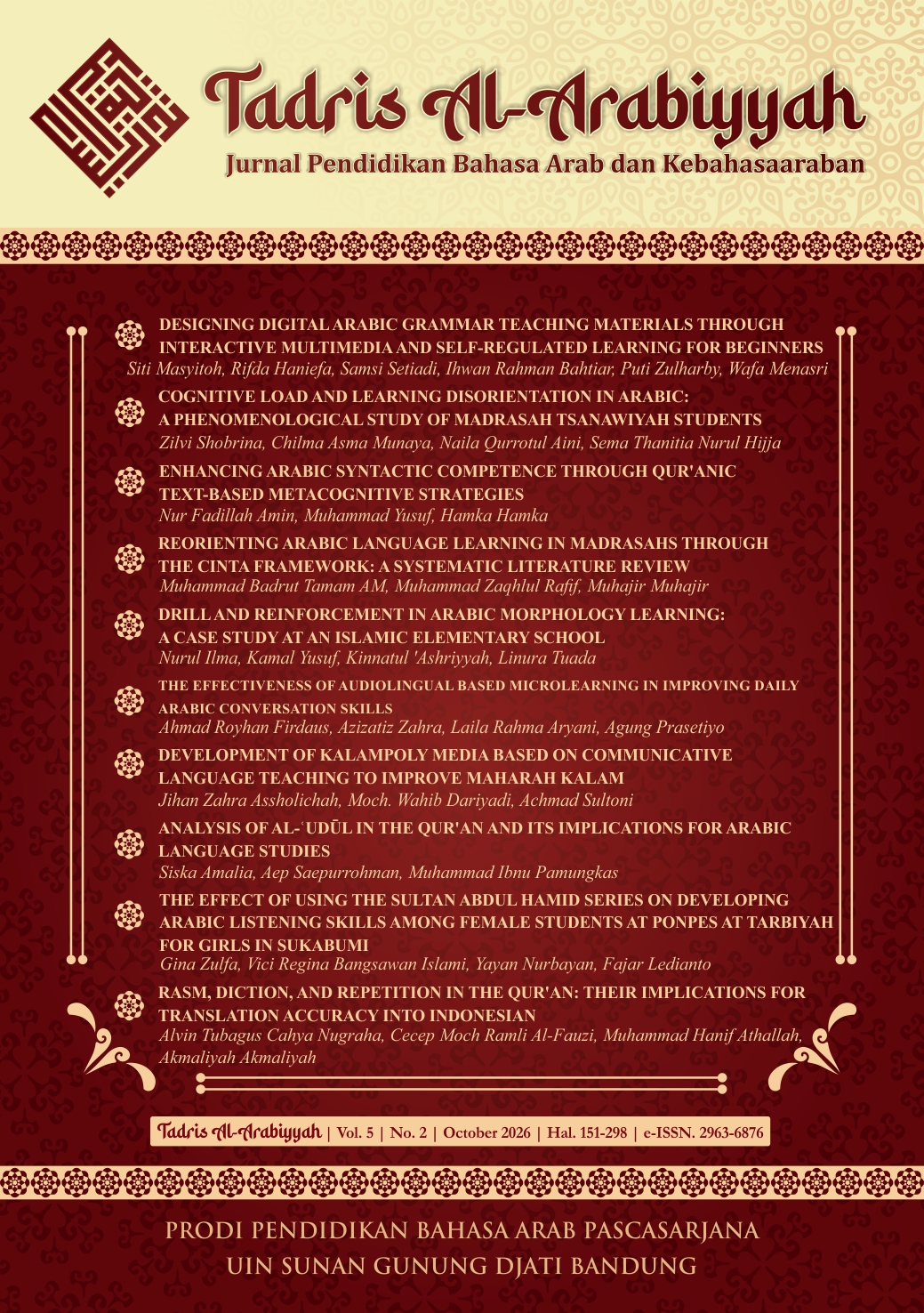
Rasm, Diction, and Repetition in the Qur’an: Their Implications for Translation Accuracy into Indonesian
DOI:
https://doi.org/10.15575/ta.v5i2.52676Keywords:
Arabic Linguistics, Diction, Rasm, Repetition, Translation AccuracyAbstract
Translating the Qur’an into Indonesian presents challenges in preserving the linguistic characteristics of the source text, particularly in terms of rasm, diction, and repetition. This study aims to analyze these three aspects and explain their implications for the accuracy of Qur’anic translation. It employs a qualitative-descriptive approach through library research. The data are analyzed using content analysis with a comparative approach, supported by Qur’anic exegesis, Arabic linguistics, the science of Qur’anic orthography, balaghah, and translation theory. The findings indicate that rasm must be examined in light of the orthographic conventions of the Qur’anic codex, variant readings (qira’at), and exegetical context, as differences in written forms do not necessarily produce differences in meaning. Regarding diction, the use of overly general equivalents may obscure semantic nuances between words with related meanings. Meanwhile, repetition contributes to textual cohesion, emphasis, and rhetorical effects, which may be diminished when repeated elements are omitted or replaced with pronouns. This study concludes that translation accuracy depends not only on semantic equivalence but also on preserving the linguistic functions of the source text while maintaining naturalness and readability in the target language.
References
Abdul-Latif, E. (2023). Verifying the terminology of Arabic rhetorical tradition: The case of ʾiltifāt. Lexikos, 33(1), 448–473. https://doi.org/10.5788/33-1-1831
Akra, D., & Jarrar, M. (2025). Lemmatization and morphosyntactic inter-linking in classical Arabic corpora. Computational Linguistics, 51(2), 341–365. https://doi.org/10.1162/coli_a_00512
Al-Areqi, A. M., & Al-Badani, B. (2022). Rhetorical devices in the Holy Qur'an: Grammatical shift and communicated subject matters in Surah Al-Baqarah. Hamdard Islamicus, 44(2), 45–68. https://doi.org/10.57144/hi.v44i2.301
Alhaj, A. A. M., Abdelkarim, M. B. A., Ali, D. A. A., & Alian, E. M. I. (2022). Semantic and stylistic problems encountered in translating Qur’anic digression “Iltifât” into English: A contrastive linguistic study. International Journal of Linguistics, Literature and Translation, 5(2), 9–15. https://doi.org/10.32996/ijllt.2022.5.2.2
Al-Khulaidi, A. A. G., & Yaseen, S. (2025). Data generation models for enhanced classical Arabic information retrieval. Information Processing & Management, 62(5), Article 103780. https://doi.org/10.1016/j.ipm.2025.103780
Arsyad, A., et al. (2024). Al-iltifāt al-ṣarfī fī al-Qur’ān al-Karīm: Dirāsah fī ḍaw’ ʿilm al-maʿānī wa-al-badīʿ. A Jamiy: Jurnal Bahasa dan Sastra Arab. https://journal.umgo.ac.id/index.php/AJamiy/article/view/3218
Arsyad, B. (2025). Iltifāt dalam Al-Qur’an: Analisis semantik–retoris Surah al-Baqarah dan Āli ‘Imrān. Al-Kalim: Jurnal Pendidikan Bahasa Arab dan Kebahasaaraban, 4(1). https://doi.org/10.60040/jak.v4i1.154
Arsyad, B., Garancang, S., Kasim, A., Haniah, H., Miolo, M. I., & Ilolu, R. (2024). Stilistika Al-Qur'an: Kajian Ma’ani dan Badi terhadap penggunaan uslub al-iltifāt al-ṣarfī. A Jamiy: Jurnal Bahasa dan Sastra Arab, 13(1). https://journal.umgo.ac.id/index.php/AJamiy/article/view/3218
Ashidiqi, M. A., & Rahli, M. (2024). Balaghah; antara pengetahuan dan disiplin ilmu (Telah kritis terhadap sejarah perkembangan bahasa & sastra Arab). International Journal of Modern Education, 6(22), 650–662. https://doi.org/10.35631/IJMOE.726044
Bentahar, A. (2022). Tense shift and aspectual meaning in Qur'anic Arabic: A discourse analysis perspective. Arab World English Journal, 13(1), 214–228. https://doi.org/10.24093/awej/vol13no1.14
Dukes, K., & Habash, N. (2022). Morphological annotation of Quranic Arabic: Multi-stage tagging and collaborative verification. Language Resources and Evaluation, 56(3), 821–845. https://doi.org/10.63317/4b87kwj4mt83
Haji Mohammad bin Seman, H., Hussin, M. H. bin, & Jumat, M. A. A. bin A. (2021). Iltifat makna leksikologi al-insan dan al-nafs dalam Surah Al-Fajr dan implikasinya terhadap laras wacana Qurani. JALL: Journal of Arabic Linguistics and Literature, 3(1), 116–132. https://doi.org/10.59202/jall.v3i1.333
Hasanain, T., & Jarrar, M. (2024). Structural islands and movement strategies in Quranic Arabic syntax. Natural Language & Linguistic Theory, 42(3), 975–1002. https://doi.org/10.1007/s11049-024-09615-z
Hasibuan, S. (2022). Penggunaan gaya bahasa refetisi dalam Surah Al-Jin (sebuah tinjauan stilistika). El-Jaudah: Jurnal Pendidikan Bahasa dan Sastra Arab, 3(1), 15–31. https://doi.org/10.56874/faf.v3i1.712
Hassanein, H. (2022). Double or half reading, double or full meaning: Amphibological and anacoluthic syntax through the lens of Qur’an translators. Russian Journal of Linguistics, 26(3), 668–700. https://doi.org/10.22363/2687-0088-26692
Jarrar, M., & Hammouda, T. (2025). QuranMorph: A manually annotated gold-standard corpus for Quranic Arabic morphology. Journal of Language Resources and Evaluation, 59(1), 102–125. https://doi.org/10.1007/s10579-024-09712-x
Kamran, A., & Abro, B. (2024). AI-assisted parsing and oversight in Qur'anic translation models. Digital Scholarship in the Humanities, 39(4), 890–908. https://doi.org/10.1093/llc/fqad088
Mohammad bin Seman, M. M., et al. (2021). [Judul artikel tentang iltifāt dan analisis leksikologi dalam wacana Al-Qur’an]. Journal of Arabic Language and Literature, 3(1). https://doi.org/10.59202/jall.v3i1.333
Mutter, J. (2023). Iltifāt and narrative voice in the Qur’ān: Grammatical shifts and nested dialogue in Sūrahs 19, 20 and 28. Journal of the International Qur’anic Studies Association, 7(1). https://doi.org/10.5913/jiqsa.7.2022.a004
Nordin, F. H., & Mohamed, I. I. (2022). A review of Quranic rhetoric techniques and linguistic features. International Journal of Academic Research in Business and Social Sciences, 12(8), 415–429. https://doi.org/10.6007/IJARBSS/v12-i8/14512
Rashad, H. A. M., & Abu Zaid, N. M. (2021). The purposes of change in Quranic discourse: The conditions of ungratefuls as a model. QURANICA: International Journal of Quranic Research, 13(2), 171–200. https://doi.org/10.22452/quranica.vol13no2.8
Raza, A., & Khan, S. U. (2023). Computational exploration of classical Arabic stylistic patterns. IEEE Access, 11, 45120–45132. https://doi.org/10.1109/ACCESS.2023.3271102
Razak, M. A. A., & Qunawi, Q. A. (2022). Development of decision-making framework for food premises based on Wara' parameter. Islāmiyyāt, 44(2), 29–39. https://doi.org/10.17576/islamiyyat-2022-4402-02
Saadiyeh, O., & Zaki, C. (2025). QurSci-Onto: A foundational resource for multi-hop sequential reasoning over Arabic texts. Artificial Intelligence Review, 58(3), 201–225. https://doi.org/10.1007/s10462-025-10811-9
Sawalha, M., & El Amsy, T. (2026). NoorGhateh: A benchmark dataset for evaluating Arabic morphological analysis systems. ACM Transactions on Asian and Low-Resource Language Information Processing, 25(2), Article 3632110. https://doi.org/10.1145/3632110
Tabassum, N., & Mayuuf, A. (2021). Grammatical shift and discourse analysis in sacred texts: A study of Qur'anic iltifāt. Journal of Religion and Communication, 44(2), 112–130. https://doi.org/10.57144/hi.v44i2.301
Wan Ahmad, W. A., Mohd Zainal Abidin, A. F., & Mohamed, Y. (2025). The effect of the technique of iltiṭāf (shifts in address) in enhancing the understanding of implicit meanings in the Quranic text: A rhetorical analytical study on the issue of reverence in Surah Al-Mulk. Al-Azkiyaa: International Journal of Language and Education, 4(1). https://doi.org/10.33102/alazkiyaa145
Downloads
Published
How to Cite
Issue
Section
Citation Check
License
Copyright (c) 2026 Alvin Tubagus Cahya Nugraha, Cecep Moch Ramli Al-Fauzi, Muhammad Hanif Athallah, Akmaliyah Akmaliyah

This work is licensed under a Creative Commons Attribution-ShareAlike 4.0 International License.