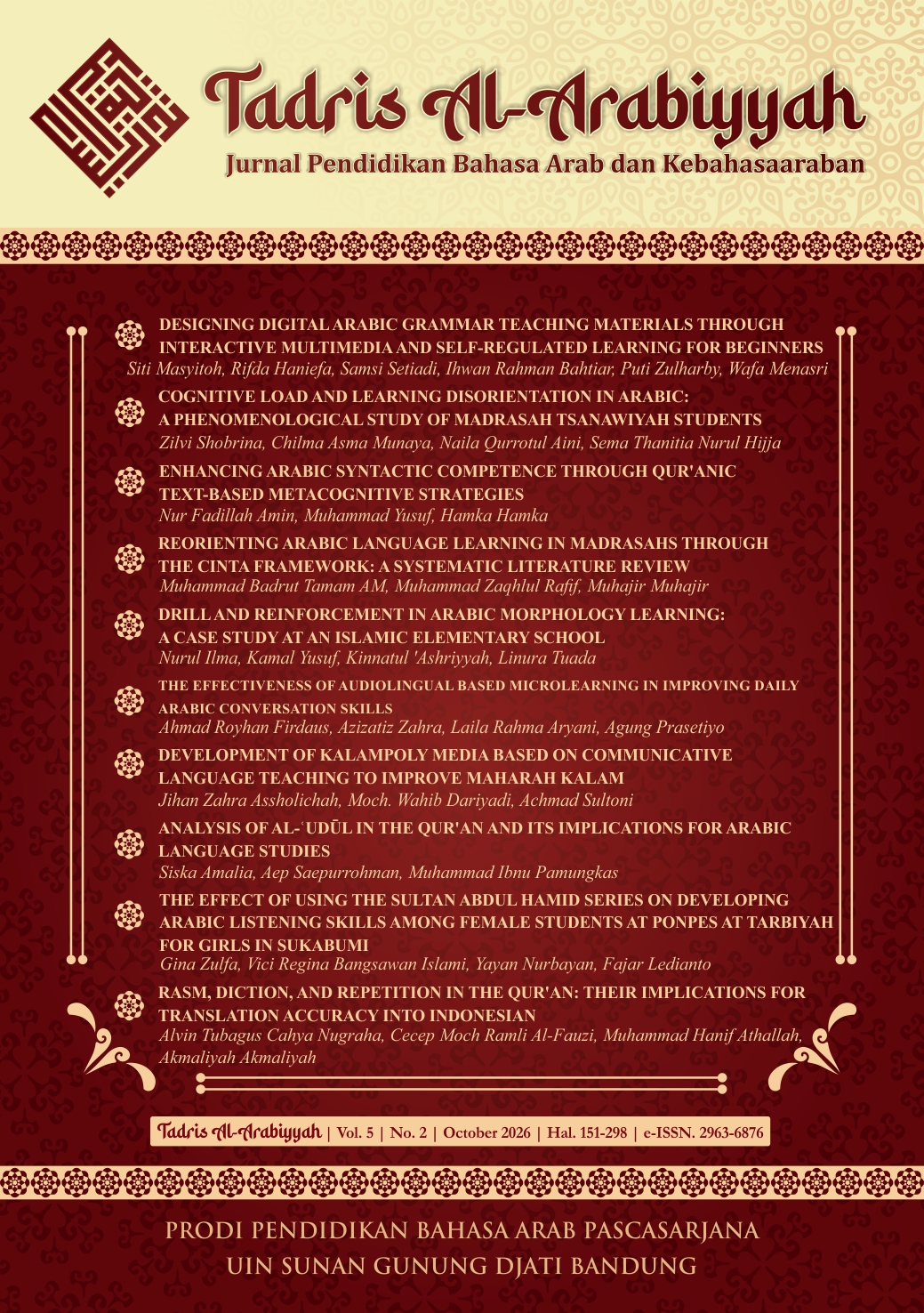
Designing Digital Arabic Grammar Teaching Materials Through Interactive Multimedia and Self-Regulated Learning for Beginners
DOI:
https://doi.org/10.15575/ta.v5i2.58370Keywords:
Arabic Grammar, digital teaching materials, interactive multimedia, Self-Regulated Learning, beginner studentsAbstract
Teaching Arabic grammar to beginner-level university students can be challenging because grammatical concepts are often abstract, and learners may struggle to apply rules in context. This study aimed to develop a preliminary conceptual design for interactive, multimedia-based digital Arabic grammar teaching materials oriented toward Self-Regulated Learning (SRL). Using an Educational Design Research (EDR) approach, the study focused on needs analysis and preliminary design. Data were collected from 55 first-semester students in the Arabic Language Education Study Program at Universitas Negeri Jakarta through classroom observations, interviews, and a 20-item questionnaire using a five-point response scale. Questionnaire data were analyzed descriptively, while observation and interview findings were used to contextualize students’ reported needs. The findings indicated three main design requirements: simplified, systematic grammar explanations supported by formulas, keywords, contextual examples, and varied exercises; accessible digital materials with purposeful multimedia, interactive quizzes, and immediate feedback; and features that support self-assessment and progress monitoring. These findings informed the proposed content structure, multimedia features, and six preliminary design principles: simplification with conceptual accuracy, sequential and contextualized learning, purposeful visualization, interactive application and feedback, embedded SRL opportunities, and accessible and consistent navigation. The principles were formulated by synthesizing the identified learner needs with corresponding instructional design responses; however, they have not yet undergone expert validation or empirical testing. The study therefore offers a needs-informed design proposal for developing digital Arabic grammar teaching materials, rather than a validated or demonstrably transferable design framework. Further research is needed to develop the proposed materials, assess their content and instructional quality, and evaluate their usability and learning outcomes.
References
Albantani, A. M., & Madkur, A. (2021). Teaching Arabic grammar in Indonesian universities: Challenges and innovative solutions. Journal of Language and Linguistic Studies, 17(2), 890–904. https://doi.org/10.52462/jlls.63
Al-ghifari, A. N., Hasanah, U., Mohammed, H., Zaid, A., Nahari, A., Mary, R., & Subagyo, A. (2025). Tadris Al- ‘ Arabiyyah. Tadris Al-‘Arabiyyah: Jurnal Pendidikan Bahasa Arab Dan Kebahasaaraban, 4(1), 15–28. https://doi.org/10.15575/ta.v4i1.44855
Al-Maroof, R. S., Alhumaid, K., & Salloum, S. A. (2021). The continuous intention to use e-learning environments in higher education: A technology acceptance perspective. International Journal of Interactive Mobile Technologies (iJIM), 15(11), 181–197. https://doi.org/10.3991/ijim.v15i11.22123
Alshammari, M. M. (2024). Interactive Multimedia and Cognitive Load Reduction in Complex Foreign Language Learning. Interactive Learning Environments, 32(3), 1120–1135. https://doi.org/10.1080/10494820.2022.2089451
El Hanif, H. (2022). Pengembangan Bahan Ajar Bahasa Arab Berbasis Multimedia Interaktif Kelas V Mts Ta’Mirul Islam Masaran Sragen. JUPE: Jurnal Pendidikan Mandala, 7(2), 473–483. https://doi.org/10.58258/jupe.v7i2.3548
Fauzia, E. L., & Abdul Aziz, A. U. (2024). Meningkatkan Penguasaan Kosakata dan Pemahaman Teks Bahasa Arab Siswa melalui Penggunaan Aplikasi Assemblr Edu Berbasis Augmented Reality. Tadris Al-’Arabiyyah: Jurnal Pendidikan Bahasa Arab Dan Kebahasaaraban, 3(1), 135–149. https://doi.org/10.15575/ta.v3i1.34109
Febriana, D., & Iswari, L. (2023). Pengembangan Aplikasi Pembelajaran Bahasa Arab untuk Pemula Berbasis Web. Insect (Informatics and Security): Jurnal Teknik Informatika, 8(2), 100–109. https://doi.org/10.33506/insect.v8i2.2246
Ghafar, L. A., & Noor, N. M. (2026). Gamification Learning Environment (GLE) for Supporting Self-Regulated Learning in Arabic Vocabulary: A Quasi-Experimental Study. International Journal of Research and Innovation in Social Science, 10(1), 7565–7585. https://doi.org/10.47772/IJRISS.2026.10100586
Hamid, et. a. (2024). Evaluating Student Acceptance of Interactive Infographics Module for Arabic Grammar Learning Using the Technology Acceptance Model (TAM). International Journal of Learning, Teaching and Educational Research, 23(9), 121–140. https://doi.org/10.26803/ijlter.23.9.7
Hamid, M. (2024). Application Of Fuzzy Delphi Method in Designing Interactive Infographic Module for Learning Arabic Grammar. International Journal of Religion, 5(11), 235–248. https://doi.org/10.61707/2b1r2d45
Han, F., & Ellis, R. A. (2023). Continuing To Investigate Self-Regulated Learning In Digital Language Learning Environments: The Role of Automated Feedback and Monitoring Tools. Computer Assisted Language Learning, 36(5), 1042–1065. https://doi.org/10.1080/09588221.2021.1962381
Haniefa, R., Masyitoh, S., Setiadi, S., bin Abdul Hakim, M. K., Rahmaputri, W. S., Ibtizah, S. Y., & Ramdiansyah, S. D. (2025, December). Desain Bahan Ajar Digital Interaktif untuk Meningkatkan Keterampilan Berbicara Bahasa Arab dengan Pendekatan Meaningful Learning. In Proceeding of International Conference on Innovation, Reflection, and Creativity in Arts, Literature, and Language Education (I-CIRCALLED) (Vol. 1, No. 1, pp. 230-237). https://doi.org/10.1234/ic.v1i1.62202
Huda, S., Alim, A., & Mujahidin, E. (2023). Model pembelajaran keterampilan bahasa Arab pada program prakuliah di STIBA Ar-Raayah Sukabumi. Edukasi Islami: Jurnal Pendidikan Islam, 12(02). https://doi.org/10.30868/ei.v12i02.4336
Ilmiani, A. M., Rahman, N. F., & Rahmah, Y. (2024). Multimedia Interaktif Untuk Mengatasi Problematika Pembelajaran. Bahasa, Al-Ta’rib : Jurnal Ilmiah Program Studi Pendidikan Bahasa Arab UIN Palangka Raya, 8(1), 17-32. https://doi.org/10.23971/altarib.v8i1.
Fadhil, A. (2025). Development of Booklet-Based Teaching Materials to Improve Mufrodat Mastery of Students at MIN 3 Nagan Raya. Journal of Indonesian Primary School, 2(4), 1–11. https://doi.org/10.62945/jips.v2i4.815.
Khedher, M., & Al-Thubaiti, A. (2025). Visualizing syntactic dependencies in Arabic NLP and pedagogy: A comparative functional approach. Language Resources and Evaluation, 59(1), 45–68. https://doi.org/10.1007/s10579-024-09712-x
Magda, M., & Anwar, N. (2023). Desain Media Interaktif Berbasis Android untuk Pembelajaran Qawa’id Siswa Kelas XII di Madrasah Aliyah Muhammadiyah 1 Malang. Emergent Journal of Educational Discoveries and Lifelong Learning (EJEDL), 2(4), 1–16. https://doi.org/10.47134/emergent.v2i4.8
Maimuna, M., Ainin, M., & Taufiqurrochman, R. (2022). Arrangement of text-based handbooks to enhance writing skills in Arabic language education. Ijaz Arabi: Journal of Arabic Learning, 5(1), 287–303. https://doi.org/10.18860/ijazarabi.v5i1.14857
Masaeli, M., Azimi, S. A., Ajaqi, M., & Karami, A. A. (2024). A prototype for evaluating and preparing content for Arabic language teaching applications for children based on Mayer’s cognitive theory of multimedia learning. Studies in Arabic Language Teaching and Learning, 10(2), 1–22. https://doi.org/10.22099/jsatl.2025.52322.1238
Masyitoh, S., Haniefa, R., Setiadi, S., & Bahtiar, I. R. (2026). Analisis Kebutuhan Bahan Ajar Qawa ’ id Berbasis Multimedia Interaktif untuk Tingkat Pemula. PENA: Penelitian Dan Penalaran, 13(1), 78–91. https://doi.org/10.26618/v41gz979
Mayer, R. (2005). Cognitive theory of multimedia learning. In R. Mayer (Ed.), The Cambridge handbook of multimedia learning. Cambridge University Press. https://doi.org/10.1017/CBO9780511816819.004
Mayer, R. E. (2009). Multimedia learning (2nd ed.). Cambridge University Press.
Mayer, R. E. (2021). Thirty years of research on online learning and multimedia principles: What works in digital education. Educational Psychology Review, 33(4), 1523–1540. https://doi.org/10.1007/s10648-021-09618-w
McKenney, S. E., & Reeves, T. C. (2019). Conducting educational design research (2nd ed.). https://doi.org/10.4324/9781315105642
Mustafa, M., & Yasin, M. (2023). Digitalizing Arabic grammar: Evaluating the impact of dynamic visual patterns on morphological retention. Foreign Language Annals, 56(2), 410–431. https://doi.org/10.1111/flan.12680
Nufus, erlina, Koderi, H., Utama, M., & Ramadhan, C. (2022). Development of Tarkib Teaching Materials Based on Motion Graphic in Islamic Junior High School Jurnal Al Bayan: Jurnal Jurusan Pendidikan Bahasa Arab, 14(1), 40-57. https://doi.org/10.24042/albayan.v14i1.7145.
Nurmahanani, I. (2025). Impact of integration of self-regulated learning (SRL) and phonic approach in flipped classroom model on reading literacy skills, reading strategies, and reading motivation. JPI (Jurnal Pendidikan Indonesia), 14(2), 360–370. https://doi.org/10.23887/jpi-undiksha.v14i2.92415
Plomp, T. (2013). Educational design research: An introduction. In T. Plomp & N. Nieveen (Eds.), Educational design research: Part A: An introduction (pp. 11–50). SLO.
Ritonga, M., Asy'ari, H., & Rahmawati, F. (2022). Formulaic approach to Arabic syntax for beginner learners in higher education: Design and feasibility. Arab World English Journal (AWEJ), 13(1), 312–326. https://doi.org/10.24093/awej/vol13no1.20
Rufaiqoh, E., Rosyidi, A. W., Machmudah, U., Ibrahim, N. I. E., & Sodik, A. J. (2023). The learning of Arabic speaking skills with constructive theory perspective. Izdihar: Journal of Arabic Language Teaching, Linguistics, and Literature, 6(3), 243–252. https://doi.org/10.22219/jiz.v6i3.29971
Rusdiah, R. (2021). Penggunaan Self Regulated Learning Untuk Meningkatkan Motivasi Belajar Bahasa Arab Sistem Pembelajaran Online di SMAN 1 Mataraman. Jurnal Pendidikan Dan Kebudayaan (JURDIKBUD), 1(3), 1–17. https://doi.org/10.55606/jurdikbud.v1i3.71
Soliman, A. (2023). Scaffolding Arabic syntactic analysis through interactive sentence-diagramming platforms. CALICO Journal, 40(2), 215–236. https://doi.org/10.1558/cj.22415
Sweller, J. (2011). Cognitive load theory. Psychology of learning and motivation 55, 37–76 https://doi.org/10.1016/B978-0-12-387691-1.00002-8
Sweller, J. (2024). Cognitive load theory and instructional design for complex domain learning: Recent advances. Educational Psychology Review, 36(1), Article 12. https://doi.org/10.1007/s10648-023-09840-2
Syarifah, A., Huda, M. N., & Hasim, M. O. F. (2026). Customized Moodle-based LMS for Arabic grammar: Transforming Al-Qawa’id Al-Naḥwiyah pedagogy in higher education. Ijaz Arabi: Journal of Arabic Learning, 9(1). https://doi.org/10.18860/ijazarabi.v9i1.41494
Syihabuddin, S., Gunawan, G., & Wekke, I. S. (2022). Self-regulated learning scaffolding in mobile-assisted Arabic grammar applications. International Journal of Advanced Computer Science and Applications (IJACSA), 13(8), 512–520. https://doi.org/10.14569/IJACSA.2022.0130861
Thohir, M. (2020). The implementation of counseling learning method to improve Arabic speaking skills for the freshmen. Jurnal Al Bayan: Jurnal Jurusan Pendidikan Bahasa Arab, 12(2), 169–186. https://doi.org/10.24042/albayan.v12i2.7216
Utami, S. P. T., & Syihabuddin, S. (2023). Self-efficacy and self-regulated learning among undergraduate in learning Arabic as a foreign language via online. Dirasat: Jurnal Pendidikan Bahasa Arab, 10(2). https://doi.org/10.33736/ils.5566.2023
Wahab, M. A. (2022). Revitalisasi dan reaktualisasi bahasa Arab sebagai bahasa pendidikan. Jurnal Pendidikan Islam, 8(1), 1–14. https://doi.org/10.15408/jpi.v8i1.23456
Wijaksono, A. (2020). Pengembangan Bahan Ajar Bahasa Arab Berbasis Aplikasi Android. At-Turost: Journal of Islamic Studies, 7(2), 165–185. https://doi.org/10.52491/at.v7i2.33
Zimmerman, B. J. (2002). Becoming a self-regulated learner: An overview. Theory into Practice, 41(2), 64–70. https://doi.org/10.1207/s15430421tip4102_2
Zimmerman, B. J. (2015). Self-Regulated Learning: Theories, Measures, and Outcomes. International Encyclopedia of the Social & Behavioral Sciences: Second Edition, 541–546. https://doi.org/10.1016/B978-0-08-097086-8.26060-1
Zimmerman, B. J., & Moylan, A. R. (2023). Self-regulation in digital learning environments: Scaffolding forethought, performance, and self-reflection. Metacognition and Learning, 18(2), 289–310. https://doi.org/10.1007/s11409-023-09341-9
Downloads
Published
How to Cite
Issue
Section
Citation Check
License
Copyright (c) 2026 Siti Masyitoh, Rifda Haniefa, Samsi Setiadi, Ihwan Rahman Bahtiar, Puti Zulharby, Wafa Menasri

This work is licensed under a Creative Commons Attribution-ShareAlike 4.0 International License.