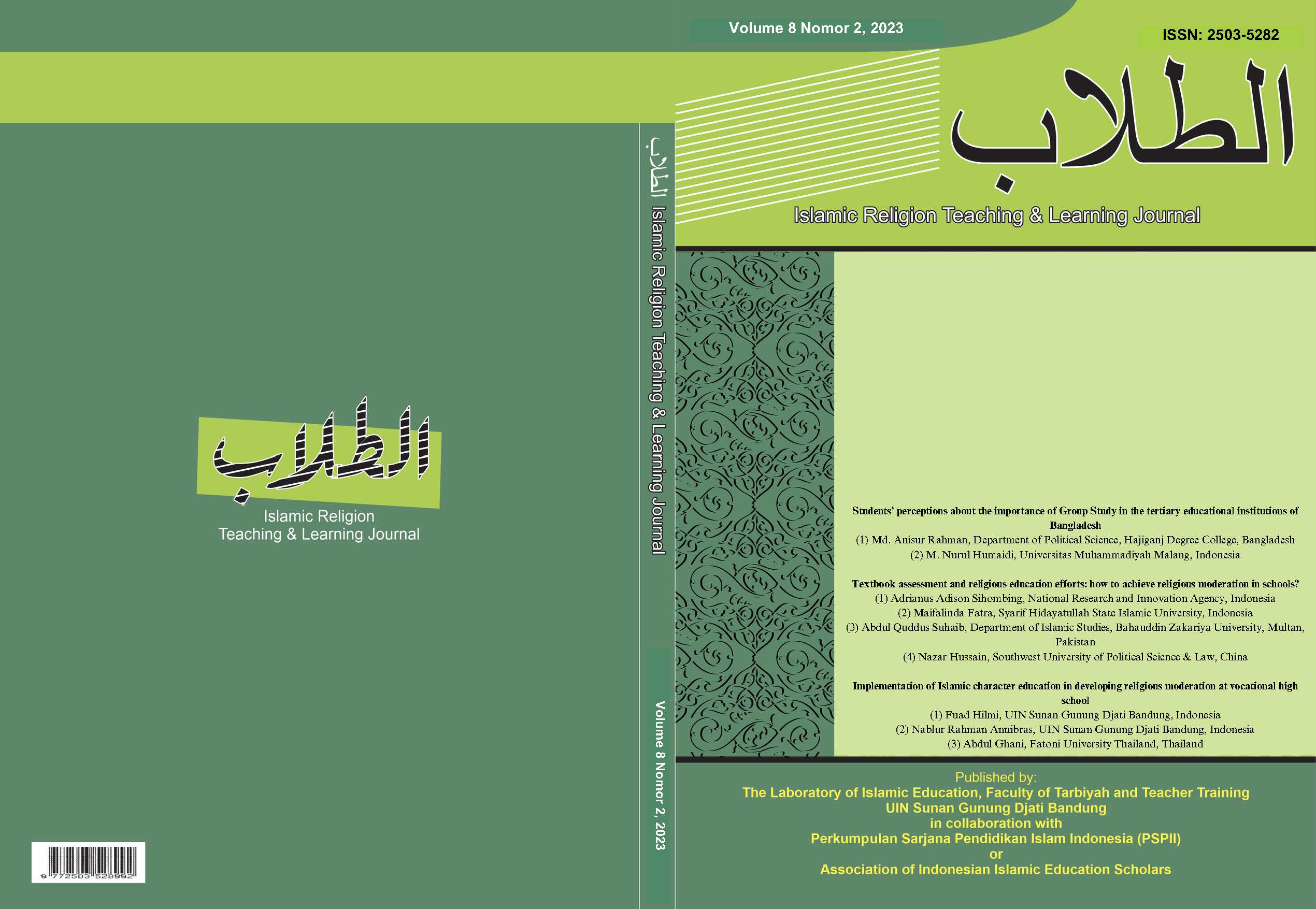
Students’ Perceptions About The Importance of Group Study in The Tertiary Educational Institutions of Bangladesh
DOI:
https://doi.org/10.15575/ath.v8i2.30169Keywords:
Group Study, Student-Centered Learning, Students’ Academic DevelopmentAbstract
This study is grounded in the need to shift from teacher-centered to student-centered learning approaches in tertiary education, particularly in Bangladesh, where collaborative learning remains underutilized. The research aims to examine students’ perceptions of the importance of group study in supporting their academic development. A mixed-method design was employed, involving 80 first-year honors students from an Islamic college affiliated with Bangladesh National University. Data were collected through questionnaires, interviews, observations, and focus group discussions to ensure comprehensive and reliable findings. The results reveal that most students perceive group study positively, as it enhances their understanding, engagement, communication skills, and overall academic performance. However, several challenges were identified, including unequal participation and limited organizational skills among some group members. These findings suggest that structured and well-managed group study can significantly improve student-centered learning practices. The study contributes to the development of collaborative learning strategies in higher education and highlights the importance of institutional support, effective facilitation, and student readiness in optimizing the benefits of group study for academic success.
References
Abidin, M. Z., Wati, R. I., & Darmayanti, R. (2023). Implementasi Amaliyah Ahlussunnah Wal Jama’ah Dalam Mengatasi Perilaku Amoral Sebagai Upaya Pembentukan Akhlak Remaja. Assyfa Journal of Islamic Studies, 1(1), 51–62. Retrieved from https://garuda.kemdiktisaintek.go.id/documents/detail/3858444
Ahmed, M. A., & Kumalasari, N. (2023). ANDIN-MU: Development of Android-Based Descriptive Text Interactive Multimedia Materials in High School English Subjects. Assyfa Learning Journal, 1(1), 49–59. https://doi.org/10.61650/alj.v1i1.17
Andersen, L. L. (2021). Barriers and opportunities for prolonging working life across different occupational groups: The SeniorWorkingLife study. European Journal of Public Health, 30(2), 241–246. https://doi.org/10.1093/EURPUB/CKZ146
Arif, V. R., Afnan, M., Usmiyatun, U., & Lestari, C. Y. (2023). Development of Social Studies Animation Video (S2AV) Teaching Materials on the Material" Plurality of Indonesian Society" for Junior High School Students. Assyfa Learning Journal, 1(1), 1–11. https://doi.org/10.61650/alj.v1i1.2
Astuti, P., Anwar, M. S., Wahyudi, A., & Darmayanti, R. (2023). The Effect of Mathematical Logical Intelligence on Problem Solving Ability in Completion of Story Questions. Al-Ibda: Jurnal Pendidikan Guru Madrasah Ibtidaiyah, 3(2), 63–69. https://doi.org/10.54892/jpgmi.v3i02.357
Beilharz, F. (2021). Development of a positive body image chatbot (KIT) with young people and parents/carers: Qualitative focus group study. Journal of Medical Internet Research, 23(6). https://doi.org/10.2196/27807
Berry, J. W. (2022). Design of the study: Selecting societies of settlement and immigrant groups. Immigrant Youth in Cultural Transition: Acculturation, Identity, and Adaptation Across National Contexts, 15–46. https://doi.org/10.4324/9781003309192-2
Chogani, A. (2020). The effect of chemical functional groups and salt concentration on performance of single-layer graphene membrane in water desalination process: A molecular dynamics simulation study. Journal of Molecular Liquids, 301. https://doi.org/10.1016/j.molliq.2020.112478
Cholil, S. (2022). First Essay Freedom of Religion amid Polarization and Religious Moderation Policy. Interreligious Studies and Intercultural Theology, 6(2), 196–204. https://doi.org/10.1558/isit.24603
Chye, Y. (2020). Subcortical surface morphometry in substance dependence: An ENIGMA addiction working group study. Addiction Biology, 25(6). https://doi.org/10.1111/adb.12830
da Silva Santiago, P. V., Darmayanti, R., & Sugianto, R. (2023). Conquering IMO Problems in Brazil by Recognizing the Didactic Situation, Mathematics Teachers Must Know!. Assyfa Learning Journal, 1(2), 73-88. https://doi.org/10.61650/alj.v1i1.60
Daheri, M. (2023). Strengthening Religious Moderation: Learning from the Harmony of Multireligious People in Indonesia. Journal of Population and Social Studies, 31, 571–586. https://doi.org/10.25133/JPSSv312023.032
Darmayanti, R., Fikri, M., & Rahman, M. A. (2023). Student learning outcomes will "improve" when using counting box media. How significant is the impact of this media?. Assyfa Journal of Islamic Studies, 1(2), 143–154. https://doi.org/10.61650/ajis.v1i2.223
Fang, S. (2020). The efficacy of group-based acceptance and commitment therapy on psychological capital and school engagement: A pilot study among Chinese adolescents. Journal of Contextual Behavioral Science, 16, 134–143. https://doi.org/10.1016/j.jcbs.2020.04.005
Fauzan, F. A., Hasbiyallah, H., & Fikri, M. (2022). The Creativity of Islamic Religious Education Teachers for Effective Learning. Jurnal Inovasi Pendidikan Agama Islam (JIPAI), 2(2), 120–132. https://doi.org/10.15575/jipai.v2i2.18196
Fikri, M., Darmayanti, R., Hussain, N., & Riono, S. H. (2023). How applicable are the KuMo and FiC as teaching tools for mathematics content?. Assyfa Journal of Islamic Studies, 1(2), 199–212. https://doi.org/10.61650/ajis.v1i2.224
Forsyth, D. R. (2021). Recent Advances in the Study of Group Cohesion. Group Dynamics, 25(3), 213–228. https://doi.org/10.1037/gdn0000163
Ge, X. (2020). A virtual adjustment method and experimental study of the support attitude of hydraulic support groups in propulsion state. Measurement: Journal of the International Measurement Confederation, 158. https://doi.org/10.1016/j.measurement.2020.107743
Gutiérrez, J. K. R. (2017). Technical bibliometrics in dynamics of production scientific of the research groups. case study - UPTC, biology. Revista Lasallista de Investigacion, 14(2), 73–82. https://doi.org/10.22507/rli.v14n2a7
Hapriadi, Y. F., & Arifin, B. S. (2023). Self-Regulated Learning and Student Cognitive Learning Achievement in the Subject of Akidah Akhlak. ARBAS: Journal of Educational Innovation, 1(1), 1–14.
Haris, A., & Cahyadi, C. (2021). Teaching Islamic religious education for children with special needs in elementary school. AMCA Journal of Religion and Society 1 (2), 33–41-, 33–41. https://doi.org/10.51773/ajrs.v1i2.84
Hariyadi, A., Jenuri, J., Darmawan, D., Suwarma, D. M., & Pramono, S. A. (2023). Building of the Pancasila Character with Religious Harmony in the Globalization Era. AL-ISHLAH: Jurnal Pendidikan, 15(2), 2126–2133. https://doi.org/10.35445/alishlah.v15i2.3208
Hasanah, N., In’am, A., Darmayanti, R., Choirudin, C., Nurmalitasari, D., & ... (2022). Development of Al-Qur’an Context Math E-Module on Invers Function Materials Using Book Creator Application. AKSIOMA: Jurnal Program Studi Pendidikan Matematika, 11(4), 3502–3513. http://dx.doi.org/10.24127/ajpm.v11i4.5647
Hasanah, N., Syaifuddin, M., & Darmayanti, R. (2022). Analysis of the need for mathematics teaching materials" digital comic based on islamic values" for class X SMA Students in Era 5.0. Numerical: Jurnal Matematika Dan Pendidikan Matematika, 6(2), 231–240. https://doi.org/10.25217/numerical.v6i2.2584
Hidaka, M. (2020). Impact of anatomical resection for hepatocellular carcinoma with microportal invasion (vp1): A multi-institutional study by the kyushu study group of liver surgery. Annals of Surgery, 271(2), 339–346. https://doi.org/10.1097/SLA.0000000000002981
Kantor, V. K. (2019). Merezhkovsky, or actualization of religious and philosophical meanings of european culture. Voprosy Filosofii, 2019(8), 124–133. https://doi.org/10.31857/S004287440006049-8
Karim, S., & Zoker, E. M. (2023). Technology in Mathematics Teaching and Learning: An Impact Evaluation in Selected Senior Schools in Masingbi Town. Assyfa Learning Journal, 1(2), 60–72. https://doi.org/10.61650/alj.v1i2.63
Laila, A. R. N., Cholily, Y. M., Syaifuddin, M., Darmayanti, R., Sugianto, R., & ... (2023). Desain Modul Matematika Bilingual: Urgensi Pengembangan Media Matematika Bilingual dengan konten Islami. Assyfa Journal of Islamic Studies, 1(2). https://doi.org/10.61650/ajis.v2i1.133
Liew, S. L. (2022). The ENIGMA Stroke Recovery Working Group: Big data neuroimaging to study brain–behavior relationships after stroke. Human Brain Mapping, 43(1), 129–148. https://doi.org/10.1002/hbm.25015
Liu, Z. (2021). Study on the influence of new compound reagents on the functional groups and wettability of coal. Fuel, 302. https://doi.org/10.1016/j.fuel.2021.121113
Louisiana, M. (2020). Collaborative Learning Group Investigation Type Based on Lesson Study in MI Al-Ikhsan Kota Jambi. Journal of Physics: Conference Series, 1464(1). https://doi.org/10.1088/1742-6596/1464/1/012038
Manasikana, A., Anwar, M. S., Setiawan, A., Choirudin, C., & Darmayanti, R. (2023). Eksplorasi Etnomatematika Islamic Center Tulang Bawang Barat. Jurnal Perspektif, 7(1), 34–49. https://doi.org/10.15575/jp.v7i1.216
Mubarok, M. Z., Yusuf, M., & Darmayanti, R. (2023). Efforts to improve tajwid learning using the An-Nahdliyah method in Diniyah students. Assyfa Journal of Islamic Studies, 1(1), 99–109. Retrieved from https://garuda.kemdiktisaintek.go.id/documents/detail/3858449
Nasiha, W., Afifah, N., & Amir, A. N. (2023). Design of a Website-Based Arabic Typing Application for Students of Arabic Language Education Program at University. Assyfa Learning Journal, 1(1), 12–24. https://doi.org/10.61650/alj.v1i1.4
Nasrullah, M. (2020). Determinants of forest product group trade by gravity model approach: A case study of China. Forest Policy and Economics, 113. https://doi.org/10.1016/j.forpol.2020.102117
Pradana, M. D., & Uthman, Y. (2023). Development of Aqidah Akhlak Learning Media" Board Game Based on Education Fun on the Theme of Commendable Morals (E-Fun A2M)" for High School Students. Assyfa Learning Journal, 1(1), 25–36. https://doi.org/10.61650/alj.v1i1.9
Rahman, M. A. (2023). Professional Development in an institution through GROW Model. Assyfa Learning Journal, 1(2). https://doi.org/10.61650/alj.v1i2.187
Rauf, A. A. (2023). Maintaining Sacred Identities: How Religious Anti-Consumption Conflicts with Culture. Canadian Journal of Administrative Sciences, 40(2), 140–154. https://doi.org/10.1002/cjas.1697
Ruokonen, I., & Ruismäki, H. (2016). E-Learning in Music: A Case Study of Learning Group Composing in a Blended Learning Environment. Procedia - Social and Behavioral Sciences, 217. https://doi.org/10.1016/j.sbspro.2016.02.039
Sabukunze, I. D. (2023). Teaching French grammar in an informal cooperative study group through Kahoot. International Journal of Learning and Change, 15(5), 483–498. https://doi.org/10.1504/IJLC.2023.133107
Safitri, N. D., In’am, A., Latipun, L., & Mahmood, T. (2022). When did the “google classroom platform” become an issue in Islamic religious education? AMCA Journal of Religion and Society, 2(2). https://doi.org/10.51773/ajrs.v2i2.290
Saqr, M. (2020). What makes an online problem-based group successful? A learning analytics study using social network analysis. BMC Medical Education, 20(1). https://doi.org/10.1186/s12909-020-01997-7
Schabas, A. (2023). Game-Based Science Learning: What are the Problems with Teachers Practicing It in Class? Assyfa Learning Journal, 1(2), 91–105. https://doi.org/10.61650/alj.v1i2.128
Strijker, M. (2020). Establishing and Coordinating a Nationwide Multidisciplinary Study Group: Lessons Learned by the Dutch Pancreatic Cancer Group. Annals of Surgery, 271(4). https://doi.org/10.1097/SLA.0000000000003779
Sugianto, R., Darmayanti, R., Amany, D. A. L., Rachmawati, L. N., Hasanah, S. N., & ... (2017). Experiment on Ability to Understand Three Dimensional Material Concepts Related to Learning Styles Using the Geogebra-Supported STAD Learning Model. Al-Jabar: Jurnal Pendidikan Matematika, 8(2), 205–212. https://doi.org/10.24042/ajpm.v8i2.16430
van Langen, S. K. (2021). Promoting circular economy transition: A study about perceptions and awareness by different stakeholders groups. Journal of Cleaner Production, 316. https://doi.org/10.1016/j.jclepro.2021.128166
Vidyastuti, A. N., Darmayanti, R., & Sugianto, R. (2018). The Role of Teachers and Communication Information Technology (ICT) Media in the Implementation of Mathematics Learning in the Digital Age. Al-Jabar: Jurnal Pendidikan Matematika, 9(2), 221–230. https://doi.org/10.24042/ajpm.v9i2.16412
Widiantari, D., Susanto, P., & Haedari, A. (2022). Re-Interpretation of women’s position in religious texts: A gender humanistic study. AMCA Journal of Religion and Society, 2(1), 26–30. https://doi.org/10.51773/ajrs.v2i1.152
Williams, S. N. (2021). Public attitudes towards COVID-19 contact tracing apps: A UK-based focus group study. Health Expectations, 24(2), 377–385. https://doi.org/10.1111/hex.13179
Winson, V. R. V, Arunkumar, V., & Rao, D. P. (2023). Exploring the Landscape of Teaching and Learning English as a Second Language in India. Assyfa Learning Journal, 1(2). https://doi.org/10.61650/alj.v1i2.123
Xie, W. (2021). A study of group effects in pedestrian crowd evacuation: Experiments, modelling and simulation. Safety Science, 133. https://doi.org/10.1016/j.ssci.2020.105029
Zahroh, U., Maghfiroh, W., Darmayanti, R., & Hidayat, A. (2023). Innovation in mathematics education for high school students using small group discussion as a case study. Assyfa International Scientific Journal, 1(1), 8–14. https://doi.org/10.61650/dpjpm.v2i1.28
Zahroh, U., Rachmawati, N. I., Darmayanti, R., & Tantrianingrum, T. (2023). “ Guidelines” for collaborative learning in 21st century education at Madrasah Tsanawiyah. Assyfa Journal of Islamic Studies, 1(2). https://doi.org/10.61650/ajis.v1i2.239
Downloads
Published
How to Cite
Issue
Section
License
Copyright (c) 2023 Author

This work is licensed under a Creative Commons Attribution-ShareAlike 4.0 International License.
Authors who publish with this journal agree to the following terms:
- Authors retain copyright and grant the journal right of first publication with the work simultaneously licensed under a Creative Commons Attribution-ShareAlike License that allows others to share the work with an acknowledgement of the work's authorship and initial publication in this journal.
- Authors are able to enter into separate, additional contractual arrangements for the non-exclusive distribution of the journal's published version of the work (e.g., post it to an institutional repository or publish it in a book), with an acknowledgement of its initial publication in this journal.
- Authors are permitted and encouraged to post their work online (e.g., in institutional repositories or on their website) prior to and during the submission process, as it can lead to productive exchanges, as well as earlier and greater citation of published work (See The Effect of Open Access).