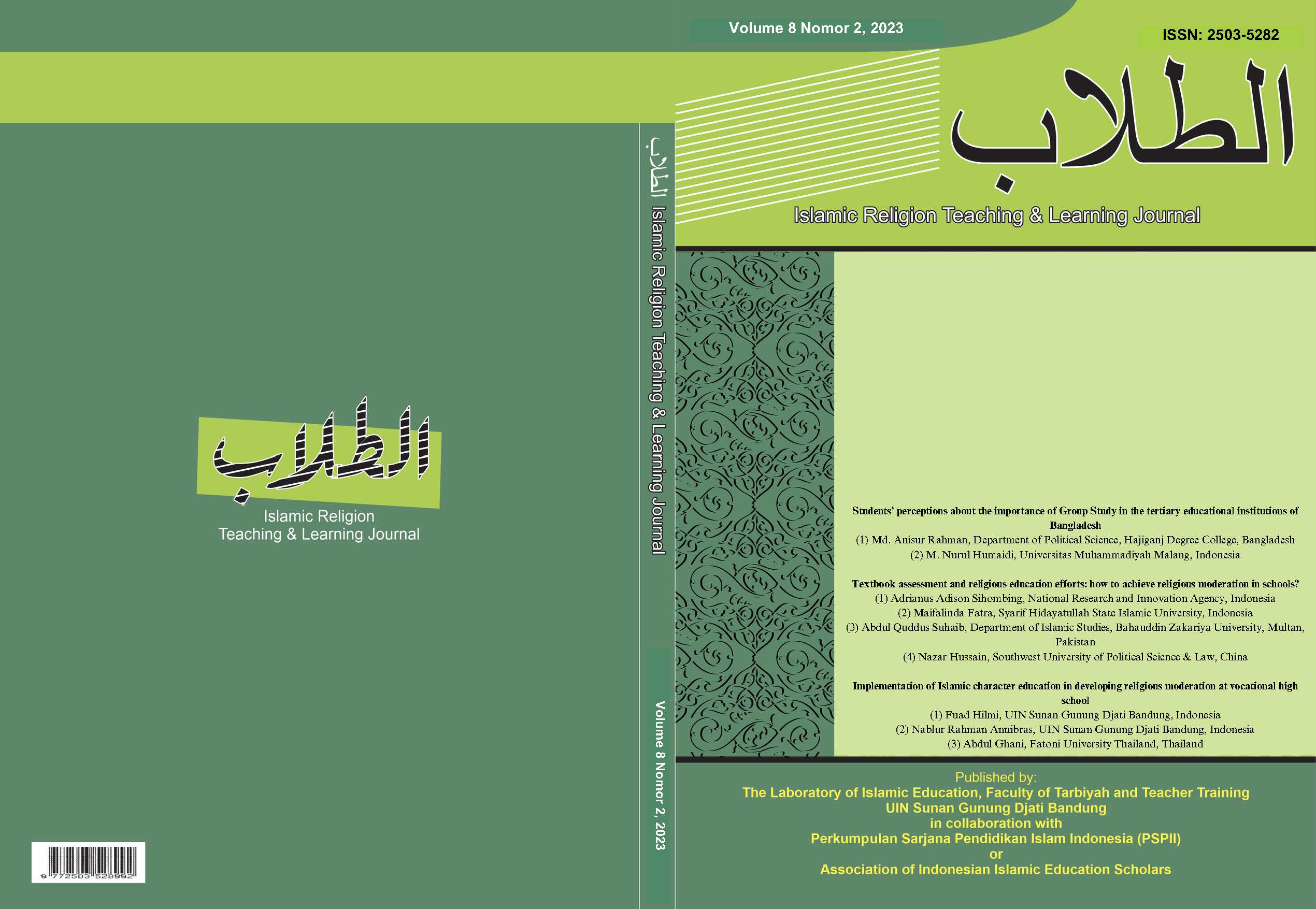
Textbook Assessment and Religious Education Efforts: How to Achieve Religious Moderation in Schools?
DOI:
https://doi.org/10.15575/ath.v8i2.30170Keywords:
Assessment, Education, Moderation, Religious, TextbooksAbstract
This study addresses the growing concern of intolerance and bias in religious education within pluralistic societies, particularly in Indonesia. It aims to examine the role of religious textbook assessment as a strategic effort to promote religious moderation in schools. The research employs a qualitative descriptive-exploratory approach, utilizing document analysis, observations, in-depth interviews, and focus group discussions with experts and assessment teams. The study analyzes 237 religious education textbooks from kindergarten to high school levels across five religions: Islam, Catholicism, Protestantism, Hinduism, and Buddhism. The findings reveal that many textbooks still contain elements of violence, bias, intolerance, and inappropriate content, with overall quality ranging from moderate to low, thus requiring substantial revision in content, presentation, language, and graphics. Textbook assessment emerges as a crucial mechanism to ensure alignment with national values, cultural diversity, and principles of tolerance and inclusivity. Furthermore, the study highlights the lack of clear guidelines and training for authors and publishers as a key challenge. This research contributes to strengthening religious moderation through educational policy and offers a practical framework for improving the quality and inclusivity of religious education materials.
References
Aarnio-Linnanvuori, E. (2013). Environmental issues in Finnish school textbooks on religious education and ethics. Nordidactica: Journal of Humanities and Social Science Education, 1, 131-157. Retrieved from https://journals.lub.lu.se/nordidactica/article/view/1894
Afifah, A., Darmayanti, R., Sugianto, R., & Choirudin, C. (2022). How does Newman analyze student errors when solving BADER story problems? AMCA Journal of Religion and Society, 2(2). https://doi.org/10.51773/ajrs.v2i2.275
Afifah, A., Nurohman, S., & Maryanto, A. (2021). The Development of Interactive Learning Media on Android Platform Assisted By Google Sites. Journal of Science Education Research, 5(2). https://doi.org/10.21831/jser.v5i2.44288
Al-Ghifary, D. F., Rochman, C., & Hasbiyallah. (2023). Profile of the Final Level Evaluation Instrument in Islamic Religious Education Subjects. ARBAS: Journal of Educational …, 1(1), 15–26. Retrieved from http://arbasjournal.com/index.php/ajei/article/view/7%0Ahttps://arbasjournal.com/index.php/ajei/article/download/7/2
Alhumaidan, H. (2018). Co-designing with children a collaborative augmented reality book based on a primary school textbook. International Journal of Child-Computer Interaction, 15, 24–36. https://doi.org/10.1016/j.ijcci.2017.11.005
Andreassen, B. O. (2019). ‘Knowledge about Religions’ and Analytical Skills in Religious Education: Reflections from a Norwegian Context. Center for Educational Policy Studies Journal, 9(4), 73–90. https://doi.org/10.26529/cepsj.676
Araya, B. (2021). Developing a health education comic book: the advantages of learning the behaviours of a target audience. Journal of Visual Communication in Medicine, 44(3), 87–96. https://doi.org/10.1080/17453054.2021.1924639
Ashwal, G. (2018). Are comic books appropriate health education formats to offer adult patients? AMA Journal of Ethics, 20(2), 134–140. https://doi.org/10.1001/journalofethics.2018.20.2.ecas1-1802
Attwood, A. I. (2020). Comic Books and Graphic Novels for the Differentiated Humanities Classroom. Kappa Delta Pi Record, 56(4), 176–182. https://doi.org/10.1080/00228958.2020.1813520
Author, B. (2018). Book Title : George Eliot ’ s Religious Imagination Religion in a Secular World Middlemarch and the Mysticism of the Everyday.
Basil, J. D. (2013). Russian school textbooks on religion: Theological learning, ideological confrontation, or religious education. Journal of Church and State, 55(4), 712-739. https://doi.org/10.1093/jcs/css056
Berendes, K. (2018). Reading demands in secondary school: Does the linguistic complexity of textbooks increase with grade level and the academic orientation of the school track? Journal of Educational Psychology, 110(4), 518–543. https://doi.org/10.1037/edu0000225
Bi, J. (2020). How large a vocabulary do Chinese computer science undergraduates need to read English-medium specialist textbooks? English for Specific Purposes, 58, 77–89. https://doi.org/10.1016/j.esp.2020.01.001
Blinkova, A., & Vermeer, P. (2017). Religious education in Russia : a critical analysis of a widely used textbook. British Journal of Religious Education, 6200(December), 1–14. https://doi.org/10.1080/01416200.2017.1405794
Boostrom, R. (2001). Whither textbooks? Journal of Curriculum Studies, 33(2), 229–245. https://doi.org/10.1080/00220270120459
Buchanan, M. T. (2009). textbooks in religious education. 749–762.
Burchardt, M. (2018). Law and Religious Diversity: How South African Courts Distinguish Religion, Witchcraft and Culture. International Studies in Religion and Society, 32, 272–294. https://doi.org/10.1163/9789004367111_017
Cahyadi, M. R., Maryanto, B. P. A., Syaifuddin, M., & Darmayanti, R. (2023). Development of Essay Test Assessment Rubric for Polya Theory-Based Mathematical Problem-Solving. JNPM (Jurnal Nasional Pendidikan Matematika), 7(1). http://dx.doi.org/10.33603/jnpm.v7i1.7724
Campbell, L. (2017). A diagnosis of religious moderation: Matthew parker and the 1559 settlement. Moderate Voices in the European Reformation, 32–50. https://doi.org/10.4324/9781315248776-3
Chen, J., & Chen, J. (2006). Reforming textbooks , reshaping school knowledge : Taiwan ’ s textbook deregulation in the 1990s Reforming Textbooks , Reshaping School Knowledge : Taiwan ’ s. September 2014, 37–41. https://doi.org/10.1080/14681360200200129
Cheng, K. K. Y., & Beigi, A. B. (2012). Education and religion in Iran: The inclusiveness of EFL (English as a Foreign Language) textbooks. International Journal of Educational Development, 32(2), 310–315. https://doi.org/10.1016/j.ijedudev.2011.05.006
Choirudin, C., Darmayanti, R., Afifah, A., Karim, S., & Sugianto, R. (2021). Mathematics Teacher Vs Media Development, What Are the Learning Problems in MTs. AMCA Journal of Religion and Society, 1(2). https://doi.org/10.51773/ajrs.v1i1.280
Cholil, S. (2022). First Essay Freedom of Religion amid Polarization and Religious Moderation Policy. Interreligious Studies and Intercultural Theology, 6(2), 196–204. https://doi.org/10.1558/isit.24603
Cholily, Y. M., Darmayanti, R., Lovat, T., Choirudin, C., Usmiyatun, U., & ... (2023). Si-GEMAS: Serious Game Mathematical Crossword Puzzle Learning Media for Students Critical Thinking Ability. Al-Jabar: Jurnal Pendidikan Matematika, 14(1), 165–179. https://doi.org/10.24042/ajpm.v14i1.16113
Cuttler, C. (2019). Students’ Use and Perceptions of the Relevance and Quality of Open Textbooks Compared to Traditional Textbooks in Online and Traditional Classroom Environments. Psychology Learning and Teaching, 18(1), 65–83. https://doi.org/10.1177/1475725718811300
Daghigh, A. J. (2021). Neoliberalism in ELT textbooks: an analysis of locally developed and imported textbooks used in Malaysia. Pedagogy, Culture and Society, 29(3), 493–512. https://doi.org/10.1080/14681366.2020.1755888
Daheri, M. (2023). Strengthening Religious Moderation: Learning from the Harmony of Multireligious People in Indonesia. Journal of Population and Social Studies, 31, 571–586. https://doi.org/10.25133/JPSSv312023.032
Darmayanti, R., Effendi, M. M., Hasanah, N., & In’am, A. (2022). Development of Ethnomathematical Media Based on the Book Creator Application on the Syawalan Tradition in the Junior High School Curriculum. AL-ISHLAH: Jurnal Pendidikan, 14(4), 6181–6196. https://doi.org/10.35445/alishlah.v14i4.2416
Darmayenti. (2021). Developing efl religious characters and local wisdom based efl textbook for islamic higher education. Studies in English Language and Education, 8(1), 157–180. https://doi.org/10.24815/siele.v8i1.18263
De Cea, A. V. (2011). A cross-cultural and Buddhist-friendly interpretation of the typology exclusivism-inclusivism-pluralism. Sophia, 50(3), 453–480. https://doi.org/10.1007/s11841-011-0242-8
Dinh, T. N. (2017). Vietnamese cultural conceptualisations in the locally developed english textbook: A case study of ‘lunar new year’/‘tet.’ Asian Englishes, 19(2), 148–159. https://doi.org/10.1080/13488678.2017.1279763
Dutta, A. (2021). CNN-based segmentation of speech balloons and narrative text boxes from comic book page images. International Journal on Document Analysis and Recognition, 24(1), 49–62. https://doi.org/10.1007/s10032-021-00366-4
Eisenstein, M. A., & Clark, A. K. (2013). Portraits of Religion in Introductory American Government Textbooks : Images of Tolerance or Intolerance Portraits of Religion in Introductory American Government Textbooks : Images of Tolerance or Intolerance. Political Science Education, December 2014, 37–41. https://doi.org/10.1080/15512169.2013.747929
Emerson, A. (2018). The making of the (Il)legitimate citizen: The case of the pakistan studies textbook. Global Change, Peace and Security, 30(3), 295–311. https://doi.org/10.1080/14781158.2018.1501011
Engebretson, K. (2007). Writing Church ‐ sponsored Religious Education Textbooks Writing Church-sponsored Religious Education Textbooks. British Journal of Religious Education, 25(1), 33–46. https://doi.org/10.1080/0141620020250104
Fauzan, F. A., Hasbiyallah, H., & Fikri, M. (2022). The Creativity of Islamic Religious Education Teachers for Effective Learning. Jurnal Inovasi Pendidikan Agama Islam (JIPAI), 2(2), 120–132. https://doi.org/10.15575/jipai.v2i2.18196
Franken, L. (2017). Coping with diversity in Religious Education: an overview. Journal of Beliefs and Values, 38(1), 105–120. https://doi.org/10.1080/13617672.2016.1270504
Freathy, R., & Aylward, K. (2010). “Everything is in parables”: An exploration of students’ difficulties in understanding Christian beliefs concerning Jesus. Religious Education, 105(1), 86–102. https://doi.org/10.1080/00344080903472758
Gada, M. Y. (2016). On pluralism , religious ‘ other ’, and the Quran : a post September-11. 6(2), 241–271. https://doi.org/10.18326/ijims.v6i2.241-271
Gill, S., & Niens, U. (2014). Education as humanisation: a theoretical review on the role of dialogic pedagogy in peacebuilding education. Compare, 44(1), 10–31. https://doi.org/10.1080/03057925.2013.859879
González, L. E. Q. (2018). Beyond the textbook. Gamification through ITC as an innovative alternative in Physical Education. Retos, 34, 343–348.
Gracin, D. G. (2018). Requirements in mathematics textbooks: a five-dimensional analysis of textbook exercises and examples. International Journal of Mathematical Education in Science and Technology, 49(7), 1003–1024. https://doi.org/10.1080/0020739X.2018.1431849
Grady, K. O., & Metcalfe, J. (2019). Textbook violence. British Journal of Religious Education, 41(4), 463–464. https://doi.org/10.1080/01416200.2019.1633131
Grissett, J. (2019). An Open versus Traditional Psychology Textbook: Student Performance, Perceptions, and Use. Psychology Learning and Teaching, 18(1), 21–35. https://doi.org/10.1177/1475725718810181
Gunawan, I. I., Darmayanti, R., In’am, A., Vedianty, A. S. A., & Vereshchaha, V. (2023). Clap-Breathe-Count: Using Ice-Breaking Ma-Te-Ma-Ti-Ka to Increase High School Students’ Learning Motivation. Delta-Phi: Jurnal Pendidikan Matematika, 1(1), 51–57. https://doi.org/10.61650/dpjpm.v1i1.216
Haan, I. De, & Lok, M. (2019). The Politics of Moderation in Modern European History. In The Politics of Moderation in Modern European History. https://doi.org/10.1007/978-3-030-27415-3
Hakim, W. (2017). Moderation effect of organizational citizenship behavior on the performance of lecturers. Journal of Organizational Change Management, 30(7), 1136–1148. https://doi.org/10.1108/JOCM-11-2016-0242
Hanafi, Y. (2022). Students’ perspectives on religious moderation: A qualitative study into religious literacy processes. HTS Teologiese Studies / Theological Studies, 78(1). https://doi.org/10.4102/hts.v78i1.7638
Hasanah, N., In’am, A., Darmayanti, R., Choirudin, C., Nurmalitasari, D., & ... (2022). Development of Al-Qur’an Context Math E-Module on Invers Function Materials Using Book Creator Application. AKSIOMA: Jurnal Program Studi Pendidikan Matematika, 11(4), 3502–3513. http://dx.doi.org/10.24127/ajpm.v11i4.5647
Hasim, Moh. (2015). Potensi Radikalisme di Sekolah Studi Terhadap Buku Pendidikan Agama Islam Sekolah Dasar. EDUKASI: Jurnal Penelitian Pendidikan Agama Dan Keagamaan, 13(2), 255–268. https://doi.org/10.32729/edukasi.v13i2.242
Hernawan, W. (2021). Religious moderation in naskah wawacan babad walangsungsang: A sundanese religious diversity wisdom. HTS Teologiese Studies / Theological Studies, 77(4). https://doi.org/10.4102/HTS.V77I4.6773
Höllinger, F. (2021). Religiosity in the major religious cultures of the world. International Journal of Sociology, 51(5), 345–359. https://doi.org/10.1080/00207659.2021.1958181
Ibrahim, H. (2018). The Principle of Wasaṭiyyah (Moderation) and the Social Concept of Islam: Countering Extremism in Religion. AL-ITQAN, 1(November), 39–48. Retrieved from https://journals.iium.edu.my/al-itqan/index.php/al-itqan/article/view/71
Jackson, L. (2015). Religion in Hong Kong education : representation in liberal studies textbooks. 14(1), 43–56.
Jayanti, E. F., Choirudin, Anwar, M. S., & Darmayanti, R. (2023). Application of Mind Mapping Learning Model to Improve Understanding of Mathematics Concepts in Building Space Materials. Delta-Phi: Jurnal Pendidikan Matematika, 1(1), 43–56.
Jenkins, J. J. (2020). Textbook broke: Textbook affordability as a social justice issue. Journal of Interactive Media in Education, 2020(1). https://doi.org/10.5334/jime.549
Karaosmanoglu, E. (2018). Corporate brand transgression and punishing the transgressor: moderation of religious orientation. Journal of Product and Brand Management, 27(2), 221–234. https://doi.org/10.1108/JPBM-01-2017-1388
Kementerian Agama, T. P. (2019). Moderasi Beragama (1st ed.). Kementerian Agama.
Kuhbandner, C. (2019). Do students really prefer repeated rereading over testing when studying textbooks? A reexamination. Memory, 27(7), 952–961. https://doi.org/10.1080/09658211.2019.1610177
Kurniawan, B. D. (2023). Muhammadiyah and Religious Moderation: Response to Actions of Muhammadiyah to Prevent Modern Radicalism (Case Study of Leadership Period 2015 - 2021). Sociologia y Tecnociencia, 13(1), 102–123. https://doi.org/10.24197/st.1.2023.102-126
Latif, D. (2019). Considering religious education in context: politics, reform and debates among Turkish Cypriots. Journal of Beliefs and Values, 40(1), 64–76. https://doi.org/10.1080/13617672.2018.1472998
Lee, B. (2010). Broadening the Boundary of “ Textbooks ” for Intercultural Communication in Religious Education. Religious Education, 105(3), 37–41. https://doi.org/10.1080/00344081003771966
Lipnicka, M. (2021). Religious self-identification and culture—About the role of religiosity in cultural participation. Religions, 12(11). https://doi.org/10.3390/rel12111028
McDonald, C. V. (2017). Representations of Nature of Science in School Science Textbooks: A Global Perspective. Representations of Nature of Science in School Science Textbooks: A Global Perspective, 1–241. https://doi.org/10.4324/9781315650524
Mishra, A. (2016). The role of customer gratitude in relationship marketing: moderation and model validation. Journal of Strategic Marketing, 24(6), 529–549. https://doi.org/10.1080/0965254X.2016.1148762
Moore, A. R. (2021). Understanding heteronormativity in ELT textbooks: A practical taxonomy. ELT Journal, 74(2), 116–125. https://doi.org/10.1093/ELT/CCZ058
Mulyana, R. (2023). Religious moderation in Islamic religious educatiotextbook and implementation in Indonesia. HTS Teologiese Studies / Theological Studies, 79(1). https://doi.org/10.4102/HTS.V79I1.8592
Mutawali. (2023). As The Foundation of Islamic Moderation: Theo-Philosophical Insight against Extreme Religious Ideology. Ulumuna, 27(1), 341–366. https://doi.org/10.20414/ujis.v27i1.560
Nawani, D. (2010). School Textbooks: Understanding Frameworks for Analysis 1. 7(2).
Newton, L. D., & Newton, D. P. (2006). Can explanations in children’s books help teachers foster reason-based understandings in religious education in primary schools? British Journal of Religious Education, 28(3), 225–234. https://doi.org/10.1080/01416200600811311
Nwanaju, I. U. (2016). " Nostra Aetate" and the Effect of Segregation on the Attitude of Children: A Call for a Dynamic Re-Evaluation of Pedagogical Policy in a Pluralist Society. Journal of Education and Practice, 7(10), 163-169. Retrieved from https://eric.ed.gov/?id=EJ1099603
Pajarianto, H. (2022). Tolerance between religions through the role of local wisdom and religious moderation. HTS Teologiese Studies / Theological Studies, 78(4). https://doi.org/10.4102/hts.v78i4.7043
Pajarianto, H. (2023). Youth religious moderation model and tolerance strengthening through intellectual humility. HTS Teologiese Studies / Theological Studies, 79(1). https://doi.org/10.4102/hts.v79i1.8196
PPIM UIN Jakarta. (2018). Ancaman Radikalisme di Sekolah. 1(13), 1–10.
PPIM UIN Jakarta. (2019). Menyalakan Pelita Yang Meredup : Memperkuat Moderasi dan Toleransi Guru di Sekolah. Policy Brief, 2(2).
Putra, F. G., Sari, A. P., Qurotunnisa , A., Rukmana , A., Darmayanti, R., & Choirudin, C. (2023). What are the advantages of using leftover cooking oil waste as an aromatherapy candle to prevent pollution?. Jurnal Inovasi Dan Pengembangan Hasil Pengabdian Masyarakat, 1(2), 59–63. https://doi.org/10.61650/jip-dimas.v1i2.230
Rahim, H. A. (2020). Locally-developed vs. Global Textbooks: An Evaluation of Cultural Content in Textbooks Used in ELT in Malaysia. Asian Englishes, 22(3), 317–331. https://doi.org/10.1080/13488678.2019.1669301
Rahmah, K., Inganah, S., Darmayanti, R., Sugianto, R., & Ningsih, E. F. (2022). Analysis of Mathematics Problem Solving Ability of Junior High School Students Based on APOS Theory Viewed from the Type of Kolb Learning Style. INdoMATH: Indonesia Mathematics Education, 5(2), 109–122. http://dx.doi.org/10.30738/indomath.v5i2.25
Rahman, Y. (2022). Critical Thinking and Religious Moderation Instilling Religiously Moderate Values through the Teaching of Islamic Philosophy in Indonesia. Journal of Indonesian Islam, 16(1), 49–74. https://doi.org/10.15642/JIIS.2022.16.1.49-74
Rahmiwati, S. (2018). The Implementation of Integrated Natural Science Textbook of Junior High School be Charged on Character-based Shared Models to Improve the Competence of Learners’ Knowledge. IOP Conference Series: Materials Science and Engineering, 335(1). https://doi.org/10.1088/1757-899X/335/1/012076
Rasero, L. S., & Bochaca, J. G. (2011). Muslims in Catalonian textbooks. Journal of Educational Media, Memory, and Society, 3(1), 81–96. https://doi.org/10.3167/jemms.2011.030106
Ridho’i, A. V, Darmayanti, R., Afifah, A., & Nurmaltasari, D. (2023). Pizzaluv-Math: Analysis of Learning Media Needs to Make It Easy for Students to Learn the Limits of Trigonometric Functions. Delta-Phi: Jurnal Pendidikan Matematika, 1(3). https://doi.org/10.61650/dpjpm.v1i3.201
Rigaud, C. (2018). Segmentation-Free Speech Text Recognition for Comic Books. Proceedings of the International Conference on Document Analysis and Recognition, ICDAR, 3, 29–34. https://doi.org/10.1109/ICDAR.2017.288
Risager, K. (2020). Language textbooks: windows to the world. Language, Culture and Curriculum, 1–14. https://doi.org/10.1080/07908318.2020.1797767
Rismawati, S. D. (2021). The Legal Politics of Religious Moderation in Indonesia: Responsive or Repressive? Journal of Legal, Ethical and Regulatory Issues, 24(4), 1–8. Retrieved from https://www.abacademies.org/articles/the-legal-politics-of-religious-moderation-in-indonesia-responsive-or-repressive-10805.html
Ropi, I. (2019). Whither religious moderation? The state and management of religious affairs in contemporary Indonesia. Studia Islamika, 26(3), 597–601. https://doi.org/10.36712/sdi.v26i3.14055
Saber, M. D. (2022). ‘Islamic Culture’ textbook content and religious needs of literacy students. HTS Teologiese Studies / Theological Studies, 78(1). https://doi.org/10.4102/hts.v78i1.7994
Satoko, F. (2019). Buddhism in RE Textbooks in England : Before Shap and After the Call for Community Cohesion. Religion & Education, 46(2), 234–252. https://doi.org/10.1080/15507394.2018.1469906
Schwedler, J. (2013). Islamists in Power? Inclusion, Moderation, and the Arab Uprisings. Middle East Development Journal, 5(1), 37–41. https://doi.org/10.1142/S1793812013500065
Sekaryanti, R., Darmayanti, R., Choirudin, C., Usmiyatun, U., Kestoro, E., & ... (2022). Analysis of Mathematics Problem-Solving Ability of Junior High School Students in Emotional Intelligence. Jurnal Gantang, 7(2), 149–161. https://doi.org/10.31629/jg.v7i2.4944
Setiawan, K. (2018). sembilan-kasus-buku-teks-pendidikan-keagamaan. NU Online. Retrieved from https://www.nu.or.id/balitbang-kemenag/sembilan-kasus-buku-teks-pendidikan-keagamaan-BH8pi
Setyono, B. (2018). The Portrayal of Women in Nationally-Endorsed English as a Foreign Language (EFL) Textbooks for Senior High School Students in Indonesia. Sexuality and Culture, 22(4), 1077–1093. https://doi.org/10.1007/s12119-018-9526-2
Shnirelman, V. (2017). Religious culture or invitation to religion: What are the new textbooks about? Gosudarstvo, Religiia, Tserkov’ v Rossii i Za Rubezhom/State, Religion and Church in Russia and Worldwide, 35(4), 89–118. https://doi.org/10.22394/2073-7203-2017-35-4-89-118
Sihombing, A. A. (2020). Nostra aetate and space for religious moderation: Interfaith dialogue in multicultural Indonesia. Journal for the Study of Religions and Ideologies, 19(55), 142–157. Retrieved from https://thenewjsri.ro/index.php/njsri/index
Simon, J. (2019). Proposed new pulmonary hypertension definition: Is 4 mm(Hg) worth re-writing medical textbooks? European Respiratory Journal, 53(3). https://doi.org/10.1183/13993003.00197-2019
Somer, M. (2014). Moderation of religious and secular politics, a country’s “centre” and democratization. Democratization, 21(2), 244–267. https://doi.org/10.1080/13510347.2012.732069
Stausberg, M., & Engler, S. (2013). Textbooks in the study of religion s : introducing a new feature series. 1151. https://doi.org/10.1080/0048721X.2013.781882
Subchi, I. (2022). Religious Moderation in Indonesian Muslims. Religions, 13(5). https://doi.org/10.3390/rel13050451
Suciati, R. (2022). Development of Textbook Integrated of Metacognition, Critical Thinking, Islamic Values, and Character. Pegem Egitim ve Ogretim Dergisi, 12(4), 20–28. https://doi.org/10.47750/pegegog.12.04.03
Sugianto, R., Cholily, Y. M., Darmayanti, R., Rahmah, K., & Hasanah, N. (2022). Development of Rainbow Mathematics Card in TGT Learning For Increasing Mathematics Communication Ability. Kreano, Jurnal Matematika Kreatif-Inovatif, 13(2), 221–233. https://doi.org/10.15294/kreano.v13i2.38068
Sugianto, R., Darmayanti, R., da Silva Santiago, P. V, & Choirudin, C. (2023). MONICA Math: Design of Mathematical Monopoly Media Development on High School Student’s Critical Thinking Ability. AMCA Journal of Science and Technology, 3(1). https://doi.org/10.51773/ajst.v3i1
Suharsiwi, NI Rachmawati, SH Dehham, & R Darmayanti. (2023). “DINO Vs. DINI” educational game to increase children’s cognitive abilities—what are its level elements? Delta-Phi: Jurnal Pendidikan Matematika, 1(2). Retrieved from https://www.journal.assyfa.com/index.php/dpjpm/article/view/244
Sumarni, S., Ramadhani, R., Sazaki, Y., Astika, R. T., Andika, W. D., & Prasetiyo, A. E. (2019). Development of “child friendly ICT” textbooks to improve professional competence of teacher candidates: A case study of early childhood education program students. Journal for the Education of Gifted Young Scientists, 7(3). https://doi.org/10.17478/jegys.596095
Taylor, C. (2019). DROP TABLE textbooks: An argument for SQL injection coverage in database textbooks. SIGCSE 2019 - Proceedings of the 50th ACM Technical Symposium on Computer Science Education, 191–197. https://doi.org/10.1145/3287324.3287429
Ushama, T. (2014). Is islam a religion of moderation or extremism? a study of key islamic teachings. Asian Social Science, 10(8), 184–197. https://doi.org/10.5539/ass.v10n8p184
Vanner, C., Kovinthan, T., & Spogmai, L. (2019). South Sudanese primary school textbooks : Transforming and reinforcing conflict. PROSPECTS, 0123456789. https://doi.org/10.1007/s11125-019-09452-2
Vestøl, J. M. (2014). British Journal of Religious Education Text interpretation and educational design in Norwegian textbooks of religious education. British Journal of Religious Education, 36(1), 88–101. https://doi.org/10.1080/01416200.2013.856286
Vestøl, J. M. (2016). Textbook Religion and Lived Religion : A Comparison of the Christian Faith as Expressed in Textbooks and by Young Church Members. 4087(March). https://doi.org/10.1080/00344087.2016.1124015
Vorotnykova, I. (2019). Organizational, psychological and pedagogical conditions for the use of e-books and e-textbooks at school. Turkish Online Journal of Distance Education, 20(3). https://doi.org/10.17718/tojde.598227
Weinryb, B. D. (2006). Religious Education : The official journal of the Religious Education Association I . Intergroup Content in Jewish Religious Textbooks. The Official Journal of the Religious Education Association, 55(2), 37–41. https://doi.org/10.1080/0034408600550208
Yaakub, M. B., & Othman, K. (2016). A Textual Analysis aor The Term ‘Wasatiyyah’ (Islamic Moderation) In Selected Quranic Verses And Prophetic Tradition. Education and Social Sciences, 5, 61–68. Retrieved from https://jesoc.com/wp-content/uploads/2016/11/JESOC5_29.pdf
Zahroh, U., Maghfiroh, W., Darmayanti, R., & Hidayat, A. (2023). Innovation in mathematics education for high school students using small group discussion as a case study. Assyfa International Scientific Journal, 1(1), 8–14. Retrieved from https://journal.assyfa.com/index.php/dpjpm/article/view/28
Downloads
Published
How to Cite
Issue
Section
License
Copyright (c) 2023 Author

This work is licensed under a Creative Commons Attribution-ShareAlike 4.0 International License.
Authors who publish with this journal agree to the following terms:
- Authors retain copyright and grant the journal right of first publication with the work simultaneously licensed under a Creative Commons Attribution-ShareAlike License that allows others to share the work with an acknowledgement of the work's authorship and initial publication in this journal.
- Authors are able to enter into separate, additional contractual arrangements for the non-exclusive distribution of the journal's published version of the work (e.g., post it to an institutional repository or publish it in a book), with an acknowledgement of its initial publication in this journal.
- Authors are permitted and encouraged to post their work online (e.g., in institutional repositories or on their website) prior to and during the submission process, as it can lead to productive exchanges, as well as earlier and greater citation of published work (See The Effect of Open Access).