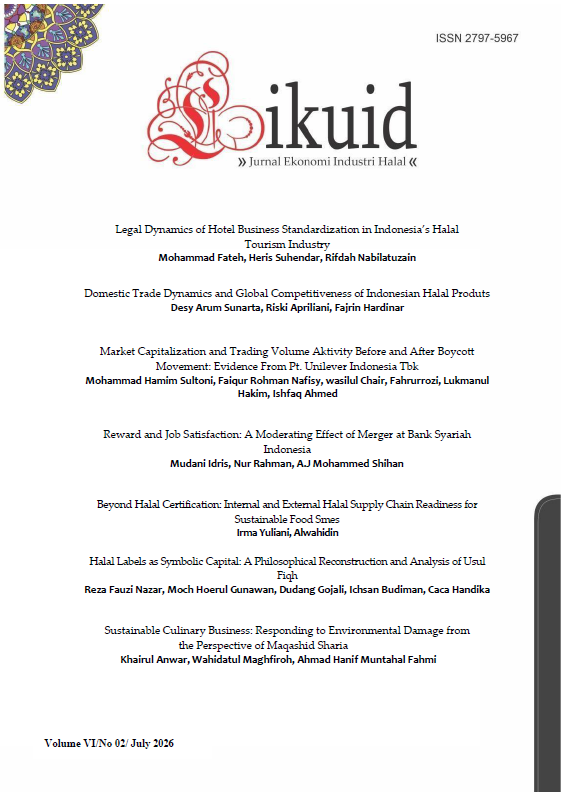
Beyond Halal Certification: Internal and External Halal Supply Chain Readiness for Sustainable Food Smes
DOI:
https://doi.org/10.15575/likuid.v6i2.57948Abstract
Indonesia’s Free Halal Certification Program/Program Sertifikasi Halal Gratis (SEHATI) has significantly accelerated halal certification among food and beverage small and medium enterprises (SMEs). However, limited attention has been given to whether certification is accompanied by adequate halal supply chain readiness to sustain business performance. This study examines the internal and external halal supply chain readiness of halal-certified food and beverage SMEs following participation in the SEHATI Program. A qualitative multiple-case study was conducted involving three halal-certified SMEs in Yogyakarta. Data were collected through in-depth interviews, observation, and document analysis, and were analyzed using cross-case analysis. The findings indicate that halal certification enhances internal halal supply chain readiness by strengthening compliance with halal production requirements, including raw material selection, production processes, and the Halal Product Assurance System. However, these improvements do not automatically ensure a sustainable halal supply chain because upstream integration remains constrained by the limited availability of halal-certified raw materials. Halal certification also improves external halal supply chain readiness by increasing product visibility through digital marketing channels and strengthening consumer trust. Nevertheless, the absence of integrated digital halal governance, particularly halal verification and traceability mechanisms on digital platforms, limits the effectiveness of these benefits. These findings demonstrate that the sustainability of halal SMEs depends not only on certification itself but also on the integration of internal operational readiness and external ecosystem readiness. This study extends the Halal Supply Chain Management literature by introducing an integrated internal - external halal supply chain readiness framework and offers policy recommendations to strengthen Indonesia’s post-certification halal ecosystem.
Downloads
Published
Issue
Section
Citation Check
License
Copyright (c) 2026 Irma Yuliani Yuliani, Alwahidin Alwahidin

This work is licensed under a Creative Commons Attribution-NonCommercial-ShareAlike 4.0 International License.