
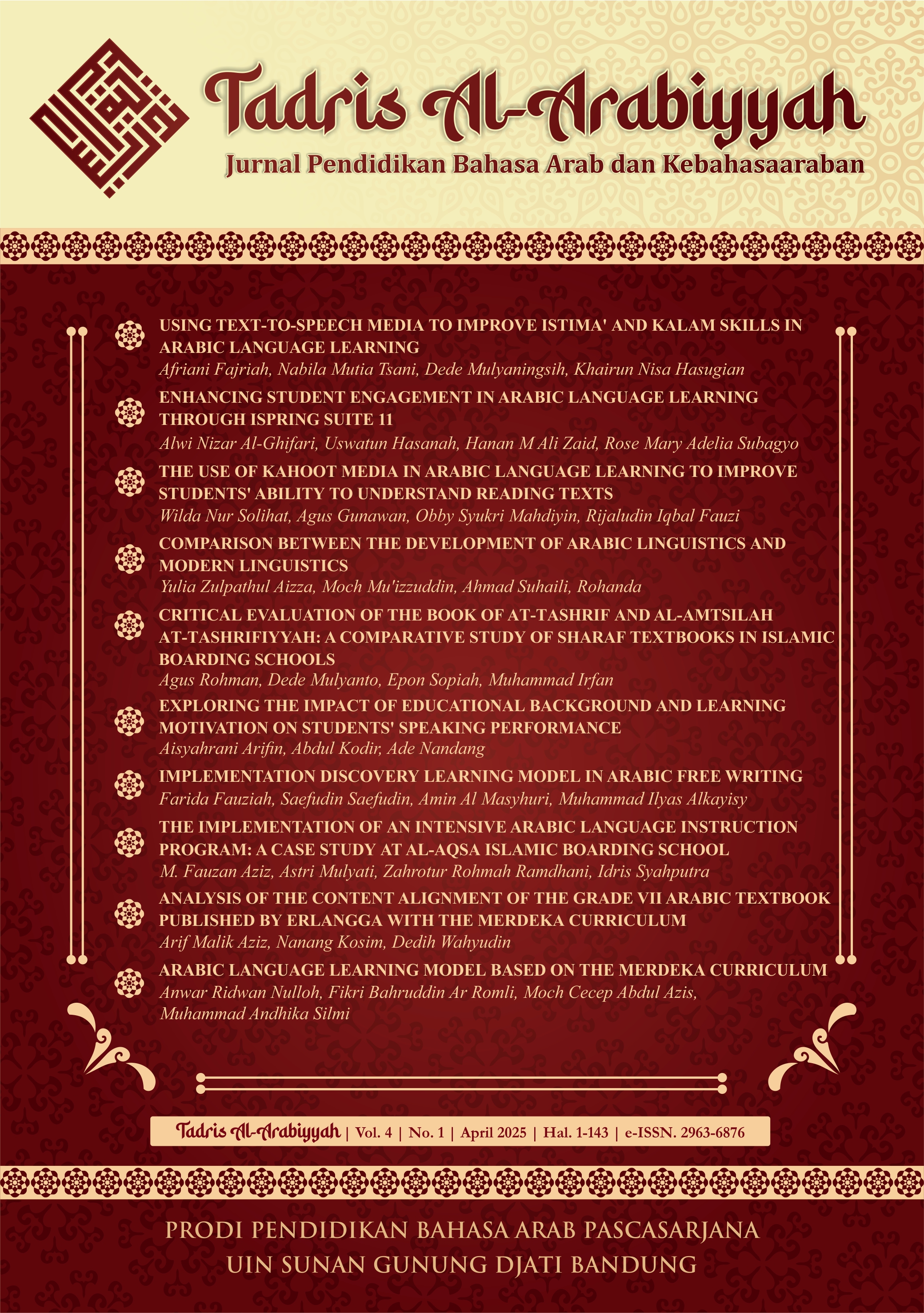
Comparison Between the Development of Arabic Linguistics and Modern Linguistics
DOI:
https://doi.org/10.15575/ta.v4i1.44830Keywords:
Arabic Linguistics, Modern Linguistics, Morphology, Phonology, Semantics, SyntaxAbstract
Arabic linguistics is a branch of science that focuses on the study of Arabic from various fields, namely phonology, morphology, syntax, and semantics. Since classical times, Muslim scholars have developed linguistic theories that have contributed greatly to understanding the structure of the Arabic language. In its further development, Arabic linguistics began to interact with modern linguistic approaches, which offer more systematic and comprehensive analysis methods. Modern linguistics, which includes various branches such as structuralism, sociolinguistics, psycholinguistics, and discourse analysis, provides a new perspective in understanding Arabic, both in theoretical and applied aspects. The influence of this modern approach not only enriches the study of Arabic linguistics, but also supports the development of language technology, translation, and Arabic language learning for foreign speakers. This article aims to examine the development of Arabic linguistics from traditional to modern perspectives and to explore the scope of modern linguistics that has an impact on Arabic language studies in the contemporary era. Through a descriptive and analytical approach, this article identifies the role of modern linguistics in expanding the scope of Arabic language studies, resulting in a deeper understanding of the structure and function of the language in various contexts.
References
Ahmad, M. I., & Anwari, Moh. K. (2024). Computational Linguistics and Natural Language Processing Techniques for Semantic Field Extraction in Arabic Online News. Studies in English Language and Education, 11(3), 1685–1709. https://doi.org/10.24815/siele.v11i3.38090
Ahyar, J., Ibrahim, M. Y., & Muzir, M. (2023). Semantic and Pragmatic Linguistic Aspects in Translation. Jurnal Indonesia Sosial Sains, 4(07), 595–600. https://doi.org/10.59141/jiss.v4i07.841
Alkiyumi, M. (2023). The Creative Linguistic Achievements of Alkhalil bin Ahmed Al-Farahidi, and Motives Behind his Creations: A Case Study. Cogent Arts & Humanities, 10(1), 2196842. https://doi.org/10.1080/23311983.2023.2196842
Al-Sharkawi, M. (2016). History and Development of the Arabic Language. Routledge.
Ardiansyah, A. A., Musthafa, I., & Hermawan, A. (2023). Analysis of The Dialogical Narration in The Story of Prophet Yusuf in The Quran. Ta’lim al-’Arabiyyah: Jurnal Pendidikan Bahasa Arab & Kebahasaaraban, 7(2), 278–298. https://doi.org/10.15575/jpba.v7i2.25684
Aziz, A., & Dinata, Y. M. (2019). Bahasa Arab Modern dan Kontemporer; Kontinuitas dan Perubahan. Mumtaz: Jurnal Studi Al-Qur’an Dan Keislaman, 3(2), 152–168. https://doi.org/10.36671/mumtaz.v3i2.38
Badrun, M., Nasution, A., Amroin, H. Y., Azmi, A. N., Mustika, J. A., Maghfiroh, U., & Multazamia, S. (2023). The Significance of the Quranic Language as a Fundamental Concept of Semantics: An Analysis of Toshihiko Izutsu’s Thought. QURANICA-International Journal of Quranic Research, 15(1), 1-21. Retrieved from https://sare.um.edu.my/index.php/quranica/article/view/44859.
Dika, P., Rohanda, R., Fauziah, I., & Halim, M. A. (2023). Persamaan Bahasa Minang dan Kerinci dari Segi Fonetik. Innovative: Journal Of Social Science Research, 3(6), 8270-8281. Retrieved from https://j-innovative.org/index.php/Innovative/article/view/6938.
Effendi, S. S., Harahap, A. I., & Mulyadi, M. (2024). Struktur Semantis Verba “Menciptakan” Bahasa Arab: Kajian Metabahasa Semantik Alami. Al Mi’yar: Jurnal Ilmiah Pembelajaran Bahasa Arab Dan Kebahasaaraban, 7(1), 141–156. https://doi.org/10.35931/am.v7i1.3175
Farid, E. K. F. (2020). Sintaksis Bahasa Indonesia Dan Bahasa Arab:(Studi Analisis Kontrastif Frasa, Klausa dan Kalimat). BAHTSUNA: Jurnal Penelitian Pendidikan Islam, 2(1), 139–156. https://doi.org/10.55210/bahtsuna.v2i1.70
Febriani, S. R., & Anasruddin, A. (2020). Technology For Four Skills Arabic In The Era Emergency Of Covid-19 In Indonesia. Ta’lim al-’Arabiyyah: Jurnal Pendidikan Bahasa Arab & Kebahasaaraban, 4(1), 1–11. https://doi.org/10.15575/jpba.v4i1.8221
Fowler, R. (2022). Understanding language: An introduction to linguistics. Routledge.
Habib, R. (2025). Decolonizing Arabic Sociolinguistics: A Path Toward New Linguistic Inquiries. Journal of Arabic Sociolinguistics, 3(1), 24–42. https://doi.org/10.3366/arabic.2025.0039
Harris, R. (2019). Saussure and his Interpreters. Edinburgh University Press.
Hizbullah, N., Arifa, Z., Suryadarma, Y., Hidayat, F., Muhyiddin, L., & Firmansyah, E. K. (2020). Source-Based Arabic Language Learning: A Corpus Linguistic Approach. Humanities & Social Sciences Reviews, 8(3), 940–954. https://doi.org/10.18510/hssr.2020.8398
Holes, C. (2018). Modern Arabic: Structures, Functions, and varieties. Georgetown University Press.
Kosim, A. (2020). Penerapan Linguistik Arab Dalam Memahami Bahasa Al-Qur’an. Kalamuna: Jurnal Pendidikan Bahasa Arab Dan Kebahasaaraban, 1(1), 19–35. https://doi.org/10.52593/klm.01.1.02
Li, Z. Z., Arcodia, C., Yang, E. C. L., & Le, T. H. (2024). Children’s Learning Processes in Family Travel: A Narrative Review Through a Social Cognitive Lens. Tourism Management Perspectives, 54, 101320. https://doi.org/10.1016/j.tmp.2024.101320
Luthfan, M. A., & Hadi, S. (2019). Morfologi Bahasa Arab: Reformulasi Sistem Derivasi dan Infleksi. Alsina: Journal of Arabic Studies, 1(1), 1–22. https://doi.org/10.21580/alsina.1.1.2599
Musthafa, I., & Hermawan, A. (2018). Metodologi Penelitian Bahasa Arab: Konsep Dasar Strategi Metode Teknik. Remaja Rosdakarya.
Nandang S, A., & Kosim, A. (2018). Pengantar Linguistik Arab. PT. Remaja RosdaKarya.
Nazir, F., Majeed, M. N., Ghazanfar, M. A., & Maqsood, M. (2019). Mispronunciation Detection Using Deep Convolutional Neural Network Features and Transfer Learning-Based Model for Arabic Phonemes. IEEE Access, 7(1), 52589–52608. https://doi.org/10.1109/ACCESS.2019.2912648
Peniro, R., & Cyntas, J. (2019). Applied Linguistics Theory and Application. Linguistics and Culture Review, 3(1), 1–13. https://doi.org/10.21744/lingcure.v3n1.7
Pountain, C. J. (2019). Modern Languages as an Academic Discipline: The Linguistic Component. Language, Culture and Curriculum, 32(3), 244–260. https://doi.org/10.1080/07908318.2019.1661153
Pratama, B., Kadar, H., Husaini, B., Aziz, M. A., & Saputra, D. A. (2024). Modern vs Traditional: Comparative Study of Efficacious Arabic Language Learning Methods. Jurnal Al Bayan: Jurnal Jurusan Pendidikan Bahasa Arab, 16(1), 239–257. https://doi.org/10.24042/albayan.v16i1.22812
Ridder, H.-G. (2014). Book Review: Qualitative Data Analysis. A Methods Sourcebook. Sage publications Sage UK: London, England.
Rini, R. (2019). Ushul al-Nahwi al-Arabi: Kajian Tentang Landasan Ilmu Nahwu. Arabiyatuna: Jurnal Bahasa Arab, 3(1), 145–162. http://dx.doi.org/10.29240/jba.v3i1.773
Ruhmadi, A., & Al Farisi, M. Z. (2023). Analisis Kesalahan Morfologi Penerjemahan Arab–Indonesia pada ChatGPT. Aphorisme: Journal of Arabic Language, Literature, and Education, 4(1), 55–75. https://doi.org/10.37680/aphorisme.v4i1.3148
Salim, L. (2017). Sejarah Pertumbuhan dan Perkembangan Bahasa Arab. Diwan : Jurnal Bahasa Dan Sastra Arab, 3(1), 77–90. https://doi.org/10.24252/diwan.v3i1.2928
Stanley, M. (2023). Qualitative Descriptive: A Very Good Place to Start (pp. 52–67). Routledge.
Syafei, I., Ardiansyah, A. A., & Nafsi, Z. (2020). Analisis Kontrastif Proses Afiksasi Pada Verba dalam Bahasa Arab dan Bahasa Minangkabau. Metalingua: Jurnal Penelitian Bahasa, 18(2), 225–237. Retrieved from https://metalingua.kemdikbud.go.id/jurnal/index.php/metalingua/article/view/480
Downloads
Published
How to Cite
Issue
Section
Citation Check
License
Copyright (c) 2025 Yulia Zulpathul Aizza, Moch Mu'izzuddin, Ahmad Suhaili, Rohanda Rohanda

This work is licensed under a Creative Commons Attribution-ShareAlike 4.0 International License.