
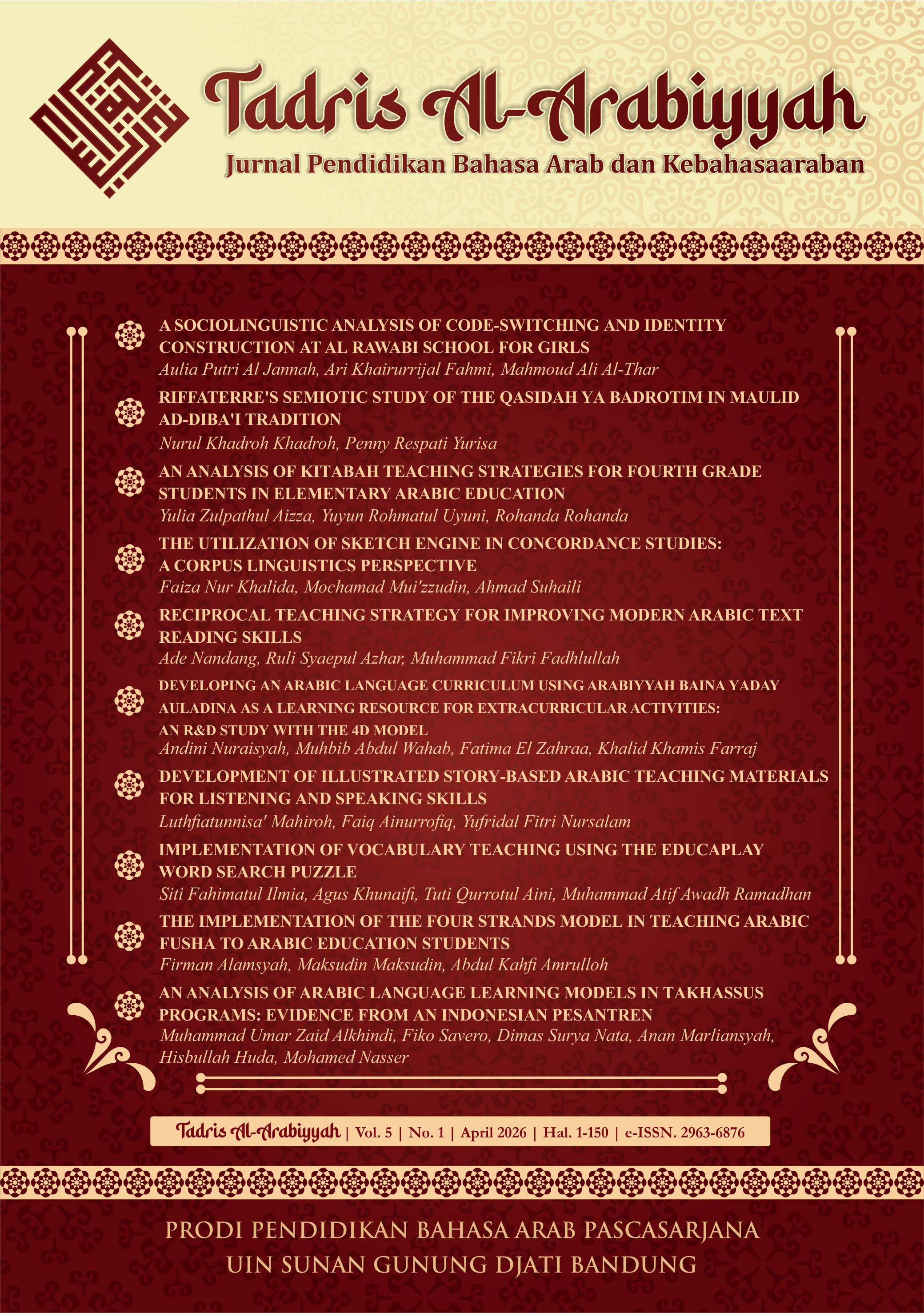
An Analysis of Kitābah Teaching Strategies for Fourth Grade Students in Elementary Arabic Education
DOI:
https://doi.org/10.15575/ta.v5i1.44839Keywords:
Arabic Language, Kitābah Learning, Learning Strategies, Writing SkillsAbstract
Kitābah (Arabic writing) instruction plays a crucial role in developing students' productive language skills; however, its implementation at the elementary level remains constrained by limited instructional strategies and low student proficiency. Previous studies have mainly focused on learning media, online instruction, or error analysis, leaving a gap in context-based kitābah strategies in primary education. This study aims to analyze the implementation of kitābah learning strategies and their contribution to improving students' writing skills. Using a descriptive qualitative approach, the study involved an Arabic teacher and fourth-grade students at SD Bani Daud Al-Islami Petir. Data were collected through observations, interviews, and documentation, and analyzed using an interactive model. The findings indicate that effective kitābah instruction involves integrating communicative approaches, guided practice, visual media, and linking writing with reading (qirā’ah) and speaking (muḥādathah). These strategies enhance student engagement, support grammatical understanding, and improve sentence construction. Additionally, structured learning stages and the use of student worksheets (LKPD) contribute to consistent skill development. This study highlights the importance of student-centered, structured instructional design for improving Arabic writing skills. Future studies are recommended to examine these strategies using quantitative or mixed-method approaches.
References
Aatif, M. (2022). Attitude and Motivation of Arab Learners Learning Chinese Language in China. International Journal of Chinese Education, 11(1), 2212585X221089103. https://doi.org/10.1177/2212585X221089103
Aditya, V., Zulhannan, Z., Ghazi, F., Koderi, K., & Kusuma, G. C. (2025). ChatGPT as an Interactive Dictionary for Mahārah Kitābah Learning: A Literature Review. Tadris Al-’Arabiyyah: Jurnal Pendidikan Bahasa Arab Dan Kebahasaaraban, 4(2), 157–172. https://doi.org/10.15575/ta.v4i2.45609
Anggaraini, M., Distrik, I. W., & Abdurrahman, A. (2025). Pengembangan e-LKPD Berbasis Problem Based Learning Berbantuan Aplikasi Thunkable untuk Meningkatkan Keterampilan Berpikir Kritis Peserta Didik. Unnes Physics Education Journal, 14(2), 157–168. https://doi.org/10.15294/upej.v14i2.24764
Anggraeni, C. W., Mujiyanto, J., Rustipa, K., & Widhiyanto, W. (2025). Effects of Utilizing Self-Regulated Learning-Based Instruction on EFL Students' Academic Writing Skills: A Mixed-Method Investigation. Asian-Pacific Journal of Second and Foreign Language Education, 10(1), 15. https://doi.org/10.1186/s40862-024-00317-6
Annisa, A., Arifina, D. F., Al-Ghozi, H. G., Jabat, Y. J., & Nasution, S. (2024). Penggunaan Metode Insya’Muwajjah Sebagai Proses Pembelajaran Kitabah. Al-Tarbiyah: Jurnal Ilmu Pendidikan Islam, 2(2), 180–189. https://doi.org/10.59059/al-tarbiyah.v2i2.928
Ardiansyah, A. A. (2020). Trial Use of Inquiry Methods in Learning to Write Arabic in Junior High School Santi Asromo Majalengka. Alsuna: Journal of Arabic and English Language, 3(1), 56–65. https://doi.org/10.31538/alsuna.v3i1.706
Auliya, A. N., & Smith, H. (2024). Implementation of Talking Stick Media to Improve Arabic Vocabulary Mastery and Speaking Skills. Tadris Al-’Arabiyyah: Jurnal Pendidikan Bahasa Arab Dan Kebahasaaraban, 3(2), 194–204. https://doi.org/10.15575/ta.v3i2.39367
Barrot, J. S. (2023). Using ChatGPT for Second Language Writing: Pitfalls and Potentials. Assessing Writing, 57, 100745. https://doi.org/10.1016/j.asw.2023.100745
Bowen, G. A. (2009). Document Analysis as a Qualitative Research Method. Qualitative Research Journal, 9(2), 27–40. https://doi.org/10.3316/QRJ0902027
Chen, C. (2021). Using Scaffolding Materials to Facilitate Autonomous Online Chinese as a Foreign Language Learning: A Study During the COVID-19 Pandemic. Sage Open, 11(3), 21582440211040131. https://doi.org/10.1177/21582440211040131
Creswell, J. W., & Poth, C. N. (2018). Qualitative Inquiry and Research Design. Sage publications.
Dado, M., Spence, J. R., & Elliot, J. (2023). The Case of Contradictions: How Prolonged Engagement, Reflexive Journaling, and Observations Can Contradict Qualitative Methods. International Journal of Qualitative Methods, 22, 16094069231189372. https://doi.org/10.1177/16094069231189372
Dvorianchykova, S., Bondarchuk, J., Syniavska, O., & Kugai, K. (2022). Development of Intercultural Communicative Competence in the Process of Teaching English to Future Interpreters. Arab World English Journal, 13(2), 50–60. https://doi.org/10.24093/awej/vol13no2.4
Dwiputra, D. F. K., & Sundawa, D. (2023). Analysis of Potentials and Challenges of Culture-based Learning in Indonesia: A Systematic Literature Review. Jurnal Kependidikan: Jurnal Hasil Penelitian Dan Kajian Kepustakaan Di Bidang Pendidikan, Pengajaran, Dan Pembelajaran, 9(1), 213–223. https://doi.org/10.33394/jk.v9i1.6556
Faidah, R. N., Oktavianti, R., Maulidia, P. M., Muliyani, E. P., & Luqiyah K, H. (2024). Meningkatkan Hasil Belajar Peserta Didik Materi Penjumlahan dan Pengurangan Bersusun Melalui Penerapan Media Papan Jurasun pada Kelas II SDN Kedondong 1 Tulangan. Indonesian Research Journal on Education, 4(1), 321–326. https://doi.org/10.31004/irje.v4i1.496
Fallucchi, F., Ghattas, B., Spielhaus, R., & De Luca, E. W. (2022). Digital Qualitative and Quantitative Analysis of Arabic Textbooks. Future Internet, 14(8), 1–14. https://doi.org/10.3390/fi14080237
Hassen, S. K., Adugna, E. T., & Bogale, Y. N. (2024). EFL Students' Writing Achievement Via the Execution of Scaffolding Strategies Instruction. System, 125, 103439. https://doi.org/10.1016/j.system.2024.103439
Hayati, S., Mubshirah, D., Adnan, A., Rizki, A., & Bahaeddin, M. S. M. (2022). Tasmīm LKPD Ta’līm Al Lughah Al ‘Arabiyyah Bi Uslūb STAD Fī Mādah Al Hiwāyah. Ta’lim al-’Arabiyyah: Jurnal Pendidikan Bahasa Arab & Kebahasaaraban, 6(2), 239–254. https://doi.org/10.15575/jpba.v6i2.20296
Huda, N., Isnaini Maulidia Annisa, & Muhammad Nuruzzaman Syam. (2024). Writing Skills Teaching Methods for Elementary School Students: Scramble in Connecting Arabic Letters. Alibbaa’: Jurnal Pendidikan Bahasa Arab, 5(2), 268–287. https://doi.org/10.19105/ajpba.v5i2.15084
Husaini, N. K. R. (2024). Efektifitas Metode Modern Written Arabic Dalam Maharah Kitabah Pada Mahasiswa IAIN Ambon. Lingue : Jurnal Bahasa, Budaya, Dan Sastra, 6(1), 13–25. https://doi.org/10.33477/lingue.v6i1.7074
Hussin, S. N. L., & Abdul Aziz, A. (2022). Rethinking the Teaching Approaches of ESL/EFL Writing Skills. International Journal of Academic Research in Progressive Education and Development, 11(1), 1044–1054. https://doi.org/10.6007/IJARPED/v11-i1/12174
Jiang, D., & Kalyuga, S. (2022). Learning English as a Foreign Language Writing Skills in Collaborative Settings: A Cognitive Load Perspective. Frontiers in Psychology, 13, 932291. https://doi.org/10.3389/fpsyg.2022.932291
Kamal, H. (2025). Teaching Arabic Today: Challenges, Strategies, and Opportunities in Islamic Higher Education. International Journal of Learning, Teaching and Educational Research, 24(10), 644–659. https://doi.org/10.26803/ijlter.24.10.31
Khumairotuzzahra, S., & Mulyadi, I. A. (2022). Tahlīl Al-Akhthā Al-Lughawiyyah fī Al-Muhādatsah Al-Yaumiyyah bi Ma’had Tahfīdz Al-Qurān Dār Al-‘Ulūm Lido. Tadris Al-’Arabiyyah: Jurnal Pendidikan Bahasa Arab Dan Kebahasaaraban, 1(1), 87–98. https://doi.org/10.15575/ta.v1i1.17398
Lenkauskaitė, J., Bubnys, R., Masiliauskienė, E., & Malinauskienė, D. (2021). Participation in the Assessment Processes in Problem-Based Learning: Experiences of the Students of Social Sciences in Lithuania. Education Sciences, 11(11), 678. https://doi.org/10.3390/educsci11110678
Li, D., & Zhang, L. (2022). Contextualizing feedback in L2 writing: The role of teacher scaffolding. Language Awareness, 31(3), 328–350. https://doi.org/10.1080/09658416.2021.1931261
Li, M., & Wilson, J. (2025). AI-Integrated Scaffolding to Enhance Agency and Creativity in K-12 English Language Learners: A Systematic Review. Information, 16(7), 519. https://doi.org/10.3390/info16070519
Li, Z., Chen, B., Ling, Z., Wu, R., & Ling, D. (2026). Scaffolding the Story: A Mixed-Methods Investigation of AI-Generated Pre-Writing Support for EFL Continuation Writing. Journal of Qualitative Research in Education, (46), 65–80. https://doi.org/10.54963/jqre.i46.2036
Mäkipää, T., Hahl, K., Luodonpää-Manni, M., & Lahti, L. (2024). Teaching Strategies and Materials in Foreign Language Teaching in Finland. Nordic Journal of Language Teaching and Learning, 12(1), 106–134. https://doi.org/10.46364/njltl.v12i1.1235
Miles, M. B., Huberman, A. M., & Saldaña, J. (2014). Qualitative Data Analysis: A Methods Sourcebook. SAGE Publications Sage.
Mulyani, S., Suyanto, E., Sariyati, S., & Thohir, M. S. (2018). Tahlil al-Akhtha’al-Lughawiyah at-Tahririyah fi Kitabah al-Insya’. Regional Convention On Islamic Studies (RCIS 2018), 380–413.
Munawarah, M., & Zulkiflih, Z. (2021). Pembelajaran Keterampilan Menulis (Maharah al-Kitabah) dalam Bahasa Arab. Loghat Arabi: Jurnal Bahasa Arab Dan Pendidikan Bahasa Arab, 1(2), 22–34. https://doi.org/10.24252/loghat.v1i2.17610
Pimada, L. H., Toba, R., & Rasyidi, A. W. (2020). Learning of Imla' Using Flashcards on Writing Skill at Islamic Elementary School Level in Samarinda. Izdihar : Journal of Arabic Language Teaching, Linguistics, and Literature, 3(1), 1–16. https://doi.org/10.22219/jiz.v3i1.11682
Ritonga, M., Martias, D., Dani, N. R., & Jumusti, L. (2023). Strategi Pembelajaran Kitabah dalam Upaya Peningkatan Keterampilan Menulis Bahasa Arab bagi Peserta Didik Madrasah Tsanawiyah. Rausyan Fikr : Jurnal Pemikiran Dan Pencerahan, 19(1), 1–14. https://doi.org/10.31000/rf.v19i1.7196
Setiadi, S., Kamal, M., Arifah, F., & Ilham, A. (2022). Model Materi Ajar Kitābah Muqayyadah Berbasis CEFR dan Terintegrasi Keterampilan Abad Ke-21. Ta’lim al-’Arabiyyah: Jurnal Pendidikan Bahasa Arab & Kebahasaaraban, 6(1), 83–94. https://doi.org/10.15575/jpba.v6i1.17347
Sholikhah, M., & Ammar, F. M. (2023). Insya’ Muwajjah Approach for Arabic Writing in Elementary School: Pendekatan Insya’ Muwajjah untuk Menyempurnakan Pembelajaran Menulis Bahasa Arab di Sekolah Dasar. Indonesian Journal of Education Methods Development, 21(4), 23–43. https://doi.org/10.21070/ijemd.v21i4.783
Siregar, R. S. (2025). Improving the Arabic Writing Skills of Students through the Application of Contextual Learning Methods at Dayah Irsyadul Abidin Qurani. Indonesian Journal of Education and Social Humanities, 2(1), 358–369. https://doi.org/10.62945/ijesh.v2i1.726
Sutiani, A., Situmorang, M., & Silalahi, A. (2021). Implementation of an Inquiry Learning Model with Science Literacy to Improve Student Critical Thinking Skills. International Journal of Instruction, 14(2), 117–138. https://doi.org/10.29333/iji.2021.1428a
Yue, Z., & Jansem, A. (2022). An Empirical Study of Translanguaging Practice in Interpreters' Note-Taking. Journal of Language Teaching and Research, 13(2), 308–314. https://doi.org/10.17507/jltr.1302.10
Yusyac, R., Muslem, A., & Yasin, B. (2021). Using Contextual Teaching and Learning (CTL) Approach to Improve Students' Speaking Ability. English Education Journal, 12(3), 459–475. https://doi.org/10.24815/eej.v12i3.19189
Downloads
Published
How to Cite
Issue
Section
Citation Check
License
Copyright (c) 2026 Yulia Zulpathul Aizza, Yuyun Rohmatul Uyuni, Rohanda Rohanda

This work is licensed under a Creative Commons Attribution-ShareAlike 4.0 International License.